
Key Findings
- Maine has the oldest population: median age 44.9, 24.6% aged 65 and older, 142 seniors per 100 children.
- Vermont (44.4) and New Hampshire (44.1) follow, with West Virginia (43.2) and Florida (43.1) next.
- Hawaii has the highest share of residents 85 and older (3.0%).
- Seven states have median ages of 42 or more; together they hold 31.2 million people, 75% of them in Florida.
- All six New England states are older than the national median of 39.4.
- Seventeen states have more residents 65 and older than under 18 on 2025 shares; the Census Bureau counted 11 in 2024.
- Maine is the only state whose median age fell between 2020 and 2025, according to the Maine State Economist.
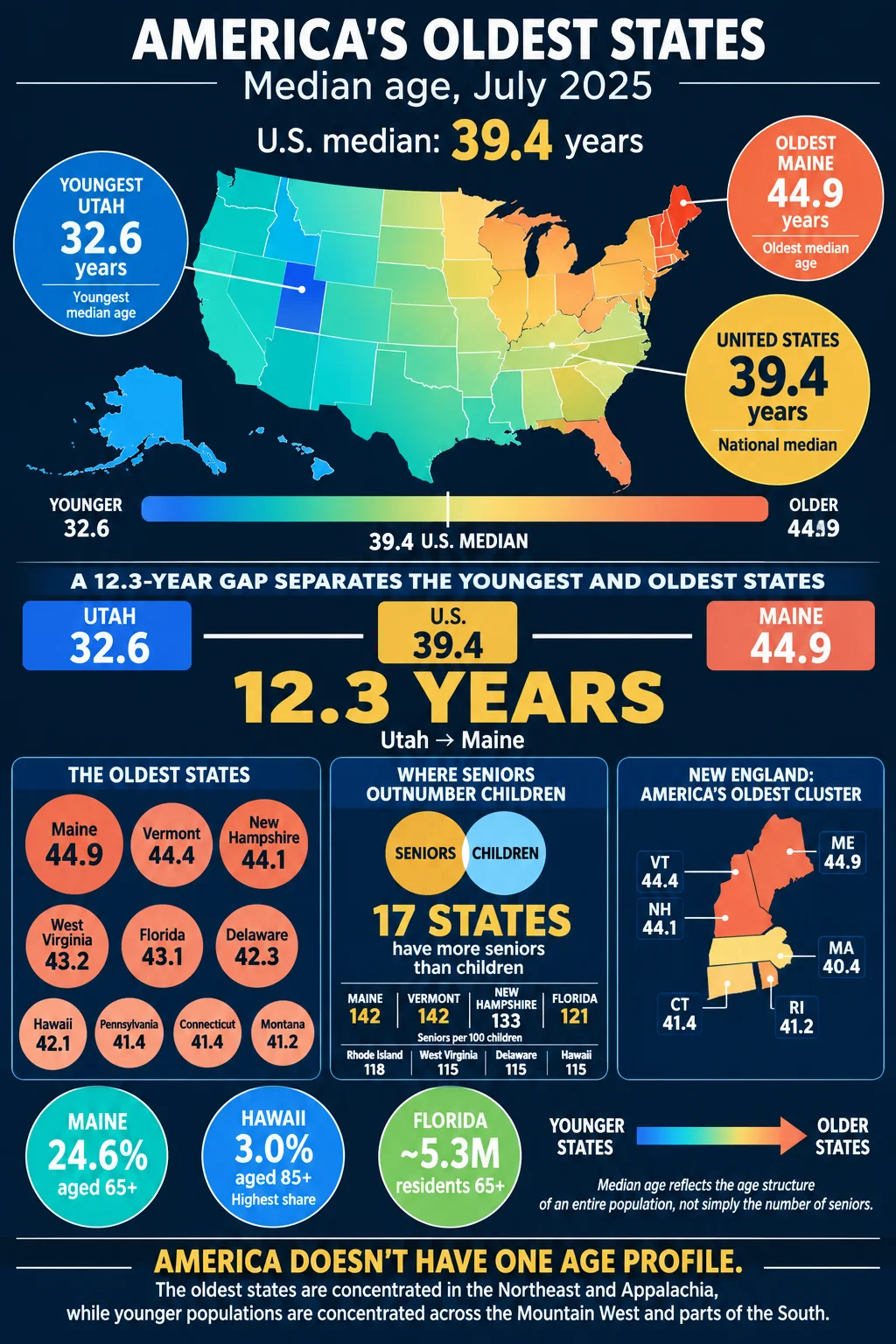
Maine has 142 residents aged 65 or older for every 100 residents under 18, a ratio matched only by Vermont and well ahead of the national figure of about 90. The two states anchor a list of the oldest populations in America that is dominated by northern New England and Florida, with outliers in Appalachia, the Pacific and the Mountain West. By the Census Bureau’s Vintage 2025 estimates, Maine’s median age is 44.9, Vermont’s 44.4 and New Hampshire’s 44.1, against a national median of 39.4.
Age can be ranked several ways, and the order shifts with the measure. Median age, the share of residents 65 and older, the share 85 and older, and the ratio of seniors to children all point to the same few states but with different winners. State figures here come from the Census Bureau’s Vintage 2025 estimates as compiled by Population Pyramids (median age and shares of 65-plus, 85-plus and under-18 residents, rounded to one decimal) and population totals from SmartAsset’s compilation of the same release. Ties share a rank.
Data Snapshot
| Metric | Figure | Reference |
|---|---|---|
| Oldest state by median age | Maine, 44.9 | July 1, 2025 |
| Highest 65-plus share | Maine, 24.6% | |
| Highest 85-plus share | Hawaii, 3.0% | |
| Highest seniors-per-child ratio | Maine and Vermont, 142 per 100 | |
| States with median age of 42 or older | 7 (31.2 million people, 9.1% of the US) | |
| States with median age of 41 or older | 14 | |
| US median age | 39.4 | |
| Oldest county median age | 70.1 |
The 15 Oldest States by Median Age
| Rank | State | Median age | 65 and older | 85 and older | Under 18 | Seniors per 100 children | Population |
|---|---|---|---|---|---|---|---|
| 1 | Maine | 44.9 | 24.6% | 2.6% | 17.3% | 142 | 1,414,874 |
| 2 | Vermont | 44.4 | 24.1% | 2.4% | 17.0% | 142 | 644,663 |
| 3 | New Hampshire | 44.1 | 23.0% | 2.3% | 17.3% | 133 | 1,415,342 |
| 4 | West Virginia | 43.2 | 22.5% | 2.2% | 19.5% | 115 | 1,766,147 |
| 5 | Florida | 43.1 | 22.8% | 2.7% | 18.9% | 121 | 23,462,518 |
| 6 | Delaware | 42.3 | 22.8% | 2.1% | 19.8% | 115 | 1,059,952 |
| 7 | Hawaii | 42.1 | 22.6% | 3.0% | 19.7% | 115 | 1,432,820 |
| 8 | Pennsylvania | 41.4 | 21.4% | 2.5% | 19.7% | 109 | 13,059,432 |
| 8 | Connecticut | 41.4 | 20.4% | 2.5% | 19.5% | 105 | 3,688,496 |
| 10 | Montana | 41.2 | 22.2% | 2.2% | 20.2% | 110 | 1,144,694 |
| 10 | Rhode Island | 41.2 | 20.9% | 2.4% | 17.7% | 118 | 1,114,521 |
| 12 | South Carolina | 41.1 | 21.1% | 2.0% | 20.6% | 102 | 5,570,274 |
| 12 | Oregon | 41.1 | 21.0% | 2.2% | 19.0% | 111 | 4,273,586 |
| 14 | Wisconsin | 41.0 | 20.8% | 2.2% | 20.5% | 101 | 5,972,787 |
| 15 | Michigan | 40.7 | 20.5% | 2.1% | 20.4% | 100 | 10,127,884 |
The oldest seven states, those with median ages of 42 or older, are Maine, Vermont, New Hampshire, West Virginia, Florida, Delaware, and Hawaii. They hold 31.2 million people, 9.1% of the country, and Florida alone accounts for three quarters of that total.
At 41.0 or above, the list grows to 14 states, adding Pennsylvania, Connecticut, Montana, Rhode Island, South Carolina, Oregon and Wisconsin. Every one of the six New England states is above the national median of 39.4: Maine (44.9), Vermont (44.4), New Hampshire (44.1), Connecticut (41.4), Rhode Island (41.2) and Massachusetts (40.4).
Four Ways to Rank Age
| Measure | First | Second | Third |
|---|---|---|---|
| Median age | Maine 44.9 | Vermont 44.4 | New Hampshire 44.1 |
| Share aged 65 and older | Maine 24.6% | Vermont 24.1% | New Hampshire 23.0% |
| Share aged 85 and older | Hawaii 3.0% | Florida 2.7% | Maine 2.6% |
| Seniors per 100 children | Maine 142 (tied with Vermont) | New Hampshire 133 | Florida 121 |
| Number of residents 65 and older | California, about 6.9 million | Florida, about 5.3 million | Texas, about 4.7 million |
The oldest-old measure gives a different order. Hawaii leads the 85-plus share at 3.0%, followed by Florida (2.7%) and Maine (2.6%), and Connecticut, Iowa, and Pennsylvania are tied at 2.5%. Iowa’s presence shows that old age also concentrates in Midwestern farm states whose median ages (39.3 for Iowa) are close to the national figure. In absolute numbers, California has the most older residents despite a median age (38.7) below the national figure, because the state has nearly 40 million people.
Seniors Per 100 Children
The ratio of residents 65 and older to residents under 18 shows where the older population already outweighs the younger one.
| Seniors per 100 children | States |
|---|---|
| 130 or more | Maine (142), Vermont (142), New Hampshire (133) |
| 110 to 129 | Florida (121), Rhode Island (118), West Virginia (115), Delaware (115), Hawaii (115), Oregon (111), Montana (110) |
| 100 to 109 | Pennsylvania (109), Massachusetts (107), Connecticut (105), South Carolina (102), New Mexico (102), Wisconsin (101), Michigan (100) |
Seventeen states have a ratio of 100 or more, which means more older adults than children. The Census Bureau counted 11 states and 1,411 counties in that position in its 2024 estimates. Because shares are rounded, Michigan, Wisconsin, New Mexico and South Carolina are close to parity, and a precise classification would need the unrounded counts.
Why These States Are Old
The oldest states do not share a single cause. Several patterns overlap.
Northern New England: Maine, Vermont and New Hampshire have the three highest median ages and the lowest child shares (17.0% to 17.3%). The Maine State Economist attributes part of Maine’s age structure to a long history of net out-migration of young adults and low birth rates, and notes that Maine is the only state whose median age fell between 2020 and 2025, as in-migration brought in younger adults.
Retirement destinations: Florida (43.1) and Delaware (42.3), along with South Carolina (41.1) and Arizona (39.4, with 20.6% aged 65 and older), draw retirees from other states. Florida’s 85-plus share of 2.7% is the second highest in the country.
Aging in place in older industrial and rural states: West Virginia (43.2), Pennsylvania (41.4), and Montana (41.2) have older populations mainly because their younger residents have been leaving or have fewer children, not because retirees move in. The Census Bureau finds that natural decrease, with more deaths than births, characterizes 2,055 of the nation’s 3,143 counties.
Island and Pacific: Hawaii (42.1) has the highest 85-plus share, reflecting long life expectancy in the state.
These explanations are from state demographers and general demographic research and describe tendencies, not proofs. The Census estimates do not measure the reasons individuals move or choose to have children.
How Large Is the Gap With the Youngest States
Maine’s median age of 44.9 is 12.3 years above Utah’s 32.6. The share of residents 65 and older ranges from 24.6% (Maine) to 13.0% (Utah), a spread of 11.6 percentage points. County extremes are wider still: the oldest US county has a median age of 70.1, nearly twice the 38.1 median age of American men and women under 40, and 75% of counties are at or above the national median. A companion article ranks the youngest states.
Looking Ahead
The Weldon Cooper Center projects that the national median age will rise from 38.8 in 2020 to 41.9 in 2050, and that Maine will still have the nation’s highest median age in 2050, with Utah the lowest. Those projections imply that states that are old now will remain old, though the gap with younger states may narrow as the baby boom cohort ages. Older states will also see more deaths than births for longer: the CBO projects that deaths will exceed births nationally from 2030, and in northern New England that point has already been reached.
Conclusion
The states with the oldest populations are a small group, but they are old in different ways: Maine and Vermont because there are few children, Florida because retirees arrive, Hawaii because people live long. What they share is a ratio that has already tipped, with more people past 65 than under 18. As the national median age moves toward 42 by 2050, the question for the rest of the country is how many states will join them.
Frequently Asked Questions
1. Which state has the oldest population?
Maine, with a median age of 44.9 and 24.6% of residents aged 65 and older in 2025.
2. What are the 10 oldest states?
By median age: Maine, Vermont, New Hampshire, West Virginia, Florida, Delaware, Hawaii, Pennsylvania, Connecticut, and Montana (tied with Rhode Island at 41.2 for 10th).
3. Is Florida the oldest state?
No. Florida is fifth by median age (43.1) and tied fourth by 65-plus share (22.8%), but it has the second-highest 85-plus share (2.7%) and the second-largest number of residents 65 and older (about 5.3 million).
4. Which state has the most residents over 85?
By share, Hawaii (3.0%). By number, California and Florida have the most, because they have the largest populations.
5. Why is Maine so old?
Out-migration of young adults over time, low birth rates, and an older resident population, according to the Maine State Economist. Its median age has also fallen slightly since 2020.
6. How many states have more seniors than children?
17 in the 2025 shares used here, 11 in the Census Bureau’s 2024 estimates. Several states are within rounding of parity.
7. Which region has the oldest states?
New England. All six states are above the national median, and Maine, Vermont, and New Hampshire hold the top three places.
8. How much older is Maine than Utah?
12.3 years in median age (44.9 versus 32.6), and 11.6 percentage points in the 65-plus share.
9. What is the oldest county in America?
The oldest county has a median age of 70.1, according to Census Bureau Vintage 2025 data.
10. Will the oldest states stay the oldest?
Projections suggest so. The Weldon Cooper Center projects Maine will still have the highest median age in 2050 and Utah the lowest.
Recommended Articles in the USA Population Series:
- USA Baby Boomer Population Falls to 64.4 Million, Down 14 Million From Its Peak
- Generation X Population in the USA Reaches About 65 Million, Nearly Matching Boomers
- Working-Age Population in the US Stands at 205 Million, but Its Share Has Fallen
- Number of Children Under 18 in America Falls to 72 Million as the South Gains
- US Aging Population Statistics: 64.6 Million Seniors, 7 Million Over 85, 119,100 Centenarians
- How Will America’s Age Structure Change by 2050? Key Shifts to Watch
- US Population Pyramid Is Turning Into a Column With a Heavy Middle
- US States With the Youngest Populations: Utah Has Twice as Many Children as Seniors
- US Population Over 65 by State Ranges From 24.6% in Maine to 13.0% in Utah
- Generation Alpha Population in America Reaches 51 Million
- Generation Z Population in the USA Reaches 71 Million, With Nearly 2 Million More Boys
- Millennial Population in America Tops 74 Million and Dominates the Middle of the Age Pyramid
- Median Age in the United States Reaches 39.4, With Maine 12.3 Years Older Than Utah
- Largest Cities in America by Population: The 25 Biggest Urban Centers
- Most Densely Populated Cities in America: A Tiny Jersey Town Outranks New York
- US Metropolitan Population Projections for 2050: Where Growth Will Be Concentrated
- Fastest-Growing Metropolitan Areas in the USA Are Concentrated in Smaller Southeast Metros
- How America’s Biggest Cities Changed Places Between 1900 and 2027
- Cities Losing Population in the USA: New York Falls by 166,000 as St. Louis Drops 7.4%
- Largest Urban Areas in the United States: The Metro Regions With the Most Residents
- Largest Metropolitan Areas in the USA: Where 86% of Americans Live
- Fastest-Growing Cities in the US Are Texas Suburbs, While Charlotte Leads in New Residents
- Top 25 Most Populated Cities in the USA in 2027: America’s Biggest Urban Centers
Sources
- Population Pyramids, “Oldest States in the US, Ranked by Median Age (2025)” (state median age, 65-plus, 85-plus shares, Census Vintage 2025).
- Population Pyramids, “Youngest States in the US, Ranked by Median Age (2025)” (state under-18 shares).
- SmartAsset via Boston 25 News, “US population trends by state,” September 17, 2026 (state populations, July 2025).
- U.S. Census Bureau, “Populations in All Age Groups Growing in the South,” press release CB26-105, June 25, 2026.
- U.S. Census Bureau, “Older Adults Outnumber Children in 11 States and Nearly Half of U.S. Counties,” June 26, 2025.
- Maine Office of the State Economist, Vintage 2025 summary.
- University of Virginia Weldon Cooper Center, “U.S. Population Projected to Grow More Slowly through 2050.”
- Congressional Budget Office, “The Demographic Outlook 2026 to 2056.”