Key Findings
- Guttenberg, New Jersey, is the densest incorporated place, at about 62,264 people per square mile, ahead of Union City (53,294), West New York (53,217), and Hoboken (48,327).
- New York is the densest city of 100,000 or more at about 29,303 per square mile, nearly 1.5 times Jersey City (19,835).
- Twenty-two cities of 100,000 or more exceed 10,000 per square mile; 10 are in the Northeast and seven in California.
- Only New York, Chicago and Philadelphia combine more than 1 million residents with density above 10,000.
- Manhattan’s density is about 74,782 per square mile, nearly double Brooklyn’s 39,438 and more than three times Queens’.
- Los Angeles city (about 8,300) is far less dense than New York, yet its urban area (7,476) is denser than New York’s (5,981).
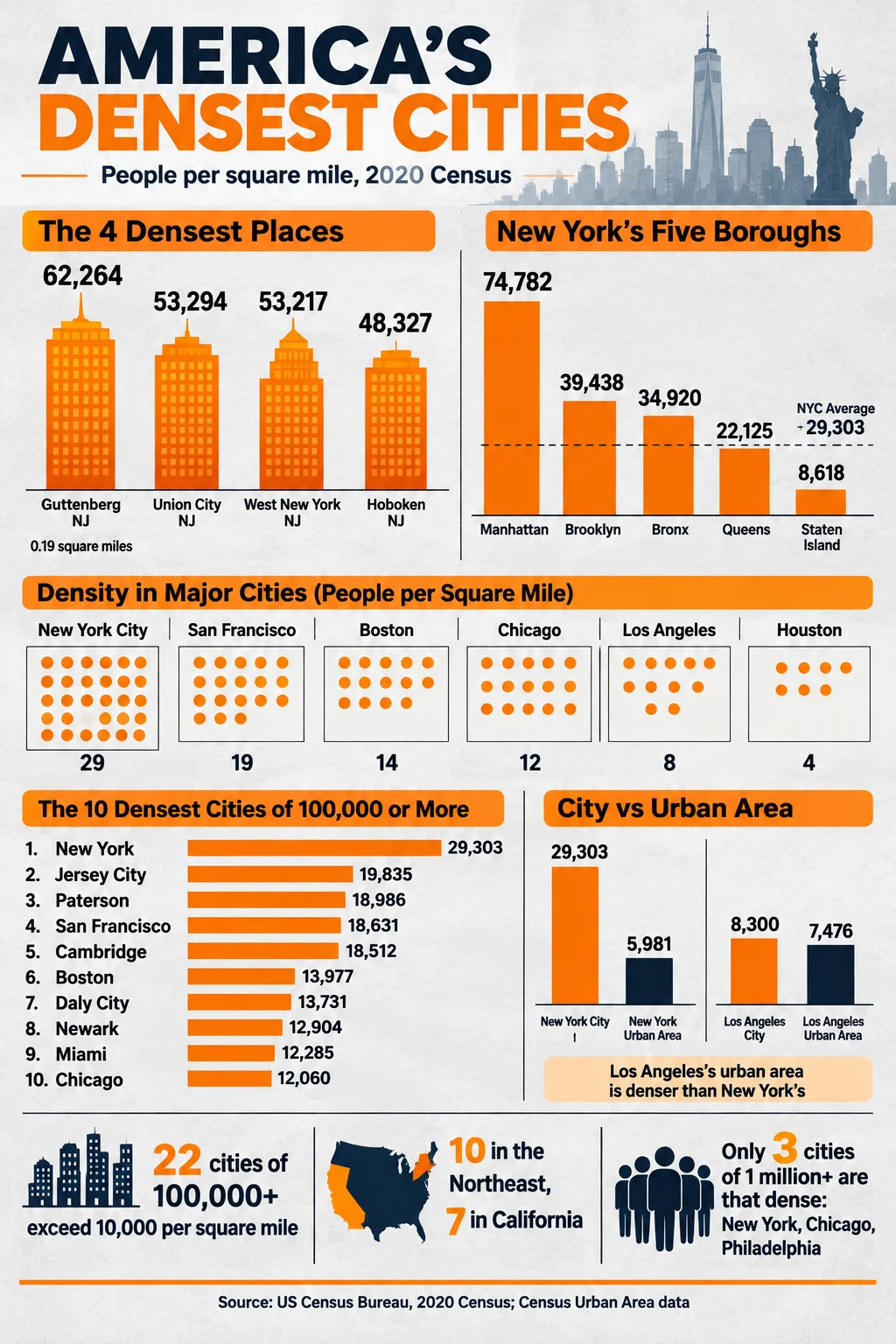
Guttenberg, New Jersey, packs 12,017 residents into 0.19 square miles, a density of about 62,264 people per square mile, more than twice that of New York City (about 29,303). It is the densest incorporated place in the 2020 Census, and three more Hudson County towns, Union City, West New York and Hoboken, take the next three spots. None has more than 70,000 residents. Density, in other words, is a measure of how land is used within a boundary, and the most crowded places are often small, old and wedged against the Hudson River.
This ranking uses 2020 Census populations and land areas for incorporated places, which is the latest source that pairs both with a consistent boundary. The Census Bureau’s annual population estimates are not paired with annual land area, so no 2025 or 2027 density ranking exists. Density is residents divided by land area, excluding water.
Data Snapshot
| Metric | Figure | Reference |
|---|---|---|
| Densest incorporated place | Guttenberg, NJ, about 62,264 per square mile | 2020 Census |
| Densest city with 100,000 or more residents | New York, about 29,303 per square mile | 2020 Census |
| Cities of 100,000 or more, above 10,000 per square mile | 22 | 2020 Census |
| Cities of 1 million or more above 10,000 per square mile | 3 (New York, Chicago, Philadelphia) | 2020 Census |
| Densest New York borough | Manhattan, about 74,782 per square mile | 2020 Census |
| Densest large urban area | Los Angeles, 7,476 per square mile | 2020 Census |
The Four Densest Places of Any Size
| Rank | Place | State | Population | Land area (square miles) | People per square mile |
|---|---|---|---|---|---|
| 1 | Guttenberg | NJ | 12,017 | 0.19 | 62,264 |
| 2 | Union City | NJ | 68,589 | 1.29 | 53,294 |
| 3 | West New York | NJ | 52,912 | 0.99 | 53,217 |
| 4 | Hoboken | NJ | 60,419 | 1.25 | 48,327 |
All four sit within a few miles of Manhattan on the New Jersey side of the Hudson. Land areas are rounded in the table, so dividing the rounded numbers gives slightly different results than the Census figures (68,589 divided by 1.29 is about 53,170, against the published 53,294).
The 22 Densest Cities With 100,000 or More Residents
A population threshold keeps tiny municipalities from crowding the list. Twenty-two cities of 100,000 or more exceed 10,000 residents per square mile.
| Rank | City | State | People per square mile |
|---|---|---|---|
| 1 | New York | NY | 29,303 |
| 2 | Jersey City | NJ | 19,835 |
| 3 | Paterson | NJ | 18,986 |
| 4 | San Francisco | CA | 18,631 |
| 5 | Cambridge | MA | 18,512 |
| 6 | Boston | MA | 13,977 |
| 7 | Daly City | CA | 13,731 |
| 8 | Newark | NJ | 12,904 |
| 9 | Miami | FL | 12,285 |
| 10 | Chicago | IL | 12,060 |
| 11 | Philadelphia | PA | 11,937 |
| 12 | Berkeley | CA | 11,920 |
| 13 | Inglewood | CA | 11,881 |
| 14 | Yonkers | NY | 11,750 |
| 15 | El Monte | CA | 11,449 |
| 16 | Santa Ana | CA | 11,347 |
| 17 | Washington | DC | 11,281 |
| 18 | Elizabeth | NJ | 11,145 |
| 19 | Alexandria | VA | 10,681 |
| 20 | Norwalk | CA | 10,584 |
| 21 | Providence | RI | 10,374 |
| 22 | Hialeah | FL | 10,338 |
By region, 10 of the 22 are in the Northeast, seven in the West (all in California), four in the South, and one, Chicago, in the Midwest. California supplies seven, New Jersey four, and Massachusetts, New York, and Florida two each.
By Population Category
| Population class | Dense cities (over 10,000 per square mile) | Examples |
|---|---|---|
| 1 million or more | 3 | New York, Chicago, Philadelphia |
| 500,000 to 999,999 | 3 | San Francisco, Boston, Washington |
| 250,000 to 499,999 | 4 | Jersey City, Newark, Miami, Santa Ana |
| 100,000 to 249,999 | 12 | Paterson, Cambridge, Daly City, Berkeley, Hialeah |
Only three cities above 1 million are denser than 10,000 per square mile. The 12 smaller cities are mostly compact municipalities inside larger metro areas: Daly City, Berkeley and Inglewood in California and Paterson, Elizabeth and Yonkers in the New York region.
How the Largest Cities Compare
| City | Approximate people per square mile | Note |
|---|---|---|
| New York | 29,303 | 8.80 million residents on about 300 square miles |
| San Francisco | 18,631 | 46.9 square miles |
| Boston | 13,977 | 48.3 square miles |
| Chicago | 12,060 | about 228 square miles |
| Philadelphia | 11,937 | about 134 square miles |
| Washington | 11,281 | 61 square miles |
| Los Angeles | about 8,300 | about 469 square miles |
| Houston | about 3,600 | about 640 square miles |
| Phoenix | about 3,100 | about 518 square miles |
| Jacksonville | about 1,300 | consolidated city and county |
Figures marked “about” are calculated from 2020 Census totals and Census land areas and rounded. The comparison shows why total population says little about crowding. Los Angeles has more than 3.8 million residents but roughly 8,300 per square mile, less than half of San Francisco’s. Houston, the fourth largest city, is less dense than Washington by a factor of three.
New York’s Boroughs
New York City’s 29,303 per square mile is an average over five very different places.
| Borough | People per square mile (2020) |
|---|---|
| Manhattan | 74,782 |
| Brooklyn | 39,438 |
| Bronx | 34,920 |
| Queens | 22,125 |
| Staten Island | 8,618 |
Manhattan, treated as its own area, is more than 20% denser than Guttenberg and is the densest county in the country by this measure. Staten Island’s 8,618 per square mile is similar to Los Angeles city.
City Density Versus Urban Area Density
Municipal density depends on where a city draws its line. When density is measured across continuous development, the order changes.
| Region | City density (2020) | Urban area density (2020) |
|---|---|---|
| New York | 29,303 | 5,981 |
| Los Angeles | about 8,300 | 7,476 |
New York City is about 3.5 times denser than Los Angeles within city limits, yet the Los Angeles urban area is denser than the New York urban area (7,476 versus 5,981), because Los Angeles’s urban footprint is dense and uniform while New York’s includes extensive lower-density suburbs. The Census Bureau’s 2020 urban area data list Los Angeles as the densest large urban area, ahead of San Francisco-Oakland (6,843) and San Jose (6,436). Housing unit density, another measure, ranks San Francisco-Oakland first at 2,709 units per square mile, followed by Los Angeles (2,660) and New York (2,358).
Why Some Cities Are Denser
Several factors recur in urban planning research and match the pattern in the data, though the Census numbers alone cannot prove cause.
- Small boundaries. The densest places are small. Guttenberg covers 0.19 square miles and Union City 1.29, and a municipality that is mostly built-up will show a high density even if the region around it is sparse.
- Multifamily housing. Hudson County towns and Manhattan are dominated by apartment buildings, while the lowest-density large cities (Jacksonville, Houston, Phoenix) are dominated by single-family neighborhoods and large annexed areas.
- Age of development. Many of the densest places were built before cars. Hoboken, Union City, Boston and Cambridge all have street grids and building types from the 19th and early 20th centuries.
- Land and housing costs. Cities with limited land and high housing demand, such as San Francisco and Boston, rank high in density. Zoning and land-use rules also shape what can be built, and the effect varies by city.
- Location next to a larger center. Most of the densest cities (Jersey City, Paterson, Newark, Daly City, Cambridge, Inglewood) sit beside a bigger city, so their boundaries cover a compact slice of a larger region.
Density Versus Sprawl
A dense city can sit inside a low-density metro area. Chicago city is 12,060 per square mile, yet the Chicago urban area is 3,709, and Atlanta’s urban area, covering 2,553 square miles, is 1,998. The reverse also happens: a city with modest limits can have a high density without being large. Metro density, urban area density, and municipal density measure different things, and a comparison is only fair when the same geography is used on both sides.
How Density Is Calculated
Population density equals total resident population divided by land area, with water excluded.
For New York City in 2020, 8,804,190 residents on about 300.5 square miles of land gives about 29,298 people per square mile, close to the published 29,303 (the small gap comes from rounding the land area). Square miles convert to square kilometers by multiplying by 2.59, so Guttenberg’s 62,264 per square mile equals about 24,000 per square kilometer. Reference years must match: a 2025 population over 2020 land area mixes dates, which is why this ranking stays at 2020.
Does High Density Mean Crowded Living?
Not necessarily. Density counts people per area of land, not per room or per home. A city can be dense because many people live in tall apartment buildings with modest land use, while overcrowding is measured by persons per room in housing data. Higher density is associated with more walkable neighborhoods and lower per-capita land use, and also with higher housing prices in the cities where supply is limited, but those links vary by city and are not shown by the Census density figures alone.
Conclusion
Density rankings expose how much a boundary shapes a statistic. The densest places in America are not New York or San Francisco but small New Jersey towns, and the densest big city, New York, owes its lead to Manhattan’s 74,782 per square mile. At the regional level, the order flips, with Los Angeles’s continuous development denser than New York’s mixture of core and suburbs. Any claim about the densest place needs three qualifiers: the size threshold, the geography, and the year.
Frequently Asked Questions
1. What is the most densely populated city in America?
Among incorporated places of any size, Guttenberg, New Jersey, at about 62,264 per square mile. Among cities of 100,000 or more, New York at about 29,303.
2. Is New York City the densest city in the United States?
Among large cities, yes. Among all incorporated places, four Hudson County, New Jersey, towns (Guttenberg, Union City, West New York and Hoboken) are denser.
3. What are the densest large cities in America?
New York, Jersey City, Paterson, San Francisco and Cambridge lead the 100,000-plus list, followed by Boston, Daly City, Newark, Miami and Chicago.
4. How is population density calculated?
Resident population divided by land area. New York’s 8,804,190 residents over about 300.5 square miles gives about 29,300 per square mile.
5. Why do smaller US cities sometimes have higher population density?
Small boundaries can enclose only built-up land. Guttenberg has 12,017 residents on 0.19 square miles.
6. What is the difference between city density and metropolitan density?
City density counts only land within municipal limits. Metro and urban area density include suburbs, so New York City (29,303) is far denser than the New York urban area (5,981).
7. Which US state has the most densely populated cities?
California and New Jersey lead among large cities: seven California cities and four New Jersey cities of 100,000 or more exceed 10,000 per square mile.
8. Does higher population density mean more crowded living conditions?
Not by itself. Density measures people per land area, while overcrowding is measured by persons per room, which requires housing data.
9. Is Los Angeles denser than New York?
Not within city limits (about 8,300 versus 29,303). The Los Angeles urban area, though, is denser than the New York urban area, 7,476 to 5,981.
10. How many large US cities are denser than 10,000 people per square mile?
Twenty-two cities with 100,000 or more residents in the 2020 Census.
Sources
- Wikipedia, “List of United States cities by population density” (compilation of 2020 Census populations, land areas and densities for incorporated places).
- U.S. Census Bureau, “2020 Census Urban Areas Facts” (urban area population, land area, density and housing unit density).
- U.S. Census Bureau, Vintage 2025 population estimates (context on city populations).
- U.S. Census Bureau, 2020 Census redistricting data and Gazetteer land area files (New York City population 8,804,190).