
Continents Population 2026 | Live Estimation Clock
Population estimates based on UN World Population Prospects 2024 · All continents sum to world total 8,282,474,995
North & South America split based on UN geoscheme · Antarctica has no permanent civilian population
Sources: UN DESA, PRB, World Bank, CIA World Factbook · Counters reset at midnight UTC daily
Population by Continent 2026: A Complete Global Demographic Breakdown
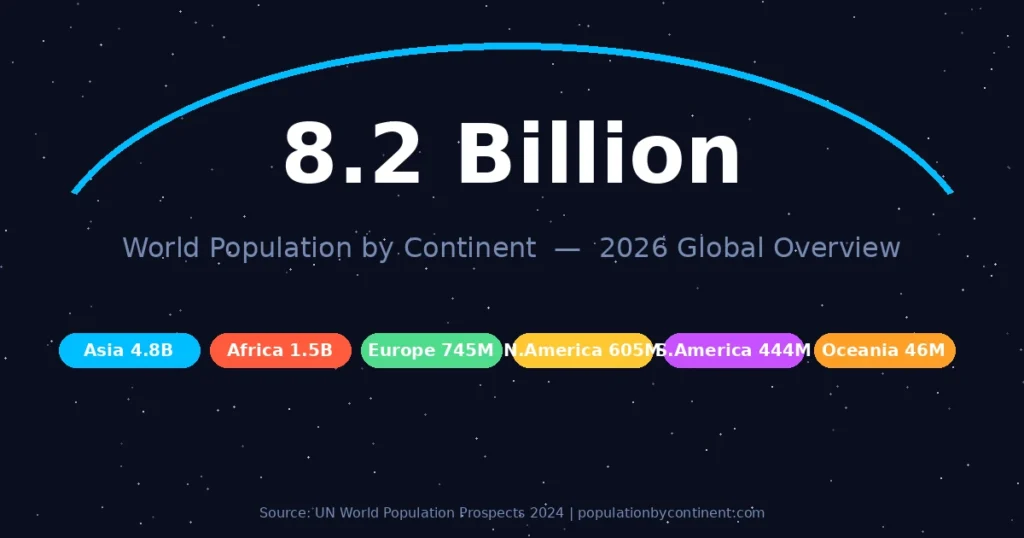
The number crossed 8 billion in November 2022. By 2026, the world’s population will have pushed past 8.2 billion, a figure that would have been unfathomable just a century ago, when global headcount sat below 2 billion. Yet the story behind that number is far more layered than a single statistic can capture.
Population by continent tells a dramatically different tale depending on where one looks: staggering density in South Asia, explosive growth across sub-Saharan Africa, quiet demographic contraction in Southern and Eastern Europe, and near-total absence of human life at the poles.
Understanding how the population is distributed across the seven continents is not merely an exercise in geography. It shapes resource allocation, drives geopolitical power, determines labor markets, and influences everything from climate negotiations to urban planning.
The continents that are growing fastest today will reshape the global economy within a generation. Those facing population decline are already grappling with pension system stress, workforce shortages, and immigration policy overhaul.
The data presented here draws from the United Nations World Population Prospects 2024, the most authoritative global demographic dataset produced by the UN Department of Economic and Social Affairs (DESA). Figures represent mid-2026 estimates unless noted otherwise. What follows is a continent-by-continent breakdown of current populations, growth trends, density comparisons, and forward-looking projections that frame one of the most consequential stories of the 21st century.
Population by Continent 2026: The Complete Overview
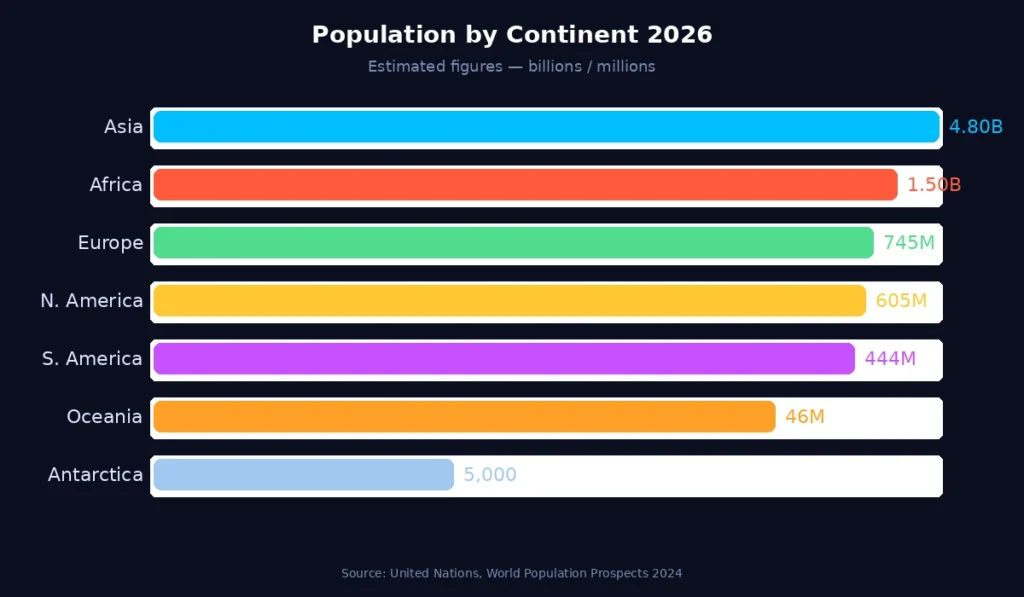
The table below summarizes the most current estimated population of each continent, along with key metrics that put those figures in the global context.
| Continent | Population (2026 Est.) | % of World Population | Annual Growth Rate | Pop. Density (per km²) |
|---|---|---|---|---|
| Asia | 4.80 billion | 59.5% | 0.7% | ~150 |
| Africa | 1.50 billion | 18.6% | 2.4% | ~47 |
| Europe | 745 million | 9.2% | -0.1% | ~106 |
| North America | 605 million | 7.5% | 0.5% | ~23 |
| South America | 444 million | 5.5% | 0.6% | ~25 |
| Oceania | 46 million | 0.6% | 1.3% | ~5 |
| Antarctica | ~5,000 (non-permanent) | <0.001% | N/A | <0.001 |
| World Total | ~8.21 billion | 100% | 0.9% | ~57 |
Source: United Nations, World Population Prospects 2024 – Mid-2026 Estimates
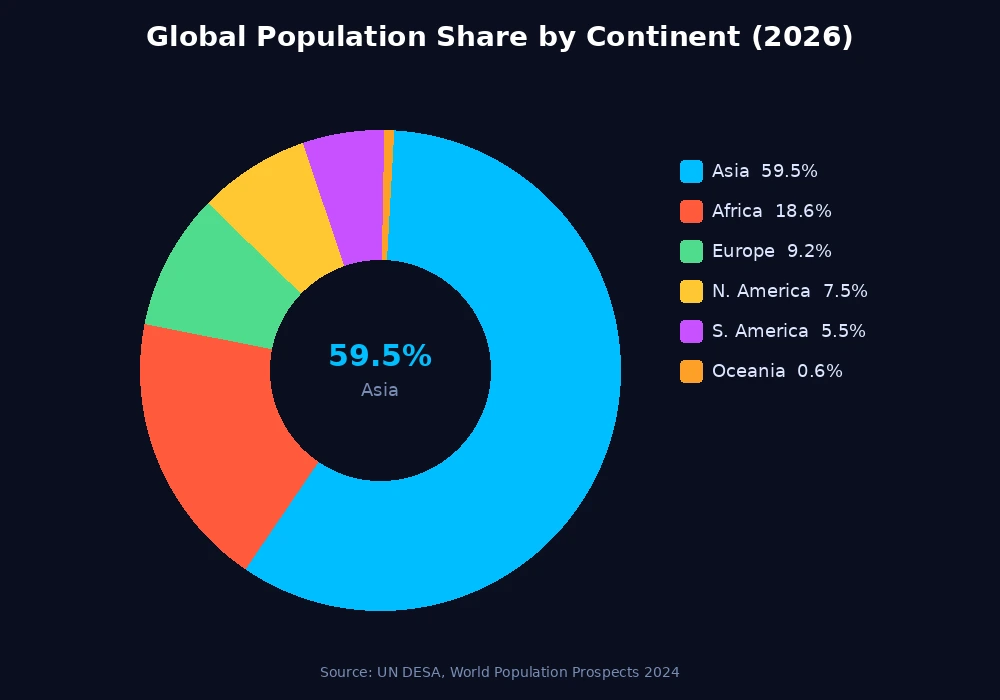
The most striking observation from this table is the asymmetry. Asia alone holds nearly 60 percent of humanity. Africa, despite occupying roughly 20 percent of Earth’s landmass, is home to nearly 19 percent of the global population, a share that will only grow in the decades ahead. Meanwhile, Europe and Oceania combined account for less than 10 percent of the world’s people.
Asia: The Most Populated Continent by a Wide Margin
No other region of the world concentrates human life as much as Asia does. With an estimated population of 4.8 billion in 2026, Asia accounts for nearly three in every five people alive today. The continent spans 44.6 million square kilometers but houses a population density that, in its most crowded pockets, defies easy comprehension. Bangladesh, the world’s most densely populated large nation, packs over 1,100 people into every square kilometer.
Asia’s Most Populated Countries in 2026
India surpassed China in total population in 2023, according to UN data, and the gap has widened since. As of 2026, India is estimated to have approximately 1.45 billion people, while China has around 1.41 billion, marking a historic demographic shift after decades of Chinese numerical dominance. Together, these two nations account for more than 35 percent of the entire world’s population.
Pakistan, Bangladesh, and Japan round out Asia’s top five most populous nations. Pakistan’s population of roughly 247 million has grown at rates exceeding 2 percent annually, making it one of the fastest-growing large economies in the region. Japan, by contrast, is in the grip of one of the steepest demographic contractions on record; its population has declined for 13 consecutive years, driven by ultra-low birth rates and minimal immigration.
Asia’s Population Growth Outlook
Asia’s aggregate growth rate sits near 0.7 percent annually as of 2026, modest by global standards, but still adding tens of millions of people per year given the continent’s enormous base. South Asia continues to drive most of Asia’s growth, while East Asia trends toward stagnation or decline. China’s lifting of its one-child policy in 2015 (and subsequent relaxation to three children in 2021) has yielded limited demographic recovery, with birth rates remaining stubbornly low due to the high cost of urban living.
Africa: The Fastest Growing Continent
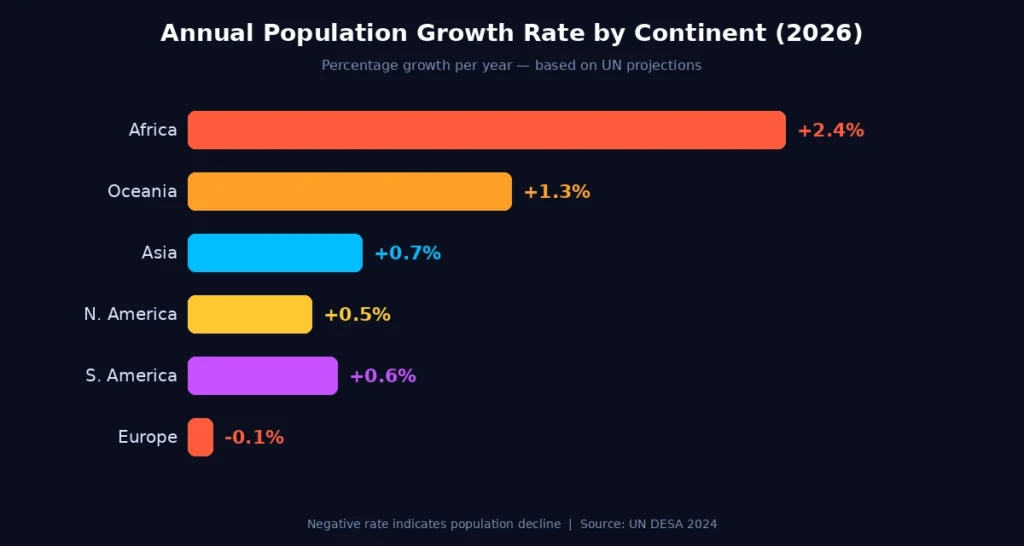
If Asia commands the present, Africa is writing the future. At an estimated 1.5 billion people in 2026, Africa is growing at approximately 2.4 percent annually, a rate more than three times faster than the global average.
The continent added over 30 million people to its population in 2025 alone. By 2050, the UN projects Africa’s population will reach 2.5 billion, and by 2100, it could approach 4 billion under medium-variant scenarios.
Africa’s Top Five Most Populated Nations
Nigeria is the continent’s most populous country at approximately 229 million in 2026, and it is on track to become the third-most-populated nation on Earth before mid-century.
Ethiopia follows at around 132 million, having added nearly 60 million people since the year 2000. Egypt, the Democratic Republic of Congo, and Tanzania complete the top five, each exceeding 65 million people.
The DRC’s demographic trajectory deserves particular attention: with a fertility rate hovering above 6 children per woman and a population doubling time of roughly 25 years, it is one of the fastest-growing large nations anywhere in the world.
Population Density Across Africa
Africa’s 1.5 billion people are distributed across the world’s largest continent by area, approximately 30.4 million square kilometers, yielding an average density of just 47 people per square kilometer. That figure, however, obscures enormous variation.
The Nile Delta in Egypt is among the most densely settled strips of land on the planet, while vast stretches of the Sahara, Namib, and Kalahari deserts remain virtually uninhabited. Sub-Saharan Africa’s rapidly urbanizing cities, particularly Lagos, Kinshasa, and Nairobi, are expanding at a pace that urban planners are struggling to match.
Europe: A Continent in Demographic Decline
Europe stands as the only continent recording a negative natural population growth rate. With approximately 745 million residents in 2026, the continent is shrinking in population terms despite some offset from international migration.
The birth rate across much of Southern and Eastern Europe has fallen well below the replacement level of 2.1 children per woman. Italy, Greece, Spain, and Portugal have recorded some of the lowest fertility rates in recorded modern history, a trend with significant structural consequences.
Europe’s Demographic Imbalance
Germany is Europe’s most populous country at roughly 84 million people, followed by France at 68 million, the United Kingdom at 67 million, and Italy at approximately 58 million. Russia, though straddling both Europe and Asia, accounts for a significant share of the continent’s total headcount.
The European Union has responded to demographic contraction partly through immigration. Between 2015 and 2025, net migration into EU countries averaged 1.5 to 2 million people annually, partially offsetting natural population decline. Still, the continent’s median age, now approaching 44 years, is the highest of any major region outside Japan, raising persistent concerns about labor force sustainability and public pension solvency.
Europe’s population is projected to fall to approximately 703 million by 2050 under the UN’s medium-variant scenario, representing a decline of roughly 40 million from its early 21st-century peak.
North America: Stable Growth Built on Immigration
North America’s population stands at an estimated 605 million in 2026, growing at a moderate rate of approximately 0.5 percent annually. The continent’s demographic stability is primarily a function of robust immigration policy, particularly in the United States and Canada, both of which rely on net migration to sustain population growth in the face of declining domestic birth rates.
Most Populated Countries in North America
The United States holds approximately 340 million people as of 2026, making it the world’s third-most-populated country after India and China. Mexico follows at roughly 130 million, with Canada at 38 million. The Caribbean and Central American nations collectively add around 60 million more to the continental total.
The US population, despite a decade of declining birth rates that have approached the replacement-level threshold, continues to grow through immigration. The American Community Survey and Census Bureau data show that net international migration has accounted for more than 40 percent of the US population growth in recent years.
Population Density in North America
Despite its large population, North America has an average density of only 23 people per square kilometer, reflecting the continent’s vast tracts of boreal forest, tundra, desert, and prairie. Canada, the world’s second-largest country by land area, is also one of the least densely settled nations, with approximately 4 people per square kilometer outside of its southern urban corridor.
South America: Moderate Growth, Urban Concentration
South America is home to an estimated 444 million people in 2026, growing at around 0.6 percent per year. The continent is one of the most urbanized in the world; over 85 percent of South Americans live in urban areas, compared to a global average of roughly 57 percent, according to UN-Habitat data.
Brazil is South America’s dominant demographic force, with an estimated population of 216 million that accounts for nearly half of the continent’s total. Colombia and Argentina each hold around 50 million. Venezuela, despite a severe economic crisis that triggered the largest migration wave in Latin American history during the 2010s, still maintains a population of approximately 30 million.
South America’s fertility rates have declined sharply since the 1970s, with Brazil now recording a rate of approximately 1.7 children per woman, below replacement level. The continent’s growth trajectory is slowing, and projections suggest South America’s population will approach 490 million by 2050 before stabilizing.
Oceania: The Least Populated Inhabited Continent
With approximately 46 million residents spread across thousands of islands and one continental landmass, Oceania is the smallest inhabited continent by population. Australia accounts for roughly 54 percent of the total, with a population nearing 27 million in 2026. Papua New Guinea follows with around 10 million, while New Zealand holds approximately 5 million.
Oceania’s population density of approximately 5 people per square kilometer is the lowest of any inhabited continent, but this figure is distorted by Australia’s vast interior deserts, the Outback, where settlements are separated by hundreds of kilometers. Growth in Oceania is driven partly by immigration into Australia and New Zealand, countries that have long relied on skilled migration programs to address labor market shortfalls.
The Pacific Island nations like Fiji, Samoa, Tonga, Vanuatu, and others represent some of the world’s most geographically dispersed populations and are acutely vulnerable to sea-level rise driven by climate change, a demographic risk factor that does not appear in traditional population models.
Antarctica: The Continent Without Permanent Residents
Antarctica is unique in the global demographic picture. The continent’s population, if it can be called that, consists entirely of temporary scientific and support personnel stationed at research bases maintained by over 30 countries through an international treaty. At the peak summer season, the total presence reaches approximately 5,000 individuals. During the austral winter, that number drops to around 1,000.
No government claims sovereignty over Antarctica, and no permanent civilian population has ever existed there. The 1959 Antarctic Treaty and its subsequent protocols have kept the continent demilitarized and free from resource exploitation. For the purposes of global population accounting, Antarctica’s contribution is so small as to be statistically negligible.
Most Densely Populated Continents: A Comparative Analysis
Population density reveals a continent’s livability conditions, infrastructure demands, and natural resource pressures far more clearly than raw headcount.
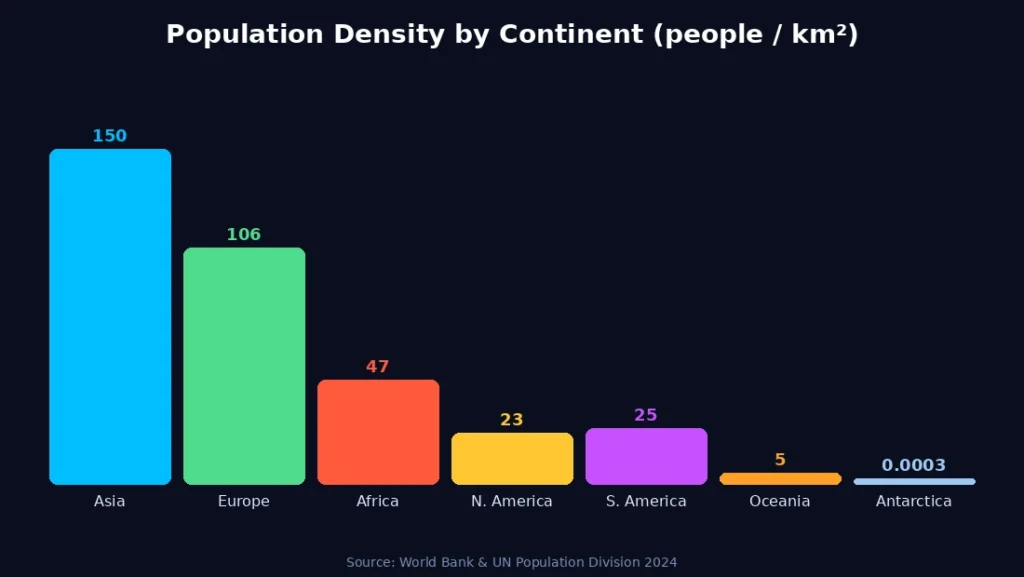
Asia’s average density of roughly 150 people per square kilometer is the highest of any continent and in its most crowded subregions, such as the Indo-Gangetic Plain and the Pearl River Delta, densities exceed 1,000 per square kilometer. Europe ranks second at around 106 per square kilometer, a figure that reflects the continent’s long history of intensive agricultural and urban development.
Africa’s 47 per square kilometer average obscures severe urban-rural variation. South America and North America share similar low-to-moderate densities in the 23 to 25 range. Oceania has just 5 people per square kilometer, the lowest of any inhabited region.
High density is neither inherently problematic nor advantageous. The Netherlands, the most densely populated country in Europe, maintains a high standard of living through efficient land use and infrastructure. Bangladesh, Asia’s densest major nation, faces substantially more acute resource and governance challenges. Context, including wealth, governance quality, and infrastructure, determines whether density is an asset or a burden.
Population Trends: 2000 to 2026
The span from 2000 to 2026 represents one of the most consequential demographic quarters of a century in modern history. Global population grew from approximately 6.1 billion in 2000 to over 8.2 billion today, an addition of more than 2.1 billion people in 26 years.
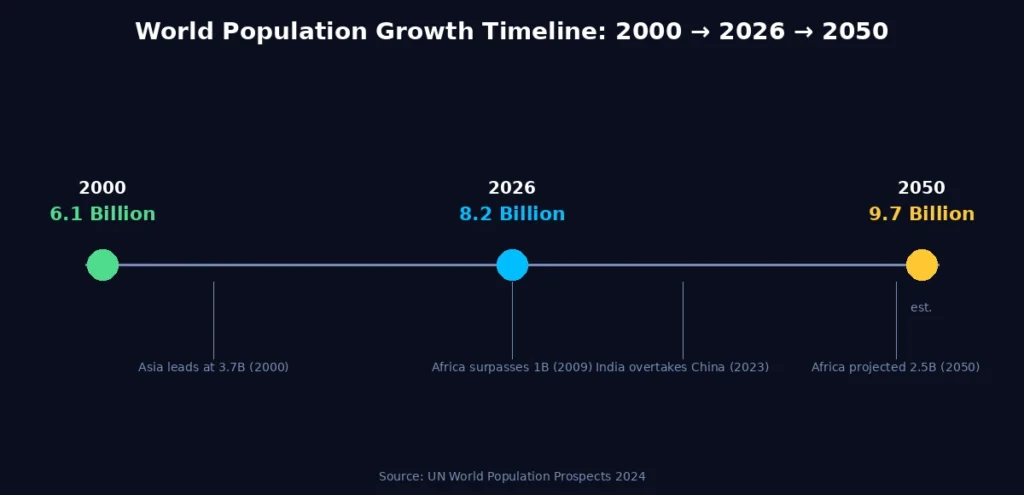
Africa’s population has roughly doubled in this period, rising from approximately 796 million in 2000 to 1.5 billion in 2026. Asia added approximately 1.3 billion people in the same timeframe, representing a growth of about 37 percent over its 2000 base of 3.5 billion. India and China alone accounted for the majority of that increase, though China’s growth has slowed dramatically since the early 2000s.
Europe, by contrast, added only a marginal number of net residents over the same period, with most growth attributable to migration rather than natural increase. North America grew by roughly 120 million people between 2000 and 2026, while South America added approximately 90 million.
Projected Population by Continent: 2030 and 2050
The UN’s medium-variant population projections offer the most widely referenced forward-looking benchmark for global demographics.
| Continent | 2026 Est. | 2030 Projection | 2050 Projection |
|---|---|---|---|
| Asia | 4.80 billion | 4.93 billion | 5.30 billion |
| Africa | 1.50 billion | 1.68 billion | 2.50 billion |
| Europe | 745 million | 738 million | 703 million |
| North America | 605 million | 626 million | 680 million |
| South America | 444 million | 459 million | 490 million |
| Oceania | 46 million | 49 million | 63 million |
Source: UN World Population Prospects 2024, Medium Variant
Africa’s trajectory stands out starkly. From 1.5 billion today to a projected 2.5 billion by 2050, the continent will add approximately 1 billion people in just 24 years. Much of that growth will occur in sub-Saharan Africa, particularly in Nigeria, Ethiopia, the DRC, and Tanzania. This demographic expansion will have profound consequences for food systems, climate adaptation, urbanization patterns, and the global labor supply.
Asia’s growth is projected to plateau around 2055 before beginning a slow decline, driven primarily by falling fertility in China, Japan, South Korea, and parts of Southeast Asia. South Korea’s total fertility rate, at approximately 0.72 as of the most recent data, is the lowest ever recorded for any country in the modern era.
Europe’s continued decline will deepen unless migration policy undergoes significant liberalization. Countries such as Germany and Poland have already shifted toward more aggressive skilled immigration recruitment to address labor gaps.
Interesting Facts and Continental Population Comparisons
The following observations help illustrate just how unevenly distributed and fast-changing the world’s population truly is.
Asia’s population (4.8 billion) is larger than the populations of all other continents combined. If Asia were a country, it would dwarf every other nation on Earth.
Africa is on track to house more than one-quarter of the world’s population by 2050. No other continent is projected to grow at a remotely comparable pace. By 2100, Africa could account for nearly 40 percent of the global population under high-variant projections.
India is projected to remain the world’s most populated country through at least 2100, while China’s population could fall below 1 billion by the end of the century under current trends, according to multiple peer-reviewed demographic analyses.
Europe’s collective population is smaller than India’s, and the gap is widening each year. In 2000, Europe had more than twice Africa’s population. By 2050, Africa will have more than three times Europe’s population.
The entire population of Oceania, at 46 million, is smaller than that of a single large African city such as Lagos. The Lagos metropolitan area alone is estimated to house between 15 and 25 million people, depending on how the urban boundary is defined.
Antarctica’s 5,000 seasonal residents represent less than 0.000001 percent of the global population. No continent, or pseudo-continent, holds fewer humans.
What the Data Tells Us About the Future
The continent-by-continent population picture of 2026 is a snapshot of a world in motion. It captures a demographic reality that is shifting, sometimes subtly and sometimes dramatically, on every continent simultaneously. The numbers themselves are not simply statistics; they carry the weight of billions of human lives, each shaped by fertility decisions, migration pressures, health outcomes, economic conditions, and policy environments that vary enormously across regions.
Two macro-trends dominate the forward view. The first is Africa’s extraordinary growth, which will reshape the global order over the next several decades in ways that are still only beginning to be fully modeled by economists, development specialists, and geopolitical analysts. A continent that contributes a rapidly growing share of the world’s youth population will have an outsized influence over the global labor market, consumption patterns, and political dynamics by mid-century.
The second is the aging and contraction of populations across East Asia and Europe, regions that will face sustained fiscal pressure, labor shortfalls, and social system reform challenges unless they successfully integrate migrants or engineer meaningful reversals in birth rate trends.
Population by continent is, ultimately, a lens through which the most consequential structural forces of the coming century become visible. Whether one is tracking economic growth potential, climate vulnerability, public health capacity, or geopolitical power dynamics, the demographic foundation beneath each continent provides an indispensable starting point for any serious analysis.
Frequently Asked Questions
1. Which continent has the highest population in 2026?
Asia is the most populated continent by far, with an estimated 4.8 billion people in 2026. That figure represents approximately 59.5 percent of the entire global population. India and China, the two most populous countries on Earth, are both located in Asia.
2. Which continent is the least populated?
Antarctica is the least populated landmass on Earth, with no permanent residents and a seasonal scientific population of approximately 1,000 to 5,000 people depending on the time of year. Among inhabited continents, Oceania is the least populated, with roughly 46 million people.
3. What percentage of the world population lives in Africa?
Africa accounts for approximately 18.6 percent of the global population in 2026, with an estimated 1.5 billion residents. That share is projected to rise significantly, to more than 25 percent by 2050 and potentially 38 to 40 percent by 2100 under medium-variant UN projections.
4. Which continent is growing the fastest?
Africa is the fastest-growing continent, with an annual growth rate of approximately 2.4 percent. That rate is more than three times the global average of around 0.9 percent. Sub-Saharan African nations, particularly Nigeria, Ethiopia, and the DRC, are driving the majority of the continent’s overall growth.
5. Is Europe’s population declining?
Yes. Europe is the only continent recording a negative natural population growth rate as of 2026. Several countries, including Italy, Spain, Portugal, Hungary, and much of Eastern Europe, have birth rates well below the 2.1 replacement threshold. Migration partially offsets this decline, but the continent’s total population is expected to fall from 745 million in 2026 to approximately 703 million by 2050.
6. How is the global population distributed across continents?
The world’s 8.2 billion people are distributed unevenly: Asia holds 59.5%, Africa 18.6%, Europe 9.2%, North America 7.5%, South America 5.5%, Oceania 0.6%, and Antarctica a negligible fraction. This distribution reflects a combination of historical settlement patterns, agricultural capacity, and decades-long fertility and mortality trends.
7. What is the population of North America in 2026?
North America’s estimated population is approximately 605 million in 2026. The United States is the continent’s most populated nation at around 340 million, followed by Mexico at 130 million and Canada at 38 million. The continent grows at a moderate 0.5 percent annually, sustained primarily by international migration.
8. Which continent has the highest population density?
Asia has the highest average population density of any continent, at approximately 150 people per square kilometer. However, within specific countries, extremes go far higher; Bangladesh records more than 1,100 people per square kilometer, making it one of the densest large nations in the world.
9. What will the world population be by continent in 2050?
According to UN medium-variant projections, the population breakdown in 2050 will be approximately: Asia 5.3 billion, Africa 2.5 billion, Europe 703 million, North America 680 million, South America 490 million, and Oceania 63 million. Africa will see the sharpest increase, adding roughly 1 billion people in just 24 years.
10. Why does Oceania have such a low population compared to other continents?
Oceania’s low population, approximately 46 million, reflects its geographical composition: a vast region of ocean punctuated by one large but extremely arid landmass (Australia) and thousands of small Pacific islands. Much of Australia’s interior is uninhabitable desert. The Pacific Island nations, while numerous, are very small in both area and population, and many face existential threats from rising sea levels.