
Austria Population 2026 | Live Clock by Federal State
Vienna alone accounts for ~21% of Austria’s total population and has the highest birth rate of all federal states.
TFR ≈ 1.46 · Deaths slightly exceed births in most rural states · Population growth is driven by net migration.
| # | Federal State ↕ | German Name | Abbr | Capital | Zone | Population ↕ | Share | Births Today ↕ | Deaths Today ↕ | Net Today |
|---|
Austria Population 2026: Federal States, Demographics, and Key Trends
Key Facts About Austria’s Population
- Austria’s 2026 population is ~9.17 million, 21% of whom live in Vienna alone.
- Deaths exceed births by ~8,000/year. Austria depends on immigration for population growth.
- Vienna has Austria’s highest birth rate (11.5/1000) and youngest demographic profile.
- Burgenland and Carinthia have the most severe natural population decline of all states.
- ~20% of Austria’s residents were born abroad, primarily from Germany, Romania, and Hungary.
- Austria’s median age of 44.5 years is among the highest in the world.
- TFR of ~1.46 is well below the 2.1 replacement level.
- Tyrol and Vorarlberg in the west have strong birth rates and growing, younger populations.
- Austria’s population is projected to reach 9.5–10 million by 2050, driven by net migration.
- Austria ranks consistently among the world’s most liveable countries, and Vienna often takes the top spot globally.
Austria, Republik Österreich, is a small, landlocked Alpine nation of approximately 9.17 million people nestled in the heart of Europe, bordered by Germany, Switzerland, Italy, Slovenia, Hungary, Slovakia, Czechia, and Liechtenstein. Despite its modest size, Austria punches well above its demographic weight on the global stage: it is a founding member of numerous European institutions, home to multiple UN agencies in Vienna, and consistently ranked among the world’s highest-quality-of-life nations.
Austria’s population dynamics in 2026 tell a story of a mature European democracy confronting low fertility, an ageing population, and growing reliance on immigration to sustain its workforce. This article examines Austria population in 2026 from multiple angles, total figures, state-by-state breakdowns, growth trends, immigration, urbanisation, and future projections.
Total Population of Austria (2026)
As of 2026, Austria’s population is estimated at approximately 9.17 million people. This makes Austria a mid-sized European nation, larger than Switzerland or Denmark, but considerably smaller than its neighbours Germany (84 million) or Italy (60 million). Austria accounts for roughly 0.11 percent of the global population.
Austria’s vital statistics reveal a country in natural demographic decline. Annual births number approximately 82,000, while deaths total around 90,000, meaning deaths exceed births by roughly 8,000 per year. This natural population loss would lead to an absolute decline without immigration. Net migration has, in recent years, more than compensated for this deficit, with Austria receiving significant inflows from Germany, Romania, Hungary, Syria, Afghanistan, and other countries.
Austria’s total fertility rate (TFR) stands at approximately 1.46 births per woman, well below the replacement level of 2.1 and among the lower rates in Western Europe, though not as extreme as South Korea or Japan. The median age of 44.5 years reflects the ageing character of Austrian society, with a large cohort of baby boomers moving through their 60s and 70s.
| Metric | Figure |
| Total Population (2026) | ~9.17 Million |
| Annual Births | ~82,000 |
| Annual Deaths | ~90,000 |
| Natural Change/Year | −8,000 (natural decline) |
| Net Migration (est.) | ~50,000–80,000/yr |
| Median Age | 44.5 years |
| Total Fertility Rate | ~1.46 |
| Official Language | German |
| Federal States (Bundesländer) | 9 |
| EU Member Since | 1995 |
Austria’s 9 Federal States: Population by Bundesland
Austria is organised into nine federal states, known as Bundesländer. These range from Vienna, a city-state of nearly 2 million people, to Burgenland, Austria’s least populous state with under 300,000 residents. The geographic clustering of Austria’s federal states into three broad zones, East, West, and South, reflects both historical development patterns and contemporary demographic trends.
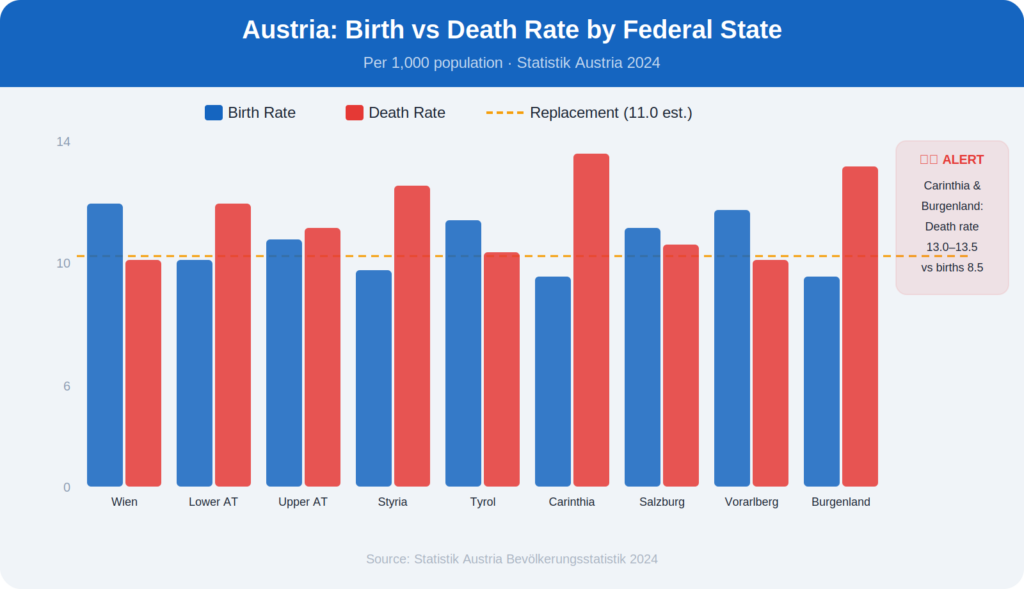
| Federal State | German Name | Capital | Zone | Population (2026) | Birth Rate | Death Rate |
| Vienna | Wien | Vienna | East (Capital) | ~1,971,000 | 11.5 | 9.2 |
| Lower Austria | Niederösterreich | St. Pölten | East | ~1,704,000 | 9.2 | 11.5 |
| Upper Austria | Oberösterreich | Linz | West | ~1,519,000 | 10.0 | 10.5 |
| Styria | Steiermark | Graz | South | ~1,264,000 | 8.8 | 12.2 |
| Tyrol | Tirol | Innsbruck | West | ~772,000 | 10.8 | 9.5 |
| Carinthia | Kärnten | Klagenfurt | South | ~564,000 | 8.5 | 13.5 |
| Salzburg | Salzburg | Salzburg | West | ~567,000 | 10.5 | 9.8 |
| Vorarlberg | Vorarlberg | Bregenz | West | ~404,000 | 11.2 | 9.2 |
| Burgenland | Burgenland | Eisenstadt | East | ~298,000 | 8.5 | 13.0 |
Vienna: Austria’s Demographic Engine
Vienna, with a population approaching 1.97 million, accounts for approximately 21 percent of Austria’s entire population, an extraordinary urban primacy for a country of this size. Vienna is Austria’s only city that could be described as a true metropolis, combining the functions of national capital, cultural centre, international diplomatic hub, and economic powerhouse.
Vienna has the highest birth rate of all nine federal states at 11.5 per 1,000, driven by its young, cosmopolitan, and highly international population. The city is home to large communities from Turkey, Serbia, Germany, Romania, Poland, and increasingly, people from the Middle East and Sub-Saharan Africa. Vienna has consistently been ranked among the world’s most liveable cities in annual quality-of-life surveys.
Rural Decline: Burgenland, Carinthia, and Styria
At the opposite demographic extreme, Burgenland and Carinthia have death rates that substantially exceed birth rates, 13.0 and 13.5 per 1,000, respectively, against birth rates of 8.5. This natural population loss reflects the ageing of rural Austrian populations as young people move to Vienna, Graz, Linz, or abroad. Styria, home to Graz (Austria’s second city), has a death rate of 12.2 against a birth rate of 8.8, also resulting in natural decline.
Population Growth Trends in Austria
Austria’s overall population has grown modestly over the past two decades, driven almost entirely by immigration. Between 2000 and 2024, Austria’s population grew from approximately 8 million to 9.17 million, an increase of nearly 1.2 million people, or about 15 percent. This growth is entirely attributable to net migration, since natural population change (births minus deaths) has been negative for most of this period.
Austria experienced a significant surge in asylum applications in 2015–2016, during the European refugee crisis, when hundreds of thousands of migrants and refugees transited through or settled in Austria. The political and social reverberations of this period continue to shape Austrian immigration policy and public debate. More recently, Austria has received significant inflows of Ukrainian refugees following Russia’s full-scale invasion in 2022.
Austria’s workforce is increasingly dependent on immigrant labour, particularly in healthcare, elder care, construction, hospitality, and agriculture. With an ageing domestic population and low fertility, Austria faces a structural labour shortage that immigration partially addresses, though integration challenges and housing pressures in Vienna are sources of ongoing tension.
Vienna vs The Rest: A Tale of Two Austrias
Perhaps the most striking feature of Austrian demographics is the contrast between Vienna and the rest of the country. Vienna is young, growing, international, and cosmopolitan. Many of the other eight federal states are ageing, experiencing natural population decline, and losing young residents to Vienna and other Austrian cities.
This urban-rural divide has political dimensions as well. Vienna, which has been governed by the Social Democrats for over a century, tends to vote very differently from rural Austria, which often favours the conservative Austrian People’s Party (ÖVP) or the right-wing Freedom Party (FPÖ). Demographic differences, age, education, and immigration background map closely onto these political divisions.
The economic geography mirrors the demographic one. Vienna generates a disproportionate share of Austrian GDP and houses the headquarters of most major Austrian corporations, banks, and cultural institutions. Efforts to develop secondary economic centres in Graz, Linz, Salzburg, and Innsbruck have had some success, but Vienna’s gravitational pull on skilled workers and investment remains dominant.
Immigration and Multicultural Austria
Approximately 20 percent of Austria’s resident population was born outside Austria, a significant share for a country that has not historically seen itself as a nation of immigration. The largest groups of foreign-born residents include people from Germany (the largest single group), followed by Romania, Hungary, Serbia, Turkey, Bosnia-Herzegovina, and increasingly, Syria, Afghanistan, and Ukraine.
Austria operates a points-based Red-White-Red card system for skilled non-EU migration, designed to attract workers in shortage occupations. EU citizens have freedom of movement and constitute the majority of new arrivals. Integration policy has been a contentious political issue, with ongoing debates about language requirements, values tests, and the speed of social integration.
The Turkish-origin community, now in its third generation in Austria, is among the most established immigrant communities. It has produced notable Austrian politicians, athletes, and cultural figures, while also remaining a focus of integration debates around language acquisition and social participation.
Age Structure and Ageing Demographics
Austria’s age structure reflects a classic low-fertility, high-longevity European pattern. The proportion of the population aged 65 and over is approximately 19 percent and rising. The proportion aged 0–14 is around 14 percent, substantially lower than the working-age and elderly cohorts.
This inverted demographic pyramid creates fiscal pressures on pension systems, healthcare, and elder care. Austria operates a generous pay-as-you-go pension system, under which current workers fund current pensioners. As the ratio of pensioners to workers increases, either contribution rates must rise, benefits must fall, or retirement ages must increase. Austria has gradually been reforming its pension system, but the challenge remains acute.
Life expectancy in Austria is approximately 81 years, with women living to around 83.5 and men to 78.5. These figures are broadly in line with the Western European average and reflect Austria’s high-quality healthcare system, which ranks among the best in the EU.
Future Population Projections for Austria
Statistik Austria projects that Austria’s population will continue to grow slowly, primarily through immigration, reaching approximately 9.5 to 10.0 million by 2050 in the medium-growth scenario. Without net migration, the population would decline noticeably due to natural decrease. The high-migration scenario projects over 10 million Austrians by mid-century.
Vienna is projected to continue growing and could approach or exceed 2.1 million residents by 2040. Western states like Tyrol, Vorarlberg, and Salzburg are also expected to grow, buoyed by strong local economies and quality of life. Southern and eastern rural states will likely continue to experience population stagnation or modest decline without structural economic interventions.
Climate change may increasingly affect Austrian demographics. Rising temperatures are reducing snow cover in the Alps, threatening winter tourism-dependent economies in Tyrol, Salzburg, and Carinthia. This could accelerate rural depopulation as traditional livelihoods become less viable.
Sources: Statistik Austria 2024 | Bevölkerungsstatistik 2023–2024 | Eurostat | OECD | World Bank | UN World Population Prospects 2024