
World Population On Your Birthday
Population on Your Birthday
Find out how many people were on Earth the exact day you were born — and how much the world has grown since.
Values are interpolated estimates. Current world population ≈ 8.2 billion (2026).
World Population On Your Birthday: Insights From Global Data
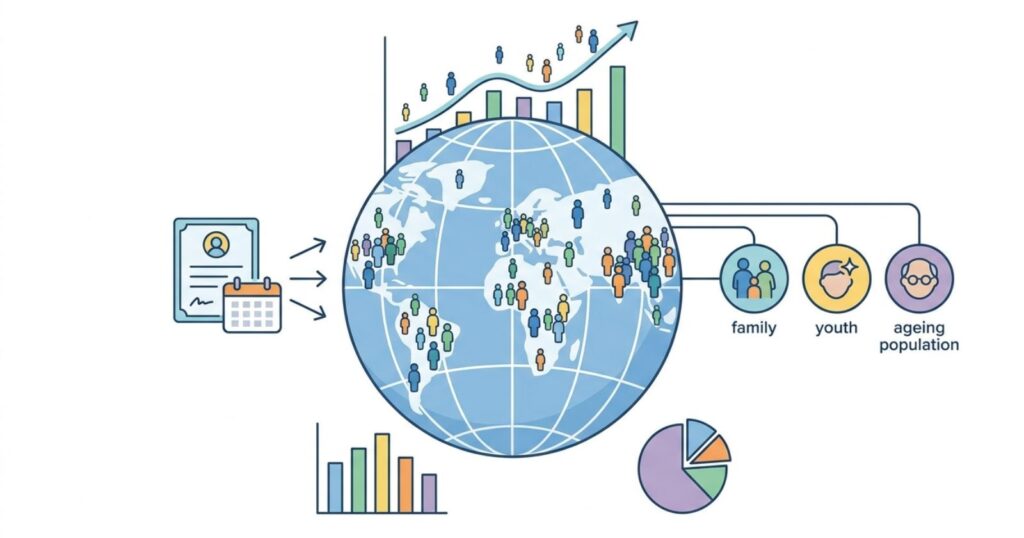
The world population on your birthday offers a precise marker of human presence at one moment in time. For individuals born in the middle of the last century, the number stood far lower than the more than eight billion alive in 2026. That contrast captures the extraordinary pace of expansion that defined much of the twentieth century and the early part of the twenty-first.
Data compiled through rigorous methods by international agencies shows how fertility rates, mortality improvements, and regional migration combined to drive these increases. The result is a global figure that continues to evolve, yet at a noticeably slower rate than in earlier periods.
Such snapshots connect personal history to broader patterns. Someone born in 1975 entered a world of roughly four billion people. By contrast, current estimates place the total near eight point three billion. This doubling within roughly fifty years reflects advances in health care, sanitation, and agriculture that lowered death rates while birth rates remained high for decades. Reliable tracking relies on national censuses, vital registration systems, and statistical modeling to fill gaps where direct counts prove incomplete. These methods produce estimates accurate enough for policy planning and research, even if exact daily totals remain approximations.
The figures carry implications beyond mere curiosity. Population size influences discussions around resource allocation, urban planning, and environmental pressures, though experts emphasize that per capita consumption patterns matter as much as sheer numbers. Tracking the world population on your birthday, therefore, situates individual lives within larger demographic shifts that have reshaped societies, economies, and ecosystems over time. The data also underscores how growth has become more concentrated in specific regions while others stabilize or even decline.
Historical Milestones That Defined World Population Growth
The global population passed one billion around 1804, according to widely accepted historical reconstructions. It then took more than a century to reach two billion in 1927. From that point onward, the pace accelerated markedly. Three billion arrived in 1960, followed by four billion in 1975, five billion in 1987, six billion in 1999, seven billion in 2011, and eight billion in 2022. Each successive billion came faster until the most recent additions, which required about twelve years apiece.
These milestones illustrate the transition from slow preindustrial growth to the explosive increases of the modern era. Improvements in food production through the green revolution and widespread access to basic medical care played central roles. Yet the intervals between billions also began to lengthen after the late twentieth century as fertility rates declined in many parts of the world. The United Nations Population Division documents these turning points through its World Population Prospects series, which draws on thousands of national censuses and surveys conducted since 1950.
Trends in Population Growth Rates Over Decades
Annual growth rates peaked above two percent during the late 1960s before beginning a sustained decline. By the early 2020s, the rate had fallen below one percent. In 2026, the yearly increase stands at roughly 0.84 percent according to elaborations of United Nations data. This moderation stems primarily from lower fertility levels linked to higher education, urbanization, and expanded access to family planning options across diverse societies.
The table below organizes population totals and growth rates for selected years to illustrate the pattern clearly.
| Year | Estimated Population | Yearly Percent Change |
|---|---|---|
| 1950 | 2 500 000 000 | 1.80 |
| 1975 | 4 000 000 000 | 1.85 |
| 2000 | 6 171 702 993 | 1.36 |
| 2010 | 7 021 732 148 | 1.28 |
| 2020 | 7 887 001 292 | 0.97 |
| 2026 | 8 300 678 395 | 0.84 |
Data for recent decades comes from the World Population Prospects 2024 revision. Earlier figures represent consensus estimates refined through demographic analysis. Net annual additions have dropped from peaks near ninety million in the 1980s and 1990s to around sixty-nine million projected for 2026. This slowdown occurs even as the absolute number of people continues to rise because the base population is now much larger.
Determining World Population On Your Birthday
Specialized calculators draw on the same underlying United Nations datasets to estimate the total on any given date. Users input a birth date and receive an approximate figure based on interpolated daily or monthly data. These tools account for the fact that population changes continuously through births, deaths, and net migration. The daily net gain currently averages around two hundred thousand people, though that number fluctuates with seasonal birth patterns and unexpected events.
Accuracy improves for dates after 1950 when systematic data collection became more widespread. For earlier periods, estimates rely on historical records, archaeological evidence, and modeling techniques that carry wider margins of uncertainty. Still, the results offer a reliable sense of scale. Someone born in the 1990s, for instance, entered a planet with roughly five point five billion inhabitants. The same process applied to a 2025 birth date would reflect a total exceeding eight billion.
Sources and Methods Behind Population Estimates
The United Nations Population Division serves as the primary authoritative source. Its World Population Prospects series incorporates data from 1 910 national censuses conducted between 1950 and 2023, along with vital registration records and 3 189 nationally representative surveys. Statisticians adjust for undercounting in regions with limited infrastructure and project forward using fertility, mortality, and migration assumptions.
Worldometer and similar platforms elaborate these official figures into daily updates and interactive tools. They apply the medium fertility variant of the United Nations projections, which experts regard as the most balanced scenario. Independent verification comes from national statistical offices and academic demographers who cross-check against census results. Discrepancies between sources usually amount to only a few million people on a global scale, which represents less than 0.1 percent of the total.
Regional Contributions and Future Projections
Growth has become increasingly concentrated. More than half the projected increase between 2022 and 2050 is expected to occur in just eight countries. Meanwhile, many high-income nations report fertility rates below replacement level, leading to slower growth or outright declines offset by migration. These dynamics produce a more balanced global distribution over time.
The 2024 revision projects the world population to reach 8.5 billion by 2030, 9.7 billion by 2050, and a peak of just under 10.3 billion around 2084. After that point, a gradual decline becomes possible under the medium scenario. Such forecasts rest on continued improvements in female education and reproductive health services, which have already lowered fertility in many regions faster than anticipated in prior revisions.
The world population on your birthday, therefore, functions as more than a historical curiosity. It anchors personal timelines within the larger arc of demographic transition. The data shows both the remarkable expansion of recent generations and the emerging stabilization that could define the remainder of the century. Policymakers, researchers, and planners rely on these figures to anticipate needs in health infrastructure, education, and environmental stewardship. As estimates grow more refined through better data collection, the picture becomes clearer. The numbers highlight how interconnected individual lives remain with collective trends that span continents and generations. Understanding where the count stood on any given birth date adds depth to discussions about sustainability, equity, and the shared future of humanity on a finite planet.