
Canada Population October 2026: 40.1 Million [LIVE Population Clock]
| # | Province / Territory ↕ | Abbr | Type | Population ↕ | Share | Births Today ↕ | Deaths Today ↕ | Net Today |
|---|
Canada Population 2026: Provinces, Growth, and Key Demographics Statistics
Key Facts About Canada’s Population
- Canada’s 2026 population is ~40.1 million, tiny relative to its 9.98 million km² land area.
- Ontario alone holds ~38% of Canada’s population, anchored by Toronto, one of the world’s most multicultural cities.
- Canada admits ~400,000–500,000 permanent residents/year, the highest immigration rate per capita in the G7.
- ~23% of Canadians were born outside Canada, one of the highest foreign-born shares in the world.
- India is now Canada’s single largest source country for immigration, surpassing China and the Philippines.
- Nunavut has a birth rate of 22.0/1,000, the highest in Canada, reflecting its young Inuit population.
- Newfoundland & Labrador has a death rate of 12.5/1,000, the highest of any province, reflecting severe demographic ageing.
- Alberta is Canada’s fastest-growing major province, driven by oil sands wealth and interprovincial migration.
- ~82% of Canadians live in urban areas; the top 6 metro areas hold 45%+ of the national population.
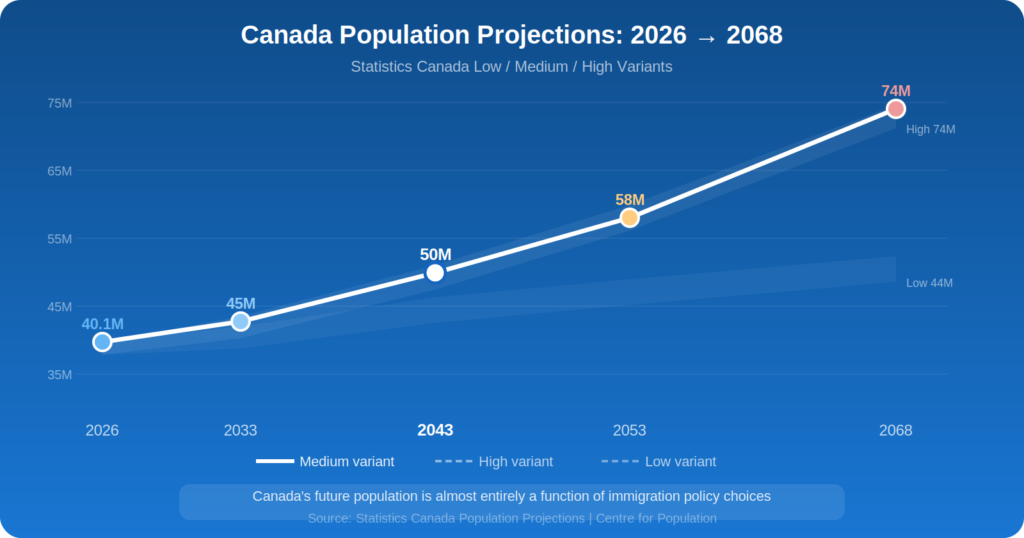
- Canada’s population is projected to reach 50 million by the 2040s under current immigration targets.
- Canada’s Indigenous population (~1.8M) is growing rapidly and has the youngest age structure of any demographic group.
- Housing affordability in Toronto and Vancouver ranks among the worst in the world, threatening continued urban growth.
Canada is one of the world’s most remarkable demographic stories. The second largest country on Earth by total land area, spanning nearly 10 million square kilometres from the Pacific to the Atlantic and deep into the Arctic, it is home to approximately 40.1 million people in 2026. That makes Canada one of the least densely populated developed nations on the planet, with a population density of fewer than 4 people per square kilometre. Yet within this vast, sparsely settled landmass sit some of North America’s most dynamic, multicultural, and rapidly growing cities.
Canada’s population dynamics in 2026 are a product of deliberate policy choices, geographic realities, and the complex interplay of Indigenous demographics, European settlement history, and one of the world’s most ambitious immigration programmes. Understanding Canada’s population means understanding how a country with low natural growth rates has chosen to build itself, through the front door of immigration, into one of the fastest-growing developed economies in the world.
This article provides a comprehensive examination of Canada’s population in 2026, covering total figures, province-by-province breakdowns, growth trends, immigration policy, age structure, Indigenous demographics, regional disparities, and long-term projections based on Statistics Canada 2024 data.
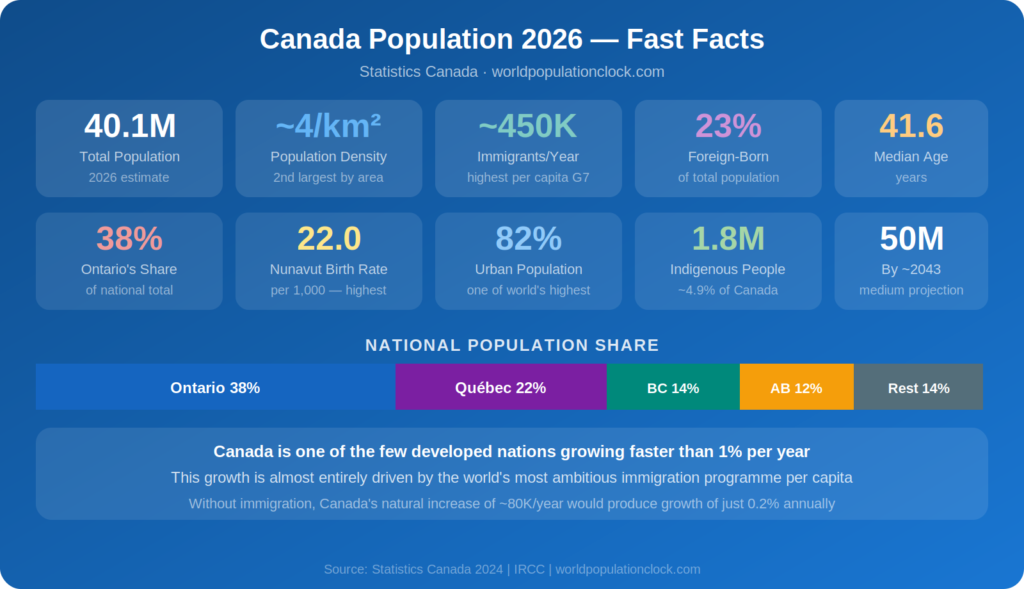
Total Population of Canada (2026)
As of 2026, Canada’s estimated population is approximately 40.1 million people. This represents around 0.5 percent of the global population of 8.3 billion. Despite its geographic immensity, Canada’s population is smaller than the state of California plus New York combined, a reflection of how empty the Canadian interior and north truly are.
Canada’s annual birth rate produces approximately 370,000 births per year, while around 290,000 Canadians die annually, yielding a natural increase of roughly 80,000 people per year. This natural increase alone would produce a growth rate of only about 0.2 percent annually, too slow to sustain current economic ambitions. It is immigration that drives Canada’s actual growth rate, which has averaged 1.5 to 2.5 percent per year in recent years, among the fastest of any G7 nation.
Canada’s total fertility rate (TFR) stands at approximately 1.44 births per woman in 2026, below the replacement level of 2.1 and similar to other low-fertility developed nations. The median age of 41.6 years reflects an ageing population, though Canada’s median age is somewhat younger than Germany, Japan, or Italy, partly because of its consistently high immigration of young adults.
| Metric | Figure |
| Total Population (2026) | ~40.1 Million |
| Annual Births | ~370,000 |
| Annual Deaths | ~290,000 |
| Natural Increase/Year | ~+80,000 |
| Net Migration (est.) | ~400,000–500,000/yr |
| Median Age | 41.6 years |
| Total Fertility Rate | ~1.44 |
| Official Languages | English & French |
| Provinces | 10 |
| Territories | 3 |
| Population Density | ~4 people/km² |
| World Population Share | ~0.5% |
Canada Population by Province and Territory
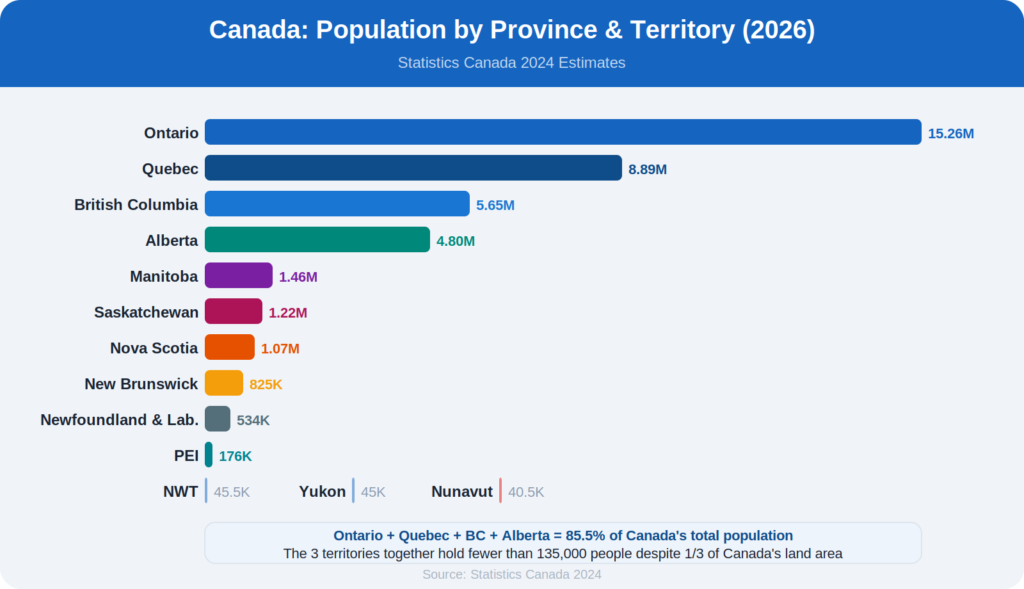
Canada’s population is extremely unevenly distributed across its 10 provinces and 3 territories. The vast majority of Canadians live in a relatively narrow band within 200 kilometres of the US border, concentrated in four major provinces: Ontario, Quebec, British Columbia, and Alberta. The three northern territories, Yukon, Northwest Territories, and Nunavut, together hold fewer than 135,000 people despite covering over a third of Canada’s total land area.
| Province/Territory | Abbr | Type | Population (2026) | Birth Rate | Death Rate | Net Change |
| Ontario | ON | Province | ~15,262,000 | 9.8 | 7.2 | + |
| Quebec | QC | Province | ~8,888,000 | 9.2 | 8.5 | + |
| British Columbia | BC | Province | ~5,647,000 | 8.8 | 7.5 | + |
| Alberta | AB | Province | ~4,795,000 | 11.5 | 6.5 | ++ |
| Manitoba | MB | Province | ~1,459,000 | 12.5 | 9.5 | + |
| Saskatchewan | SK | Province | ~1,216,000 | 12.2 | 9.8 | + |
| Nova Scotia | NS | Province | ~1,073,000 | 8.5 | 11.5 | − |
| New Brunswick | NB | Province | ~825,000 | 8.8 | 11.8 | − |
| Newfoundland & Lab. | NL | Province | ~534,000 | 7.8 | 12.5 | − |
| Prince Edward Island | PE | Province | ~176,000 | 9.5 | 10.5 | − |
| Northwest Territories | NT | Territory | ~45,500 | 14.5 | 5.5 | + |
| Yukon | YT | Territory | ~45,000 | 11.5 | 6.5 | + |
| Nunavut | NU | Territory | ~40,500 | 22.0 | 6.0 | ++ |
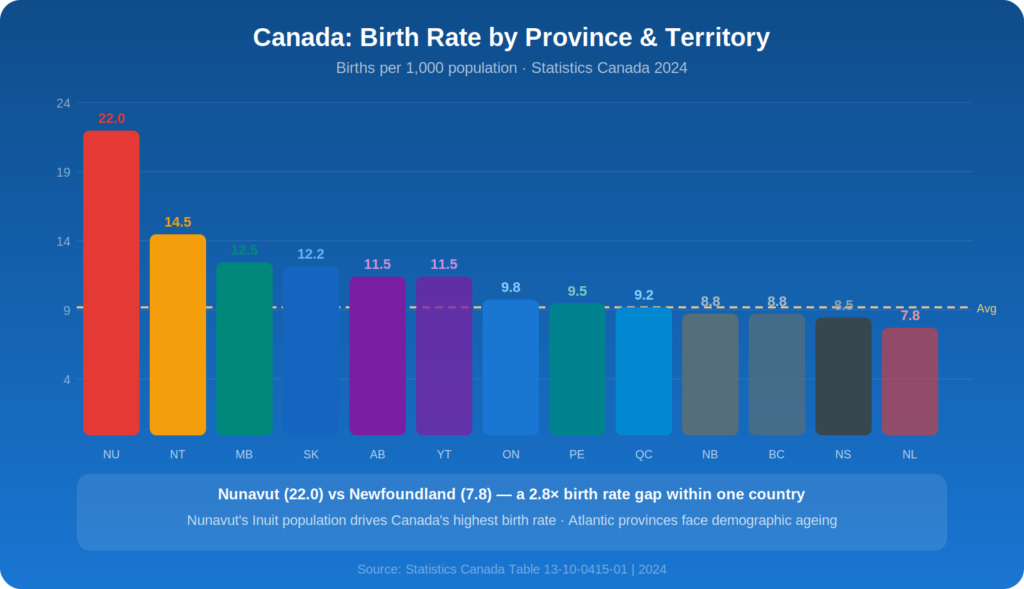
Ontario: Canada’s Population Giant
Ontario is by far Canada’s most populous province, home to approximately 15.26 million people, nearly 38 percent of the entire national population. Toronto, Ontario’s capital and Canada’s largest city, is a metropolitan area of over 6 million people and one of the most ethnically diverse cities in the world. More than half of Toronto’s residents were born outside Canada, making it arguably the most multicultural major city on Earth. Ontario’s birth rate of 9.8 per 1,000 and death rate of 7.2 per 1,000 produce a natural increase, but the province’s explosive growth is driven overwhelmingly by international immigration. Over 100,000 permanent residents settle in Ontario each year, the majority in the Greater Toronto Area (GTA).
Quebec: The Francophone Heartland
Quebec, with approximately 8.89 million residents, is Canada’s second most populous province and its cultural and linguistic counterpart to English-speaking Canada. Quebec is the only majority-French-speaking province and fiercely guards its linguistic and cultural distinctiveness through legislation such as Bill 101 (the Charter of the French Language), which mandates French as the language of business, education, and government. Quebec’s demographic profile shows a birth rate of 9.2 per 1,000 and a death rate of 8.5, producing modest natural growth. Montreal, Quebec’s largest city and a major cultural and economic hub, has a metropolitan population of approximately 4.2 million.
Alberta: The Growth Powerhouse
Alberta stands out among Canadian provinces for its exceptionally high growth rate, driven by a combination of resource-sector wealth, interprovincial migration, international immigration, and a relatively high birth rate of 11.5 per 1,000 against a death rate of only 6.5 per 1,000. Calgary and Edmonton, Alberta’s two major cities, are among the fastest-growing metropolitan areas in Canada. Alberta’s population has grown from under 4 million in 2020 to nearly 4.8 million in 2026, a remarkable pace of expansion driven by oil sands wealth and a diversifying economy.
Atlantic Canada: Ageing and Declining Naturally
The four Atlantic provinces, Nova Scotia, New Brunswick, Newfoundland and Labrador, and Prince Edward Island, present a stark demographic contrast to central and western Canada. All four have death rates that exceed or nearly equal birth rates, reflecting ageing populations that have long experienced out-migration of young people to Ontario, Alberta, and British Columbia. Newfoundland and Labrador has the most extreme profile: a birth rate of just 7.8 per 1,000 against a death rate of 12.5, the highest death rate of any province. Without immigration, these provinces would face a significant population decline.
Nunavut: Canada’s Youngest Territory
Nunavut, Canada’s newest and largest territory (created in 1999), is the demographic outlier in an entirely different direction. With a birth rate of 22.0 per 1,000, the highest of any province or territory, and a total population of only about 40,500, Nunavut has a demographic profile more reminiscent of sub-Saharan Africa than of developed-world North America. This exceptionally high birth rate reflects the predominantly Inuit population of Nunavut, which has a significantly younger age structure and higher fertility rate than the Canadian average. Nunavut’s median age is believed to be around 27 years, the lowest in Canada, and its population is growing rapidly from natural increase, though it faces severe challenges in healthcare, housing, education, and infrastructure.
Immigration: The Engine of Canadian Population Growth
Canada’s immigration programme is, by deliberate design, the most ambitious in the developed world relative to population size. In recent years, Canada has welcomed between 400,000 and 500,000 new permanent residents per year, a figure that, relative to Canada’s population of 40 million, represents an immigration rate more than double that of the United States. This extraordinary intake has been explicitly set by government policy as a tool to offset demographic ageing, maintain labour force growth, and sustain economic dynamism.
Canada’s immigration system operates through multiple streams. The Express Entry system manages applications for skilled workers through the Federal Skilled Worker Program, the Canadian Experience Class, and the Federal Skilled Trades Program, selecting applicants based on a Comprehensive Ranking System (CRS) score that evaluates education, language ability, work experience, and age. The Provincial Nominee Program (PNP) allows individual provinces and territories to select immigrants who meet their specific labour market needs, a particularly important tool for provinces like Manitoba, Saskatchewan, and the Atlantic provinces that struggle to attract immigrants through federal streams alone.
Family reunification, refugee resettlement, and temporary worker programmes add further layers to Canada’s immigration framework. The Temporary Foreign Worker Program and International Mobility Program together bring hundreds of thousands of additional workers annually, many of whom transition to permanent residency.
The result is a Canada that is among the most multicultural nations on Earth. Approximately 23 percent of Canada’s population was born outside the country, a higher foreign-born share than the United States, Australia, or most European nations. The largest sources of recent immigrants include India (now the single largest source country by a wide margin), the Philippines, China, Nigeria, Pakistan, and various francophone African nations, who settle primarily in Quebec.
Immigration has transformed the cultural landscape of Canada’s major cities. Toronto and Vancouver are majority-visible-minority cities, meaning that over 50 percent of their populations identify as a visible minority (non-white, non-Indigenous). This transformation, accomplished in a few decades, represents one of the most rapid demographic shifts of any wealthy nation in modern history.
Indigenous Population of Canada
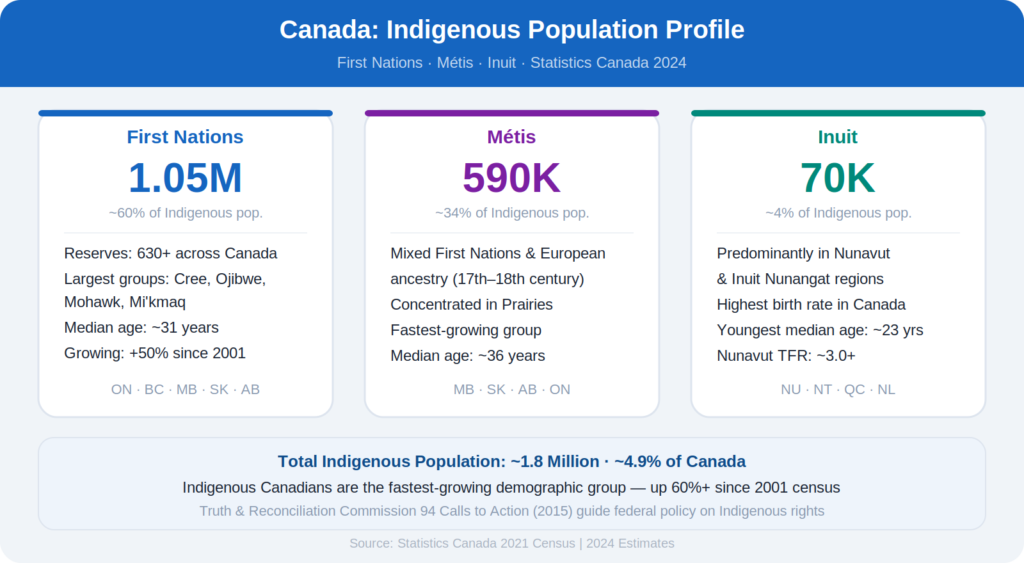
Canada’s Indigenous population, comprising First Nations, Métis, and Inuit peoples, numbered approximately 1.8 million in the 2021 census, or about 5 percent of the national population. This figure has been growing rapidly: Indigenous Canadians have significantly higher birth rates than the non-Indigenous population, and increasing numbers of Canadians with Indigenous ancestry are now identifying as such on census forms, partly reflecting cultural revitalisation and greater social acceptance.
The geographic distribution of Indigenous Canadians is distinctive. First Nations communities are spread across the country, with significant populations in Ontario, British Columbia, Manitoba, Saskatchewan, and Alberta. The Métis, people of mixed First Nations and European ancestry, are concentrated particularly in the Prairie provinces. The Inuit live predominantly in four regions collectively known as Inuit Nunangat: Nunavut, Nunavik (northern Quebec), Nunatsiavut (northern Labrador), and the Inuvialuit Settlement Region (Northwest Territories).
Indigenous Canadians have a significantly younger age structure than the non-Indigenous population. The median age of First Nations people living off-reserve is approximately 31 years, compared to 41.6 for the Canadian population as a whole. This young population is growing rapidly and will be an increasingly important part of Canada’s demographic and economic future.
Despite their growing numbers, Indigenous Canadians continue to face significant socioeconomic disparities relative to non-Indigenous Canadians, including lower incomes, higher poverty rates, lower educational attainment, and substantially worse health outcomes. Closing these gaps is one of the central challenges of Canadian public policy, given additional impetus by the Truth and Reconciliation Commission’s 94 Calls to Action published in 2015.
Urbanisation and Canada’s City-Centric Demographics
Canada is one of the most urbanised countries in the world, with approximately 82 percent of Canadians living in urban areas. Unlike the United States, where urbanisation is broadly distributed across dozens of major cities, Canada’s urban population is heavily concentrated in a small number of very large metropolitan areas. The six largest census metropolitan areas, Toronto, Montreal, Vancouver, Calgary, Edmonton, and Ottawa-Gatineau, together account for over 45 percent of Canada’s entire population.
Toronto’s census metropolitan area, with over 6.5 million people, is the fourth largest in North America after New York, Los Angeles, and Chicago. Vancouver, built between mountains and the Pacific Ocean, has grown to over 2.7 million in its metropolitan area and faces some of North America’s most severe housing affordability challenges. Montreal, with 4.2 million metropolitan residents, is the cultural capital of French Canada and a major technology and aerospace hub.
The concentration of growth in major urban centres has created significant regional imbalances. Rural and small-town Canada, particularly in Atlantic Canada, Quebec’s regions outside Montreal, and the Prairies, faces population stagnation, ageing, and decline of public services. The dominance of Toronto, Vancouver, and Montreal in attracting immigrants and young Canadians is a source of ongoing political and economic tension between the regions.
Housing affordability has become the defining domestic political issue in Canada in recent years. Home prices in Toronto and Vancouver have risen to levels that make homeownership impossible for many middle-income Canadians without substantial family wealth transfers. The federal government has set ambitious housing construction targets, but progress has been hindered by municipal zoning restrictions, construction labour shortages, and high financing costs.
Age Structure and the Ageing Challenge
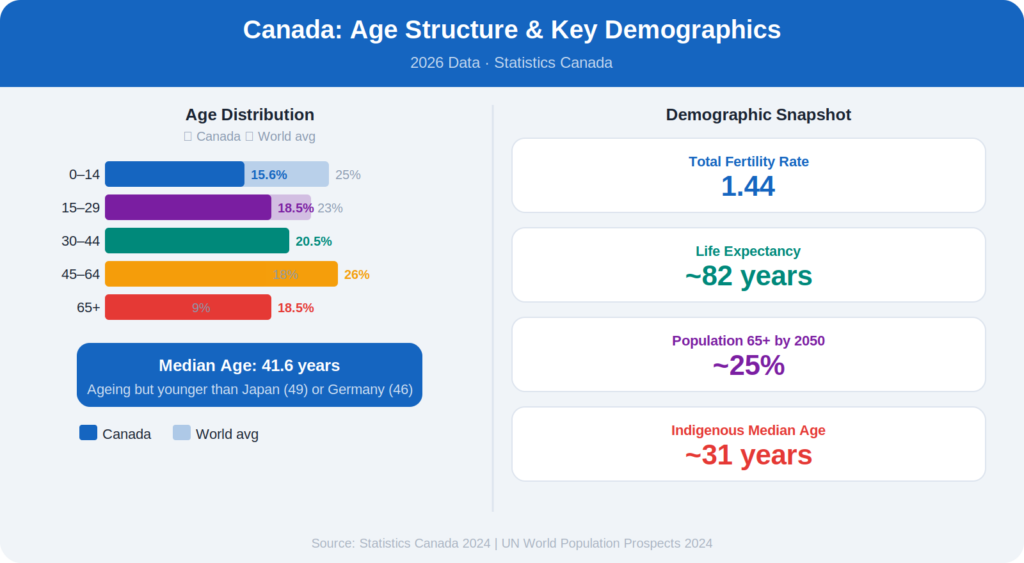
Canada’s age structure reflects the characteristic pattern of a low-fertility, high-longevity developed nation. The baby boom generation, born approximately 1946 to 1964, is now in the 62–80 age range and moving through the peak demand years for healthcare, pension benefits, and elder care services. The proportion of Canadians aged 65 and over is approximately 18.5 percent in 2026 and is projected to reach 25 percent by 2050.
Canada’s life expectancy of approximately 82 years (84 for women, 80 for men) is among the highest in the world, reflecting the country’s universal healthcare system, high incomes, and relatively healthy lifestyle patterns. This longevity, combined with low fertility, is the fundamental driver of demographic ageing.
The dependency ratio, the proportion of dependents (children and elderly) to working-age adults, is increasing in Canada and is projected to worsen significantly in the coming decades. This creates fiscal pressure on government programmes, including the Canada Pension Plan (CPP), Old Age Security (OAS), provincial health systems, and long-term care services. Immigration of young, working-age adults is Canada’s primary strategy for managing this challenge, providing additional workers, taxpayers, and consumers to support an ageing native-born population.
Future Population Projections for Canada
Statistics Canada projects that Canada’s population will reach approximately 46 to 50 million by 2043 and could be between 44 million (low scenario) and 74 million (high scenario) by 2068, depending primarily on immigration levels. The extraordinary range of these projections, spanning 30 million people, underscores how completely Canada’s demographic future is a matter of political choice rather than demographic destiny.
Under current immigration targets, Canada is likely to reach 50 million people sometime in the 2040s. Ontario is projected to approach 20 million people by mid-century, and the Greater Toronto and Hamilton Area (GTHA) could have a population of nearly 10 million. Alberta, buoyed by its energy sector and growing technology economy, is projected to rival Quebec in population by the 2050s.
The three territories will remain sparsely populated in absolute terms, but are strategically critical. Nunavut, in particular, is attracting growing attention for its vast mineral resources, particularly critical metals including gold, diamonds, iron ore, and rare earth elements, which will drive some economic development and population growth in the coming decades. Climate change is also making the Far North more accessible, with complex implications for resource development, Indigenous communities, and Arctic sovereignty.
Canada’s long-term demographic trajectory is, in the most fundamental sense, a reflection of its values. Unlike countries that have struggled with declining populations by attempting to boost fertility, with limited success, Canada has chosen immigration as its demographic strategy. This choice has made Canada one of the most diverse and dynamic societies on Earth, and one of the few developed nations positioned to sustain robust population growth into the 22nd century.
Sources: Statistics Canada 2024 | Statistics Canada Table 13-10-0415-01 | Canada Centre for Population | Immigration, Refugees & Citizenship Canada (IRCC) | Truth and Reconciliation Commission | UN World Population Prospects 2024