
Real-Time Age Calculator: Check Your Age Now
| —Total seconds lived | —Total minutes lived | —Total days lived |
| —Est. days spent sleeping | —Est. heartbeats (70 bpm) | —Est. breaths (15/min) |
| —Days | —Hours | —Minutes | —Seconds |
| Day of week born— | Zodiac sign— |
| Chinese zodiac— | Season of birth—Northern Hemisphere |
Real-Time Age Calculator Guide: Instant Online Age Calculation By Date of Birth
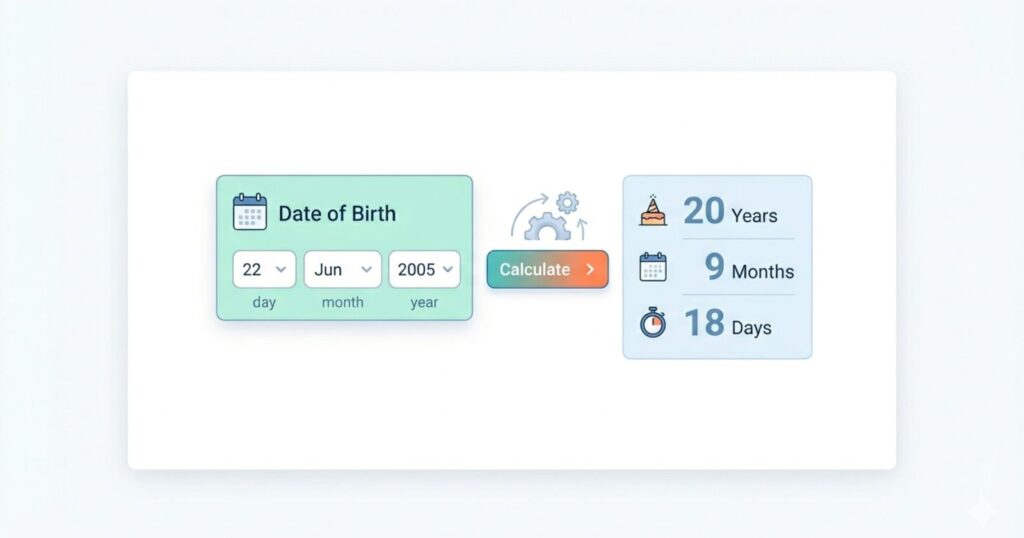
In an era defined by digital immediacy, few details carry more weight than knowing the exact age at any given moment. Birth records establish a fixed starting point, yet the passage of time introduces layers of complexity through leap years, shifting calendars, and the relentless tick of seconds. A real-time age calculator addresses this reality by delivering precise outcomes the instant a date of birth enters the system.
The demand for such tools has grown alongside the need for accuracy in everything from official documentation to personal reflection. Traditional methods of counting years often overlook finer details that matter in specific contexts. Online age calculation by date of birth removes guesswork and supplies consistent results that align with universal time standards.
This level of detail proves valuable because age influences eligibility, planning, and record-keeping across countless situations. A real-time age calculator meets that need by operating continuously and updating with the current moment whenever required.
How Real-Time Age Calculators Deliver Instant Results
Real-time age calculators process input dates against the present moment using established calendar algorithms. The process begins with the Gregorian system, which has governed date tracking since its introduction centuries ago. These tools subtract the birth date from the current date while adjusting for every irregularity in month lengths and leap years.
The output appears immediately because modern implementations rely on efficient programming that handles large date differences without delay. Unlike manual counting, which invites arithmetic errors, the calculator performs all adjustments automatically. Results display in multiple formats so users see the full picture rather than a single rounded number.
Precision extends beyond whole years. Many versions break the total into months, weeks, days, and even smaller increments when the user selects that option. This capability stems from the same underlying logic that powers reliable time-tracking systems worldwide.
The Mechanics Behind Online Age Calculation By Date of Birth
Online age calculation by date of birth rests on straightforward yet meticulous date arithmetic. The system first identifies the total number of days between the two dates. It then converts that span into years by dividing by the average length of a year while carrying over remainders into months and days.
Leap years receive special treatment. Every four years, an extra day enters the calendar, and the calculator incorporates this rule without exception. February 29 exists only in qualifying years, so the tool skips it in non-leap periods to maintain accuracy.
Time zones add another consideration for users who supply birth time. Calculators that include hour and minute data reference coordinated universal time or the local zone to prevent off-by-one errors. The result stays consistent regardless of where the user accesses the tool.
| Sample Date of Birth | Age in Years (as of April 2026) | Additional Breakdown (Months / Days) | Total Days Lived (Approximate) |
|---|---|---|---|
| January 1, 1990 | 36 | 3 / 17 | 13,256 |
| May 15, 2000 | 25 | 11 / 3 | 9,469 |
| October 10, 2015 | 10 | 6 / 8 | 3,847 |
This table illustrates how the same current reference date produces different granular outputs. Each row reflects the calculator’s ability to handle varying birth years while preserving exact intervals.
Why Precision Matters Across Everyday and Professional Contexts
Age data shapes decisions in areas that range from enrollment processes to contract reviews. A discrepancy of even a single day can shift eligibility in programs that enforce strict cutoffs. Real-time age calculators eliminate that risk by supplying verifiable figures on demand.
Professionals in human resources consult these tools when verifying workforce demographics or confirming compliance with age-sensitive policies. The instant output supports faster processing of forms that once required cross-referencing physical documents.
Individuals use the same technology for personal milestones. Planning a significant birthday or tracking generational timelines becomes simpler when exact intervals appear without manual effort. The calculator turns abstract time into concrete numbers that inform choices.
Research published in the Proceedings of the National Academy of Sciences in 2017 demonstrated that accurate chronological records remain essential for population studies in communities without widespread calendar use. Digital solutions now bridge that gap by offering the same level of detail to anyone with internet access.
Comparing Real-Time Tools to Traditional Calculation Methods
Manual age calculation depends on paper calendars and step-by-step subtraction. The approach works for rough estimates, yet falters when leap years or irregular months enter the equation. A single overlooked February 29 can shift the final count by an entire day.
Spreadsheets improve on paper but still require users to build formulas that account for every exception. Real-time age calculators bypass this setup entirely. The user enters two dates and receives a complete breakdown without writing a single line of code.
The difference becomes obvious in volume tasks. Processing dozens of records manually consumes hours, while the digital version finishes each one in under a second. Accuracy rates rise because the tool applies uniform rules rather than variable human judgment.
Practical Applications That Benefit from Instant Age Data
Human resources departments integrate age calculators into onboarding systems to confirm eligibility for benefits or training programs. The speed of verification reduces administrative backlog and improves record consistency.
Educational institutions rely on precise age figures when placing students in grade levels or extracurricular activities. The calculator helps administrators apply age-based guidelines without repeated manual checks.
Legal and administrative offices use the technology to validate documents that reference age thresholds. The immediate result supports quicker approvals and fewer disputes over eligibility.
Event planners schedule milestone celebrations with confidence once exact intervals confirm the timing. Families track generational patterns by comparing multiple birth dates side by side.
Addressing Common Challenges in Age Computation
Users sometimes encounter confusion when birth records list only the year or omit the time of day. Real-time calculators handle partial data by defaulting to midnight and still produce reliable year-level results. Full precision returns once additional details become available.
Cross-border differences in calendar systems pose another hurdle. The Gregorian standard prevails in most digital tools, yet the calculator notes any historical shifts for users entering older dates.
Daylight saving time adjustments rarely affect age calculations because the focus remains on calendar dates rather than clock hours. When birth time matters, the tool references the original zone to keep results stable.
The Role of Technology in Enhancing Calculation Accuracy
Continuous updates to underlying algorithms keep pace with evolving calendar standards. Developers test against historical edge cases, such as century years that are not leap years, to ensure long-term reliability.
Integration with device clocks allows some calculators to refresh results live when left open. This feature proves useful for monitoring intervals that approach important thresholds.
Future enhancements may link age data to broader time-tracking ecosystems without compromising privacy. The core function stays centered on delivering transparent, verifiable numbers from any valid date of birth.
The cumulative effect of these improvements is a tool that feels invisible yet indispensable. Users trust the output because it rests on the same mathematical foundations that govern global timekeeping.
Real-time age calculators have transformed a once tedious task into an effortless interaction. Their ability to handle complexity behind the scenes frees attention for decisions that actually matter. The technology continues to refine itself, maintaining relevance as needs evolve.
FAQ Section
How does a real-time age calculator determine exact age from a date of birth?
The tool subtracts the provided birth date from the current date using calendar mathematics. It factors in leap years, month lengths, and time differences automatically. Results appear broken into years, months, days, and smaller units for complete clarity.
What makes online age calculation by date of birth more accurate than manual counting?
Manual methods often miss calendar exceptions such as leap days or varying month durations. Digital calculators apply consistent rules every time and complete the process in seconds. The output stays identical regardless of who performs the calculation.
Can a real-time age calculator include hours, minutes, and seconds in the result?
Yes, versions that accept birth time data extend the breakdown to the second level. The feature requires the exact hour and minute of birth for proper alignment with the current time. Without that input, the tool defaults to whole days.
Does the calculator adjust for different time zones automatically?
Most tools reference coordinated universal time or the user’s local zone when birth time is supplied. This step prevents off-by-one errors caused by regional clock shifts. The final age remains consistent across locations.
Is there a difference between basic age calculators and real-time versions?
Basic versions stop at years or months and use a fixed reference date. Real-time calculators update in real time and often include finer increments. The added detail supports situations that demand current precision.
Why would someone need age results broken down to the exact day?
Certain eligibility rules or planning milestones hinge on reaching a specific day count rather than a rounded year. The granular output confirms status without doubt and prevents errors in record-keeping.
How do leap years affect results in an online age calculator?
The tool adds the extra day only in qualifying years and skips it otherwise. This adjustment ensures the total interval matches actual calendar history. Without it, age figures would drift over decades.
Can the calculator process dates from centuries ago?
Yes, provided the date falls within the supported Gregorian range. The system applies historical rules for earlier periods and delivers the correct interval. Results remain reliable even for dates from the 1800s.
Are real-time age calculators suitable for professional or legal verification?
They supply consistent, documented outputs that align with standard calendar mathematics. Organizations reference them for preliminary checks while pairing the data with official records when required.
What should users verify before relying on the calculated age?
Confirm that the entered date of birth matches official documents exactly. Double-check any supplied birth time against known records. Treat the result as a helpful reference rather than a substitute for certified proof.