Key Findings
- The 100th largest US city has 233,627 residents; New York has 36.7 times as many.
- There are 12 cities at 1 million or more, 27 between 500,000 and 1 million, 53 between 250,000 and 500,000, and 256 between 100,000 and 250,000.
- California and Texas each have 15 of the 100 largest cities.
- The South holds 41 of the top 100, the West 35, the Midwest 17, and the Northeast 7.
- Thirty-four states have their largest city in the top 100; five states have no city of 100,000.
- Between ranks 26 and 50, Miami (+10.6%), Raleigh (+8.6%) and Tampa (+6.4%) grew fastest, while Long Beach (-3.2%), Memphis (-3.0%) and Portland (-2.7%) lost the most in percentage terms.
- Seattle ranks 18th by population but 4th in the Oxford Economics Global Cities Index.
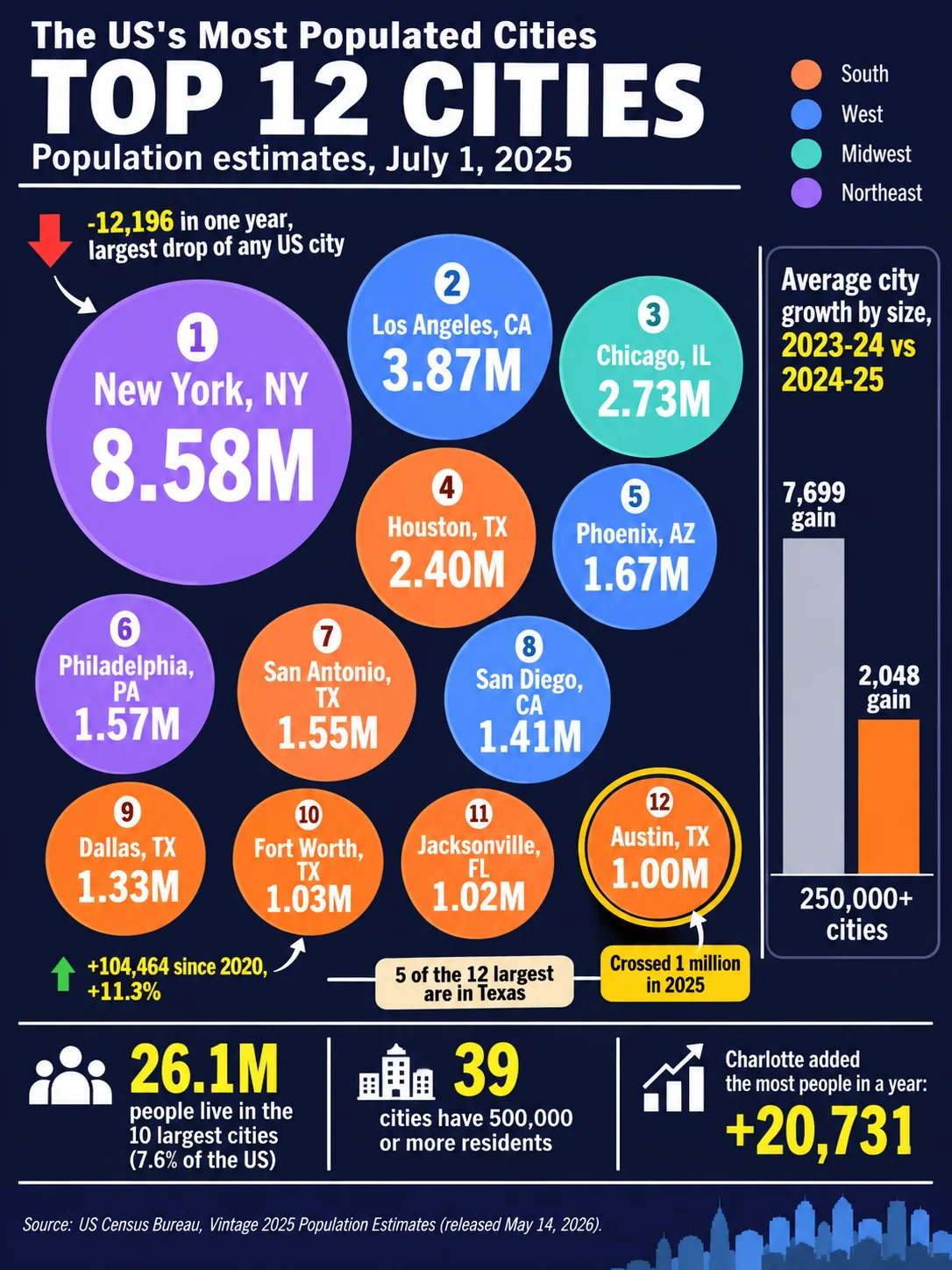
It takes 233,627 residents to make the list of the 100 largest cities in the United States, a bar Huntsville, Alabama, cleared in July 2025. At the other end, New York City’s 8,584,629 residents are 36.7 times larger than the city in 100th place. That spread, and where each rung of the ladder sits, is the real subject of a city-size ranking: the top 10 get the headlines, but 348 incorporated places have 100,000 or more residents, and the shape of that list says more about American settlement than any single name at the top.
This article ranks incorporated cities by resident population using Census Bureau Vintage 2025 estimates for July 1, 2025, released May 14, 2026. It measures municipal limits only. Metropolitan areas and urban areas are different geographies and are covered in separate articles. Rankings change with each vintage, so the table is dated rather than described as permanent.
Size Ladder at a Glance
| Tier | Number of cities | Rank range |
|---|---|---|
| 1,000,000 or more | 12 | 1 to 12 |
| 500,000 to 999,999 | 27 | 13 to 39 |
| 250,000 to 499,999 | 53 | 40 to 92 |
| 100,000 to 249,999 | 256 | 93 to 348 |
| Total with 100,000 or more | 348 |
The Census Bureau counts 39 cities at 500,000 or more and 12 at 1 million or more. The 100th city, Huntsville, has 233,627 residents, and Garland, Texas, at 249,625 is the first city below the quarter-million line. Five states have no city of 100,000: Delaware, Maine, Vermont, West Virginia and Wyoming.
The 25 Most Populated US Cities
All figures are Census Bureau Vintage 2025 estimates. Change is measured from the April 1, 2020 estimates base to July 1, 2025.
| Rank | City | State | April 2020 base | July 2025 | Change | Percent change |
|---|---|---|---|---|---|---|
| 1 | New York | NY | 8,751,188 | 8,584,629 | -166,559 | -1.9% |
| 2 | Los Angeles | CA | 3,896,473 | 3,869,089 | -27,384 | -0.7% |
| 3 | Chicago | IL | 2,741,640 | 2,731,585 | -10,055 | -0.4% |
| 4 | Houston | TX | 2,298,295 | 2,397,315 | +99,020 | +4.3% |
| 5 | Phoenix | AZ | 1,612,458 | 1,665,481 | +53,023 | +3.3% |
| 6 | Philadelphia | PA | 1,600,737 | 1,574,281 | -26,456 | -1.7% |
| 7 | San Antonio | TX | 1,438,310 | 1,548,422 | +110,112 | +7.7% |
| 8 | San Diego | CA | 1,382,566 | 1,406,106 | +23,540 | +1.7% |
| 9 | Dallas | TX | 1,303,503 | 1,329,491 | +25,988 | +2.0% |
| 10 | Fort Worth | TX | 923,653 | 1,028,117 | +104,464 | +11.3% |
| 11 | Jacksonville | FL | 951,880 | 1,017,689 | +65,809 | +6.9% |
| 12 | Austin | TX | 962,163 | 1,002,632 | +40,469 | +4.2% |
| 13 | San Jose | CA | 1,009,573 | 989,814 | -19,759 | -2.0% |
| 14 | Charlotte | NC | 874,907 | 964,784 | +89,877 | +10.3% |
| 15 | Columbus | OH | 906,675 | 938,396 | +31,721 | +3.5% |
| 16 | Indianapolis | IN | 887,223 | 901,116 | +13,893 | +1.6% |
| 17 | San Francisco | CA | 875,139 | 826,079 | -49,060 | -5.6% |
| 18 | Seattle | WA | 740,675 | 784,777 | +44,102 | +6.0% |
| 19 | Denver | CO | 717,680 | 740,613 | +22,933 | +3.2% |
| 20 | Nashville-Davidson | TN | 689,780 | 721,074 | +31,294 | +4.5% |
| 21 | Oklahoma City | OK | 682,938 | 719,849 | +36,911 | +5.4% |
| 22 | Washington | DC | 670,958 | 693,645 | +22,687 | +3.4% |
| 23 | El Paso | TX | 679,296 | 683,012 | +3,716 | +0.5% |
| 24 | Las Vegas | NV | 647,676 | 679,817 | +32,141 | +5.0% |
| 25 | Boston | MA | 669,665 | 672,973 | +3,308 | +0.5% |
Nineteen of the 25 cities are larger than they were at the 2020 base, and six are smaller: New York, Los Angeles, Chicago, Philadelphia, San Jose and San Francisco. The six shrinking cities lost a combined 299,273 residents. The 19 growing cities added 855,008, a net gain of 555,735 for the group. Six Texas cities (Houston, San Antonio, Dallas, Fort Worth, Austin and El Paso) account for 383,769 of those additions, or 44.9% of everything the growing cities gained.
Ranks 26 to 50
| Rank | City | State | April 2020 base | July 2025 | Percent change |
|---|---|---|---|---|---|
| 26 | Detroit | MI | 638,419 | 649,095 | +1.7% |
| 27 | Louisville/Jefferson County | KY | 631,872 | 641,962 | +1.6% |
| 28 | Portland | OR | 653,049 | 635,109 | -2.7% |
| 29 | Memphis | TN | 628,282 | 609,647 | -3.0% |
| 30 | Baltimore | MD | 583,295 | 569,997 | -2.3% |
| 31 | Milwaukee | WI | 577,151 | 562,407 | -2.6% |
| 32 | Albuquerque | NM | 564,752 | 556,588 | -1.4% |
| 33 | Fresno | CA | 542,675 | 555,549 | +2.4% |
| 34 | Tucson | AZ | 542,621 | 548,371 | +1.1% |
| 35 | Sacramento | CA | 525,615 | 536,449 | +2.1% |
| 36 | Atlanta | GA | 500,086 | 529,110 | +5.8% |
| 37 | Kansas City | MO | 508,128 | 521,220 | +2.6% |
| 38 | Mesa | AZ | 505,990 | 513,656 | +1.5% |
| 39 | Raleigh | NC | 466,310 | 506,306 | +8.6% |
| 40 | Colorado Springs | CO | 481,230 | 494,743 | +2.8% |
| 41 | Miami | FL | 442,895 | 489,812 | +10.6% |
| 42 | Omaha | NE | 492,766 | 488,797 | -0.8% |
| 43 | Virginia Beach | VA | 459,626 | 453,737 | -1.3% |
| 44 | Long Beach | CA | 465,566 | 450,469 | -3.2% |
| 45 | Oakland | CA | 441,157 | 440,838 | -0.1% |
| 46 | Minneapolis | MN | 430,772 | 430,324 | -0.1% |
| 47 | Bakersfield | CA | 405,185 | 422,165 | +4.2% |
| 48 | Tulsa | OK | 413,617 | 416,209 | +0.6% |
| 49 | Tampa | FL | 388,655 | 413,554 | +6.4% |
| 50 | Aurora | CO | 386,688 | 410,053 | +6.0% |
Ten of the 25 lost residents between the 2020 base and July 2025: Portland, Memphis, Baltimore, Milwaukee, Albuquerque, Omaha, Virginia Beach, Long Beach, Oakland and Minneapolis (the last two by only about 0.1%). The fastest gainers in this band were Miami (up 46,917, or 10.6%), Raleigh (up 39,996, or 8.6%) and Tampa (up 24,899, or 6.4%). Detroit’s gain of 10,676 residents makes it one of the few big Rust Belt cities with a higher count than in 2020.
Where the Top 100 Cities Sit
Counting the 100 largest cities by state shows two giants and a long tail.
| State | Cities in the top 100 | Examples |
|---|---|---|
| California | 15 | Los Angeles, San Diego, San Jose, Fresno |
| Texas | 15 | Houston, San Antonio, Dallas, Fort Worth, Austin |
| Florida | 7 | Jacksonville, Miami, Tampa, Orlando |
| Arizona | 7 | Phoenix, Mesa, Tucson, Gilbert |
| North Carolina | 5 | Charlotte, Raleigh, Greensboro, Durham |
| Ohio | 4 | Columbus, Cleveland, Cincinnati, Toledo |
| Nevada | 4 | Las Vegas, Henderson, North Las Vegas, Reno |
| Virginia | 3 | Virginia Beach, Chesapeake, Richmond |
| Colorado | 3 | Denver, Colorado Springs, Aurora |
California and Texas together hold 30 of the 100 places. Counted by Census region, the South has 41 cities in the top 100, the West 35, the Midwest 17, and the Northeast just 7 (New York City, Buffalo, Philadelphia, Pittsburgh, Boston, Newark and Jersey City). The Northeast’s small count is a function of its municipal structure as much as its population, since a large share of residents live in suburban towns that sit outside the central city’s limits.
Largest City in Each State
Thirty-four states have their largest city in the top 100, from New York (8,584,629) to Huntsville in Alabama (233,627, which has overtaken Birmingham as the state’s largest). Notable cases include Louisiana, where New Orleans (362,154) is the largest city, and Missouri, where Kansas City (521,220) is larger than St. Louis (278,144).
Sixteen states have a largest city that falls outside the top 100: Arkansas, Connecticut, Delaware, Iowa, Maine, Mississippi, Montana, New Hampshire, North Dakota, Rhode Island, South Carolina, South Dakota, Utah, Vermont, West Virginia and Wyoming. Billings, Montana, for example, held 121,239 residents in 2025, well below the 100th-place mark.
Census Size Classes
The Census Bureau groups all places by size when it reports average growth. Counting every city, town, and village in the Vintage 2025 release, the classes by 2023 population are:
| Size class | Number of places |
|---|---|
| Largest (250,000 and up) | 91 |
| Large (50,000 to 249,999) | 719 |
| Medium (5,000 to 49,999) | 4,049 |
| Small (under 5,000) | 14,624 |
The 91 places in the top class are a tiny share of the roughly 19,500 places counted, yet they behave differently. In the year to July 2025 the average place of 250,000 or more grew 0.3%, compared with 0.7% for medium places. The numbers 91 (by 2023 population) and 92 (by 2025 population, from the ranking above) differ because Chesapeake crossed the line.
Land, Boundaries and Why Rankings Differ
Population ranks reflect where a city drew its borders as much as how many people live nearby. New York City covers about 300 square miles of land, Chicago 228, Philadelphia 134, Washington 61, San Francisco 47, and Miami 36 (2020 Census land areas).
Houston, Phoenix, San Antonio and Jacksonville annexed far larger territories over decades, and Jacksonville, Nashville-Davidson and Louisville/Jefferson County are consolidated city-county governments, which is why they outrank cities with denser cores. Honolulu appears in Census tables as a census-designated place (341,868 in 2025) because the entire city and county of Honolulu is one jurisdiction.
For that reason, comparing San Francisco (826,079 residents on 47 square miles) with Jacksonville (1,017,689 residents on a far larger consolidated boundary) says little about which place is more urban. Density rankings are a separate measure and are covered in a standalone article.
How the Biggest Cities Rank Globally
Population is one measure of size. The Oxford Economics Global Cities Index 2026, which scored 1,000 cities on economics, human capital, quality of life, environment and governance, gives a different order. Eight US cities appear in its top 25.
| City | Oxford Global Cities Index rank | Economics rank | US population rank (July 2025) |
|---|---|---|---|
| New York | 1 | 1 | 1 |
| Seattle | 4 | 4 | 18 |
| San Francisco | 5 | 5 | 17 |
| Boston | 7 | 9 | 25 |
| San Jose | 8 | 3 | 13 |
| Los Angeles | 12 | 2 | 2 |
| Washington, DC | 14 | 8 | 22 |
| Dallas | 17 | 6 | 9 |
Seattle (784,777 residents) is the 18th largest US city but ranks fourth in the index, and San Jose is 13th by population and eighth in the index. Chicago, Houston, and Philadelphia do not appear in the global top 25. The index measures cities by their own boundaries, so the comparison with city-limit populations is approximate.
Conclusion
Ranking cities by size reveals a country with a few giants and a very wide middle. Twelve places pass 1 million residents, but 256 cities sit between 100,000 and 250,000, and the 100th city is still a place of about 234,000. California and Texas supply a third of the top 100, while the Northeast, despite hosting the nation’s largest city, supplies only seven. The ranking will keep shifting as Texas and Southeastern cities add residents and some older big cities hold flat or decline.
Frequently Asked Questions
1. What is the largest city in America by population?
New York City, with 8,584,629 residents on July 1, 2025. Los Angeles is second at 3,869,089, and Chicago is third at 2,731,585.
2. How many US cities have more than 100,000 people?
There are 348 incorporated places with 100,000 or more residents as of July 2025. Delaware, Maine, Vermont, West Virginia, and Wyoming have none.
3. What is the 100th largest city in the United States?
Huntsville, Alabama, with 233,627 residents. Huntsville has overtaken Birmingham as the largest city in its state.
4. What is the largest city in each US region?
New York in the Northeast, Chicago in the Midwest, Houston in the South, and Los Angeles in the West.
5. Which states have the most large cities?
California and Texas, with 15 cities each in the top 100. Florida and Arizona follow with seven each.
6. Are the largest US cities also the densest?
Not usually. New York is both the largest and the densest large city, but Jacksonville, Phoenix, and Houston are spread over far more land. San Francisco (826,079 residents) is far denser than much larger cities.
7. How many American cities have more than 500,000 residents?
Thirty-nine. Raleigh crossed that threshold between 2024 and 2025, reaching 506,306.
8. Does land area affect a city’s population rank?
Yes. Cities that annexed territory or merged with their counties, such as Jacksonville and Nashville-Davidson, report populations over larger boundaries than cities such as Boston or San Francisco.
9. Is the largest city in each state also the capital?
Often not. New York, California, Illinois, Texas, Florida, and Pennsylvania all have a largest city that is not the state capital.
10. What is the difference between the largest city and the largest metropolitan area?
A city counts residents inside municipal limits, while a metro area counts whole counties tied to a core by commuting. The New York metro area has 20.1 million residents, more than twice the 8.6 million in the city.
Sources
- U.S. Census Bureau, “Population Growth Holds Steady in Midsized Cities Amid Widespread Slowdown,” press release CB26-80 (Vintage 2025), May 14, 2026.
- The Facts Institute, “100 Most Populous US Cities,” compilation of Census Bureau Vintage 2025 city estimates.
- Wikipedia, “List of United States cities by population” (compilation of Census Bureau July 1, 2025 estimates; count of 348 places above 100,000).
- Wikipedia, “List of United States cities by population density” (2020 Census land areas).
- Flathead Beacon, “Flathead County Cities Retain Modest Population Growth Amid Overall Slowdown,” May 14, 2026 (Billings, Montana estimate from Census Vintage 2025).