Key Fact & Findings
- Millennials number 74.1 million (22%), making them the largest generation in the United States.
- They are aged 29 to 44, which includes three of the nation’s four largest five-year age groups (25 to 29, 30 to 34, and 35 to 39).
- The 25-to-44 population grew 5.9% (5.1 million) between 2020 and 2025, and the South accounted for 57.6% of that gain.
- The oldest part of the group, ages 40 to 44, grew fastest at 9.6%.
- Millennials and Generation Z make up over 42% of Americans.
- The first Millennials turn 65 in 2046 and the last in 2061.
- Millennials passed Baby Boomers as the largest living adult generation in 2019.
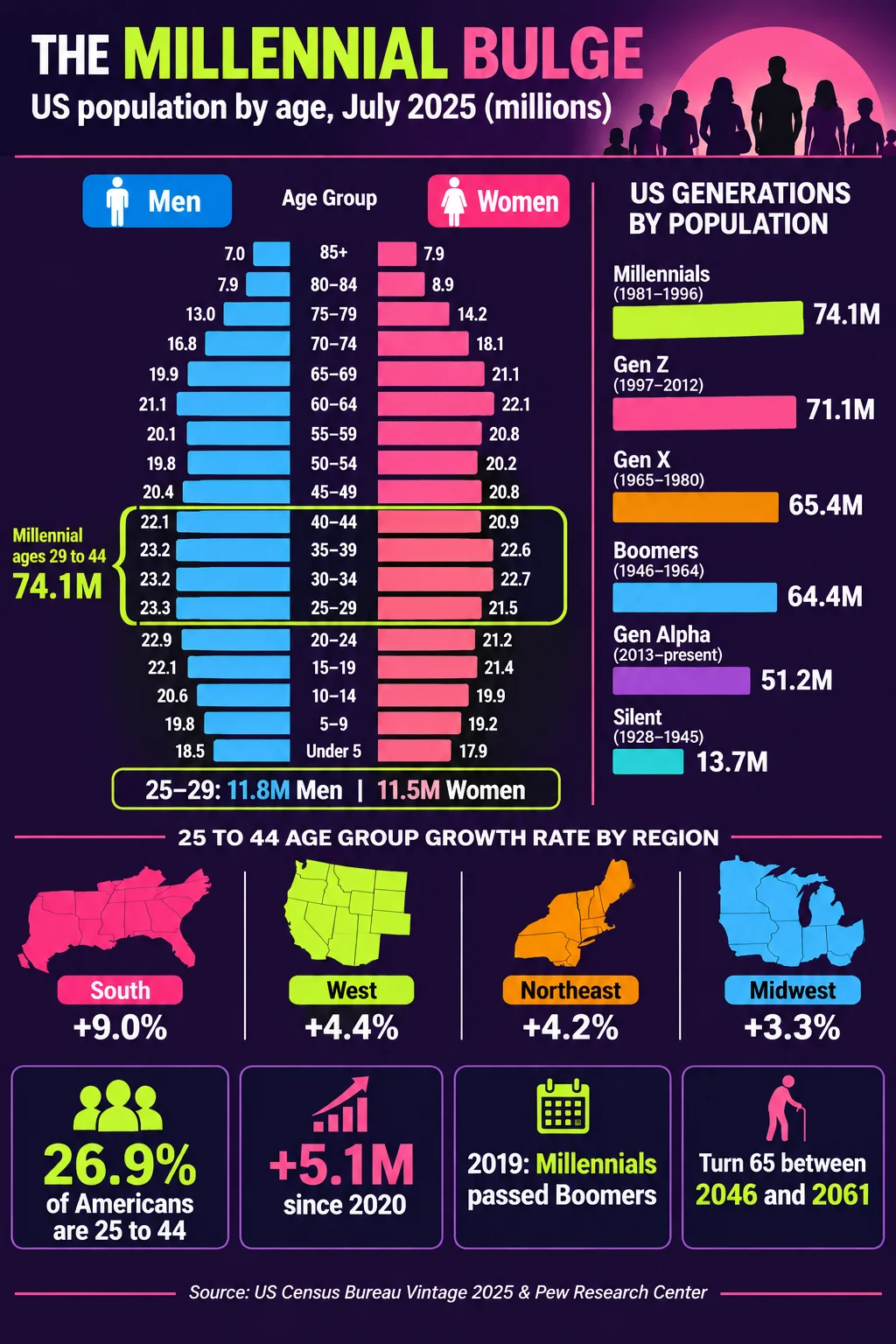
Three of the four largest five-year age groups in the United States in 2025 hold most of the Millennial generation: ages 25 to 29 (23.3 million), 30 to 34 (23.2 million) and 35 to 39 (23.2 million). Ages 20 to 24 (22.9 million) rank fourth and ages 40 to 44 (22.1 million) rank fifth. Born from 1981 through 1996 and aged 29 to 44, Millennials number about 74.1 million, or 22% of the country, making them the largest generation in the United States. Together with Generation Z, they account for more than 145 million people, over 42% of the population.
Pew Research Center defines Millennials as people born from 1981 to 1996. The generation count comes from analysis of Census Bureau data that sums to 340.1 million, the Census Bureau’s July 2024 total, using ages in 2025. Age-group figures are from the Census Bureau’s Vintage 2025 estimates for July 1, 2025. Age brackets do not align exactly with birth-year boundaries, so the five-year groups below describe the ages that Millennials mostly occupy and include some Generation X and Generation Z members at the edges.
Data Snapshot
| Metric | Figure | Reference |
|---|---|---|
| Millennial population | 74,104,186 (22%) | 2025 ages, Census-based |
| Birth years | 1981 to 1996 | Pew Research Center |
| Ages in 2025 | 29 to 44 | |
| Population aged 25 to 44 | 91,885,062 (26.9%) | July 1, 2025 |
| Growth of the 25-to-44 group since 2020 | +5,095,797 (+5.9%) | April 2020 to July 2025 |
| Millennials passed Boomers as the largest living adult generation | 2019 | Pew Research Center |
| First and last Millennials turn 65 | 2046 and 2061 |
The Largest Generation
| Generation | Birth years | Age in 2025 | Population | Share |
|---|---|---|---|---|
| Millennials | 1981 to 1996 | 29 to 44 | 74,104,186 | 22% |
| Generation Z | 1997 to 2012 | 13 to 28 | 71,146,116 | 21% |
| Generation X | 1965 to 1980 | 45 to 60 | about 65.4 million | 19% |
| Baby Boomers | 1946 to 1964 | 61 to 79 | 64,448,248 | 19% |
| Generation Alpha | 2013 to 2025 | 0 to 12 | 51,238,687 | 15% |
Pew found that Millennials passed Baby Boomers as the largest living adult generation in 2019, in part because immigration kept adding young adults to the Millennial ranks. An earlier Census-based tally put the generation at 74.2 million, or 21.8% of the population. Pew’s 2020 projections used a lower population base and expected the generation to peak near 72 million and to number 72.2 million by 2050.
The actual count is already above that, which fits the Census Bureau’s 2024 revision, described by the Congressional Budget Office, that raised its estimates of net immigration and of the resident population in 2022 and 2023.
Millennials in the Age Pyramid
The July 2025 age pyramid is widest between 25 and 44, which is where the Millennial generation sits.
| Age group | April 2020 | July 2025 | Change | Percent | Men per 100 women |
|---|---|---|---|---|---|
| 25 to 29 | 22,294,151 | 23,342,365 | +1,048,214 | +4.7% | 102.5 |
| 30 to 34 | 22,467,432 | 23,221,682 | +754,250 | +3.4% | 100.9 |
| 35 to 39 | 21,813,474 | 23,171,303 | +1,357,829 | +6.2% | 99.4 |
| 40 to 44 | 20,214,208 | 22,149,712 | +1,935,504 | +9.6% | 98.1 |
| 25 to 44 | 86,789,265 | 91,885,062 | +5,095,797 | +5.9% | 100.2 |
Every group in the table grew over the five years, and the oldest (40 to 44) grew fastest at 9.6%, as larger cohorts moved into the group than left it. The 25-to-44 population is now 26.9% of residents, larger than the 72.0 million children under 18 (21.1%) and the 64.6 million people aged 65 and older (18.9%). The female majority begins in the 35-to-39 group (99.4 men per 100 women), which is where the group crosses from more men to more women.
Where Millennials Are Growing
The Census Bureau’s regional data for ages 25 to 44, the group that holds most Millennials, show a gain concentrated in the South.
| Region | April 2020 | July 2025 | Numeric change | Percent |
|---|---|---|---|---|
| Northeast | 14,955,496 | 15,577,995 | +622,499 | +4.2% |
| Midwest | 17,493,500 | 18,079,215 | +585,715 | +3.3% |
| South | 32,644,568 | 35,579,611 | +2,935,043 | +9.0% |
| West | 21,695,701 | 22,648,241 | +952,540 | +4.4% |
| United States | 86,789,265 | 91,885,062 | +5,095,797 | +5.9% |
The South added 2,935,043 people aged 25 to 44, 57.6% of the national gain, and grew at twice the national rate. The fastest growth was in the outlying counties of Southern metro areas (+16.0%), which the Census Bureau says grew fastest across all age groups. Those counties added far more young adults than nearby central counties (+8.9%), which fits the pattern of exurban housing construction attracting families. Outlying metro counties also showed above-average growth for this age group in the West (+7.6%), Northeast (+5.5%), and Midwest (+5.1%).
What Comes Next
Millennials are in the middle of their working lives. Between July 2025 and July 2026, the Census Bureau’s short-term projection has the 25-to-44 group growing by 511,052, or 0.6%, to 92.4 million, while the 18-to-24 group shrinks by 275,723 and the 45-to-64 group by 467,242. That makes 25-to-44 the only working-age group projected to grow, with Millennials and the oldest part of Generation Z driving it.
The generation’s turn to retire is a long way off. The first Millennials, born in 1981, turn 65 in 2046, and the last, born in 1996, turn 65 in 2061. By then, the Census Bureau’s 2023 projections show 29.1% of Americans age 65 or older in 2100 compared with 16.4% under 18. Millennials will be most of the labor force in the 2030s as Gen X retires and Boomers enter their eighties.
What happens to total population after 2050 will depend on how many births this generation has and how many young immigrants arrive. The total fertility rate fell to 1.63 in 2024, down from 2.11 in 2001, so the children of Millennials make up a smaller generation than their parents.
Reading Generation Counts Carefully
Counts of the Millennial generation differ by source. A Census Bureau tally one vintage earlier gave 74.2 million and the UN’s World Population Prospects 2024 projection used by Population Pyramids puts the generation at 75.7 million for 2026, because it uses different age conventions and a higher population base. Sources also vary on the end year: some define Millennials as born through 1995 or 1997. For consistency, this article uses the Pew boundaries of 1981 to 1996, and the Census Bureau’s own estimates, wherever possible.
Conclusion
The Millennial generation does not need a label to be seen in the data. It is the broad central band of the 2025 age pyramid, with every five-year group from 25 to 44 holding at least 22 million people. What the next decade holds depends on a few numbers: how fast the 25-to-44 group keeps growing (0.6% in the short-term projection), where it lives (mostly the South) and how many children it has, a number that has fallen to 1.63 per woman.
Frequently Asked Questions
1. How many Millennials are there in the United States?
About 74.1 million in 2025, or 22% of the population, according to a Census Bureau-based tally. Other counts range from about 74 million to 75.7 million.
2. What birth years define Millennials?
1981 to 1996, per Pew Research Center.
3. How old are Millennials in 2025?
29 to 44.
4. Are Millennials the largest generation?
Yes. At about 74.1 million they are larger than Generation Z (71.1 million), Generation X (about 65 million) and Baby Boomers (64.4 million).
5. When did Millennials surpass Baby Boomers?
In 2019, when they became the largest living adult generation, according to Pew.
6. How many Americans are between 25 and 44?
91,885,062 in July 2025, or 26.9% of the population.
7. Where are Millennials growing fastest?
The South, where the 25-to-44 population grew 9.0% between 2020 and 2025, and especially its outlying metro counties (+16.0%).
8. Are there more men or women in the Millennial age range?
The balance is almost even: 100.2 men per 100 women for ages 25 to 44, with men slightly ahead at 25 to 34 and women ahead from 35 to 39 upward.
9. When will Millennials retire?
The first turn 65 in 2046 and the last in 2061, though retirement age varies.
10. Will the Millennial generation shrink?
Yes, slowly. Pew’s 2020 series projected about 72.2 million in 2050 as deaths outweigh immigration, but the 2025 count is already higher than that projection assumed.
Sources
- U.S. Census Bureau, “Populations in All Age Groups Growing in the South,” press release CB26-105 (Vintage 2025), June 25, 2026.
- Business Stats, “How Many Adults Live in the US” (five-year age groups by sex; July 2026 projection; fertility rate).
- Pew Research Center, “Millennials overtake Baby Boomers as America’s largest generation,” 2020.
- MarketingCharts, “So how many Millennials are there in the US anyway?”
- Population Pyramids, “United States Generation Breakdown 2026” (UN World Population Prospects 2024).
- Congressional Budget Office, “The Demographic Outlook 2026 to 2056.”
- U.S. Census Bureau, 2023 National Population Projections.