Key Fact & Findings
- Generation Z numbers about 71.1 million (21%) in a Census-based tally, or 73.1 million in the UN’s 2026 projection.
- It is the second largest generation, about 3 million smaller than Millennials.
- The generation is 13 to 28 years old in 2025, and roughly 30% are still under 18.
- The 18-to-24 population grew 2.1% since 2020, and is projected to fall 0.9% in the year to July 2026.
- UN data show 37.7 million males and 35.4 million females in Gen Z, about 106 males per 100 females.
- The last Gen Zers turn 18 in 2030.
- Gen Z and Gen Alpha together number about 122.4 million, 36% of Americans.
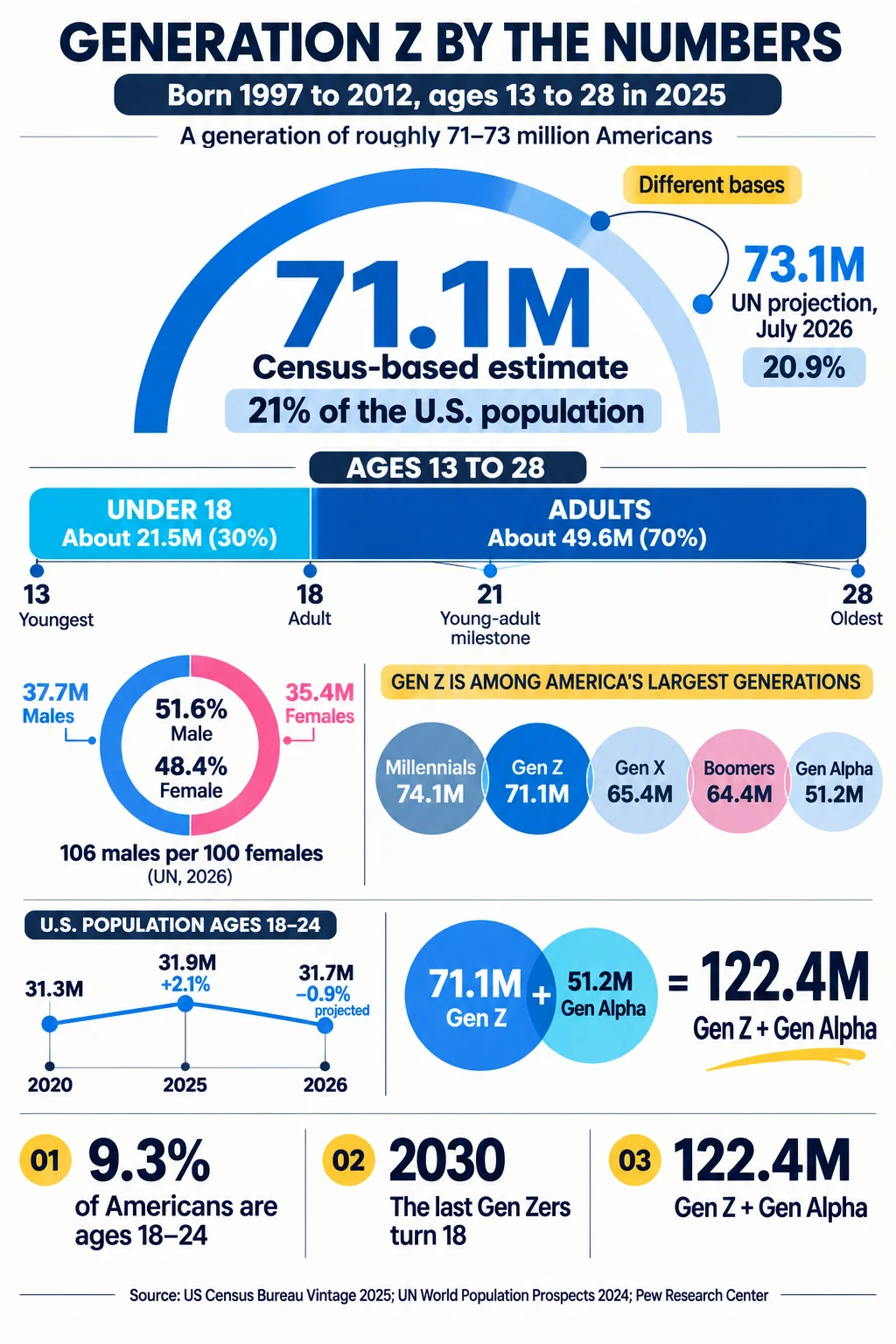
Generation Z, the cohort born from 1997 through 2012, numbers about 71.1 million Americans in a Census Bureau-based tally for 2025, which is 21% of the population and about 3 million fewer than Millennials. The United Nations’ 2026 projection puts the generation at 73.1 million and shows an unusual feature: 37.7 million males against 35.4 million females, a surplus of 2.3 million boys and young men, or about 106 males for every 100 females. The generation ranges from 13 to 28 years old in 2025, so it straddles school, college, entry-level work and early family formation, and about one in three members is still under 18.
Data Snapshot
| Metric | Figure | Reference |
|---|---|---|
| Generation Z population, Census-based | 71,146,116 (21%) | 2025 ages |
| Generation Z population, UN projection | 73,104,496 (20.9%) | July 1, 2026 |
| Birth years | 1997 to 2012 | Pew Research Center |
| Ages in 2025 | 13 to 28 | |
| Males per 100 females (UN) | about 106 | July 1, 2026 |
| Population aged 18 to 24 | 31,936,859 | July 1, 2025 |
| Change in 18-to-24 population since 2020 | +664,909 (+2.1%) | April 2020 to July 2025 |
| Last Gen Zers turn 18 | 2030 |
Two Counts of the Same Generation
| Source | Date and basis | Gen Z population | Share |
|---|---|---|---|
| Analysis of Census Bureau data | 2025 ages, total 340.1 million | 71,146,116 | 21% |
| UN World Population Prospects 2024 | July 1, 2026, total 349.0 million | 73,104,496 | 20.9% |
The 1.96 million difference comes from the population base and the age window. The UN’s total for the United States is 7 to 9 million higher than the Census Bureau’s resident estimates, and by July 2026 Gen Z is aged 14 to 29, not 13 to 28, so the count shifts by one year of age at each end. Neither number is wrong. They answer slightly different questions, and cross-source comparisons should hold the source constant.
How Gen Z Compares
| Generation | Birth years | Census-based 2025 | UN projection 2026 |
|---|---|---|---|
| Millennials | 1981 to 1996 | 74,104,186 | 75,725,892 |
| Generation Z | 1997 to 2012 | 71,146,116 | 73,104,496 |
| Generation X | 1965 to 1980 | about 65.4 million | 66,775,322 |
| Baby Boomers | 1946 to 1964 | 64,448,248 | 66,623,086 |
| Generation Alpha | 2013 onward | 51,238,687 | 47,123,271 (2013 to 2024) |
Gen Z is the second largest of the six generations on both counts, 2.96 million smaller than Millennials in the Census-based tally and 2.62 million smaller in the UN projection. Gen Z and Gen Alpha together total 122.4 million in the Census-based figures, 36% of the population. The Gen Alpha lines differ more sharply because the UN counts only people born from 2013 through 2024 and treats those born from 2025 as a separate group, Generation Beta (5.5 million).
The Age Structure of Gen Z
The ages that Gen Z occupies include some of the largest single age groups in the pyramid.
| Age group (July 2025) | Population (millions) |
|---|---|
| 10 to 14 (part Gen Alpha, part Gen Z) | 20.6 |
| 15 to 19 | 22.1 |
| 20 to 24 | 22.9 |
| 25 to 29 (part Millennial, part Gen Z) | 23.3 |
The 20-to-24 group is the fourth largest five-year group in the country (22.9 million), behind only 25 to 29, 30 to 34 and 35 to 39. On a rough estimate from these group averages, about 21.5 million Gen Zers (30%) are 13 to 17 and still under 18, while about 49.6 million are adults. The last members born in 2012 turn 18 in 2030, after which every living member of the generation is an adult.
The 18-to-24 Population
The Census Bureau tracks the 18-to-24 group as the youngest adult category.
| Measure | Figure |
|---|---|
| 18 to 24, April 2020 | 31,271,950 |
| 18 to 24, July 2025 | 31,936,859 |
| Change 2020 to 2025 | +664,909 (+2.1%) |
| Projected change July 2025 to July 2026 | -275,723 (-0.9%) |
| Share of US population, July 2025 | 9.3% |
The group grew 2.1% over the five years, compared with a 3.1% increase in the total population since April 2020. The Census Bureau’s short-term projection to July 2026 shows the 18-to-24 group falling 0.9%, a steeper percentage drop than the 45-to-64 group (-0.6%). Children and the 45-to-64 group are the only other age groups projected to shrink. Projections for a single year can change when new estimates arrive, so the decline is a signal to watch, not a settled trend.
More Young Men Than Young Women
The UN projection counts 37.7 million males and 35.4 million female Gen Zers, a difference of 2.3 million, or 106.4 males per 100 females. That is larger than the ratio in the population as a whole (about 101 males per 100 females in the UN projection) and mirrors the sex ratio at birth, in which boys outnumber girls by about 5%.
Census Bureau data for single age groups show the same pattern at the youngest ages, with men outnumbering women until the mid-30s, where the ratio crosses to a female majority (99.4 men per 100 women at ages 35 to 39).
Generation Z and the Fertility Decline
The generations that follow Gen Z are smaller, and the cause is not Gen Z’s own choices alone. The total fertility rate in the United States fell from 2.11 births per woman in 2001 to 1.63 in 2024, and Generation Alpha (51.2 million) is about 20 million smaller than Gen Z (71.1 million) in the Census-based count, though a part of that gap is that Alpha spans a shorter age range of 13 birth years against 16 for Gen Z. The population under 18 fell by 1.8 million (-2.4%) between 2020 and 2025.
Gen Z’s own children, if the fertility rate stays near current levels, will form an even smaller group. The Census Bureau’s 2023 projections put the under-18 share at 18% by 2050, down from 22% in 2022. Immigration changes that picture only modestly: the Congressional Budget Office projects the number of people 24 or younger will decline for three decades.
Reading Generation Labels Carefully
A generation is a set of birth years, not a homogeneous group. Pew Research Center has said it will stop introducing new generation labels, and it draws a distinction between age, period, and cohort effects when it studies attitudes. Counts of Gen Z are reliable because they depend on birth years and the Census Bureau’s age data. Statements about how Gen Z thinks or behaves require survey evidence, not population estimates, so they are outside this article.
Conclusion
Generation Z is large enough to define the nation’s youth population for another decade and small enough to be outnumbered by the Millennials who precede it. Its sex ratio, its 31.9 million young adults, and the narrowing of the cohorts behind it are all measurable, and all point to a fertility decline that makes this the last generation of its size in a long time. What it does with that size is a question for surveys, not for population counts.
Frequently Asked Questions
1. How many people are in Generation Z in the USA?
About 71.1 million in 2025 by a Census-based tally, and 73.1 million in the UN’s July 2026 projection. The difference comes from the population base and age window.
2. What birth years define Generation Z?
1997 to 2012, according to the Pew Research Center.
3. How old is Generation Z in 2025?
13 to 28 years old, and 14 to 29 in 2026.
4. Is Generation Z bigger than Millennials?
No. Millennials number about 74.1 million, compared with 71.1 million for Gen Z on the Census-based count.
5. How many members of Gen Z are adults?
Roughly 49.6 million, or about 70%, on an estimate from five-year age groups. The remaining 21.5 million or so are 13 to 17.
6. Are there more men or women in Gen Z?
More men. The UN counts 37.7 million males and 35.4 million females in Gen Z, about 106 males per 100 females.
7. How many Americans are 18 to 24?
31,936,859 in July 2025, or 9.3% of the population.
8. Is the 18-to-24 population growing?
It grew 2.1% between April 2020 and July 2025, but the Census Bureau’s short-term projection shows a 0.9% decline (275,723) by July 2026.
9. When will all of Generation Z be adults?
In 2030, when the last members, born in 2012, turn 18.
10. How does Generation Z compare with Generation Alpha?
Gen Z is larger: 71.1 million against 51.2 million for Alpha in the Census-based count, partly because Gen Z spans 16 birth years and Alpha only 13.
Sources:
- U.S. Census Bureau, “Populations in All Age Groups Growing in the South,” press release CB26-105 (Vintage 2025), June 25, 2026.
- Population Pyramids, “United States Generation Breakdown 2026” (UN World Population Prospects 2024, medium variant).
- Business Stats, “How Many Adults Live in the US” (age groups, sex ratios, short-term projection, fertility rate).
- Pew Research Center, generation definitions and “Millennials overtake Baby Boomers,” 2020.
- Congressional Budget Office, “The Demographic Outlook 2026 to 2056.”
- Population Reference Bureau, “Fact Sheet Aging in the United States” (Census 2023 projections).