Key Findings
- Celina, Texas, grew 24.6% in a year to 64,427, the fastest of any city with 20,000 or more residents; Texas has eight of the 15 fastest.
- Charlotte added 20,731 residents, the most of any city; Fort Worth added 19,512.
- Only Celina and Fulshear appear on both the percentage and numeric top-15 lists.
- The South has 10 of the 15 fastest-growing cities and 11 of the 12 largest numeric gains.
- Average growth in cities of 250,000 or more fell from 0.9% to 0.3% in one year.
- Port St. Lucie grew about 29.6% since 2020, the most among the 100 largest cities.
- Fort Mill, South Carolina (+6.8%) outgrew Charlotte (+2.2%) by percentage, and smaller suburbs frequently outpace the central city.
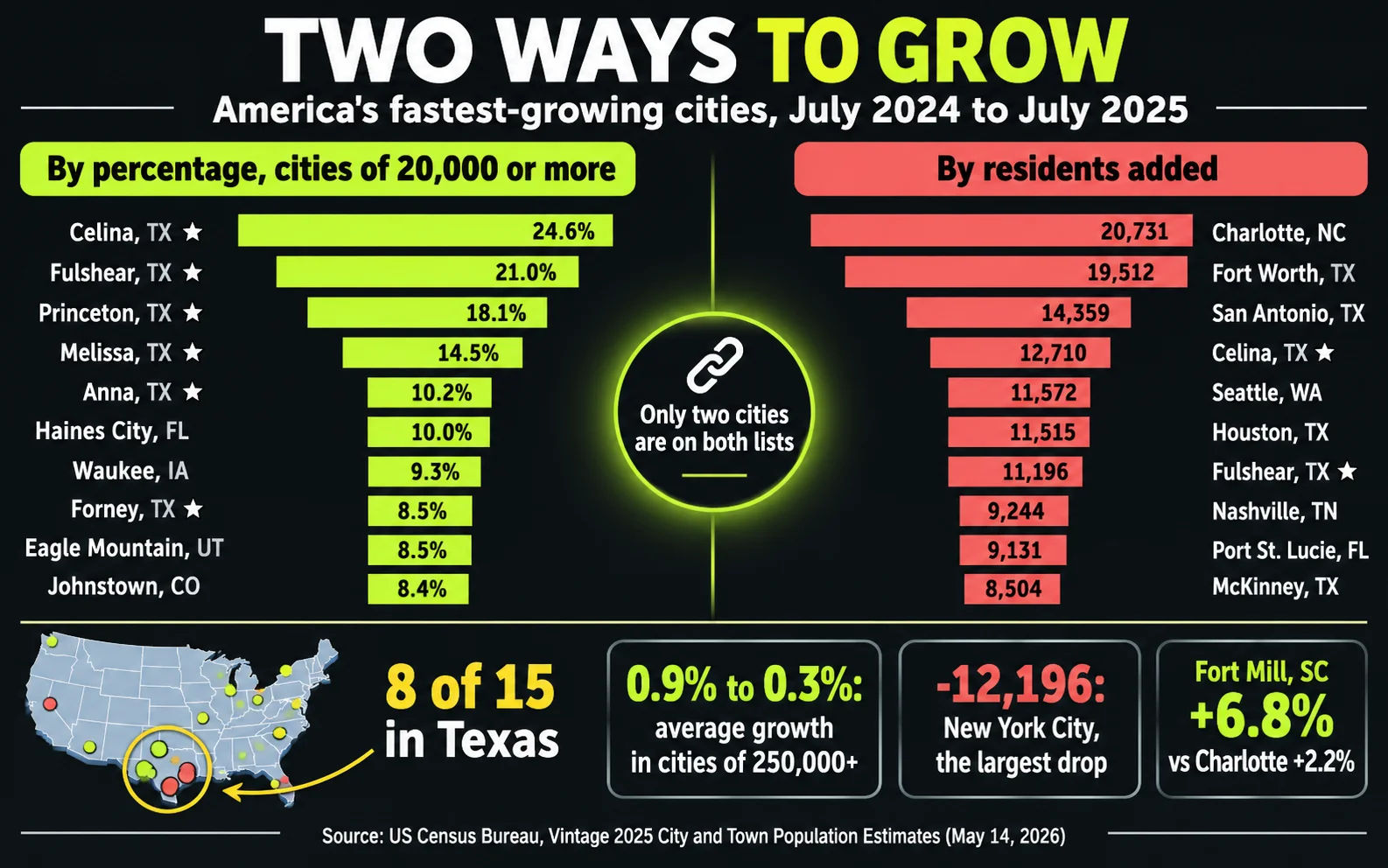
Celina, Texas, grew 24.6% in a single year, from about 51,700 residents to 64,427, and it is not even the biggest numeric gainer on the list. That title belongs to Charlotte, North Carolina, which added 20,731 residents between July 2024 and July 2025, more than any other city in the country. The two measures, percentage growth and raw gains, produce almost entirely different rankings, and the Census Bureau’s Vintage 2025 estimates, released May 14, 2026, show how far apart they have drifted as national growth slowed.
This article separates the lists on purpose. The percentage ranking covers cities and towns with at least 20,000 residents, the Census Bureau’s own threshold, so that tiny places do not dominate. The numeric ranking covers the same group. A third section looks at five-year growth among the 100 largest cities, using the April 2020 estimates base in the same vintage. All of these are estimates, and the Census Bureau advises comparing years only within a single vintage.
Data Snapshot
| Metric | Figure | Period |
|---|---|---|
| Fastest-growing city (20,000 or more) | Celina, TX, +24.6% | 2024 to 2025 |
| Largest numeric gain | Charlotte, NC, +20,731 | 2024 to 2025 |
| Texas cities among the 15 fastest-growing | 8 | 2024 to 2025 |
| Southern cities among the 15 fastest-growing | 10 | 2024 to 2025 |
| Southern cities among the 12 largest numeric gains | 11 | 2024 to 2025 |
| Fastest-growing city among the 100 largest since 2020 | Port St. Lucie, FL, about +29.6% | 2020 to 2025 |
| Average growth, cities of 250,000 or more | +0.3% (down from +0.9%) | 2023-24 vs 2024-25 |
The 15 Fastest-Growing Cities by Percentage
| Rank | City | State | Percent increase | Population, July 2025 |
|---|---|---|---|---|
| 1 | Celina | TX | 24.6% | 64,427 |
| 2 | Fulshear | TX | 21.0% | 64,630 |
| 3 | Princeton | TX | 18.1% | 43,524 |
| 4 | Melissa | TX | 14.5% | 29,969 |
| 5 | Anna | TX | 10.2% | 35,245 |
| 6 | Haines City | FL | 10.0% | 45,973 |
| 7 | Waukee | IA | 9.3% | 34,890 |
| 8 | Forney | TX | 8.5% | 41,658 |
| 9 | Eagle Mountain | UT | 8.5% | 66,557 |
| 10 | Johnstown | CO | 8.4% | 22,433 |
| 11 | Kuna | ID | 8.4% | 31,525 |
| 12 | Queen Creek | AZ | 8.2% | 89,770 |
| 13 | Hutto | TX | 7.9% | 46,048 |
| 14 | Foley | AL | 7.8% | 30,354 |
| 15 | Greenville | TX | 7.5% | 37,069 |
The top five are all in Texas: four in the Dallas-Fort Worth-Arlington suburbs (Celina, Princeton, Melissa and Anna) and one, Fulshear, outside Houston. Texas supplies eight of the 15, and the South as a whole supplies 10, with Haines City in Florida and Foley in Alabama joining them. The other five are Waukee (Iowa), Eagle Mountain (Utah), Johnstown (Colorado), Kuna (Idaho), and Queen Creek (Arizona). Every city on the list has fewer than 90,000 residents. Celina was also the nation’s fastest-growing city in 2023.
The 15 Cities Adding the Most Residents
| Rank | City | State | Residents added | Percent growth | Population, July 2025 |
|---|---|---|---|---|---|
| 1 | Charlotte | NC | 20,731 | 2.2% | 964,784 |
| 2 | Fort Worth | TX | 19,512 | 1.9% | 1,028,117 |
| 3 | San Antonio | TX | 14,359 | 0.9% | 1,548,422 |
| 4 | Celina | TX | 12,710 | 24.6% | 64,427 |
| 5 | Seattle | WA | 11,572 | 1.5% | 784,777 |
| 6 | Houston | TX | 11,515 | 0.5% | 2,397,315 |
| 7 | Fulshear | TX | 11,196 | 21.0% | 64,630 |
| 8 | Nashville-Davidson | TN | 9,244 | 1.3% | 721,074 |
| 9 | Port St. Lucie | FL | 9,131 | 3.5% | 268,062 |
| 10 | McKinney | TX | 8,504 | 3.7% | 236,001 |
| 11 | Atlanta | GA | 8,350 | 1.6% | 529,110 |
| 12 | Jacksonville | FL | 8,319 | 0.8% | 1,017,689 |
| 13 | Surprise | AZ | 7,702 | 4.6% | 175,304 |
| 14 | Columbus | OH | 7,696 | 0.8% | 938,396 |
| 15 | Goodyear | AZ | 7,690 | 6.5% | 125,359 |
Percentages in this table are calculated from the Census figures for residents added and the July 2025 total. Only two places, Celina and Fulshear, appear on both lists. Houston added 11,515 people, nearly as many as Fulshear, yet grew only 0.5%. Eleven of the 12 largest numeric gains were in the South, and Seattle was the only exception. Six of the 15 were in Texas (Fort Worth, San Antonio, Celina, Houston, Fulshear and McKinney).
The Suburban Ring Beats the Center
The Census Bureau pointed to a pattern in its release: even where the largest cities kept growing, smaller cities in the outer parts of the same metro area often outpaced them. Charlotte’s 20,731 gain was the nation’s largest, but among places with 20,000 or more residents it was only the seventh fastest-growing city in its own metro area by percentage. Fort Mill, South Carolina, about 20 miles from downtown, grew 6.8% to 38,673 and ranked 20th nationally. The cities that outranked Charlotte were all mid-sized, between about 25,000 and 70,000 residents.
New York shows the same pattern in reverse. The city lost 12,196 residents, the largest numeric decrease in the country, yet four incorporated places on the outer edge of the New York metro area ranked among the 200 fastest-growing in the nation, led by Port Chester, New York (4.1%, ranked 80th). Census statistician Matt Erickson described a “Goldilocks zone” for midsized cities, where domestic and international migration combined with new housing prevented the slowdown that hit small towns and larger metropolitan centers.
Growth Slowed in Every Size Class
| Size class | Percent change 2023-24 | Percent change 2024-25 |
|---|---|---|
| Largest (250,000 and up) | 0.9% | 0.3% |
| Large (50,000 to 249,999) | 1.0% | 0.5% |
| Medium (5,000 to 49,999) | 1.0% | 0.7% |
| Small (under 5,000) | 0.3% | 0.1% |
Average growth rates fell by at least half in the largest cities in every region. Regionally, the pattern is clear in the South’s lead.
| Region | Largest cities 2024-25 | Large 2024-25 | Medium 2024-25 | Small 2024-25 |
|---|---|---|---|---|
| South | 0.5% | 0.8% | 1.2% | 0.4% |
| West | 0.3% | 0.5% | 0.6% | 0.2% |
| Midwest | 0.2% | 0.4% | 0.5% | 0.0% |
| Northeast | 0.2% | 0.2% | 0.1% | -0.2% |
Medium-sized Southern cities, at 1.2%, were the fastest-growing category anywhere, down from 1.6% a year earlier. Small Northeastern places were the only category to shrink on average.
Five-Year Growth Among the 100 Largest Cities
A single year can mislead. Over the longer span from April 2020 to July 2025, the picture among the 100 largest cities is more stable, and Florida and Texas dominate.
| City | State | Percent change since 2020 base | Residents added | Population, July 2025 |
|---|---|---|---|---|
| Port St. Lucie | FL | +29.6% | 61,274 | 268,062 |
| Cape Coral | FL | +20.9% | 40,822 | 236,264 |
| McKinney | TX | +19.5% | 38,494 | 236,001 |
| Frisco | TX | +16.9% | 34,206 | 236,955 |
| North Las Vegas | NV | +13.6% | 35,489 | 296,653 |
| Fort Worth | TX | +11.3% | 104,464 | 1,028,117 |
| Henderson | NV | +10.9% | 34,800 | 353,289 |
| Miami | FL | +10.6% | 46,917 | 489,812 |
| Charlotte | NC | +10.3% | 89,877 | 964,784 |
| Raleigh | NC | +8.6% | 39,996 | 506,306 |
By raw numbers over the same period, the leaders are San Antonio (+110,112), Fort Worth (+104,464), Houston (+99,020), Charlotte (+89,877) and Jacksonville (+65,809). These calculations use the April 2020 estimates base from Vintage 2025, so they can differ a little from figures computed from the original 2020 Census counts.
What Drives the Growth
The Census Bureau’s own data identify housing as a common factor. The nation’s housing stock rose 1.0% (1.4 million units) to 148.3 million in 2025 even as population growth slowed, and the fastest housing growth was in Idaho (2.1%), Arizona (2.0%), and South Carolina (1.9%). Maricopa County added about 42,000 housing units, more than any other county, followed by Harris County, Texas (28,000).
Migration patterns reinforce that supply story. The 50 counties with 1 million or more residents lost 637,634 people to domestic migration in 2024 to 2025, while counties with 50,000 to 999,999 residents gained 533,766. Net international migration fell nationwide from 8.08 to 3.70 per 1,000 residents, which hit large immigrant gateway cities hardest and left the suburban ring, fed by domestic movers and new subdivisions, relatively stronger. Annexation can also lift a city’s reported population without a matching rise in people moving to an existing footprint, so very fast percentage gains in small places deserve a closer look at boundaries.
Will the Fast Growers Keep Growing?
The 2025 estimates describe a slowdown, not a reversal. The Census Bureau recorded slower growth in cities of every size, and the national population grew only 0.5% (1.78 million) in 2024 to 2025, roughly half of the previous year’s 3.25 million. Percentage rankings for places of 30,000 to 70,000 residents can swing sharply when one subdivision opens, so a single-year list is a snapshot, not a trend. The five-year table, in which several of the same Texas and Florida names recur, is a better indicator of durable momentum.
Conclusion
The two growth rankings tell different stories that fit together. Percentage growth belongs to young suburban cities like Celina and Fulshear, which are small enough that one subdivision moves the needle. Raw gains belong to Charlotte, Fort Worth, and San Antonio, which are big enough to add thousands of residents and still grow under 2%. Across both, the common thread is the South and its suburban rings, and the common risk is a national slowdown that cut average big-city growth by two-thirds in a year.
Frequently Asked Questions
1. What is the fastest-growing city in the United States?
Celina, Texas, which grew 24.6% between July 2024 and July 2025 among cities and towns with 20,000 or more residents.
2. Which US cities are gaining the most residents?
Charlotte (20,731), Fort Worth (19,512), San Antonio (14,359), Celina (12,710) and Seattle (11,572) led the list of numeric gains.
3. Why are cities in Texas and Florida growing so quickly?
Census data show a combination of domestic migration, new housing, and outer-suburb development. Texas places filled eight of the 15 fastest-growing spots, and Florida’s Haines City ranked sixth.
4. What is the difference between population growth and percentage growth?
Population growth is the number of residents added; percentage growth compares that gain with the starting population. Celina’s 12,710 gain was a 24.6% rise, while Houston’s 11,515 gain was 0.5%.
5. Which large American cities are growing fastest?
Among the 100 largest, Port St. Lucie (+29.6% since 2020), Cape Coral (+20.9%), McKinney (+19.5%) and Frisco (+16.9%) lead by percentage, and San Antonio and Fort Worth lead by number.
6. Does migration account for most urban population growth?
Migration is a large component, but the mix varies. Nationally, net international migration fell to 3.70 per 1,000, and large counties lost residents to domestic migration while midsized places gained.
7. Can annexation make a city appear to grow faster?
Yes. If a city absorbs new territory, its reported population can rise without any movement into existing neighborhoods. The Census Bureau’s estimates hold boundaries as of January 1, 2025 for the series, which limits that distortion within the vintage.
8. Are fast-growing cities experiencing housing shortages?
The Census Bureau reports that housing growth continued even as population growth slowed, with a 1.0% rise nationally. Whether that is enough locally is a question for city-level data on rents and permits.
9. Which region has the fastest-growing cities?
The South. It holds 10 of the 15 fastest-growing cities and 11 of the 12 largest numeric gains.
10. Is New York growing or shrinking?
The city lost 12,196 residents between 2024 and 2025, the largest numeric decline in the nation, though several outer-edge places in its metro area grew quickly.
Sources
- U.S. Census Bureau, “Population Growth Holds Steady in Midsized Cities Amid Widespread Slowdown,” press release CB26-80, May 14, 2026. https://www.census.gov/newsroom/press-releases/2026/vintage-2025-city-town-pop-estimates.html
- U.S. Census Bureau, “Slow Growth Impacts Nation’s Largest Counties Hardest,” press release CB26-56, March 26, 2026. https://www.census.gov/newsroom/press-releases/2026/2025-popest-metro-micro-counties.html
- The Facts Institute, “100 Most Populous US Cities” (Census Vintage 2025 compilation used for five-year calculations). https://factsinstitute.com/ranking/most-populous-us-cities/
- Business Stats, “The 25 Largest US Metro Areas in 2025” (national growth context). https://businesstats.com/population-of-metropolitan-areas-in-the-us/