Key Findings
- Generation X numbers about 65 million (19%), roughly 1 million more than Baby Boomers.
- The generation peaked at 65.6 million in 2015, and has been stable or slightly declining since.
- Gen X is 9 million smaller than the Millennial generation (74.1 million).
- The 55-to-59 age group fell 8.9% between 2020 and 2025; the 45-to-49 group grew 1.2%.
- The 45-to-64 population shrank 3.2% nationally and grew only in the South (+0.1%).
- The first Gen Xers turn 65 in 2030 and the last in 2045.
- The old-age dependency ratio rose from 27.5 to 31.5 between 2020 and 2025.
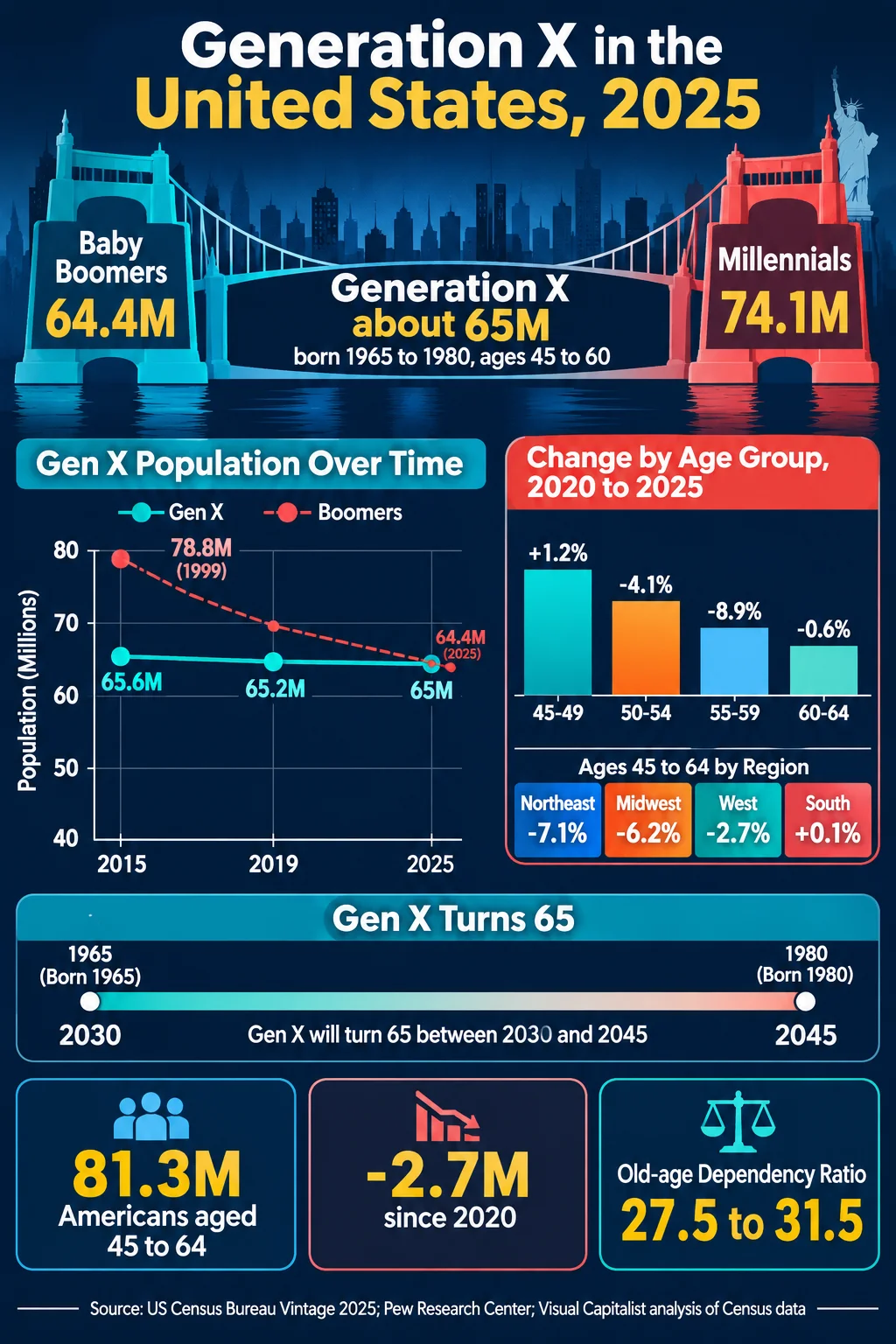
Generation X peaked at 65.6 million people in 2015 and has barely moved since, which is why it surprised demographers by drawing level with, and then edging past, a baby boom cohort that once outnumbered it by more than 13 million. In a Census Bureau-based tally for 2025, the generation born from 1965 through 1980 counts about 65 million (19% of the country) against 64.4 million Baby Boomers. The first Gen Xers turn 65 in 2030, and the last do so in 2045, so the generation will anchor the nation’s prime working ages through most of the next decade and then enter retirement in a very different economy.
Pew Research Center defines Generation X as people born from 1965 to 1980, which makes them 45 to 60 years old in 2025. The generation size here is derived from the analysis of Census Bureau data, in which the published figures for the other generations sum to 340.1 million, the Census Bureau’s July 2024 total. Gen X is the remainder after subtracting the five other groups, and the published rounded value is 65 million. It therefore includes a few thousand people older than 97, and should be read as approximate. Age-group data come from the Census Bureau’s Vintage 2025 estimates.
Data Snapshot
| Metric | Figure | Reference |
|---|---|---|
| Generation X population | about 65 million (19%) | 2025 ages, Census-based |
| Birth years | 1965 to 1980 | Pew Research Center |
| Ages in 2025 | 45 to 60 | |
| Peak population | 65.6 million | 2015, Census/Pew |
| US population aged 45 to 64 | 81,324,500 | July 1, 2025 |
| Change in that group since 2020 | -2,680,080 (-3.2%) | April 2020 to July 2025 |
| First and last Gen Xers turn 65 | 2030 and 2045 |
Gen X Compared With Its Neighbors
| Generation | Birth years | Population, 2025 ages | Share |
|---|---|---|---|
| Baby Boomers | 1946 to 1964 | 64,448,248 | 19% |
| Generation X | 1965 to 1980 | about 65.4 million | 19% |
| Millennials | 1981 to 1996 | 74,104,186 | 22% |
Generation X sits between two larger cohorts for most of its history. Pew counted 65.2 million Gen Xers in 2019, fewer than either Boomers or Millennials, and the Library of Congress still describes the generation as the smallest because of lower birth rates in the late 1960s and 1970s.
By 2025, the Boomers had shrunk enough that Gen X is no longer the smallest of the three. Pew’s 2020 projection had Gen X passing the Boomers around 2028 (63.9 million to 62.9 million), a date the newer Census-based numbers have already reached. The Millennial generation, at 74.1 million, is about 8.7 million larger than Gen X, in part because immigration has added young adults to it.
What the Age Groups Show
The Census Bureau does not publish a Generation X count directly, but the five-year age groups that contain the generation show its path.
| Age group | April 2020 | July 2025 | Change | Percent | Men per 100 women, 2025 |
|---|---|---|---|---|---|
| 45 to 49 | 20,113,531 | 20,356,102 | +242,571 | +1.2% | 96.8 |
| 50 to 54 | 20,615,157 | 19,778,682 | -836,475 | -4.1% | 95.8 |
| 55 to 59 | 22,074,569 | 20,112,899 | -1,961,670 | -8.9% | 94.6 |
| 60 to 64 | 21,201,323 | 21,076,817 | -124,506 | -0.6% | 92.2 |
The 45-to-49 group is the only one that grew. The other three lost more people to aging out and deaths than they gained from the age group below and from migration. The 55-to-59 group is down 8.9% in five years, the steepest fall of any five-year group in the adult population, because the 2020 version of that group held the large cohorts born in the early 1960s, who have since moved into their sixties.
The 45-to-64 Squeeze
The Census Bureau’s age group of 45 to 64 covers Gen X plus the youngest Boomers. It was the only age group with population declines in three of four regions between 2020 and 2025.
| Region | 45 to 64, April 2020 | 45 to 64, July 2025 | Percent change |
|---|---|---|---|
| Northeast | 15,260,232 | 14,175,891 | -7.1% |
| Midwest | 17,609,204 | 16,518,175 | -6.2% |
| South | 31,949,427 | 31,968,176 | +0.1% |
| West | 19,185,717 | 18,662,258 | -2.7% |
| United States | 84,004,580 | 81,324,500 | -3.2% |
The South was the only region where the 45-to-64 population grew, by 0.1% or about 19,000 people. In micropolitan counties, the decline was steeper: -10.3% in the Northeast, -8.2% in the Midwest, -5.8% in the West, and -4.7% in the South. Census demographer Lauren Bowers described the South’s pattern as the result of strong migration in this decade. The age group is shrinking because it is being replaced from below by the smaller cohorts of the 1980s and early 1990s and drained from above by retirement and mortality.
What Gen X Is, and Is Not
Generation labels are a way to group birth cohorts, not a demographic law. Researchers distinguish age effects (things that happen to people at a given age), period effects (events that affect everyone at once) and cohort effects (differences tied to birth years), and generation boundaries are conventions. A person born in 1980 and one born in 1981 are separated by a line that Pew drew for analytical convenience. For that reason, this article restricts itself to counts, ages, and measurable group sizes, and avoids claims about generational character.
One measurable difference is economic. Federal Reserve data cited by Visual Capitalist in 2020 showed Generation X holding $28.6 trillion in 2019, or about $440,000 per person, compared with $59.4 trillion for Baby Boomers ($834,270 per person) and $5.0 trillion for Millennials ($68,871 per person). Those are 2019 figures, older than the population estimates above, and wealth per person rises with age, so the comparison partly reflects where each cohort was in the life cycle.
When Gen X Reaches Retirement Age
The first Gen Xers, born in 1965, turn 65 in 2030, and the last, born in 1980, turn 65 in 2045. The Congressional Budget Office projects that the number of people 65 or older will grow faster than younger age groups through its projection period, with the oldest-age population growing 1.6% a year on average through 2036.
The Census Bureau’s 2023 projections put the 65-and-older population at 82 million in 2050, a 42% increase from 2022, with the group’s share of the population rising from 17% to 23%. Gen X will account for a growing share of that increase in the 2030s and 2040s, though Millennials will become the largest cohort entering the group after 2045.
A smaller pool of younger workers will follow it. The Census Bureau’s July 2026 short-term projection has the 25-to-44 group growing 0.6% and the 45-to-64 group shrinking 0.6%, with the 18-to-64 population falling by 231,913. The national old-age dependency ratio, which counts people 65 and older for every 100 aged 18 to 64, rose from 27.5 in 2020 to 31.5 in 2025 and is projected at 32.4 in 2026. The number of people supporting each retiree will keep falling as Gen X moves up.
Conclusion
Generation X is the generation whose size is the most stable, which makes its aging unusually easy to track: about 65 million people, slightly more than the Boomers, entering retirement age between 2030 and 2045. The squeeze visible in the 45-to-64 age group, down 2.7 million since 2020 and falling in three of four regions, is the preview of a narrower working-age population that Millennials and Generation Z will inherit.
Frequently Asked Questions
1. How many people are in Generation X in the United States?
About 65 million in 2025, or 19% of the population, based on a Census Bureau-derived tally. The generation peaked at 65.6 million in 2015.
2. What birth years define Generation X?
1965 to 1980, according to the Pew Research Center.
3. How old is Generation X in 2025?
45 to 60 years old. In 2026, they are 46 to 61.
4. Is Generation X bigger than the Baby Boomers?
Based on 2025 data, slightly. Gen X counts about 65 million against 64.4 million Boomers. Earlier tallies had Boomers larger, and Pew’s 2020 projection placed the crossover at 2028.
5. Is Generation X the smallest generation?
It was long described as the smallest of the three large generations because of lower birth rates. In 2025, it is larger than the Baby Boom and smaller only than Millennials (74.1 million) and Generation Z (71.1 million). The Silent Generation (13.7 million) and Generation Alpha (51.2 million) are smaller.
6. When do the first Gen Xers turn 65?
In 2030, when those born in 1965 reach 65.
7. Is the population aged 45 to 64 growing?
Not nationally. It fell 3.2% (by 2.68 million) between April 2020 and July 2025. Only the South grew, by 0.1%.
8. Why did Generation X stop growing?
Its population peaked in 2015 because the generation is fully born, and from then on mortality outweighs the net immigration of Gen X adults.
9. How much wealth does Generation X hold?
Federal Reserve data from 2019, cited by Visual Capitalist, put it at $28.6 trillion, about $440,000 per person. This is an older figure than the population data used elsewhere here.
10. How many people in their late 40s are there compared with those in their late 50s?
In July 2025, the 45-to-49 group had 20,356,102 people and the 55-to-59 group had 20,112,899, a difference of only 243,203.
Recommended Articles in the USA Population Series:
- USA Baby Boomer Population Falls to 64.4 Million, Down 14 Million From Its Peak
- Working-Age Population in the US Stands at 205 Million, but Its Share Has Fallen
- Number of Children Under 18 in America Falls to 72 Million as the South Gains
- US Aging Population Statistics: 64.6 Million Seniors, 7 Million Over 85, 119,100 Centenarians
- USA States With the Oldest Populations: Maine Has 142 Seniors for Every 100 Children
- How Will America’s Age Structure Change by 2050? Key Shifts to Watch
- US Population Pyramid Is Turning Into a Column With a Heavy Middle
- US States With the Youngest Populations: Utah Has Twice as Many Children as Seniors
- US Population Over 65 by State Ranges From 24.6% in Maine to 13.0% in Utah
- Generation Alpha Population in America Reaches 51 Million
- Generation Z Population in the USA Reaches 71 Million, With Nearly 2 Million More Boys
- Millennial Population in America Tops 74 Million and Dominates the Middle of the Age Pyramid
- Median Age in the United States Reaches 39.4, With Maine 12.3 Years Older Than Utah
- Largest Cities in America by Population: The 25 Biggest Urban Centers
- Most Densely Populated Cities in America: A Tiny Jersey Town Outranks New York
- US Metropolitan Population Projections for 2050: Where Growth Will Be Concentrated
- Fastest-Growing Metropolitan Areas in the USA Are Concentrated in Smaller Southeast Metros
- How America’s Biggest Cities Changed Places Between 1900 and 2027
- Cities Losing Population in the USA: New York Falls by 166,000 as St. Louis Drops 7.4%
- Largest Urban Areas in the United States: The Metro Regions With the Most Residents
- Largest Metropolitan Areas in the USA: Where 86% of Americans Live
- Fastest-Growing Cities in the US Are Texas Suburbs, While Charlotte Leads in New Residents
- Top 25 Most Populated Cities in the USA in 2027: America’s Biggest Urban Centers
Sources
- U.S. Census Bureau, “Populations in All Age Groups Growing in the South,” press release CB26-105 (Vintage 2025), June 25, 2026.
- Business Stats, “How Many Adults Live in the US” (five-year age groups by sex, dependency ratios).
- Pew Research Center, “Millennials overtake Baby Boomers as America’s largest generation,” 2020.
- Library of Congress, “Generations” research guide.
- Congressional Budget Office, “The Demographic Outlook 2026 to 2056,” January 2026.
- Population Reference Bureau, “Fact Sheet Aging in the United States.”