Australia’s population reached 27,801,023 people at 31 December 2025, spread across a land area of roughly 7.68 million square kilometers, the sixth-largest country in the world by territory. Divide one by the other and Australia’s national population density comes out to just 3.6 people per square kilometer, one of the lowest averages of any populous nation on Earth. That single number, however, badly misrepresents how Australians actually live: the overwhelming majority are packed into a narrow band of coastal and near-coastal cities, while vast stretches of the continent’s interior remain functionally empty.
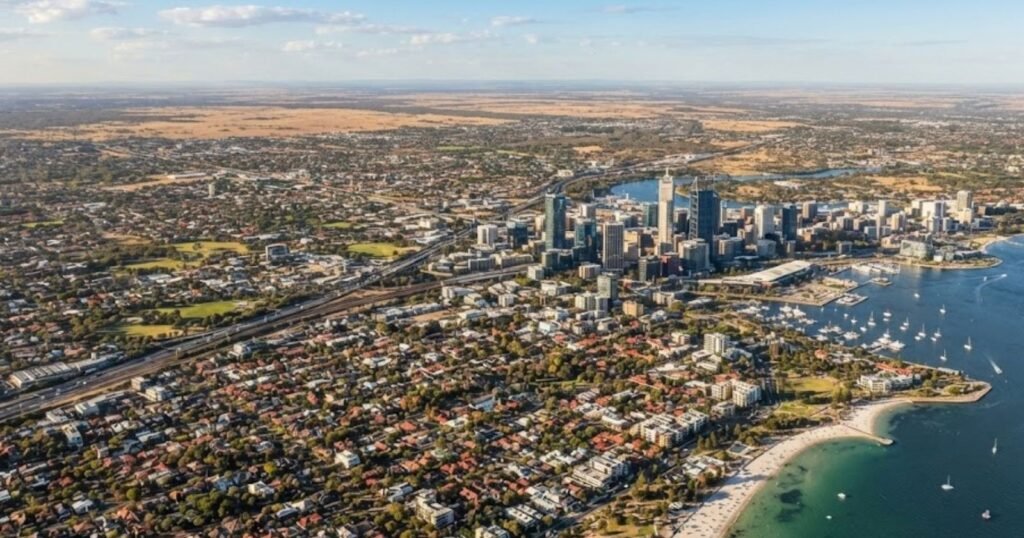
Roughly 80% of Australians live within 25 kilometers of the coast, and historical Australian Bureau of Statistics data found 85% lived within 50 kilometers as far back as 2001, a settlement pattern shaped by climate, water availability, colonial history, and the simple economics of where ports, jobs, and infrastructure ended up being built. This article works through why that pattern formed, how it varies by state, and where Australia’s population is now growing fastest.
Australia’s Population Distribution at a Glance
| Metric | Figure | Year |
|---|---|---|
| Total population | 27,801,023 | 31 December 2025 |
| National population density | 3.6 people per km² | June 2025 |
| Share living within 25km of the coast | approximately 80% | recent estimate |
| Share living within 50km of the coast | 85% | 2001 census |
| Share in urban areas (population 1,000+) | 87% | 2001 census |
| Most populous state | New South Wales, approximately 8.5 to 8.64 million (about 31% of national population) | 2025 |
| Fastest-growing state/territory | Western Australia, 2.2% annual growth | 2025 |
| Slowest-growing state/territory | Tasmania, 0.2% to 0.5% annual growth | 2025 |
| Northern Territory population density | approximately 0.18 people per km² | recent estimate |
Sources: Australian Bureau of Statistics, National, State and Territory Population releases, Centre for Population 2025 Population Statement, Bureau of Infrastructure, Transport and Regional Economics.
Australia’s population density has been rising steadily even as its settlement pattern has stayed remarkably consistent: national average density climbed from roughly 2.5 people per square kilometer in 2001 to 3.6 by mid-2025, with virtually all of that added density landing in the same coastal metropolitan regions that have dominated Australian settlement since colonization.
Track Real-time Australia Population Growth @ AUSTRALIA POPULATION CLOCK
Where Australia’s Population Is Concentrated
Australia’s population centers overwhelmingly around a handful of coastal capital cities: Sydney and Melbourne in the southeast, Brisbane and South East Queensland along the eastern coast, Perth in the far west, and Adelaide in the south. New South Wales alone holds an estimated 8.5 to 8.64 million residents, close to a third of Australia’s entire population, anchored by Sydney. Victoria, centered on Melbourne, and Queensland, centered on Brisbane and the rapidly growing South East Queensland corridor, rank as the second and third most populous states.
ABS regional population data for the 2024-25 financial year specifically tracked Australia’s calculated center of population moving 1.5 kilometers to the south-east over the year, a shift the ABS attributed directly to strong population growth in South East Queensland, illustrating in concrete geographic terms how continuing to add population to already-dense eastern coastal corridors is physically pulling the country’s demographic center of gravity toward Queensland.
Why the Interior Is Sparsely Populated
The Northern Territory, dominated by vast arid and semi-arid interior terrain, records a population density of only about 0.18 people per square kilometer, among the lowest population densities recorded for any inhabited region in the world. This is not an isolated anomaly: enormous stretches of Western Australia, South Australia, and inland New South Wales and Queensland share similarly sparse settlement, reflecting a continent where the vast majority of the interior lacks the reliable rainfall and surface water needed to support significant permanent population without major infrastructure investment.
Superprof’s compilation of Bureau of Infrastructure, Transport and Regional Economics research explains the core mechanism plainly: inland Australia is sparsely populated because much of it is arid or semi-arid, with low rainfall, limited water sources, and long distances between settlements, while coastal regions benefit from milder climates, better access to water, stronger transport links, and concentrated job opportunities that have reinforced each other since European settlement began.
Climate and Physical Geography
Australia’s interior includes some of the driest inhabited terrain on Earth, with much of the continent’s center classified as desert or semi-desert. Reliable rainfall is concentrated overwhelmingly along the eastern and southeastern coastal fringe and in a smaller pocket in the southwest around Perth, precisely the regions that now hold the large majority of Australia’s population. This is not a coincidence: agriculture, and later industrial and service-sector economic activity, developed where water was reliably available, and population settlement followed that same logic outward from the earliest colonial ports.
Coastal proximity also moderates temperature extremes relative to the continental interior, where summer heat can be substantially more severe, another practical factor that has reinforced the historical preference for coastal settlement documented in ABS data stretching back over a century.
Australia’s Major Urban Corridors
Australia’s population growth today is concentrated in a small number of well-defined urban corridors rather than spread evenly across the coastline. South East Queensland, stretching from the Gold Coast through Brisbane to the Sunshine Coast, has emerged as one of the fastest-growing regions in the country, a trend significant enough to measurably shift the ABS’s calculated national population center.
Greater Perth added an estimated 58,100 people in the 2024-25 financial year alone, a 2.4% increase, with net overseas migration of 37,300 people the largest single contributor, according to ABS regional population data. Greater Adelaide grew more modestly, adding 18,600 people, a 1.3% increase, with growth concentrated heavily in the city’s outer northern suburbs.
These corridors share a common structure: strong net overseas migration driving growth in established metropolitan areas, supplemented by more localized internal migration toward outer-suburban growth areas where new housing supply has been easiest to build.
State and Territory Differences
Population growth across Australia’s states and territories in 2025 followed a clear pattern: Western Australia, Victoria, and Queensland recorded the fastest growth, driven substantially by net overseas migration, at rates of 2.2%, 1.8%, and 1.8% respectively according to Centre for Population data.
New South Wales, South Australia, the Northern Territory, and the Australian Capital Territory grew more slowly than the national average, with New South Wales specifically constrained by the largest net interstate migration loss of any state, as residents relocated toward Queensland and Western Australia in search of more affordable housing and different lifestyle options. Tasmania recorded the slowest growth of any state or territory, at just 0.2% to 0.5% depending on the specific period measured.
This pattern reflects a broader trend of population redistribution within Australia’s existing coastal settlement footprint rather than any meaningful shift toward the interior: growth is moving between established coastal states and cities based on relative housing costs, job markets, and climate preferences, not away from the coast altogether.
Capital Cities Versus Regional Australia
ABS population data highlights a consistent demographic distinction between Australia’s capital cities and the rest of each state: capital city populations tend to be younger, with a median age of 37.0 years nationally compared with 42.1 years in the rest of the country, and capital cities disproportionately absorb net overseas migration, since new arrivals typically settle first in major metropolitan job markets before some later relocate to regional areas.
Darwin recorded the youngest capital city median age, at 34.7 years, while Hobart recorded the oldest, at 39.7 years, reflecting each city’s distinct migration and demographic profile. Darwin and Perth were also notable as the only two Australian capital cities with more males than females, a pattern tied to their historical role as centers for resource-sector and defense-related employment that has traditionally skewed male.
How Population Geography Is Changing
Australia’s population growth remains overwhelmingly driven by net overseas migration rather than natural increase from births, with migration contributing roughly three times as much to national population growth as the excess of births over deaths in the year to December 2025. Because migration flows have historically concentrated in established coastal capital cities, this migration-driven growth pattern has reinforced rather than diminished Australia’s long-standing coastal settlement concentration, even as individual growth corridors shift between cities and states over time.
Long-range ABS projections, assuming population growth continues at a broadly similar pace, suggest Australia could approach 30 million people by the early 2030s, with national average density rising toward roughly 4.3 to 4.5 people per square kilometer under baseline scenarios, growth that current planning and infrastructure patterns indicate would continue to concentrate overwhelmingly in the same established coastal urban regions rather than spreading meaningfully into the sparsely populated interior.
Will Australia’s Population Become More Geographically Distributed?
Despite periodic policy discussion about decentralization and regional population growth incentives, the structural forces that have concentrated Australian settlement along the coast for over two centuries, water availability, climate, port-based trade infrastructure, and concentrated employment, remain firmly in place. Regional and outer-suburban growth corridors, such as those recorded in Perth’s outer south and Adelaide’s outer north, represent expansion at the edges of existing metropolitan areas rather than genuine movement toward Australia’s interior.
Barring a substantial and sustained shift in national infrastructure and economic policy specifically designed to redirect population toward inland or northern Australia, the country’s settlement pattern is likely to remain what it has been since the earliest colonial period: a continent-sized landmass whose population lives overwhelmingly within sight, or a short drive, of the sea.
Key Findings
- Australia’s population reached 27,801,023 at 31 December 2025, but national average density of 3.6 people per square kilometer conceals a settlement pattern where roughly 80% of the population lives within 25 kilometers of the coast.
- The Northern Territory’s interior records a population density of just 0.18 people per square kilometer, among the lowest for any inhabited region in the world.
- New South Wales holds close to a third of Australia’s national population, with Sydney as its anchor, though the state has recorded the largest net interstate migration losses as residents move toward Queensland and Western Australia.
- South East Queensland’s rapid growth has measurably shifted the ABS’s calculated national population center 1.5 kilometers to the southeast in the 2024-25 financial year alone.
- Western Australia was Australia’s fastest-growing state or territory in 2025, at 2.2% annual growth, driven substantially by net overseas migration into Greater Perth.
- Capital cities have a notably younger median age, 37.0 years, than the rest of the country, at 42.1 years, reflecting the concentration of overseas migration in major metropolitan job markets.
- Population growth remains overwhelmingly migration-driven, reinforcing rather than diminishing Australia’s long-standing concentration of population along the coast.
Recommended Articles Related to Australia Population & Policy:
- Australia Immigration Demographics: How Migration Is Shaping the Population Future
- Only 1 in 3 New Zealand-Born Residents Are Australian Citizens
- More Boys Are Born, But Australia Ends Up Mostly Female
- Australia Just Crossed a Line It Can Never Uncross: More Seniors Than Children
- From Age 55 to Age 81: How Australians Bought Themselves an Extra Generation of Life
- Australia Population by Religion: How a Once-Christian Nation Became One of the World’s Most Secular
- Australia Population by Ancestry: The Cultural Backgrounds Shaping Modern Australia
- Australia Population Growth Rate: Historical Trends, Migration, Natural Increase and Future Growth
- One Country, Two Realities: Inside Australia’s Empty Interior and Packed Coastline
- Australia Population 2026 by State and Territory: Historical Trends and Future Growth
- After 150 Years, England Is No Longer Australia’s Top Birthplace: India Just Took Over
Frequently Asked Questions
1. Why does most of Australia’s population live near the coast?
Coastal Australia offers more reliable rainfall, milder climate, established port-based transport infrastructure, and concentrated employment opportunities that have reinforced each other since colonial settlement, while much of the interior is arid or semi-arid with limited water access.
2. Where does most of Australia’s population live?
The large majority of Australians live in a handful of coastal capital cities and their surrounding metropolitan areas, led by Sydney in New South Wales, followed by Melbourne, Brisbane and South East Queensland, Perth, and Adelaide.
3. Why is inland Australia so sparsely populated?
Much of inland Australia is arid or semi-arid, with low and unreliable rainfall, limited surface water, and long distances between settlements, conditions that have never supported the kind of dense, permanent population found in coastal regions.
4. Which Australian states are growing fastest?
Western Australia recorded the fastest population growth in 2025, at 2.2% annually, followed by Victoria and Queensland at 1.8% each, with growth in all three driven substantially by net overseas migration.
5. What is Australia’s population density?
Australia’s national average population density was 3.6 people per square kilometer as of mid-2025, one of the lowest national averages in the world, though this figure conceals extreme concentration along the coast and near emptiness across much of the interior.
6. How many Australians live near the coast?
Approximately 80% of Australians live within 25 kilometers of the coast today, with historical 2001 census data finding 85% lived within 50 kilometers, a settlement pattern that has remained remarkably stable over recent decades.
7. Is New South Wales still Australia’s most populous state?
Yes. New South Wales holds an estimated 8.5 to 8.64 million residents, close to a third of Australia’s national population, though its growth rate has trailed the national average due to significant net interstate migration losses.
8. What is the population density of the Northern Territory?
The Northern Territory records a population density of approximately 0.18 people per square kilometer, among the lowest for any inhabited region in the world, reflecting its vast, sparsely settled arid interior.
9. Is Australia’s population still growing quickly?
Yes. Australia’s population grew by 412,500 people, or 1.5%, in the year to December 2025, with the large majority of that growth driven by net overseas migration rather than natural increase from births.
10. Will Australia’s population ever spread more evenly across the country?
Current trends show no significant shift toward Australia’s interior. Growth continues to concentrate in established coastal metropolitan regions and their immediate outer-suburban growth corridors, reinforced by the same water, climate, and infrastructure factors that have shaped Australian settlement since colonization.
Sources
- Australian Bureau of Statistics, National, State and Territory Population, December 2025
- Australian Bureau of Statistics, Regional Population, 2024-25 financial year
- Australian Bureau of Statistics, Population overview
- Centre for Population, 2025 Population Statement, State and Territory Snapshots
- Bureau of Infrastructure, Transport and Regional Economics, An Introduction to Where Australians Live; The Evolution of Australia’s Towns