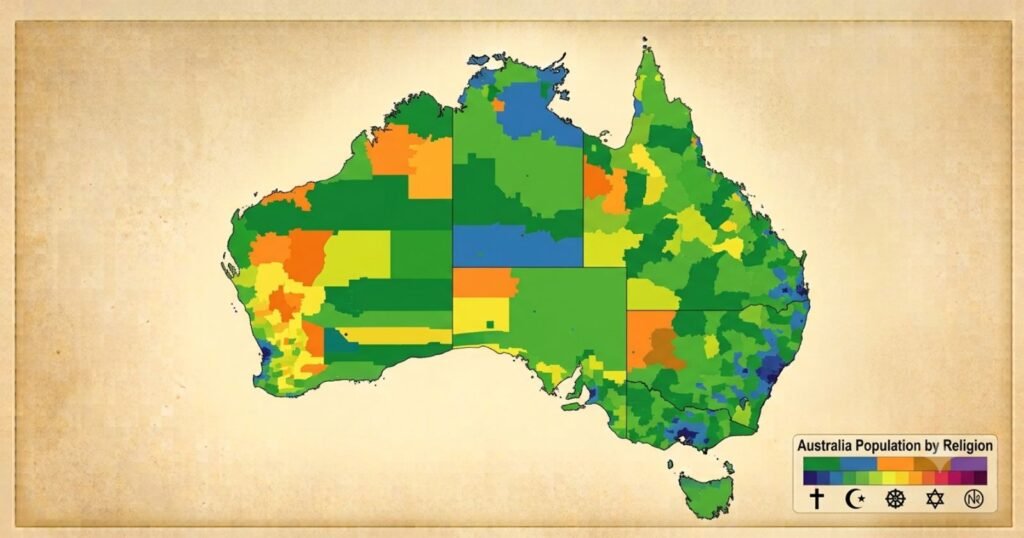
Australia’s religious makeup has flipped in a single generation. Christianity was the affiliation of roughly nine in ten Australians until the mid-1960s. Today it sits under 44%, and “no religion” has grown into the single largest response category in the national Census. This is not a slow drift; it is one of the fastest recorded religious transitions among wealthy nations, and the 2021 Census captured it in stark numbers.
Australia’s Religious Landscape at a Glance
Based on the 2021 Census of Population and Housing, conducted by the Australian Bureau of Statistics (ABS) on a population of roughly 25.4 million:
| Affiliation | Population (approx.) | Share of Population |
|---|---|---|
| Christianity (all denominations) | 11.15 million | 43.9% |
| No religion | 9.89 million | 38.9% |
| Islam | 813,392 | 3.2% |
| Hinduism | 684,002 | 2.7% |
| Buddhism | 610,000 | 2.4% |
| Sikhism | 210,000 | 0.8% |
| Judaism | 100,000 (approx.) | 0.4% |
| Other religions | 230,000 (approx.) | 0.9% |
| Not stated / inadequately described | 1.83 million | 7.2% |
Key numbers worth sitting with:
- Christianity fell below 50% of the population for the first time in the nation’s history in 2021.
- “No religion” grew by nearly three million people between 2016 and 2021, a 40% jump in five years.
- Hinduism and Islam were the fastest-growing major religions by percentage point change, driven largely by migration.
- The response rate to the religion question actually rose, from 90.9% in 2016 to 93.1% in 2021, so the shift toward secularism is not an artifact of more people skipping the question.
How Australia Measures Religion
The Census religion question has appeared in every one of Australia’s national Censuses since 1911, making it one of the longest continuously tracked social indicators in the country. A few technical points matter for reading the data correctly:
- The question is self-identified and, unlike most Census questions, entirely voluntary.
- It measures affiliation, not practice. Someone who ticks “Catholic” may never attend Mass, and someone who ticks “no religion” may still hold spiritual beliefs.
- “No religion” has been an explicit option since 1971. In 2016 the ABS moved it to the top of the list of tick-box answers, a change researchers say likely nudged some additional respondents toward selecting it.
- Multiple or write-in responses are possible, and answers researchers describe as vague, such as simply writing “Christian” without a denomination, are coded as “not further defined.”
- Roughly 7% of the population either left the question blank or gave an answer too unclear to classify in 2021, down slightly from prior Censuses.
Because affiliation and practice are different things, a person coded as Christian or Muslim in these statistics should not be assumed to be actively religious, and a person coded as having no religion should not be assumed to reject spirituality altogether. Research bodies such as NCLS Research have argued the “no religion” category captures a wide range of people, from committed atheists to those who are simply indifferent to organised religion.
Australia’s Religious Population Over the Last Century
| Period | Approximate Christian Share | Notable Development |
|---|---|---|
| Early Federation (1911) | ~96% | Religion question added to first national Census |
| Post-war Australia (1950s) | ~88% | Mass European migration diversifies Christian denominations |
| Until 1966 | ~90% | Christianity remains the default affiliation of most Australians |
| 1971 | Decline begins to register | “No religion” introduced as a tick-box option |
| 2006 | ~64% | No religion at 18.7%; Islam and Hinduism still under 2% each |
| 2011 | 61.1% | No religion climbs to 22.3% |
| 2016 | 52.1% | No religion jumps to 30.1%; option moved to top of form |
| 2021 | 43.9% | Christianity falls under 50% for the first time; no religion at 38.9% |
| 2026 (upcoming Census) | Expected further decline | ABS retained the same question format despite calls for redesign |
The turning point most demographers point to is 1966, when Christian affiliation began a decline that has not reversed in nearly six decades. What changed was not a single event but a combination of secularization common across Western societies, declining church attendance among Australian-born generations, and a migration program that, from the late twentieth century onward, began drawing more heavily from countries with non-Christian religious majorities.
Christianity in Australia
Even in decline, Christianity remains Australia’s largest religious category by a wide margin over any single alternative. The 2021 breakdown:
- Catholic – 20.0% of the population, the single largest denomination, though down from 22.6% in 2016.
- Anglican – 9.8%, continuing a long slide from 13.3% in 2016 and a far larger historical share in the early twentieth century.
- Uniting Church and Other Christian groupings – collectively around 14%, a category that includes Pentecostal, Baptist, Lutheran, and non-denominational congregations.
- Eastern Orthodox – 2.1%, concentrated among Greek, Serbian, Macedonian, and other communities with strong migration links to Australia.
One counterintuitive detail: the number of people writing in simply “Christian” without specifying a denomination grew by 12% between 2016 and 2021, faster than population growth of 9% over the same period. Analysts at the Christian Research Association read this as evidence that denominational identity itself, not just religious affiliation broadly, is weakening even among people who still consider themselves Christian.
Catholic numbers have been partly cushioned by immigration. Migrants from the Philippines, India, and parts of Latin America and Africa are disproportionately Catholic, offsetting some of the decline among Australian-born Catholics.
The Rise of “No Religion”
This is the defining trend of Australian religious demography and deserves to be treated as the headline story rather than a side note.
Historical growth:
- 2006: 18.7%
- 2011: 22.3%
- 2016: 30.1% (an increase of 2.24 million people in five years)
- 2021: 38.9% (an increase of nearly 3 million people, a 40% jump)
Age patterns. Younger Australians report no religion at far higher rates than older cohorts. Adults aged 18 to 34 were markedly more likely to select no religion than the population overall, while Australians aged 65 and over remain the most likely age group to identify as Christian. This generational gradient is the single strongest predictor of where the national numbers are headed.
State differences. Secularization is not evenly spread:
| State/Territory | Share Reporting No Religion (2021) | Notes |
|---|---|---|
| Tasmania | 50.0% | Highest in the nation; up 12.6 percentage points since 2016 |
| Australian Capital Territory | 43.2% | Up 11.1 percentage points since 2016 |
| Queensland | ~39.5% | Among the fastest-growing “no religion” states |
| Victoria | ~39.1% to 39.7% | Largest absolute number of non-religious residents, roughly 2.6 million |
| New South Wales | 33.2% | Lowest in the country, linked to higher recent migration |
“In 2021, Tasmania had the highest proportion with half of the population reporting to have no religion… The lowest was NSW with almost one-third of the population.”
The pattern is consistent with what demographers would expect: states with older, more Australian-born, less recently-migrated populations (Tasmania, the ACT) skew more secular, while states receiving large numbers of overseas-born migrants (NSW, Victoria) retain higher rates of religious affiliation, simply because many recent migrants come from more religious societies.
Islam in Australia
Islam grew to 813,392 people in 2021, or 3.2% of the population, up 69% in some jurisdictions’ local figures and roughly 33% nationally since 2016. Key characteristics:
- Muslim Australians skew notably younger than the national average, reflecting both recent migration patterns and higher fertility among some immigrant communities.
- Geographic concentration is heaviest in and around Sydney and Melbourne, particularly in southwestern Sydney and Melbourne’s northern and western suburbs.
- Migration from South Asia (Pakistan, Bangladesh, Afghanistan) and the Middle East continues to be the primary driver of growth, alongside humanitarian intakes.
- Second-generation Australian-born Muslims are a growing share of the community, meaning future growth will increasingly come from births within Australia rather than migration alone.
Hinduism, Buddhism and Other Growing Faiths
Hinduism was the fastest-growing major religion by percentage change between 2016 and 2021, rising 55.3% to 684,002 people (2.7%). This is overwhelmingly a migration-driven story, tied closely to the sharp rise in Indian-born residents over the past decade.
Buddhism reached roughly 610,000 people (2.4%), a smaller percentage gain than Hinduism or Islam over the same period but still historically significant. Buddhism’s growth was fastest in the late 1990s, when it rose 79% between the 1996 and 2001 Censuses on the back of Vietnamese and other Southeast Asian migration.
Sikhism grew to around 0.8% of the population, up from 0.5% in 2016, with strong ties to Punjabi migration and a visible community presence in outer suburban Melbourne and Sydney.
Judaism has remained comparatively stable at around 0.4% of the population, with an established community history in Australia stretching back to the First Fleet.
Other faiths worth noting for sheer rate of change: the Yezidi population rose from 63 people in 2016 to 4,123 in 2021, a 6,444% increase tied directly to a targeted humanitarian resettlement program for Yezidi families fleeing persecution in Iraq and Syria.
Religion by State and Territory
| State/Territory | Largest Group | No Religion Share | Distinctive Feature |
|---|---|---|---|
| New South Wales | Christian (47.6%) | 33.2% (lowest) | Highest non-Christian diversity, 10.1% |
| Victoria | Catholic (20.3%) | ~39.1% | Largest absolute non-religious population |
| Queensland | Christian majority | ~39.5% | Fast-growing no-religion share since 2016 |
| Western Australia | Christian majority | Near national average | High overseas-born share shapes diversity |
| South Australia | Christian majority | Near national average | Older population structure |
| Tasmania | No religion | 50.0% (highest) | Most secular jurisdiction in Australia |
| Australian Capital Territory | No religion | 43.2% | Highly educated, younger workforce population |
| Northern Territory | Mixed, incl. Aboriginal traditional beliefs | Distinct pattern | Significant Aboriginal and Torres Strait Islander religious identity |
Western Australia, South Australia and the Northern Territory have less granular public breakdowns than the states above, but ABS TableBuilder data place WA and SA close to the national average, while the Northern Territory’s profile is shaped heavily by its comparatively large Aboriginal and Torres Strait Islander population, among whom Christian affiliation and traditional Indigenous spiritual practice both remain significant and sometimes overlapping identities.
Religion and Migration
Religious change in Australia cannot be separated from the country’s migration program. Roughly half of Australians have at least one parent born overseas, and more than a quarter were born overseas themselves. The connection plays out in a few distinct ways:
- Migrants arriving in the past decade are, on average, more religiously affiliated than the Australian-born population, even as the country overall secularizes.
- Christian migration streams (Filipino, Indian Christian, some African communities) have partly offset the decline in Australian-born Christian numbers, particularly for Catholicism.
- Non-Christian migration (Indian Hindu and Sikh, Middle Eastern and South Asian Muslim, Chinese Buddhist) is the dominant driver behind the growth of minority religions.
- Second and third-generation Australian-born descendants of migrants show much higher rates of switching to “no religion” than their migrant parents or grandparents, mirroring the broader national trend.
Australia’s Religious Future
Several forces will shape where these numbers head next:
- Secularization among Australian-born residents shows no sign of reversing and is strongest in each successive younger cohort.
- Migration policy will continue to determine how much religious affiliation is “topped up” from overseas, and from which regions.
- Religious switching flows overwhelmingly in one direction, from affiliated to unaffiliated, rather than the reverse.
- Intergenerational transmission is weakening. Children of religious parents are less likely than previous generations to retain that affiliation into adulthood.
- Age structure matters mechanically. Older, more Christian cohorts are being replaced by younger, less religious ones as a simple function of mortality and new adult cohorts entering the population.
What Australia’s Religious Population Could Look Like in 2030 and 2050
These are scenario ranges, not official ABS forecasts, since the ABS does not publish long-range religious projections.
- By 2030: If the 2016–2021 pace continues at even half its rate, “no religion” would likely become an outright plurality well above 40%, with Christianity continuing to sit in the low-to-mid 40% range or slightly below it.
- By 2050: Under a continued secularization trend, some demographers project “no religion” could approach or cross 50% of the population, contingent heavily on future migration composition. A migration program skewing more toward South and Southeast Asia would likely accelerate growth in Islam and Hinduism even as Christian and no-religion shares both shift.
- Wild card: Migration policy is the single biggest variable. A significant policy shift toward or away from particular source countries could move these numbers more than any organic generational trend within Australia.
Key Findings
- Christianity dropped below 50% of the Australian population for the first time in 2021, down from 61.1% just a decade earlier.
- No religion is now effectively tied with Christianity as the largest single category and has grown faster in every Census since 2006.
- Tasmania is Australia’s most secular jurisdiction at 50% no religion; NSW is the least secular at 33.2%.
- Hinduism grew faster than any other major religion between 2016 and 2021, up 55.3%.
- Migration is now the primary source of religious diversity growth, while Australian-born secularization drives the decline of Christian affiliation.
- The religion question remains voluntary but response rates are rising, meaning the secular shift is a real behavioral trend, not a data artifact.
Frequently Asked Questions
1. What percentage of Australians are Christian in 2021?
43.9% of Australians identified as Christian in the 2021 Census, down from 52.1% in 2016 and 61.1% in 2011.
2. What percentage of Australians have no religion?
38.9%, or close to 10 million people, reported no religion in 2021, up from 30.1% in 2016.
3. Is Christianity still the largest religion in Australia?
Yes. Despite falling below 50% of the population, Christianity remains the single largest religious category, ahead of no religion by roughly five percentage points.
4. Which state has the most non-religious population?
Tasmania, where 50% of residents reported no religion in 2021, the highest of any state or territory.
5. Which state is the most religious?
New South Wales, where only 33.2% reported no religion and Christian affiliation remained comparatively high at 47.6%.
6. What is the fastest-growing religion in Australia?
By percentage growth, Hinduism grew fastest among major religions, up 55.3% between 2016 and 2021. Among smaller groups, the Yezidi population grew over 6,000% due to targeted humanitarian resettlement.
7. Why did no religion increase so sharply between 2016 and 2021?
A combination of generational secularization, the option being placed first on the Census form in 2016, and weakening intergenerational transmission of religious belief among Australian-born residents.
8. Does the Census measure religious practice or belief?
Neither directly. It measures self-reported affiliation, which may or may not correspond to attendance, belief, or active practice.
9. How is religion linked to migration in Australia?
Recent migrants are generally more religiously affiliated than Australian-born residents, and migration is the primary driver of growth in Islam, Hinduism, Sikhism, and other non-Christian faiths.
10. Will Australia have a religious majority by 2050?
Uncertain. Current trends suggest no religion could approach or overtake Christianity as the largest single category, but the outcome depends heavily on future migration patterns rather than domestic trends alone.
Sources
- Australian Bureau of Statistics, 2021 Census of Population and Housing
- Australian Bureau of Statistics, “2021 Census shows changes in Australia’s religious diversity,” media release
- Australian Bureau of Statistics, “Religious affiliation in Australia” article
- ABC News, Census 2021 coverage
- NCLS Research
- Christian Research Association
- profile.id (informed decisions), Religion community profiles
- Religions for Peace Australia
- Wikipedia, “Religion in Australia” and “Irreligion in Australia” (ABS-sourced data)