In 2025, India quietly overtook England to become the single largest country of birth among Australia’s overseas-born residents, ending a run of well over a century during which England, in one form or another, had always topped the list. The two populations sit almost neck and neck, 971,020 India-born residents against 970,950 England-born, but the direction of travel could not be clearer: India has added over half a million people to its Australia-born community in a single decade, while England’s has been shrinking for most of the past twelve years.
Australia’s Overseas-Born Population at a Glance
At 30 June 2025, Australia’s Estimated Resident Population stood at 27.6 million, made up of 18.8 million people born in Australia and 8.8 million born overseas. The overseas-born share reached 32.0% of the total population, up from 31.5% in 2024 and 29.3% in 2021. That figure sits close to the highest level ever recorded in Australia’s history, a peak of 32.4% set back in 1891 during the colonial gold-rush and land-boom migration era.
Australia’s Migration Story in Numbers
Australia’s overseas-born share has climbed roughly 9 percentage points over the past three decades, and the pace of that increase has itself accelerated. Net overseas migration, the main engine of this growth, rose from a net inflow of around 80,000 people in 1994-95 to roughly 305,000 in 2024-25. Almost half of all Australians, 48%, reported at least one parent born overseas at the 2021 Census, underscoring how deeply migration shapes the population even among those born in Australia themselves.
Top Countries of Birth
| Rank | Country of birth | Population (30 June 2025) | Change since 2015 |
|---|---|---|---|
| 1 | India | 971,020 | +522,000 |
| 2 | England | 970,950 | -36,000 |
| 3 | China | 732,000 | +223,000 |
| 4 | New Zealand | 638,000 | Increase (steady growth) |
| 5 | Philippines | ~310,000 | +171,000 |
India’s rise to the top spot is a genuinely new development in Australian demographic history; England had held the number one position for as long as consistent country-of-birth records exist. China’s population grew 32,000 in the most recent year alone, surpassing its previous 2019 peak of 661,000 after briefly dipping during the pandemic years.
India-Born Population in Australia
India-born residents have grown faster than any other birthplace group over the past decade, adding 522,000 people between 2015 and 2025 to reach 971,020, a growth rate that dwarfs every other major source country. As recently as 2012, the India-born population stood far lower; it grew 398,000 in the decade to 2022 alone before adding further hundreds of thousands through 2025. This growth reflects a combination of skilled migration, a large international student intake, and a comparatively young population profile that sustains strong family and partner migration on top of primary visa holders.
The England-Born Population
England-born residents represent Australia’s oldest and most established overseas-born community, but the population has been in slow decline for over a decade, falling from a peak of just over one million in 2013 to 970,950 in 2025. The 2024 and 2025 years both recorded a modest annual increase, the first back-to-back rises after more than ten years of decline, but the long-term trajectory remains downward as this older migrant cohort, with a median age of 60 or above, gradually passes away faster than new England-born migrants arrive.
The China-Born Population
China-born residents numbered 732,000 in 2025, having grown 223,000 since 2015, the second-fastest increase of any birthplace group after India. The China-born population dipped during the pandemic years alongside most overseas-born groups but surpassed its pre-pandemic 2019 peak of 661,000 by 2024, reflecting a rebound in skilled and student migration from China once international borders reopened.
The New Zealand-Born Population
New Zealand-born residents numbered 638,000 in 2025, up from 618,000 the year before, maintaining New Zealand’s position as a consistently large source of Australia’s overseas-born population under the long-standing Trans-Tasman Travel Arrangement. New Zealand citizens hold a distinct legal position among migrant groups: only 34.2% of New Zealand-born residents in Australia were Australian citizens at the 2021 Census, far below the 61.9% citizenship rate among the overseas-born population as a whole, because New Zealand citizens can live and work in Australia indefinitely under a Special Category Visa without needing to naturalize.
Philippines-Born and Other Fast-Growing Populations
The Philippines-born population reached roughly 310,000 by 2025, having grown 171,000 since 2015, making it the third-fastest-growing birthplace group over the decade after India and China. Nepal recorded the fourth-fastest growth, adding 163,000 people over the same period, one of the sharpest percentage increases of any birthplace group given its comparatively small starting base. At the 2021 Census, the Philippines-born population skewed heavily female, 61.5% compared with 38.5% male, reflecting historical migration patterns tied to caregiving, healthcare and family-stream visas.
Traditional European Migration vs Newer Migration Streams
Australia’s oldest migrant communities and its newest tell almost opposite stories. Italy, Greece and Germany, the backbone of Australia’s post-war migration program, have all recorded population declines since 2015: Italy down 46,000, Greece down 29,000 and Germany down 18,000, with each of these birthplace populations now carrying a median age of 60 or above. England, despite two recent years of modest growth, remains on a similar long-run downward path for the same underlying reason: population aging within a cohort that arrived, on average, many decades ago. Newer migration streams from India, China, the Philippines and Nepal show the opposite pattern entirely, growing quickly and skewing markedly younger, a generational handover that is steadily reshaping the composition of Australia’s overseas-born population.
Australia’s Overseas-Born Population by Age
The median age of Australia’s overseas-born population has fluctuated over the past two decades in a pattern closely tied to border policy and migration composition. It peaked at 46 years in 2002, fell to 44 in 2019 as younger skilled and student migrants arrived in large numbers, then rose to 45 in 2021 as COVID-19 border closures sharply reduced the arrival of younger temporary migrants. It fell again to 43 years by 2023, following the post-pandemic reopening and its associated wave of younger arrivals, and has held at 43 through 2024 and 2025. By contrast, the median age of the Australian-born population sat at 35 years in 2022, a full decade younger than the overseas-born population, since it includes the entire native-born child and youth population alongside older Australian-born residents.
Overseas-Born Population by Sex
Sex composition varies significantly by birthplace, reflecting different visa pathways and historical migration drivers. The Philippines-born population, at 61.5% female and 38.5% male in 2021, sits at one extreme, shaped by caregiving and healthcare-linked migration. New Zealand-born residents were close to balanced, 50.4% male and 49.6% female. Canada-born residents skewed female, 55.1% to 44.9%. Across the overseas-born population as a whole, the 2021 Census recorded a broadly balanced sex composition, with slightly more overseas-born males (48.3% of all Australian males) than overseas-born females relative to their respective total populations.
Country of Birth by State and Territory
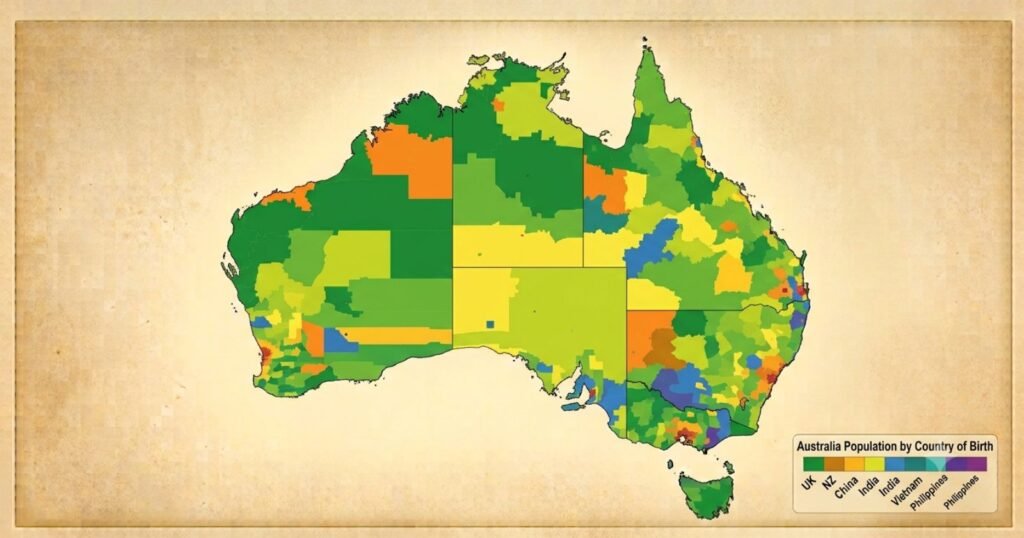
Overseas-born concentration varies sharply across Australia’s states and territories. Western Australia recorded the highest overseas-born share of any state in 2021, at 34%, reflecting sustained skilled migration into its resources sector. Tasmania recorded the lowest, at just 16%, consistent with its slower population growth and smaller migrant intake relative to the mainland states. Sydney and Melbourne together absorb the majority of new arrivals across almost every birthplace group; at the 2021 Census, 56% of permanent migrants who arrived between 2000 and 2021 had settled in either Sydney or Melbourne.
How the Country-of-Birth Map Has Changed Since 1990
Australia’s overseas-born share has risen steadily from the low-to-mid twenties as a percentage in the early 1990s to 32.0% in 2025, interrupted only briefly by the COVID-19 pandemic. The 2021 Census recorded the first decline in the overseas-born share in over 20 years, falling from 29.8% in 2020 to 29.1% in 2021, as international border closures cut off the flow of new arrivals while some existing overseas-born residents departed. That dip proved temporary; the share resumed its long-term upward trajectory as soon as borders reopened, climbing to 29.5% in 2022, roughly 30% in 2023, 31.5% in 2024 and 32.0% in 2025, closing in on the 1891 historical peak.
Largest Growing and Declining Birthplace Groups
| Category | Country of birth | Change 2015-2025 |
|---|---|---|
| Fastest growing | India | +522,000 |
| Fastest growing | China | +223,000 |
| Fastest growing | Philippines | +171,000 |
| Fastest growing | Nepal | +163,000 |
| Declining | Italy | -46,000 |
| Declining | England | -36,000 |
| Declining | Greece | -29,000 |
| Declining | Germany | -18,000 |
Australia’s Future Migration Composition
The clearest structural trend in Australia’s country-of-birth data is the generational handover from post-war European migration to twenty-first-century Asian migration. As Italy, Greece, Germany and, more slowly, England-born populations continue to age and decline in absolute numbers, India, China, the Philippines, Nepal and other South and South-East Asian birthplace groups are positioned to keep expanding their share of Australia’s overseas-born population. India’s position as the largest single birthplace group is unlikely to be seriously challenged within the next decade given the scale of the gap it has already opened relative to England, and continued strong skilled and student migration flows from South Asia.
Data Limitations
Country of birth is a precise, legally unambiguous measure, but it should not be treated as a proxy for ethnicity, citizenship or ancestry. Overseas-born does not mean non-citizen: 61.9% of Australia’s overseas-born population held Australian citizenship at the 2021 Census. Overseas-born does not mean a different ethnicity or culture from Australian-born residents, since birthplace alone reveals nothing about ancestry or self-identified cultural background. And country of birth does not capture the large population of Australian-born children of migrants, who form the fastest-growing segment of many ancestry and cultural groups despite counting as Australian-born in this dataset.
Complete Country-of-Birth Table
| Country of birth | Population (2025) | Median age | Trend since 2015 |
|---|---|---|---|
| India | 971,020 | Younger than national average | Rising sharply |
| England | 970,950 | 60+ | Slow decline |
| China | 732,000 | Middle-aged | Rising |
| New Zealand | 638,000 | Near national average | Rising steadily |
| Philippines | ~310,000 | Middle-aged | Rising |
| Italy | Declining | 60+ | Falling |
| Greece | Declining | 60+ | Falling |
| Germany | Declining | 60+ | Falling |
| Nepal | Smaller base, fast growth | Young | Rising sharply |
Key Findings
- India (971,020) overtook England (970,950) in 2025 to become Australia’s largest overseas country of birth for the first time on record
- Australia’s overseas-born population reached 8.8 million, or 32.0% of the total population, approaching the historical peak of 32.4% set in 1891
- India, China, the Philippines and Nepal recorded the largest population increases among all birthplace groups over the decade to 2025
- Italy, England, Greece and Germany recorded the largest declines, all linked to an aging post-war migrant cohort with a median age of 60 or above
- Only 34.2% of New Zealand-born residents hold Australian citizenship, far below the 61.9% rate among the overseas-born population overall, due to the Special Category Visa arrangement
- Western Australia has the highest overseas-born population share of any state (34%); Tasmania has the lowest (16%)
- The overseas-born share briefly declined in 2021 for the first time in over 20 years due to COVID-19 border closures, before resuming its long-term rise
Frequently Asked Questions
1. What is the largest country of birth for overseas-born Australians?
India, with 971,020 residents as of 30 June 2025, having overtaken England for the first time in Australia’s history.
2. What percentage of Australia’s population was born overseas?
32.0% as of 2025, or 8.8 million people, approaching the historical record of 32.4% set in 1891.
3. Which birthplace groups are declining in Australia?
Italy, England, Greece and Germany have all recorded population declines since 2015, driven by the aging of these post-war migrant communities.
4. Are New Zealand-born residents Australian citizens?
Mostly not. Only 34.2% held Australian citizenship at the 2021 Census, since New Zealand citizens can live and work in Australia indefinitely without naturalizing.
5. Which Australian state has the highest proportion of overseas-born residents?
Western Australia, at 34% in 2021, driven by sustained skilled migration into its resources sector.
6. Which Australian state has the lowest proportion of overseas-born residents?
Tasmania, at 16% in 2021.
7. Did Australia’s overseas-born population ever decline?
Yes, briefly in 2021, when COVID-19 border closures caused the first decline in the overseas-born share in over 20 years, falling from 29.8% to 29.1%.
8. What is the median age of Australia’s overseas-born population?
43 years as of 2025, compared with 35 years for the Australian-born population in 2022.
9. Does being born overseas mean someone is not an Australian citizen?
No. 61.9% of Australia’s overseas-born population held Australian citizenship at the 2021 Census.
10. Which country of birth is growing fastest in Australia?
India, adding 522,000 people between 2015 and 2025, more than triple the increase of the next fastest-growing group, China.
Sources
- Australian Bureau of Statistics, Australia’s population by country of birth, June 2025
- Australian Bureau of Statistics, 8 things of interest about Australia’s overseas-born population (media release, 2026)
- Australian Bureau of Statistics, Australia’s overseas-born population grows to 29.5% in 2022 (media release)
- Australian Bureau of Statistics, Australia’s overseas-born population drops during pandemic (media release, 2022)
- Australian Bureau of Statistics, 2021 Census Country of Birth QuickStats, Australia, New Zealand and Philippines
- Australian Institute of Health and Welfare, Profile of Australia’s population
- AMES Australia, Australia’s migrant population growing and changing