Europe’s Migrant Crisis: A Short Summary
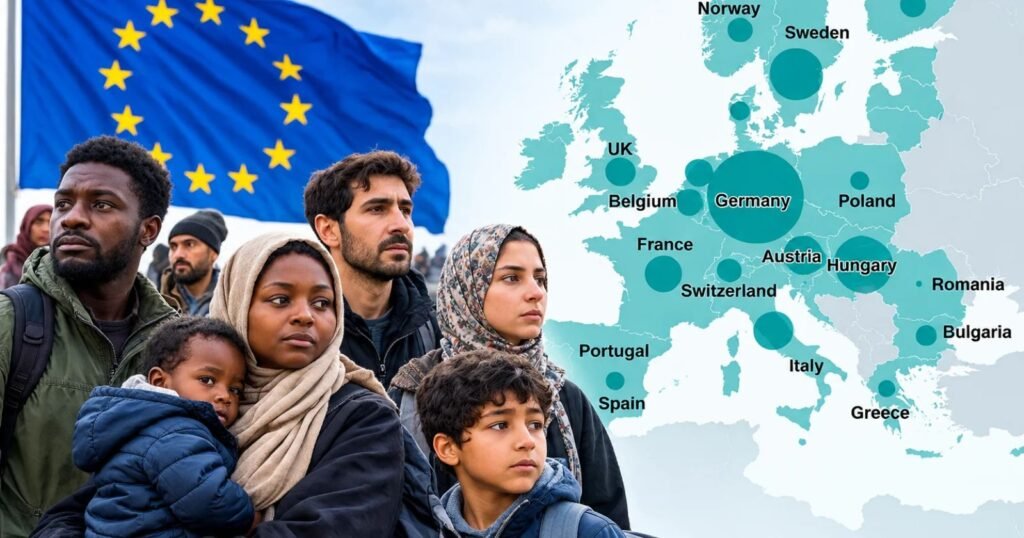
Europe’s migrant crisis in 2026 reflects a complex combination of irregular migration, refugee movements, border security concerns, political divisions and demographic change. Countries such as France, Italy, Germany, Belgium and the Netherlands face different pressures related to asylum processing, housing, public services and migrant integration.
The European Union is strengthening its migration framework through improved border screening, revised asylum procedures and greater cooperation among member states. However, implementing these policies consistently and sharing responsibility between countries remain significant challenges.
Migration also has an important economic and demographic dimension. Foreign workers can help address labour shortages and population ageing, while poorly managed arrivals and inadequate integration support can intensify pressure on local communities. Understanding the crisis requires distinguishing legal immigration, asylum applications, refugees and irregular migration rather than treating them as interchangeable categories.
The bottom line: Europe’s long term migration challenge cannot be resolved through border controls alone. Sustainable progress requires effective immigration enforcement, fair and efficient asylum systems, international cooperation, investment in integration and policies that balance humanitarian obligations with economic needs and public confidence.
Europe’s migration debate in 2026 is about far more than the number of people arriving at its borders. Governments are under pressure to control irregular migration, improve asylum procedures, address public safety concerns, manage housing shortages and demonstrate that immigration laws are being enforced. At the same time, European economies continue to need workers, millions of displaced people require protection, and demographic ageing is reshaping the continent’s long-term outlook.
The debate has become particularly intense in France, Italy, Belgium, the Netherlands and Germany, where migration policy intersects with concerns about crime, social cohesion, national identity and trust in public institutions. Violent incidents have contributed to public anxiety, but their causes differ. Some involve individual criminal suspects, others involve political extremists, and still others arise from demonstrations, organised crime or interpersonal disputes. Establishing a migrant connection requires evidence about each case rather than assumptions based on nationality or appearance.
The latest available European data also complicate the idea that migration is increasing uniformly. The European Union recorded approximately 178,000 detections of irregular external border crossings in 2025, a decline of 26% from 2024. First-time asylum applications by non-EU citizens fell to 669,400 in the same year, down 27% from 912,400 in 2024. Nevertheless, border pressure, asylum backlogs, local accommodation shortages and disagreements over responsibility remain serious political challenges.
Understanding the Europe migrant crisis in 2026 therefore requires looking beyond headlines. The central questions concern who is arriving, why people move, how national governments respond, what the evidence says about public safety, and whether Europe’s new migration rules can deliver more effective and accountable management.
Europe Migrant Crisis 2026: Key Facts and Figures
The European migration situation includes several distinct categories. Irregular border crossings, asylum applications, legal immigration, temporary protection, and the number of people living in a country are different measures. Treating them as interchangeable produces misleading conclusions.
The most useful starting point is to examine the latest complete annual figures and then distinguish them from events reported during 2026.
Europe’s latest migration statistics
| Indicator | Latest reported figure | What it measures |
|---|---|---|
| Irregular external border crossing detections in 2025 | Approximately 178,000 | Detections recorded by Frontex |
| Change in irregular crossing detections | Down 26% | Compared with 2024 |
| First-time asylum applicants in the EU in 2025 | 669,400 | Non-EU citizens applying for international protection for the first time |
| First-time asylum applicants in 2024 | 912,400 | Previous annual comparison |
| Largest origin group among first-time asylum applicants in 2025 | Venezuelans, 89,500 | Nationality of applicants |
| Second largest origin group | Afghans, 63,800 | Nationality of applicants |
| Third largest origin group | Syrians, 40,000 | Nationality of applicants |
| Main EU destination countries for asylum applications | Spain, Italy, France and Germany | Leading destinations by application volume |
Sources: Frontex and Council of the EU and Eurostat asylum statistics.
These figures reveal two important developments. First, irregular crossings and asylum applications declined substantially in 2025. Second, the distribution of applications remains uneven, with a relatively small number of countries receiving a large share of claims.
Neither statistic measures every form of migration. Legal employment migration, family reunification, international students, returning citizens and people moving between EU countries are not fully represented by these figures.
Why falling arrivals have not ended the crisis
The term migration crisis describes a political and administrative problem rather than a single statistical threshold. A country can record fewer new arrivals while still facing a large backlog of asylum cases, insufficient accommodation, expensive reception services or difficulties returning people whose applications have been rejected.
The geography of migration also matters. Arrivals may fall across the EU as a whole while a particular island, border town or city experiences a sudden concentration of people. Local governments can face acute pressures even when the continental total is declining.
The Council of the EU attributes part of the decline in irregular crossings to cooperation with countries of departure and transit, along with preventive measures. Such arrangements can reduce departures on particular routes, but they do not remove the underlying reasons people migrate. Conflicts, political instability, economic hardship, family ties and demand for work continue to influence movement.
Historical Context
The European migrant crisis did not begin in 2026. Its current form developed over decades, shaped by postwar labour migration, colonial relationships, conflicts in neighbouring regions, the expansion of the European Union and changes to asylum and border policies.
The 2015 refugee crisis
In 2015 and 2016, Europe experienced exceptionally high numbers of asylum applications, particularly from people fleeing Syria, Afghanistan, Iraq and other countries affected by conflict or instability. Eurostat recorded approximately 1.2 million first-time asylum applicants in the EU in 2015.
The emergency exposed weaknesses in the EU’s asylum system. Countries at the external borders, including Greece and Italy, argued that they could not manage arrivals alone. Destination countries in northern and western Europe faced difficult questions about reception capacity, processing times and integration.
The crisis also changed electoral politics. Migration became a central issue for parties campaigning on border enforcement, national sovereignty and cultural integration. Other political groups emphasised humanitarian obligations, refugee protection and the economic contribution of newcomers.
The long-term consequence was a widening disagreement over whether asylum should be managed primarily by the country of arrival, distributed across the EU or handled through greater cooperation with countries outside Europe.
Brexit, border controls and national politics
Migration was one of several major issues in the United Kingdom’s Brexit debate. Although the UK was not part of the EU’s border-free Schengen area, concerns about sovereignty, free movement and immigration influenced public discussion.
Across continental Europe, governments increasingly combined border enforcement with efforts to accelerate asylum decisions and improve returns. However, national systems continued to differ, particularly over family reunification, accommodation, work permissions and the treatment of rejected applicants.
The displacement from Ukraine
Russia’s full-scale invasion of Ukraine in February 2022 produced another major movement of people. The EU activated temporary protection arrangements, allowing millions of displaced Ukrainians to obtain residence and access to employment, education and other services without relying solely on the ordinary asylum process.
People under temporary protection should be distinguished from ordinary asylum applicants and people entering irregularly. Their legal status and protection arrangements are different.
The policy shift towards stricter controls
By the middle of the 2020s, European governments were under pressure to demonstrate greater control over borders and asylum decisions. Several countries tightened national rules, expanded cooperation with transit states or pursued measures intended to increase returns.
At the same time, courts and human rights organisations continued to scrutinise whether certain measures complied with refugee protection obligations, due process and the prohibition on returning people to places where they face serious danger.
The result is a system in transition. Europe is attempting to combine stronger enforcement with a common legal framework, but implementation and political agreement remain difficult.
Migration and Asylum in Europe: 2025 Edition
Eurostat’s Migration and asylum in Europe: 2025 edition, published on 18 December 2025, provides an important statistical baseline for understanding the European migrant crisis. It covers population diversity, immigration and emigration, international protection, irregular migration, returns, residence permits and migrant skills.
The publication is particularly useful because it distinguishes legal migration from asylum and enforcement statistics.
Key findings from the 2025 edition
| Indicator | Reference period | Reported figure | Interpretation |
|---|---|---|---|
| Non-nationals living in EU countries | 1 January 2024 | Approximately 43 million | Around 9.5% of the EU population |
| Citizens of another EU country living in an EU country | 2024 | Approximately 14 million | About 3.1% of the population |
| Citizens of non-EU countries living in the EU | 2024 | Approximately 29 million | About 6.4% of the population |
| Immigration to the EU from non-EU countries | 2023 | 4.4 million | International arrivals excluding movement from another EU country |
| Immigration from another EU country | 2023 | Approximately 1.5 million | Intra-EU movement |
| First residence permits issued to non-EU citizens | 2024 | 3.5 million | Down 8% from 2023 |
| First residence permits issued for work | 2024 | Approximately 1.1 million | About 32% of first permits |
| First residence permits issued for family reasons | 2024 | Approximately 950,000 | About 27% of first permits |
| First residence permits issued for education | 2024 | Approximately 549,000 | About 16% of first permits |
Source: Eurostat, Migration and asylum in Europe: 2025 edition.
The figures have different reference periods because the interactive publication combines the latest available observations for several statistical indicators. They should not be interpreted as a single snapshot of migration in 2025.
What the findings reveal
The first finding is that international migration is not synonymous with asylum. Work, family and education are major reasons for residence permits, while asylum applicants represent a distinct population seeking international protection.
The second finding is that the EU contains a substantial population of non-nationals, including citizens of other EU countries who have exercised free movement rights. This group should not be conflated with irregular migrants.
The third finding is that migration patterns differ substantially between countries. Some receive a high proportion of workers and students, while others experience concentrated asylum pressure or serve as entry points for irregular crossings.
For readers researching the impact of the refugee crisis in Europe, this distinction is essential. Refugee protection, regular immigration, temporary protection, and irregular entry have different legal frameworks, administrative requirements, and social consequences.
Immigration in Europe by Country
Immigration in Europe by country varies according to economic opportunities, population size, geographical position, historical ties, visa rules and national immigration systems. Spain, Germany, Italy and France are important destinations in absolute numbers, while smaller countries can have higher immigration rates relative to their populations.
A useful comparison must separate immigration flows from the number of immigrants already living in a country. Annual arrivals measure movement during a specific period, while the foreign-born population measures residents born outside their current country.
Immigration flows across European countries
The following table summarises the latest comparable 2024 immigration indicators published by Eurostat. The EU-wide total and the reported country rates provide a useful comparison, while the linked Eurostat dataset should be used to retrieve individual annual counts for each country.
| Country | Immigration indicator for 2024 | Interpretation |
|---|---|---|
| Austria | Country-level count available in Eurostat | Compare arrivals with population size |
| Belgium | Country-level count available in Eurostat | Includes EU and non EU immigration |
| Bulgaria | 8 immigrants per 1,000 residents | Relatively low immigration rate |
| Croatia | Country-level count available in Eurostat | Work related immigration is important |
| Cyprus | 42 immigrants per 1,000 residents | One of the highest reported rates |
| Czechia | Country-level count available in Eurostat | Non EU arrivals form a large share |
| Denmark | Country-level count available in Eurostat | Includes work, family and other migration |
| Estonia | Country-level count available in Eurostat | Affected by regional migration patterns |
| Finland | Country-level count available in Eurostat | Includes employment and family migration |
| France | 6 immigrants per 1,000 residents | Low reported rate relative to population |
| Germany | Country-level count available in Eurostat | One of Europe’s major destination countries |
| Greece | Country-level count available in Eurostat | Influenced by location on external migration routes |
| Hungary | Country-level count available in Eurostat | Includes regular migration and employment-related movement |
| Ireland | Country-level count available in Eurostat | Employment and education are important drivers |
| Italy | 8 immigrants per 1,000 residents | Major destination and Mediterranean entry country |
| Latvia | 8 immigrants per 1,000 residents | Influenced by regional mobility |
| Lithuania | Country-level count available in Eurostat | Includes EU and non-EU immigration |
| Luxembourg | 38 immigrants per 1,000 residents | High immigration rate relative to population |
| Malta | 60 immigrants per 1,000 residents | Highest reported rate among EU countries |
| Netherlands | Country-level count available in Eurostat | Work, family, study, and protection all contribute |
| Poland | 8 immigrants per 1,000 residents | Includes international labour and displacement-related movement, subject to national counting methods |
| Portugal | 2024 value unavailable in the cited Eurostat summary | Consult the country dataset for the latest available value |
| Romania | Country-level count available in Eurostat | Intra-EU and non-EU movement both matter |
| Slovakia | 1 immigrant per 1,000 residents | Lowest reported rate among EU countries |
| Slovenia | Country-level count available in Eurostat | Includes regional and non-EU immigration |
| Spain | Major destination by absolute number | Recorded approximately 4.2 million non-EU arrivals across the EU as a whole, with Spain receiving a substantial share |
| Sweden | Country-level count available in Eurostat | Includes asylum, family, work, and other migration |
Source: Eurostat, EU received 4.2 million immigrants in 2024, based on datasets migr_imm8 and demo_pjan.
Important methodological note: The table above reports the exact 2024 rates stated in Eurostat’s published summary and identifies the other country values as available in the underlying dataset rather than inventing numerical estimates. It covers the 27 EU member states, not every country geographically located in Europe. The UK, Norway, Switzerland, Iceland and non-EU Balkan countries use separate national statistical systems and should be added only when their definitions and reference periods can be aligned.
Why immigration rates differ
Malta, Cyprus and Luxembourg recorded the highest immigration rates relative to population in 2024. Smaller populations can experience large changes in their immigration rates even when their absolute number of arrivals is below that of larger countries.
Germany, Spain, Italy and France remain important destinations because of their economic size, employment opportunities, family networks and established migrant communities. However, their positions differ according to the indicator being measured.
The proportion of immigrants from outside the EU is another important variable. In 2024, Eurostat reported that 87% of immigration into Czechia and 86.2% into Italy came from outside the EU, while 84.5% of immigration into Spain also came from non-EU countries. Luxembourg and Romania were exceptions in which immigration from other EU countries represented a larger share.
These differences show why immigration in Europe by country cannot be understood through a single ranking. A high rate of regular immigration does not necessarily indicate high irregular migration or a large asylum backlog.
Illegal Immigration in Europe by Country
Illegal immigration in Europe is a frequently searched topic, but the phrase can refer to several different indicators. These include irregular border crossing detections, people found to be unlawfully present, people ordered to leave and people actually returned to a country outside the EU.
These measures are not interchangeable. A person may enter legally and later overstay a visa, while another may enter without authorisation and subsequently apply for asylum. An asylum applicant’s claim must be assessed under the applicable protection rules.
For a country comparison, Eurostat’s indicator for third country nationals found to be illegally present is particularly useful because it uses a defined administrative measure across EU and EFTA reporting countries.
People found to be illegally present in 2025
In 2025, authorities in the EU recorded 719,395 third country nationals found to be illegally present, down 21.7% from 918,525 in 2024. Germany and France accounted for the largest shares of the EU total, followed by Italy, Greece and Spain.
The following table reports the 2025 rate per 1,000 inhabitants for the EU and EFTA countries shown in Eurostat’s published map.
| Country | People found to be illegally present per 1,000 inhabitants in 2025 |
|---|---|
| Austria | 1.8 |
| Belgium | 0.8 |
| Bulgaria | 1.2 |
| Croatia | 13.4 |
| Cyprus | 5.4 |
| Czechia | 1.0 |
| Denmark | 0.2 |
| Estonia | 0.4 |
| Finland | 0.1 |
| France | 2.3 |
| Germany | 2.0 |
| Greece | 5.9 |
| Hungary | 2.2 |
| Ireland | 1.0 |
| Italy | 1.4 |
| Latvia | 1.3 |
| Lithuania | 1.7 |
| Luxembourg | 3.2 |
| Malta | 3.7 |
| Netherlands | 0.2 |
| Poland | 0.5 |
| Portugal | 0.1 |
| Romania | 1.3 |
| Slovakia | 0.3 |
| Slovenia | 1.7 |
| Spain | 1.2 |
| Sweden | 0.2 |
| Iceland | Not available in the cited map |
| Liechtenstein | 0.2 |
| Norway | 0.9 |
| Switzerland | 0.2 |
Source: Eurostat, Enforcement of immigration legislation statistics, 2025, dataset migr_eilpop.
How to interpret this table: These are recorded apprehensions or findings of unlawful presence relative to population, not an estimate of the total number of undocumented residents. The table covers the EU and EFTA countries reported in the cited source. It does not provide comparable figures for every European country, including the United Kingdom and several non-EU Balkan states. Those countries should not be assigned invented values.
What the illegal presence figures show
Croatia recorded the highest rate in the cited comparison, followed by Greece, Cyprus and Malta. These figures must be interpreted in the context of geography, border enforcement, migration routes and the number of people detected by authorities.
Germany and France reported the largest shares of the EU total in absolute terms. Large populations and differences in enforcement activity affect those totals, so absolute counts and population-adjusted rates can produce different comparisons.
The figures also demonstrate that unlawful presence is not the same as irregular border crossings. Eurostat includes people who entered without authorisation as well as those who initially entered lawfully but subsequently remained without a valid legal basis.
Returns and immigration enforcement
The EU recorded 491,950 third country nationals ordered to leave in 2025, up 5.8% from 2024. A total of 135,460 people were returned to a third country following an order to leave, an increase of 20.9%.
Germany reported the largest number of returns to non-EU countries, with 29,295, followed by France with 14,940 and Sweden with 11,250 Eurostat, Immigration law enforcement in the EU: 2025 figures).
These figures matter because the political debate often focuses on deportation announcements rather than completed returns. Actual removals depend on final decisions, identity documents, cooperation from countries of origin, legal appeals, and protection obligations.
Current Status and Policy Shifts (2026)
The Europe migrant crisis in 2026 is taking place during a major change in EU migration governance. Governments are attempting to reduce irregular entry, improve asylum processing, increase returns where legally permitted, and distribute responsibility more predictably among member states.
The EU Migration and Asylum Pact
The EU Migration and Asylum Pact began applying on 12 June 2026. It introduces common rules covering screening, registration, asylum procedures, responsibility for applications and solidarity arrangements for countries experiencing disproportionate migration pressure.
The reforms aim to improve the consistency of asylum processing and strengthen the ability of member states to manage arrivals. Their effectiveness depends on administrative capacity, trained staff, adequate reception facilities, cooperation between governments and compliance with legal safeguards.
The pact does not abolish the right to seek asylum. Authorities must still assess protection claims under the relevant legal framework.
Stricter returns and border enforcement
European governments have increased attention to return procedures for people who do not have a legal right to remain. In 2025, the number of people returned to third countries following orders to leave rose by 20.9% to 135,460.
The rise shows that enforcement activity has increased, but it does not by itself establish that all eligible cases can be resolved quickly. Countries of origin may not cooperate with identity verification or travel documents, and some people cannot lawfully be returned because of protection risks.
Cooperation with countries outside Europe
The EU and individual governments work with countries of departure and transit to disrupt smuggling networks, manage borders and reduce dangerous journeys. These arrangements can reduce crossings on specific routes, but they also raise questions about human rights, access to asylum and the conditions people experience outside Europe.
Political pressure and public safety
Violent incidents, terrorist attacks, organised crime and public disorder have strengthened calls for more effective enforcement in several countries. Governments are expected to protect residents, investigate serious offences and apply immigration rules consistently.
However, policies are more effective when they distinguish between individual criminal behaviour, extremist networks, irregular entry and lawful migration. Collective assumptions about migrants can obscure the specific failures that need to be addressed.
Recent Violence in Europe: What Is Actually Known?
Violence and public safety have become central to the migration debate. Knife attacks, sexual assaults, terrorist attacks, organised criminal activity and street disorder can generate intense public concern, particularly when an incident involves a suspect with a migrant background.
However, a responsible analysis must distinguish between an individual crime and a broader trend. It must also distinguish confirmed suspects from convicted offenders, foreign nationals from immigrants, and immigration status from ethnic or religious background.
France: October 2026 unrest
France experienced unrest in October 2026, with violent demonstrations, looting, arson and clashes with police reported across several cities. Reporting on the events described protests around grievances including living costs and public services before some demonstrations escalated into disorder.
French authorities attributed much of the violence to radical political groups and other offenders. The government announced additional security measures, while the scale of the unrest prompted questions about policing, intelligence and the handling of demonstrations.
These events are relevant to the wider debate about public order, but the reporting reviewed for this article does not establish that the unrest was a coordinated uprising by migrants. It would therefore be inaccurate to use these riots as direct evidence that migrants caused the violence.
France has experienced other episodes in which immigration, social exclusion and policing became part of the public discussion. The 2023 unrest following the police killing of Nahel Merzouk, for example, raised questions about police accountability, discrimination, neighbourhood disadvantage and relations between young people and state institutions. Those questions overlap with the immigration debate but are not interchangeable with it.
Italy: violent crime and public order
Italy faces several distinct public safety challenges, including violent crime, organised criminal networks, smuggling operations and occasional disorder during demonstrations. Its geographical position also makes migration across the central Mediterranean a persistent political issue.
The Italian government has pursued law and order measures and tighter migration controls. Its broader approach includes cooperation with transit countries and action against smuggling networks.
This does not mean that all recent violence in Italy is migrant related. A protester who attacks police, a person suspected of a stabbing, and a smuggling network operate in different contexts. Each requires evidence about motive, conduct and legal responsibility.
Belgium: public order and migration pressures
Belgium has faced political disputes over asylum accommodation, processing capacity and the distribution of responsibilities between national and local authorities. Brussels also hosts major EU institutions, making it a focal point for demonstrations and political mobilisation.
Violent clashes during demonstrations can damage public property and injure officers or protesters. However, violence at a protest should not be attributed to migrants without evidence that identifies the individuals involved and establishes the circumstances.
Belgium’s migration debate also includes concerns about integration, extremist networks and the ability of authorities to monitor people who pose a demonstrable security risk. These issues require careful distinctions between lawful migration, asylum, radicalisation and ordinary criminal behaviour.
The Netherlands: asylum capacity and public safety
The Netherlands has struggled with pressure on asylum accommodation and delays in processing applications. These problems have contributed to public debate over the number of people admitted, the length of temporary protection and the responsibilities of local authorities.
The country is implementing the EU Migration and Asylum Pact, which entered into application on 12 June 2026. The reforms aim to strengthen external border procedures, improve processing and change aspects of the asylum system.
Crime concerns remain part of the national discussion, but a rise in a particular offence cannot automatically be attributed to immigration. Reliable analysis must examine police and court data, suspect status, offence type, age, sex and other relevant factors.
Germany and other European countries
Germany continues to debate asylum, integration, deportation, extremist violence and the capacity of local authorities to provide housing and services. Other countries, including Sweden, Austria, Denmark and Spain, have their own disputes over border control, organised crime, public safety and the distribution of asylum responsibilities.
The underlying challenge is similar across much of Europe: governments must enforce criminal law and immigration rules while ensuring that decisions are based on evidence and comply with legal safeguards.
Comparing the main issues
| Country | Major migration-related debate | What must be verified before linking violence to migration |
|---|---|---|
| France | Integration, policing, asylum and public order | Identity and legal status of suspects, motive and investigation findings |
| Italy | Sea arrivals, smuggling, returns and public safety | Whether an offence involves a migrant, a trafficking network or an unrelated criminal dispute |
| Belgium | Asylum capacity, integration and urban security | Whether violence arose from a protest, organised crime, extremism or an individual offence |
| Netherlands | Accommodation shortages, asylum processing and enforcement | Convictions and comparable suspect statistics rather than isolated incidents |
| Germany | Asylum policy, integration and extremist violence | Whether the offence was ideologically motivated and whether migrant status is relevant |
| Sweden | Gang crime, shootings and integration | The role of specific criminal networks and the limitations of nationality-based comparisons |
| Spain | External borders, the Canary Islands and Mediterranean routes | Whether a reported incident involves irregular entry, a criminal offence or a separate local dispute |
The table summarises policy debates, not a ranking of crime levels. The situations differ within each country, and a national migration profile cannot explain every violent incident.
What the crime statistics can and cannot show
Eurostat publishes data on police recorded offences, suspects, prosecutions, convictions, prisoners and certain citizenship breakdowns. National crime recording practices are not fully harmonised, so differences in reporting, enforcement and legal definitions complicate comparisons between countries.
A sound assessment of migrant crime therefore needs to answer several questions:
- Is the data about suspects, people charged or people convicted?
- Does it distinguish foreign nationals from foreign-born residents and citizens with an immigrant background?
- Are comparisons adjusted for age and sex, given that these characteristics strongly influence recorded offending patterns?
- Does the data measure the number of offences, the number of offenders or the proportion of a population involved?
- Is there a reliable trend over several years, or is the conclusion based on a single incident?
These distinctions do not minimise victims’ experiences or remove the need for public safety measures. They help identify the interventions most likely to work, from effective policing and prosecution to targeted action against repeat offending and criminal networks.
France’s Immigration Problem: Past, Present and Future
France occupies a central place in Europe’s migration debate because of its large population, colonial history, economic opportunities, secular political tradition and long-standing disagreements over national identity and integration.
Immigration has shaped French society for generations. It has supplied workers to industry, construction, transport and healthcare, while also creating challenges involving housing, education, employment, discrimination and social cohesion. These outcomes vary considerably across regions and generations.
How immigration shaped modern France
Postwar economic expansion increased demand for labour, and workers arrived from southern Europe, North Africa and other regions. Family reunification subsequently became an important part of settlement, while asylum, student migration and international employment added further diversity.
France’s colonial relationship with Algeria and other parts of North and West Africa also influenced later migration patterns. Historical ties, language, family networks and labour demand helped shape where communities settled.
Over time, the public debate moved beyond labour supply towards questions of integration, secularism, religious expression, citizenship and the responsibilities of the state. Political disputes have become particularly intense when unemployment, poor housing and insecurity overlap in disadvantaged urban neighbourhoods.
How many immigrants live in France?
France’s national statistics agency, INSEE, publishes figures on immigrants and foreign nationals. The distinction between immigration and foreign nationality is important.
| Term | Meaning |
|---|---|
| Immigrant | A person born abroad as a foreign national who subsequently lives in France, according to the French statistical definition |
| Foreign national | A person who does not hold French nationality |
| Naturalised citizen | A person who acquired French citizenship and is no longer counted as a foreign national |
| Second generation | A person born in France to one or more immigrant parents, who is not necessarily an immigrant |
| Asylum seeker | A person whose application for international protection is being considered |
| Refugee | A person recognised as meeting the applicable criteria for refugee protection |
A French citizen with immigrant parents is not an immigrant under the standard INSEE definition. Similarly, a foreign national may have lived in France for many years, and not every foreign national is an asylum seeker or an irregular migrant.
These distinctions are essential when discussing crime, integration, employment and public spending. A statistic about foreign nationals cannot automatically be used to describe everyone with an immigrant background.
Integration, secularism and social cohesion
France’s model of laïcité establishes a form of state secularism and shapes the relationship between public institutions and religion. Its application, particularly in schools and public services, has been the subject of extensive debate.
Integration also depends on practical opportunities. Language proficiency, recognised qualifications, access to work, housing stability and contact with public institutions can affect how newcomers participate in society. Discrimination and concentrated disadvantage can create additional barriers.
No single explanation accounts for all integration outcomes. Some immigrant communities achieve high employment and educational attainment, while others face persistent disadvantages. The relevant evidence must be assessed by generation, region, socioeconomic circumstances and the measure being examined.
Immigration and crime in France
Public discussion often centres on violent offences, sexual violence, theft and repeat offending. The challenge for policymakers is to identify genuine patterns without treating immigrant background as a substitute for evidence.
France’s annual immigration reports bring together reference indicators on visas, residence permits, irregular immigration, asylum, integration and access to citizenship. Crime trends require separate justice and police datasets.
A credible crime analysis should distinguish nationality, birthplace, immigration status and parental background. It should also compare similar age groups and account for differences in income, education, neighbourhood and exposure to policing.
Where an individual with an immigrant background commits a serious crime, the offence should be investigated and prosecuted under the law. Where official evidence identifies repeat offending or a security failure, the policy response should address that failure directly. Neither approach requires attributing collective responsibility to an entire community.
France’s policy response
French migration policy combines entry controls, residence permits, asylum procedures, citizenship rules, integration measures and enforcement against irregular residence. It also operates within EU rules and France’s international obligations.
The government faces competing demands. Some voters want stricter controls, faster deportations and more restrictive residence rules. Others emphasise labour needs, humanitarian protection, family unity and safeguards against discrimination.
Policy effectiveness depends not only on the strictness of legislation but also on implementation. Long processing times, limited accommodation, difficulties obtaining travel documents and legal challenges can slow enforcement. Poorly designed integration policies can also make it harder for people with a legal right to remain to find employment and participate in society.
The central French question is therefore not simply whether immigration should rise or fall. It is how the country can maintain control over admission and residence, enforce the law consistently, improve integration and protect public safety without confusing legal categories or undermining equal treatment.
Why Migration Creates Pressure Across Europe
Migration can bring economic benefits and demographic support, but rapid or poorly managed population movement can create local pressures. The effects depend on the number and profile of arrivals, the speed of population change, available housing, labour demand and the capacity of public institutions.
Housing and local services
Housing is one of the most visible sources of tension. In areas where homes are already scarce, population growth can increase competition for rental properties and affordable accommodation. Asylum reception centres can also place additional demands on local services when national planning and funding do not keep pace.
However, migration is not the sole cause of Europe’s housing problems. Construction shortages, high interest rates, limited social housing, urban concentration and restrictions on development also influence prices and availability.
The policy question is whether governments can match housing supply, transport, education and healthcare capacity with population needs, including both existing residents and newcomers.
Employment and wages
The employment effects of immigration vary by sector, skill level and location. Employers may rely on migrant workers in healthcare, agriculture, construction, hospitality, transport and other industries. Migrants can also establish businesses, pay taxes and contribute to demand.
Potential disadvantages can arise where labour protections are weak, qualifications are not recognised or employers use vulnerable workers to undercut standards. The consequences for wages are not uniform: they depend on workers’ skills, labour market conditions, collective bargaining and the availability of complementary jobs.
Effective policy combines legal recruitment routes, enforcement against exploitation, language training and access to employment for people who are entitled to work.
Public spending and fiscal effects
Migration affects government revenue and expenditure through income taxes, social contributions, education, healthcare, housing support and other services. The net effect varies with employment, age, earnings, family composition and length of residence.
A young employed migrant may contribute differently from a newly arrived asylum seeker who cannot work while a claim is processed. A household with children has a different spending profile from a single worker. These distinctions make broad claims that migration always pays for itself or always imposes a net cost unreliable.
Governments need transparent fiscal analysis that separates short-term reception costs from longer-term employment and tax contributions.
Demographic ageing
Many European countries face low fertility, rising life expectancy and growing demand for pensions, healthcare and long-term care. Immigration can increase the working-age population and help fill some vacancies.
It cannot, by itself, solve every demographic problem. Migrants also age, and long-term fiscal outcomes depend on employment, productivity, wages, fertility and public policy. A durable response requires a combination of labour market participation, training, productivity improvements and sustainable pension and healthcare systems.
Social cohesion and trust
Rapid demographic change can create anxiety when residents believe that government decisions are not transparent, public services are overstretched, or immigration rules are not enforced. Misinformation and sensationalised reporting can intensify these perceptions.
Trust can also deteriorate when genuine problems are dismissed or when entire communities are blamed for the actions of individuals. Transparent data, consistent law enforcement, meaningful consultation and clear communication are important for maintaining public confidence.
Economic Benefits and Costs of Migration
The debate often presents migration as either an economic necessity or a public expense. In practice, the outcomes depend on labour market conditions, education, age, legal status, public policy and the time period being measured.
Where migration can benefit Europe
Migrants can help employers fill vacancies, establish businesses, contribute to social insurance systems and support sectors where demand for workers exceeds domestic supply. International students may contribute to universities and research, while skilled workers can support innovation and productivity.
In ageing societies, workers who arrive during their economically active years can increase the number of taxpayers and help sustain services. Their contribution depends on whether they can find suitable employment and progress into higher productivity roles.
Where costs and pressures arise
The costs are often concentrated in particular places and periods. Local authorities may need to fund emergency accommodation, language instruction, school places and healthcare before new arrivals become economically established. Delays in asylum processing can prolong dependence on public support, particularly where applicants are not permitted to work.
Poorly regulated employment can also leave migrant workers vulnerable to exploitation, depressing labour standards and creating unfair competition. These problems require labour inspections and enforcement against abusive employers, not simply changes to admission rules.
| Area | Potential benefits | Potential costs or risks |
|---|---|---|
| Labour market | Fills vacancies and adds skills | Exploitation and wage pressure in some sectors |
| Public finances | Income tax and social contributions | Initial reception and integration expenditure |
| Demographics | Supports the working age population | Does not permanently reverse population ageing |
| Housing | Supports construction and related industries through labour supply | Adds demand where housing supply is constrained |
| Innovation | New businesses, skills and research capacity | Benefits depend on qualifications and access to work |
| Public services | Additional workers in healthcare and care services | Increased demand before capacity expands |
| Communities | Cultural exchange and international connections | Tensions can rise when integration and services are poorly managed |
The central economic question is whether migration policy is coordinated with housing, training, employment standards and public investment. Admission figures alone cannot establish whether a migration system is economically successful.
European Government Policies in 2026
The EU’s main institutional response is the Pact on Migration and Asylum, which entered into application on 12 June 2026. The package establishes common rules for screening arrivals, registering applicants, conducting asylum procedures, determining responsibility, and supporting member states under migration pressure.
What the EU Migration and Asylum Pact changes
The pact aims to create a more consistent system across member states. It includes mandatory screening and registration procedures for irregular arrivals, revised asylum processes, rules for determining which country is responsible for a claim, and a solidarity mechanism to assist countries facing disproportionate pressure.
The legislation also includes measures intended to improve the efficiency of return procedures for people who do not have a legal right to stay. Implementation requires administrative capacity, facilities, trained staff, reliable identity checks and cooperation with countries of origin.
The pact does not remove the right to seek asylum. Authorities must still assess protection claims under the applicable legal framework, including relevant safeguards and procedural rights.
How national approaches differ
| Country or institution | Main policy direction in 2026 | Central implementation challenge |
|---|---|---|
| European Union | Common screening, asylum procedures, responsibility rules and solidarity arrangements | Coordinating different national systems and ensuring consistent application |
| France | Residence and asylum enforcement, integration policy and citizenship rules | Combining effective administration with social cohesion and legal safeguards |
| Italy | Border management, cooperation with transit countries and action against smuggling | Managing sea arrivals while maintaining effective protection procedures |
| Netherlands | Implementation of new EU asylum rules and efforts to reduce pressure on reception and processing systems | Accommodation capacity, processing delays and return enforcement |
| Germany | Asylum management, border controls, integration and returns | Balancing federal and local responsibilities with labour market needs |
| Spain | Management of Mediterranean and Atlantic routes, asylum processing and integration | Responding to concentrated arrivals and uneven regional capacity |
| Sweden and Denmark | More restrictive migration measures alongside integration and public safety policies | Evaluating enforcement, integration and longer-term economic consequences |
These descriptions summarise broad policy directions rather than claiming that every measure is identical across each country. National legislation, court rulings and administrative practices continue to evolve.
Italy’s externalisation strategy
Italy has sought to reduce dangerous crossings through cooperation with countries outside the EU, including arrangements intended to disrupt smuggling networks and manage departures. The broader European approach also relies on partnerships with transit countries.
Such arrangements can reduce departures on particular routes, but their effectiveness depends on enforcement, cooperation and the conditions people face in transit countries. They can also raise questions about access to asylum, detention conditions, legal responsibility and the risk of people being returned to unsafe situations.
Deportation and return policy
Return policy is one of the most politically sensitive areas of migration management. Governments argue that credible enforcement requires people whose applications have been finally rejected, and who have no other legal basis to remain, to leave the country.
In practice, returns can be difficult when identity documents are unavailable, countries of origin do not cooperate, legal appeals remain unresolved, or individuals face protection risks. Successful enforcement therefore depends on diplomatic cooperation, sound procedures and the ability to distinguish between cases that qualify for return and those that do not.
The policy objective is not simply to announce more removals. It is to make lawful decisions enforceable while preserving protection for people who qualify to stay.
What Could Happen Next? Europe’s Migration Outlook
The future of migration in Europe will depend on conditions in countries of origin, border cooperation, labour demand, national elections, the implementation of EU rules and the ability of governments to maintain public trust.
Scenario 1: Better managed migration
In this scenario, EU countries implement the migration pact effectively, improve asylum processing times, share responsibility more predictably and strengthen cooperation against smuggling. Legal migration channels are better matched to labour demand, while people who do not qualify to remain are subject to lawful and effective return procedures.
Better administration could reduce backlogs and make outcomes more predictable for applicants and host communities. Its success would depend on staff capacity, funding, court oversight and practical cooperation with countries of origin.
Scenario 2: Continued political conflict
If governments disagree over responsibility sharing, reception facilities and return arrangements, implementation could remain uneven. Border states might continue to argue that they carry a disproportionate burden, while destination countries press for stricter controls.
In this scenario, migration would remain a major electoral issue even if irregular arrivals stayed below previous peaks. Political disputes could weaken confidence in EU cooperation and encourage further unilateral national measures.
Scenario 3: Renewed migration pressure
New conflicts, political instability, economic shocks or changes in transit routes could increase arrivals. The 2025 decline in irregular crossings does not guarantee a permanent downward trend. Migration routes can change quickly, and the eastern Mediterranean remained an important route in 2026.
A renewed increase would test reception capacity, border management and solidarity arrangements. Countries with limited accommodation and slow procedures would face particular pressure.
Scenario 4: Greater reliance on legal migration
Some countries may expand work-related migration to address labour shortages while maintaining stricter controls on irregular entry. Such a strategy could help employers recruit needed workers, provided that qualifications, wages, employment protections and integration support are addressed.
The difficult policy question is how to reconcile demand for workers with public expectations about border control and the pace of population change. Legal pathways can improve transparency, but they cannot replace asylum procedures for people seeking international protection.
Indicators to watch through 2027
| Indicator | Why it matters |
|---|---|
| Monthly Frontex crossing detections | Shows changes in irregular border routes |
| Eurostat asylum applications | Tracks demand for international protection |
| Asylum processing times and backlogs | Measures administrative capacity |
| Return decisions and completed returns | Indicates the practical enforceability of migration decisions |
| Reception centre occupancy | Shows pressure on accommodation |
| Employment rates among immigrants | Helps assess economic integration |
| School and language programme capacity | Indicates whether integration services match local needs |
| Recorded violent offences and convictions | Helps evaluate public safety using defined measures |
| Court rulings and implementation reports | Shows how migration reforms operate in practice |
These indicators should be assessed together. A fall in arrivals may reduce immediate pressure, but it will not resolve a backlog of unresolved cases. Likewise, more returns do not automatically demonstrate improved border management unless the number of eligible cases, legal outcomes and implementation constraints are also considered.
Europe’s Challenge Is Effective and Accountable Migration Management
Europe’s migration debate in 2026 cannot be explained by one statistic or one category of violent incident. The latest complete annual figures show a substantial decline in irregular border crossing detections and asylum applications during 2025, yet disagreements over accommodation, integration, public safety, returns and responsibility sharing remain unresolved.
Recent violence has added urgency to the discussion, particularly in France and other countries experiencing public disorder or serious criminal incidents. However, the causes of violence vary, and allegations of migrant involvement require case-specific evidence. Reliable crime data, consistent law enforcement and transparent investigations provide a stronger foundation for public safety policy than collective blame.
The EU Migration and Asylum Pact represents a major attempt to improve screening, processing and cooperation. Its success will depend on practical implementation, effective national administration, lawful returns, adequate reception capacity and fair procedures for people entitled to protection.
The longer-term challenge is to establish a migration system that is enforceable, economically sustainable and compatible with Europe’s legal obligations. That means addressing irregular entry and serious crime firmly, improving integration, protecting vulnerable people and ensuring that public concerns are evaluated against credible evidence. The outcome will depend less on political slogans than on whether governments can deliver measurable improvements in security, administration and social trust.
Frequently Asked Questions
1. What is the Europe migrant crisis in 2026?
The Europe migrant crisis in 2026 refers to the combined political, administrative and social challenges associated with migration, asylum, border security, integration and returns. It persists despite a decline in irregular border crossing detections and first-time asylum applications during 2025.
2. What caused the refugee crisis in Europe?
The refugee crisis in Europe has had multiple causes, including wars in Syria and other countries, political persecution, instability, economic hardship, and unsafe living conditions. The 2015 crisis was driven largely by displacement from conflict-affected regions, while the 2022 invasion of Ukraine created a separate large-scale displacement emergency.
3. Is immigration increasing in Europe in 2026?
There is no single answer across every migration category. EU irregular border crossing detections fell to approximately 178,000 in 2025, while first-time asylum applications fell to 669,400. Legal immigration, work migration, family reunification and temporary protection follow different trends.
4. Are migrants responsible for rising violence in Europe?
That claim cannot be established for Europe as a whole from isolated incidents. Some individual crimes involve migrant suspects, but determining broader trends requires reliable statistics on suspects and convictions, clear population definitions and comparable data over time.
5. Which European countries receive the most asylum applications?
In 2025, Spain, Italy, France and Germany received the largest numbers of first-time asylum applications among EU countries. Their relative positions and application volumes can change from year to year.
6. What changed under the EU Migration and Asylum Pact in 2026?
The pact entered into application on 12 June 2026. It introduced common rules for screening and registering arrivals, asylum procedures, responsibility for applications, and support for countries facing migration pressure.
7. Why do European governments want more deportations?
Governments argue that immigration rules lose credibility when final decisions cannot be enforced. Returns are complicated by identity verification, cooperation with countries of origin, legal appeals and protection obligations, so not every rejected claim can immediately result in removal.
8. Does Europe need immigration because its population is ageing?
Immigration can help support the working-age population and fill some labour shortages. However, it does not eliminate the effects of ageing, and long-term outcomes also depend on productivity, employment, fertility, training and pension policy.
9. Will the migrant crisis worsen in Europe by 2030?
No reliable conclusion can be drawn from current figures alone. Future migration will depend on conflicts, economic conditions, transit routes, border cooperation, labour demand and how effectively European governments implement the new asylum system.
10. Where can reliable European migration and crime statistics be found?
Eurostat provides asylum and crime statistics, Frontex reports irregular border crossing detections, the European Union Agency for Asylum publishes policy and asylum research, and national statistical agencies publish country-specific data. Crime figures should be checked for definitions, time periods and methodological limitations before drawing comparisons.
Sources and Methodology
This article draws on official European statistics, EU policy publications and established news reporting. Annual statistics are distinguished from developments reported during October 2026.
- Eurostat: Migration and asylum in Europe, 2025 edition
- Eurostat: EU received 4.2 million immigrants in 2024
- Eurostat: First time asylum applications in 2025
- Council of the EU: Irregular migration routes, facts and figures
- European Commission: Migration and Asylum Pact implementation
- Eurostat: Enforcement of immigration legislation statistics
- Eurostat: Crime and criminal justice statistics
- INSEE: Immigrant and foreign national population in France
- European Union Agency for Asylum
- Reuters and Associated Press reporting on European public order and migration developments.
Methodology note: Asylum applicants, irregular crossing detections, foreign nationals, immigrants and people with an immigrant background are different populations. Crime reporting is treated separately from migration statistics, and no general causal relationship is inferred from an individual’s background. Country comparisons should be refreshed when official releases are updated. Immigration flow figures should only be compared when the definitions, reference periods, and inclusion of temporary protection populations are consistent.