
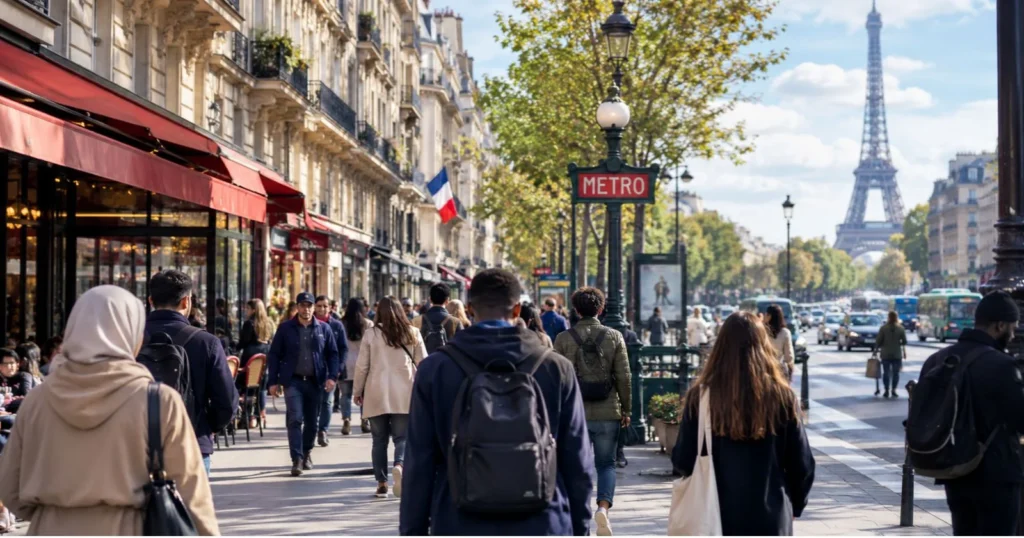
France has one of the most closely watched migration debates in Europe, and in October 2026 that debate moved from television studios to the streets. A weekend of rioting after nationwide protests drew comments from abroad that blamed migrants. French authorities did not make that link. The official statistics, meanwhile, describe a country whose immigrant population is larger than at any point in recent decades, but whose share of foreign nationals still sits below the European Union average.
INSEE, the national statistics agency, counted 7.97 million immigrants living in France in 2025, or 11.6% of the population. The United Nations counts more, at 9.2 million in 2024, because it uses a wider definition. Both figures are correct. They answer different questions. This article covers what France migrant statistics actually measure, where migrants come from, what French law now requires, how the asylum system and the Channel crossings work, what the latest unrest did and did not show, and what the 2027 presidential election could change.
Key facts
- 7.97 million immigrants lived in France in 2025, or 11.6% of the population (INSEE, provisional).
- 6.3 million foreign nationals lived in France in 2025, or 9.1% of the population. The EU average was 9.6% in 2024.
- 49.2% of immigrants were born in Africa and 30.3% in Europe. Algeria, Morocco and Portugal lead the list.
- 313,000 immigrants arrived in 2024, down 10% from 2023.
- 377,462 first residence permits were issued in 2025, and 96,158 foreigners became French citizens.
- 160,303 people were registered as asylum applicants in 2025, and the first-instance protection rate was 41.2%.
- 156,180 removal orders were issued in 2025, and 24,985 were carried out, roughly 16%.
- About 700,000 people are estimated to live in France without legal status, according to the interior minister in October 2025.
- More than 500,000 people joined the October 17, 2026 protests, and at least 2,400 people were arrested over the weekend.
Who Counts as a Migrant in France
France does not use one single definition of a migrant, and the gap between definitions explains most of the confusion in news coverage. INSEE separates people by place of birth and by nationality. An immigrant is a person born abroad as a foreign national who lives in France. Some immigrants later become French citizens and remain immigrants in the statistics. A foreign national is anyone living in France without French nationality, and that includes people born in France.
| Term | Meaning | 2025 figure |
|---|---|---|
| Immigrant | Born abroad as a foreign national, living in France | 7.97 million (11.6%) |
| Foreign national | Lives in France without French nationality | 6.30 million (9.1%) |
| Born abroad | Any person born outside France, including French citizens | 9.63 million (14.0%) |
| Immigrant with foreign nationality | Born abroad and still a foreign national | 5.35 million (7.8%) |
| Foreign national born in France | Born in France without French nationality | 953,000 (1.4%) |
| Descendant of an immigrant | Born in France with at least one immigrant parent | About 8.0 million |
The table holds a useful detail. Of the 7.97 million immigrants, about 5.35 million still hold a foreign passport, which means roughly 2.6 million immigrants have since become French citizens. The UN figure of 9.2 million for 2024 follows the broader foreign-born approach, which is why it runs higher than INSEE’s immigrant count.
Key insight: A headline that says France has 9 million migrants and a headline that says it has 6 million can both be accurate. One counts birthplace, the other counts nationality.
How Many Migrants Live in France
The immigrant population has grown steadily. INSEE reports that the number and share of immigrants in 2025 exceed those of 1946, 1975 and 2010. A change in census collection methods means figures before 2024 are not directly comparable with 2024 and 2025, so the jump between 2023 and 2024 is partly technical.
| Year | Immigrants (thousands) | Share of population |
|---|---|---|
| 2017 | 6,449 | 9.7% |
| 2019 | 6,734 | 10.0% |
| 2021 | 6,932 | 10.2% |
| 2023 | 7,309 | 10.7% |
| 2024 (provisional) | 7,749 | 11.3% |
| 2025 (provisional) | 7,970 | 11.6% |
Source: INSEE, series 1921 to 2025.
The foreign national share tells a different story. It reached 9.1% in 2025, against 6.5% in 1975 and 4.4% in 1946. Compared with its neighbors, France sits lower. In 2024 foreign nationals made up 8.8% of the French population, below the 9.6% EU average reported by Eurostat.
| Measure | France | Comparison |
|---|---|---|
| Foreign nationals, 2024 | 8.8% | EU average 9.6% |
| Foreign nationals, 2025 | 9.1% | 6.5% in 1975, 4.4% in 1946 |
| Immigrants, 2025 | 11.6% | 10.0% in 2019 |
The demographic profile is also specific. Women make up a slight majority of immigrants, with men at 48.3%. Children under 15 account for only 4.9% of immigrants, because most children of immigrants are born in France, while the same age group makes up 17.7% of foreign nationals. About 51.5% of immigrants are aged 25 to 54, which places them in prime working years. According to Wikipedia’s summary of immigration to France, around 40% of immigrants live in the Paris region.
Where France’s Migrants Come From
Africa is the largest region of birth, and the old ties between France and its former colonies still shape the map. In 2025, 49.2% of immigrants were born in Africa and 30.3% in Europe. In 2024, the INSEE split showed Asia at 14.3% and the Americas and Oceania at 5.9%.
| Country of birth | Share of immigrants, 2025 |
|---|---|
| Algeria | 12.6% |
| Morocco | 11.7% |
| Portugal | 7.2% |
| Tunisia | 4.9% |
| Italy | 3.5% |
| Turkey | 3.5% |
| Spain | 3.0% |
The mix is changing. The five leading countries held about 40% of the immigrant population in 2024, down from 50% in 2006, according to INSEE data summarized in the press. Newcomers show a similar pattern. Of immigrants who arrived in 2024, 45.9% were born in Africa and 26.6% in Europe, with Algeria (7.9%), Morocco (7.4%) and Tunisia (4.8%) in front.
| Birth region | Immigrants, 2020 (thousands) | Immigrants, 2025 (thousands) |
|---|---|---|
| Africa | 3,254 | 3,923 |
| Europe | 2,266 | 2,414 |
| Turkey and Middle East | 380 | 461 |
Arrivals fell recently. About 313,000 immigrants entered France in 2024, a 10% drop from 347,000 in 2023 and 16% below the 375,000 recorded in 2022. Nearly half, or 144,000, were born in Africa.
France also has a large second generation. INSEE’s 2025 Enquête Emploi counts about 8 million descendants of immigrants, and almost half have African roots.
| Origin of descendants of immigrants | Number (thousands) | Share |
|---|---|---|
| Africa | 3,879 | 48.3% |
| of which Algeria | 1,250 | 15.6% |
| of which Morocco and Tunisia | 1,287 | 16.0% |
| Europe | 2,938 | 36.6% |
| of which Portugal | 673 | 8.4% |
| Turkey | 311 | 3.9% |
| Other Asian countries | 438 | 5.5% |
A Short History of Migration to France
The Musée national de l’histoire de l’immigration describes France as the oldest country of immigration in Europe. The modern pattern took shape in the decades after 1945, when labor shortages pulled workers from southern Europe and North Africa. Portugal and Algeria remain among the top birthplaces of immigrants today, which reflects that postwar chapter.
| Period | Development | Why it matters |
|---|---|---|
| 1946 | Foreign nationals make up 4.4% of the population | Starting point of postwar reconstruction migration |
| 1962 | Algeria becomes independent | Created lasting family and legal ties with France |
| 1974 | Labor immigration is suspended | Family migration became the main legal channel |
| 1975 | Foreign nationals reach 6.5% | Settlement of earlier workers and families |
| 2005 | Weeks of riots in suburbs, with more than 2,700 arrests | Opened a long debate on integration and policing |
| 2023 | Riots follow the police killing of a teenager during a traffic stop | Brought the same debate back |
| 2024 | A new immigration law is passed | Tightened rules, but a third of it was struck down |
| 2025 | Foreign nationals reach 9.1% | Highest level in INSEE’s series |
| 2026 | EU Pact applies and nationwide unrest erupts | Migration became a central issue for the 2027 vote |
The 2005 riots are a useful comparison. Intelligence officials at the time said radical Islamism had no influence over the unrest. Even so, the interior minister of the day told local authorities to deport foreigners convicted of involvement. The pattern of linking social unrest to migration, then debating the evidence afterward, is not new.
Residence Permits, Visas and Citizenship
Legal migration to France runs mainly through family, study, work and humanitarian channels. More than 4.5 million residence permits were valid at the end of 2025, up around 3% from 2024.
| Indicator | 2024 | 2025 |
|---|---|---|
| First residence permits | 336,710 (preliminary) | 377,462 (ministry release) |
| Visas issued | Not stated | 2,958,607 (up 3.5%) |
| Naturalizations | 101,509 | 96,158 (down 5.3%) |
| Refugee and stateless status permits | 36,990 | 54,230 |
| Subsidiary protection permits | 13,930 | 35,000 |
Algerian nationals rank second for first residence permits and second for naturalizations, with 11,551 acquiring French nationality in 2025. Visas issued to Algerians fell 20% in 2025 even as total visas rose, reflecting tension between Paris and Algiers. A ministry note reported by the JDD said forced departures rose 22.6% in the first half of 2025 while naturalizations fell 8.4%.
Asylum Seekers and Refugees
Asylum is the most visible part of the system and the most strained. The Interior Ministry registered 160,303 asylum applicants in 2025, down from 169,956 in 2024. OFPRA, the refugee protection office, received 145,211 applications, compared with 153,715 a year earlier.
| Asylum indicator, 2025 | Figure |
|---|---|
| Applicants registered by the Interior Ministry | 160,303 |
| Applications lodged with OFPRA | 145,211 (down 5.5%) |
| OFPRA decisions | 156,590 (a record) |
| Protection rate at first instance | 41.2% (up 2.4 points) |
| Average first instance processing time | 5.4 months |
| Adults under temporary protection (December) | 51,885 |
| Applicants without reception conditions (December) | More than 60,000 |
| Top asylum origins in 2025 | Applications |
|---|---|
| Afghanistan | 13,800 |
| Democratic Republic of Congo | 13,240 |
| Haiti | 12,600 |
| Ukraine | 12,310 |
OFPRA cleared a backlog of 15,000 files during 2025, yet the reception side lagged. More than 60,000 applicants had no access to reception conditions by December. Police also cleared a migrant camp near the Stalingrad metro station in Paris in November 2025, an episode that reflected the housing gap.
Irregular Migration, Removals and the Channel
Nobody knows exactly how many people live in France without legal status. Interior Minister Laurent Nuñez said in October 2025 that the best estimate is about 700,000, and that a range of 600,000 to 900,000 was coherent. A Senate report found 465,744 people received State Medical Aid in 2024, a scheme for irregular migrants that also counts nearly 110,000 minors, so it works only as a rough indicator.
| Removals | 2025 |
|---|---|
| Removal orders issued | 156,180 |
| Removals carried out | 24,985 |
| Forced removals | 15,569 |
| Spontaneous departures recorded | 4,852 |
| Share of orders carried out | About 16% |
The gap between orders and removals is a constant political target. Many countries of origin refuse to issue travel papers, and people can appeal or disappear before departure.
The Channel and Calais
Northern France remains the departure point for small boats heading to the United Kingdom. UK figures show 41,472 arrivals by small boat in 2025. By the end of September 2026, around 19,000 people had crossed, roughly 40% below the same point in 2025. The crossings stay deadly. On September 28, 2026, a 10-year-old child and two women died on a boat carrying about 105 people that left from Calais.
On September 30, 2026, the UK government said its “one in, one out” pilot with France was no longer processing new cases. Between August 2025 and June 2026, 1,117 asylum seekers came to the UK from France while 1,087 were returned.
Migrants, Work and the Economy
The labor market numbers show a persistent gap. INSEE’s 2025 Enquête Emploi found 61.9% of immigrants aged 15 to 64 in employment, against 69.3% for the total population. Unemployment among active immigrants stood at 12.4%, against 7.7% overall.
| Group (ages 15 to 64, 2025) | Employment rate | Unemployment rate | Inactivity rate |
|---|---|---|---|
| All immigrants | 61.9% | 12.4% | 29.3% |
| Immigrants born in Africa | 60.7% | 13.8% | 29.7% |
| Immigrants from other EU countries | 70.3% | 8.3% | 23.3% |
| Descendants of immigrants | 59.5% | 11.7% | 32.6% |
| Total population | 69.3% | 7.7% | 24.9% |
Part of the gap comes from language, recent arrival and the share of women who are outside the labor market. Part does not. A 2025 government answer to a parliamentary question, citing INSEE, said half of the unemployment gap for immigrants remains unexplained after accounting for individual characteristics, and more than two thirds for descendants of immigrants. That pattern is consistent with discrimination in hiring.
Key insight: The unemployment gap affects people born in France too. Descendants of immigrants, who are mostly French citizens, still show an unemployment rate of 11.7%.
Government Policy From the 2024 Law to the EU Pact
French migration policy has moved in one direction since 2024, toward tighter conditions, faster procedures and more enforcement. The courts and the EU have shaped the result as much as ministers.
| Date | Measure | Outcome |
|---|---|---|
| January 2024 | Immigration law passed after a bitter debate | The Constitutional Council struck 35 of 86 articles, 32 on procedural grounds and 3 on substance, including migration quotas |
| September 2024 to October 2025 | Bruno Retailleau at the Interior Ministry | Higher arrests and forced departures, fewer naturalizations |
| 2025 | National Assembly votes 185 to 184 on a resolution to scrap the 1968 Algeria accord | Government chose to pursue reform rather than withdrawal |
| October 2025 | Laurent Nuñez becomes interior minister | Estimate of 700,000 irregular migrants announced |
| January 2026 | Language requirements for multi-year permits | A2 level French needed for most multi-year permits |
| April 2026 | Draft enabling law presented to adapt national law to the EU Pact | Government prepared to legislate by decree |
| May 2026 | Justice Minister Gérald Darmanin proposes a three year pause on some legal immigration | Not government policy, but it shifted the debate |
| June 12, 2026 | EU Pact on Migration and Asylum applies | Border screening, new procedures, new return rules |
| September 30, 2026 | UK ends the one in, one out pilot | Channel cooperation reset |
The EU Pact is the largest structural change. The French government did not pass the necessary laws before the deadline and used decrees and a ministerial circular instead. Nuñez warned that without French transposition, nearly everyone arriving at the border would be admitted. Implementation requires border screening, modernized biometric systems, and added reception and detention capacity.
Darmanin defended his proposal for a pause with a blunt argument.
“We have reached the limits of our integration capacities.”
He also called for a constitutional change to allow binding quotas, after the Constitutional Council struck the 2024 version. On Algeria, a CSA poll commissioned by CNews, Europe 1 and the JDD found 74% of voters wanted the 1968 accord ended, while the government said it would push for renegotiation.
The October 2026 Unrest and the Migration Debate
The latest violence began as a school protest. Students started demonstrating in September over crumbling schools, crowded classes and teacher shortages. The movement widened into a national protest about living costs and public services. On Saturday, October 17, more than 500,000 people marched, according to authorities.
| Date | Event |
|---|---|
| September 2026 | Student protests over school conditions begin |
| October 17 | Mass marches. Masked groups set fires, loot shops and attack public buildings. Limoges town hall burns, Marseille city hall is stormed, and the tourist office in Lyon is set alight |
| October 18 to 19 | Macron condemns the violence. Arrests reach nearly 2,400 |
| October 19 | Curfews in parts of Paris, Nice and Lyon, gatherings banned in Marseille. Macron refuses Nuñez’s resignation |
| October 24 | New demonstrations called by Yellow Vest organizers |
The Interior Ministry reported nearly 1,000 police officers and firefighters injured, and the Justice Ministry later put the arrest total above 2,500.
What was said about migrants
President Donald Trump posted that France was burning and tied the unrest to immigration, saying migrants had taken over the country. French officials took a different view. Prime Minister Sébastien Lecornu blamed an “ultra-left movement” for part of the violence and warned that a national state of emergency was possible. Macron condemned those who tried to bring down the republic and asked a question of the rioters.
“How can French people do this to France?”
| Claim | What the reporting shows |
|---|---|
| Migrants caused the riots | French authorities have not linked immigrants to the rioting. Fact checkers found the evidence does not show immigration drove the protests |
| The unrest was about immigration | The protests began with students and unions over schools and living costs |
| Those arrested were mostly foreign | Reports differ on age, and no official nationality breakdown appeared in the coverage reviewed |
| Rioters were all part of the protest movement | Officials said groups of looters and radical far-left elements joined the marches |
| The unrest has no migration dimension at all | Immigration is a live issue in French politics, and the 2027 vote will test it |
Some commentators pointed to the backgrounds of certain offenders. Fact checkers said those claims do not establish that immigration drove the movement. Until prosecutors publish a breakdown of those charged, any statement about the nationality or origin of rioters rests on assumption rather than data.
How it compares with earlier unrest
| Episode | Trigger | Migration link |
|---|---|---|
| 2005 riots | Deaths of two boys in a suburb | Intelligence officials said radical Islamism had no influence, yet deportation of convicted foreigners was ordered |
| 2023 riots | Police killing of a teenager at a traffic stop | Debate focused on policing, suburbs and integration |
| 2026 unrest | School conditions and living costs | Authorities have not linked it to immigrants |
The 2026 events are not the first time politicians have tied violence to migration, and the evidence in each case pointed toward social and policing causes.
Challenges Facing France and Its Migrants
| Challenge | Evidence | Who is affected |
|---|---|---|
| Reception capacity | More than 60,000 asylum applicants without reception conditions in December 2025 | Asylum seekers, local authorities |
| Processing time | 5.4 months at first instance in 2025 | Applicants, OFPRA staff |
| Labor market gap | 12.4% unemployment among immigrants versus 7.7% overall | Immigrants and their children |
| Enforcement gap | About 16% of removal orders carried out | Government, prefectures |
| Irregular status | Estimated 600,000 to 900,000 people | Undocumented residents |
| Border deaths | Deaths in the Channel in April and September 2026 | Migrants, rescue services |
| Diplomatic friction | Algeria accord dispute, 20% fall in visas for Algerians | Families and students |
| Legal uncertainty | Pact applied through decrees and a circular | Courts, NGOs, prefectures |
| Public trust | Riots and election politics | Entire society |
The Future of Migration in France
Four forces will shape the next phase.
The 2027 election: The presidential vote is scheduled for April 2027, with a possible runoff in May. Immigration is expected to be one of the dominant issues. Jordan Bardella, who leads the National Rally, has pledged to take back control of migration if his party wins. Darmanin’s proposal for a pause shows that the debate has also moved inside the governing camp.
Pact implementation: France applied the EU Pact by decree in June 2026. Courts, NGOs and prefectures will test how the new border screening and return rules work in practice, and a legislative text may still be required.
Algeria: The 1968 accord and the wider network of agreements remain a flashpoint. Visas to Algerians fell 20% in 2025, and the National Assembly has already voted once to scrap the accord.
The Channel: With the UK pilot closed, the next arrangement between Paris and London will matter for northern France. Crossings fell around 40% in 2026, but fatal incidents continue.
| What to watch | Why it matters | Timing |
|---|---|---|
| Presidential first round | Candidates will set migration positions | April 2027 |
| Pact court challenges | Decree route may face legal tests | 2026 and 2027 |
| New INSEE release | Shows whether the 11.6% immigrant share keeps rising | 2027 |
| Algeria talks | Affects visas, permits and removals | Ongoing |
| Channel deal | Determines policing and returns | Under negotiation |
| Prosecutor data on riot suspects | Would settle claims about the origin of rioters | Pending |
Conclusion
The record on migrants in France is easier to read than the debate suggests. The immigrant population stands at about 8 million, nearly half born in Africa, with Algeria, Morocco and Portugal leading. Asylum applications are falling slightly, removals are rising, and naturalizations are down. The labor market gap is real and partly unexplained.
The October 2026 unrest was a protest about schools and living costs that turned violent, and French authorities have not tied it to immigrants. France now enters a presidential campaign in which each of these numbers will be contested, and the sources behind them will matter more than the slogans.
Recommended Articles Related to France Population & Policy:
- France’s Immigration Challenges and Future
- How Religion Is Changing in France
- Can France Reverse Its Population Decline?
- France’s Growing Ageing Population
- Immigration’s Role in France’s Population Growth
- How Second Generation Immigrants Are Shaping France
- France’s Regional Population Winners and Losers
- How Demographics Are Reshaping France’s Elections
- France’s Pension Crisis: Fewer Workers, More Retirees
- France’s Religious Diversity and the Future of Laïcité
- Why French Households Are Getting Smaller
- Why Are Fewer French Families Having Children?
Frequently Asked Questions
How many migrants are in France?
INSEE counted 7.97 million immigrants in 2025, or 11.6% of the population, and 6.3 million foreign nationals, or 9.1%. The UN estimate of 9.2 million for 2024 uses the broader foreign-born definition.
Where do most migrants in France come from?
About 49.2% of immigrants were born in Africa and 30.3% in Europe. Algeria (12.6%), Morocco (11.7%) and Portugal (7.2%) are the top birth countries.
Does France accept migrants?
Yes. France issued 377,462 first residence permits in 2025 and granted protection to about 41% of asylum applicants at first instance. It also tightened rules in 2024 and 2026.
Who are the main immigrants in France?
Immigrants born in Algeria, Morocco, Portugal, Tunisia, Italy, Turkey and Spain account for about 46% of the total. Newer arrivals include applicants from Afghanistan, the Democratic Republic of Congo, Haiti and Ukraine.
Is France friendly to immigrants?
Experiences vary. Legal routes exist and about 96,000 people became French in 2025, but immigrants face higher unemployment, and reception capacity for asylum seekers is stretched.
What is the French protest about?
The October 2026 protests grew from student anger over school conditions and spread into a national protest over living costs and public services. Violence on October 17 led to about 2,400 arrests.
Did migrants cause the riots in France?
French authorities have not linked immigrants to the rioting, and fact checkers say the evidence does not show immigration drove the protests. No official nationality breakdown of those arrested had appeared in the coverage reviewed.
How many undocumented migrants live in France?
The exact figure is unknown. The interior minister estimated about 700,000 in October 2025, with 600,000 to 900,000 considered coherent.
What is the EU Pact on Migration and Asylum?
It is an EU framework that began to apply on June 12, 2026. It introduces border screening, new asylum procedures and return rules, and France implemented it by decree and circular.
What could change after the 2027 election?
Candidates are debating pauses on legal immigration, binding quotas, changes to the Algeria accord and tighter border rules. Any large change would likely need legislation or a constitutional amendment.
Sources
- INSEE, population immigrée et étrangère en France, données annuelles 1921 to 2025, and L’essentiel sur les immigrés et les étrangers (2025)
- INSEE, répartition des immigrés par pays de naissance, origine des descendants d’immigrés, activité et emploi par origine (Enquête Emploi 2025)
- INSEE, En 2024, 6,0 millions d’étrangers vivent en France (October 2025), as reported by Maire-info and Journal de l’économie
- Connexion France, report on INSEE migration flows 2024
- Interior Ministry (DGEF), immigration statistics 2025, as reported by AIDA, EUAA and Algérie-Éco
- OFPRA, Bilan 2025, via the EUAA Database on International Protection
- ECRE and AIDA, country report on France, update on 2025
- Assemblée nationale, written questions and government answers on removals and irregular migration (2025 and 2026)
- Sénat, written question on State Medical Aid (October 2025)
- Reuters via China Daily Hong Kong, French deportations 2024 (February 2025)
- Constitutional Council decision of January 25, 2024, as reported by LCP and Maire-info
- Public Sénat, hearing of Laurent Nuñez on the EU Pact (June 2026)
- Assemblée nationale, question to the government no. 1602 (May 28, 2026)
- EUAA, ministerial circular on the Pact (June 11, 2026)
- Connexion France, Darmanin proposal for a three year pause (May 2026)
- The Spectator, Algeria accord vote and CSA poll
- Hespress, Nuñez estimate of 700,000 undocumented migrants (October 2025)
- UK Home Office figures and AP, end of the one in, one out pilot (September 30, 2026)
- BBC and Al Jazeera, Channel crossings and deaths (2026)
- CBS News, NBC News, PBS NewsHour and CNBC, coverage of the October 2026 unrest
- TRT World and MEAWW, fact checks on immigration claims (October 2026)
- Fox News, Trump and Waltz comments on France (October 2026)
- Musée national de l’histoire de l’immigration
- Wikipedia, 2005 French riots and Immigration to France





