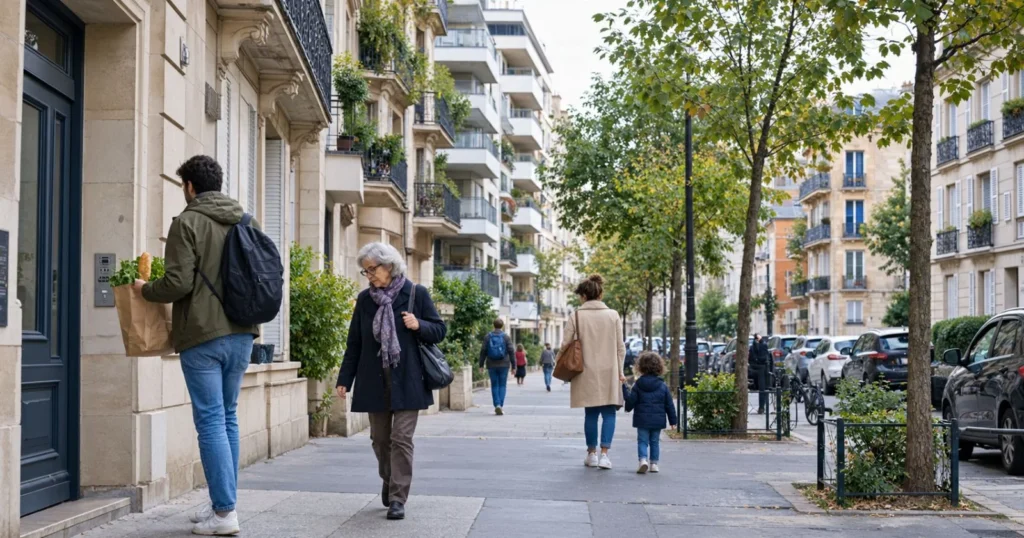
France’s demographic landscape is shifting in ways that go far beyond simple population counts. The country now has about 69.1 million people as of early 2026, yet the number of households keeps growing faster than the population itself. Smaller families, more people living alone, and a rising share of older adults are reshaping everyday life and putting new pressure on housing and local services.
INSEE data put the number of households at roughly 31 million in recent years. The average household size has dropped from 2.59 people in 1990 to 2.14 in 2023, with the latest figures hovering near 2.1. Nearly 39 percent of households now consist of just one person. These changes matter because housing needs depend more on the number of households than on the total headcount. Even as population growth slows, demand for dwellings continues to rise.
How are French households changing?
The number of households in France
In official statistics a household includes everyone who lives in the same main residence. This is different from the total population figure, which also counts people living in institutions such as retirement homes or student residences.
France had around 31 million households by the mid-2020s. That is a big jump from about 22 million in 1990 and roughly 30 million in 2018. Between 2008 and 2018 the number of households rose by an average of about 248,000 each year. Population growth has slowed to just 0.25 percent in both 2024 and 2025, but the number of separate households keeps climbing because more people are living on their own or in smaller groups.
Average household size over time
The average number of people sharing a home has been falling for decades. INSEE figures show:
- 1990: 2.59
- 1999: 2.42
- 2007: 2.30
- 2012: 2.26
- 2017: 2.21
- 2023: 2.14
Recent estimates sit near 2.1. Larger households have become rarer. In 2023 only about 5.4 percent of homes had five or more people. One-person households, by contrast, rose from 27 percent in 1990 to 38.9 percent in 2023. When the same number of people spreads across more dwellings, housing demand rises even if the overall population barely grows.
One-person households and couples without children
Living alone is now the most common arrangement. In 2023 almost four in ten households contained just one person. Women living alone still outnumber men (roughly 21.7 percent of all households versus 17.4 percent), though the number of men living alone has grown faster among working-age adults.
Couples without children at home make up about 25 percent of households, or around 7.8 million in 2023. Couples with children have declined both in absolute numbers and as a share of the total, falling from 36.4 percent of households in 1990 to 22.9 percent in 2023. Single-parent households now account for about 9.5 percent of the total. These patterns show up clearly in the 2022 and 2023 census data and in the annual demographic reports that followed.
Why are French households getting smaller?
Population ageing and older people living alone
France is getting older. By 1 January 2026, 22 percent of the population was aged 65 or over, almost matching the share under 20. The number of people in this age group reached about 14.9 million by early 2025 and is still rising.
INSEE analysis of 2021 data found that one in three people aged 65 or over lived alone in their own home. The share climbs with age: nearly half of those aged 85 and older live alone. Women are more likely to live alone than men because they live longer and because husbands tend to be older than their wives. After 85, only 14 percent of women still live with a partner, compared with 55 percent of men.
Widowhood, a clear preference for staying independent, and fewer multi-generational homes all play a part. Living with relatives other than a spouse has become less common. Most older people stay in ordinary housing until quite advanced ages. Institutional living only becomes more frequent after 85. Longer life expectancy (85.9 years for women and 80.3 for men in 2025) simply means more years spent in smaller households.
Delayed parenthood and smaller families
Fertility has fallen steadily. The total fertility rate reached 1.62 children per woman in 2024 and dropped further to 1.56 in 2025, the lowest level since the end of the First World War. Only about 645,000 babies were born in 2025, more than 20 percent fewer than the peak of over 800,000 in 2010.
Women are having children later and having fewer of them overall. This shrinks the number of households with children and pulls down average household size. Housing costs, economic uncertainty, longer education and changing attitudes all influence these decisions. Official reports are careful not to blame housing alone for the fertility decline.
Separation, partnership changes, and family structure
Family life has become more varied. In 2023, 30 percent of children under 18 lived with only one of their parents, up slightly from 28 percent in 2018. Most of them lived with their mother. Single-parent families accounted for 23 percent of children, while stepfamilies accounted for another 10 percent.
Single-parent households now make up about 9.5 percent of all households. Divorce, separation and the end of non-married partnerships create extra independent living units. Complex households that contain more than one family or unrelated adults have become less common as a share of the total.
Migration and international household formation
Net migration is now the main reason the population is still growing. The natural balance (births minus deaths) turned negative in 2025 for the first time since the post-war years. Household patterns among people with a migration background are not uniform. Some groups form larger multi-generational homes, especially in certain overseas departments and in some urban neighbourhoods. Others live in arrangements closer to the national average of smaller units. Official statistics stress the differences by origin, length of residence and income rather than treating all immigrant households as the same.
Track Real-time Population Growth @ FRANCE POPULATION CLOCK
How does household change affect housing demand?
Why household growth can outpace population growth
The arithmetic is simple. When the average number of people per home falls, more homes are needed to house the same population. With population growth slowing and household size still shrinking, the number of households can keep rising. INSEE and housing ministry projections show that changes in the way people live together now matter more than pure population growth.
Demand for apartments, family homes, and accessible housing
Smaller households and a larger older population increase demand for apartments, especially one- and two-bedroom places, and for homes that are easy to move around in (ground-floor flats, lifts, adapted bathrooms, and locations close to shops and medical services). Family-sized houses are still needed, but they form a smaller share of overall demand. Dense cities feel the strongest pressure for compact rental units. Some rural areas have the opposite problem: larger houses that are under-occupied.
Housing affordability and family formation
Housing costs remain a heavy burden for many. Rents and purchase prices take a noticeable slice of household income, especially in Paris and other large cities. High costs can delay the moment when young adults form their own households and can influence decisions about having children, though many other factors are also at work. In 2025 and 2026 the market cooled after earlier rises. Existing-home prices softened in parts of 2026, annual transactions settled around 950,000 to 960,000, and new-build activity stayed weak. Mortgage rates in late 2026 were running between roughly 3.1 and 3.5 percent, which limited how much people could borrow.
Single-person and single-parent households often feel the pressure most because their incomes tend to be lower once household size is taken into account.
How does ageing change the housing market?
Accessible homes for older adults
As the number of people aged 65 and over grows, so does the need for homes with lifts, step-free access, adapted bathrooms and good access to health services and daily shops. Many older people want to stay in their current homes for as long as possible, which creates demand for adaptations rather than wholesale moves.
Downsizing and housing turnover
Some older households do move to smaller or more convenient places, or closer to family and services. Others stay put for emotional, financial or practical reasons. The overall turnover linked to ageing is gradual. Projections point to a steady rise in older one-person households that will shape the market for decades.
Older people living alone and social isolation
Living alone is common among older adults, but it does not automatically mean loneliness. Official research separates the physical living arrangement from the quality of social connections. Many older people who live alone keep regular contact with family and friends. Policy attention focuses on those who really are isolated, especially the oldest and those with limited mobility or low income.
Illustrative future household projections
| Scenario | Households around 2018 | Households 2050 | Change |
|---|---|---|---|
| Central | ~30 million | ~34 million | +4 million |
| High | ~30 million | ~36 million | +6 million |
| Low | ~30 million | ~32 million | +2 million |
How do household patterns vary across France?
Paris and large metropolitan areas
Île-de-France and other big cities have higher shares of small households, more renters, and sharper affordability problems. Average household size is often lower and one-person households are more common among both young adults and older residents. The concentration of people intensifies competition for compact homes. Projections for Île-de-France alone point to hundreds of thousands of extra households by 2050.
Rural France and smaller towns
Rural areas and smaller towns tend to have older populations and higher proportions of older people living alone. Housing may be more available in absolute terms, yet shops, health services and public transport are often thinner, which makes independent living harder. Some departments are expected to see actual declines in the number of households if current trends continue.
Overseas departments and territorial differences
The overseas departments show different patterns. Average household sizes can be larger, and single-parent families are more common. INSEE publishes consistent figures that allow proper comparison with mainland France. Housing needs and pressure on local services therefore vary widely across the national territory.
What will France’s household structure look like in 2050?
INSEE’s household projections (the main exercise covering 2018 to 2050, later updated with newer population figures) show that the number of households will keep rising even though overall population growth is slowing and is expected to turn negative after a peak around 2037 (projected high of about 69.8 million people).
Under central assumptions that continue recent trends in fertility, mortality, migration and living arrangements, France would have around 34 million households in 2050. The full range across scenarios is 32 to 36 million. That means an increase of between 2 and 6 million households compared with 2018. Most of the extra households will be people living alone (especially those over 60) and single-parent families. Population growth itself will contribute far less.
The projections assume further declines in average household size, higher shares of adults living alone or in one-parent families, and slower but still positive net household formation. Differences between regions are expected to remain or widen. Some departments could lose households in absolute terms while major urban areas continue to gain.
These numbers are essential for housing policy, infrastructure planning and social services. They show that France will still need more dwellings for decades even if the total population stabilises or falls.
Household composition trends (selected years, France excluding Mayotte where specified)
| Household type | Approx. share 1990 | Approx. share 2023 | Notes |
|---|---|---|---|
| One person | 27% | 38.9% | Strong growth |
| Couple without children | 23.4% | ~25% | Stable to slight fall |
| Couple with children | 36.4% | 22.9% | Clear decline |
| Single-parent | 6.8% | 9.5% | Steady rise |
| Average size | 2.59 | 2.14 | Continuous decline |
Recommended Articles Related to France Population & Policy:
- France’s Immigration Challenges and Future
- How Religion Is Changing in France
- Can France Reverse Its Population Decline?
- France’s Growing Ageing Population
- Immigration’s Role in France’s Population Growth
- How Second Generation Immigrants Are Shaping France
- France’s Regional Population Winners and Losers
- How Demographics Are Reshaping France’s Elections
- France’s Pension Crisis: Fewer Workers, More Retirees
- France’s Religious Diversity and the Future of Laïcité
- Why Are Fewer French Families Having Children?
- Migrants in France Today: The Numbers Behind the Headlines
FAQs
1. What is the average household size in France?
About 2.14 people per household in 2023 according to INSEE, with more recent estimates near 2.1. It has fallen steadily from 2.59 in 1990.
2. How many people live alone in France?
Nearly 39 percent of households are one-person households (2023 data). Roughly one in three people aged 65 or over live alone in their own home.
3. Why are French households getting smaller?
The main reasons are population ageing (more older people living alone), later and lower fertility, more separations that create extra independent units, and a move away from multi-generational living.
4. How does population ageing affect housing demand?
It increases the need for accessible, adaptable and often smaller homes located near services. Many older adults prefer to stay where they are and adapt their current home.
5. Are smaller households contributing to France’s housing shortage?
Yes. A falling average household size means more dwellings are needed for the same number of people. This effect has become the main driver of household growth as population increases slow.
6. How does household composition differ between Paris and rural France?
Paris and large cities have more small and one-person households, higher shares of renters and tighter affordability. Rural areas often have older age profiles, more older people living alone, and different challenges around local services.
7. How many households will France have by 2050?
INSEE projections put the figure between 32 and 36 million, with a central estimate around 34 million, depending on the assumptions used for population and living arrangements.