The number of people living on drylands has nearly doubled in three decades, from 1.2 billion in 1990 to 2.3 billion in 2020, according to the UN Convention to Combat Desertification (UNCCD). That means close to three in ten people on Earth already live in a landscape defined by water scarcity, and UNCCD modeling suggests that figure could reach as many as 5 billion by 2100 under a high emissions scenario.
Drylands now cover 40.6 percent of the planet’s land surface, having expanded by roughly 4.3 million square kilometers, an area almost a third larger than India, since 1990. The paradox at the center of this topic is straightforward: some of the driest inhabited places on Earth are also among the most densely populated, from the irrigated floodplains of the Nile to the sprawling desert metropolises of the Arabian Peninsula.
What Counts as an Arid Region?
Aridity is typically measured using the aridity index, the ratio of average annual precipitation to potential evaporation. Land is classified along a spectrum from hyperarid (true desert, almost no rainfall) through arid and semiarid to dry subhumid. Everything in this spectrum falls under the broader UNCCD category of “drylands.” This is an important distinction because population figures for “drylands” (2.3 billion) are far larger than figures for “deserts” specifically, since drylands include large areas of semiarid grassland and rangeland that support substantial agriculture and cities.
How Many People Live in the World’s Drylands
| Year | Global Dryland Population | Share of World Population |
|---|---|---|
| 1990 | 1.2 billion | approx. 23% |
| 2020 | 2.3 billion | approx. 29% |
| 2100 (projected, high emissions) | up to 5.0 billion | modeled, not a forecast |
Source: UNCCD, “The Global Threat of Drying Lands,” released at COP16 in Riyadh. The 2100 figure is explicitly a scenario based projection under continued high greenhouse gas emissions, not a central forecast, and the UNCCD itself frames it as a warning about what unchecked drying could mean rather than an expected outcome.
About half of the world’s dryland inhabitants live in Asia and Africa, including large parts of India and northeastern China, while another substantial share lives in the Sahel, the Middle East, and parts of Australia and the western Americas.
Where the World’s Dryland Populations Are Concentrated
North Africa and the Sahara
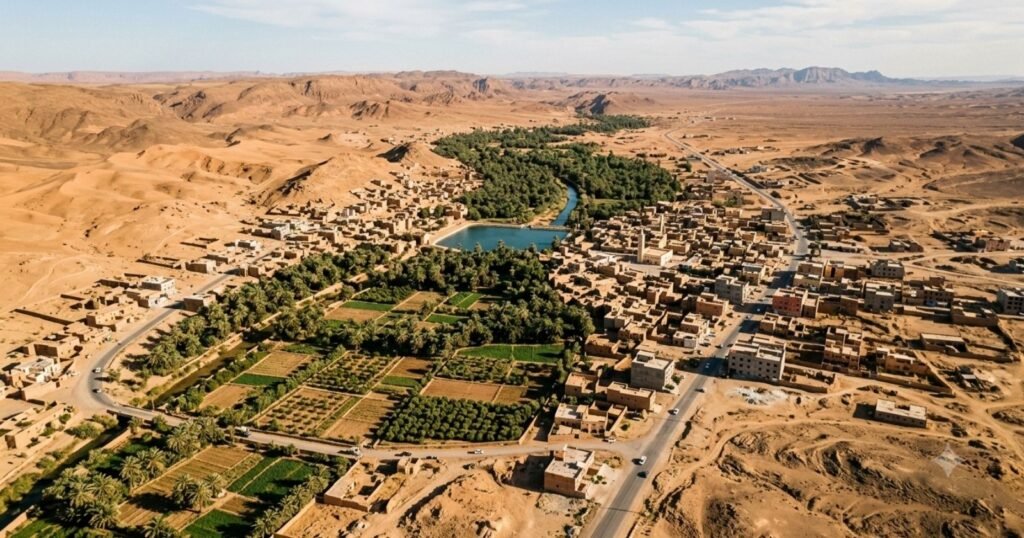
The Sahara itself, true hyperarid desert, is sparsely populated outside of oases and the Nile corridor. But North Africa’s broader dryland zone, including the semiarid fringes of Morocco, Algeria, and Tunisia, supports tens of millions of people through groundwater irrigation and coastal agriculture.
The Sahel
The Sahel, the semiarid band stretching from Senegal to Sudan, is one of the fastest growing dryland populations on Earth. Niger, at the heart of the Sahel, has one of the highest fertility rates in the world, above 6 children per woman as of the mid-2020s, meaning its dryland population is expanding even as land degradation accelerates.
The Middle East and Arabian Peninsula
This is the clearest example of dense urban populations built almost entirely on engineered water supply. Saudi Arabia, the UAE, and Qatar sustain metropolitan populations in the millions using desalination and deep groundwater extraction rather than any natural surface water source of consequence.
Central and Western Asia
Countries like Uzbekistan, Turkmenistan, and parts of Kazakhstan support large agricultural populations dependent almost entirely on river fed irrigation, a legacy of Soviet era canal systems that diverted so much water from the Amu Darya and Syr Darya rivers that the Aral Sea lost more than 90 percent of its volume.
Western China
The dryland zones of Xinjiang and Inner Mongolia support tens of millions of people, with agriculture concentrated in irrigated oasis corridors along historic Silk Road routes.
Australia
Australia’s arid interior is sparsely populated, but its dryland zone, which covers around 70 percent of the continent, includes major cities like Adelaide and Perth on its margins, illustrating how coastal proximity can offset inland aridity.
Why Cities Thrive in Extremely Dry Places
Desalination has been the single biggest technological driver of dryland urbanization in the Gulf states. Saudi Arabia alone operates some of the largest desalination capacity in the world, and Gulf states collectively account for roughly half of global desalination output. Groundwater, often drawn from ancient, non-renewable aquifers, has similarly allowed cities like Riyadh and Phoenix to grow far beyond what local rainfall could ever support.
This means dryland urban population growth is increasingly decoupled from local water availability and instead depends on energy intensive infrastructure and, in many cases, finite groundwater reserves that are being depleted faster than they recharge.
Agriculture and Livelihoods in Drylands
Over 50 percent of the people living in the world’s dryland forest zones rely on agriculture or pastoralism for their livelihoods, according to FAO estimates. Pastoralism, herding livestock across marginal rangeland, remains a primary livelihood across the Sahel, the Horn of Africa, and Central Asia, though it is under sustained pressure from both land degradation and, in some regions, conflict over shrinking grazing land.
Population Growth Meeting Water Stress
| Region | Approx. Dryland Population Share | Key Water Constraint |
|---|---|---|
| Sub-Saharan Africa (Sahel) | Rapidly growing | Rain fed agriculture, high fertility |
| Middle East / Gulf | Urban, engineered supply | Desalination, groundwater depletion |
| Central/Western Asia | Irrigation dependent | Shared river systems, historic overuse |
| Western China | Oasis agriculture | River diversion, groundwater |
| Australia | Coastal margin cities | Reservoir and desalination mix |
The UNCCD’s Riyadh report also projected that drought could affect 75 percent of the world’s population by 2050 in some form, a figure that reflects the increasing frequency and geographic spread of drought conditions rather than permanent dryland residency alone.
Climate Change and the Future of Dryland Populations
Land degradation already affects more than 70 percent of global drylands, according to the Global Land Outlook, and climate models generally project further aridification across the Mediterranean, southern Africa, and parts of the Americas. Between 2007 and 2017, droughts affected more than 1.5 billion people worldwide and cost an estimated 125 billion dollars, a toll that has since grown; UNCCD now puts the annual global cost of drought above 300 billion dollars.
The core policy question for the coming decades is not whether dryland populations will keep growing, since demographic momentum in Africa and parts of Asia makes that likely regardless of climate trends, but whether water infrastructure and land management can keep pace with both population growth and a drying climate simultaneously.
Key Findings
- The global dryland population nearly doubled from 1.2 billion in 1990 to 2.3 billion in 2020, according to UNCCD.
- Drylands now cover 40.6 percent of Earth’s land surface, having expanded by 4.3 million square kilometers since 1990, an area larger than India.
- UNCCD modeling suggests dryland population could reach 5 billion by 2100 under continued high emissions, though this is explicitly a scenario, not a forecast.
- Drought is projected to affect 75 percent of the world’s population in some form by 2050.
- More than 70 percent of global drylands already show signs of land degradation.
- Gulf states sustain multi million person cities almost entirely through desalination and groundwater rather than natural surface water.
Frequently Asked Questions
1. How many people live in drylands?
Around 2.3 billion people lived in the world’s drylands as of 2020, according to the UN Convention to Combat Desertification, nearly double the 1.2 billion recorded in 1990.
2. What is the difference between a dryland and a desert?
Drylands are a broad category including hyperarid deserts, arid land, semiarid land, and dry subhumid land. Deserts specifically refer only to the driest, hyperarid end of that spectrum, so far fewer people live in true desert than in the broader dryland category.
3. Can cities survive in extremely arid regions?
Yes, through engineered water supply. Gulf cities like Riyadh, Dubai, and Doha rely heavily on desalination and groundwater rather than local rainfall, allowing multi million person populations to exist in some of the driest inhabited environments on Earth.
4. Which region has the largest dryland population?
Asia and Africa together are home to about half the world’s dryland population, including large parts of India, northeastern China, and the Sahel.
5. Will dryland populations keep growing?
Very likely in Sub-Saharan Africa, given high fertility rates in Sahel countries like Niger, even as land degradation and drought risk increase in parallel.
6. How much of Earth’s land is now classified as dryland?
40.6 percent of the planet’s land surface, according to UNCCD’s 2024 assessment, up from a smaller share three decades earlier.
7. What percentage of the world could face drought by 2050?
UNCCD projects that drought could affect roughly 75 percent of the world’s population in some form by 2050.
8. How dependent is agriculture on drylands?
More than half of the people living in dryland forest zones rely directly on agriculture or pastoralism for their livelihoods.
9. Is the Aral Sea disaster linked to dryland population growth?
Yes. Soviet era irrigation expansion to support agricultural population growth in Central Asia’s drylands diverted so much water from the Amu Darya and Syr Darya rivers that the Aral Sea lost more than 90 percent of its volume.
10. Could the world’s dryland population reach 5 billion?
That figure comes from a UNCCD high emissions scenario for 2100, not a central projection. It illustrates a possible outcome if global emissions and land degradation continue on their current trajectory, rather than a number that is expected to occur regardless of policy choices.
Sources
- United Nations Convention to Combat Desertification (UNCCD), “The Global Threat of Drying Lands,” 2024
- UNCCD, Global Land Outlook 2.1
- FAO, Dryland Forests and Agrosilvopastoral Systems reports, 2025
- World Bank and national statistical agencies, urban water infrastructure data