Mountains cover roughly a quarter of Earth’s land surface but are frequently imagined as nearly empty. They are not. According to the FAO’s most recent global assessment, the world’s mountain population reached close to 1.19 billion people by 2030 projections, up from an estimated 1.1 billion in 2017 and just 718 million as recently as 2000. That growth trajectory means mountain regions have added roughly as many people in three decades as the entire population of the United States and Mexico combined.
The scale is easy to underestimate because mountain populations are geographically scattered rather than concentrated in a handful of visible mega cities. But taken together, they represent close to 14 to 15 percent of the world’s population, living everywhere from the Andean altiplano to the Ethiopian highlands to the valleys of the Alps.
What Counts as a Mountain Population?
Mountain classification is not standardized globally. The most widely used framework, developed by UNEP-WCMC, defines mountains using a combination of elevation and slope across six classes, together covering about 22 to 27 percent of Earth’s land surface depending on the exact dataset used. This is why population figures for “mountain regions” vary across studies: a broader elevation threshold captures more foothill population, while a stricter one captures only high altitude settlement.
How Many People Live in Mountain Regions
| Year | Global Mountain Population | Share of World Population |
|---|---|---|
| 2000 | 718 million | approx. 11.7% |
| 2012 | approx. 1.01 billion | approx. 14.3% |
| 2017 | approx. 1.1 billion | approx. 15% |
| 2030 (projected) | approx. 1.19 billion | modeled by FAO/Mountain Partnership |
Source: FAO and Mountain Partnership Secretariat technical briefs, using UNEP-WCMC mountain classification. Between 2012 and 2017 alone, the mountain population grew by 89 million people, with 86 million of that growth occurring in developing countries specifically.
Where Mountain Populations Are Concentrated
The Himalayas
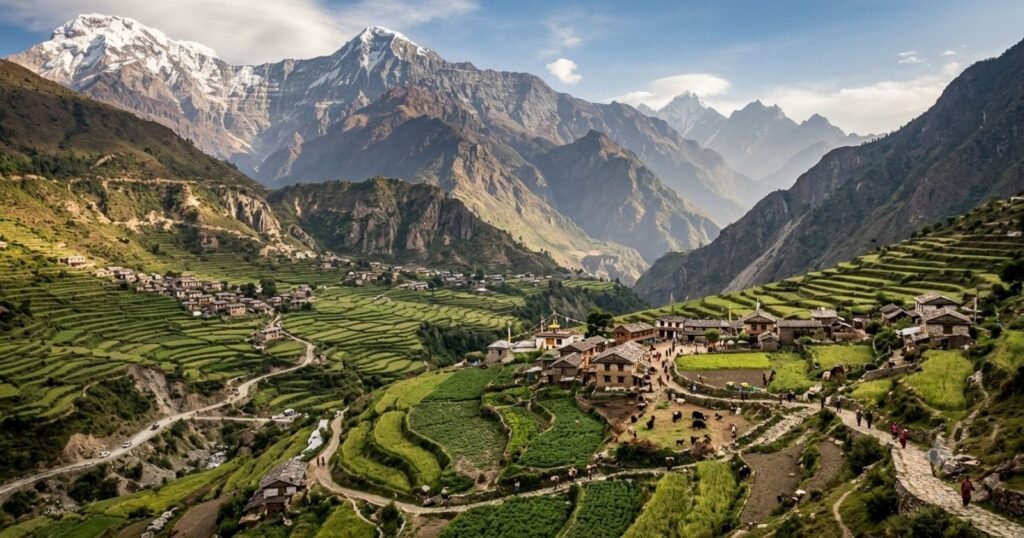
Home to hundreds of millions of people across Nepal, northern India, Bhutan, and parts of China and Pakistan, the Himalayan region combines dense valley agriculture with some of the highest permanently inhabited settlements on Earth. Kathmandu’s valley alone holds several million people at an elevation above 1,300 meters.
The Andes
Stretching more than 7,000 kilometers along the western edge of South America, the Andes support major high altitude cities including La Paz and El Alto in Bolivia, both above 3,600 meters, along with large agricultural populations across the Peruvian and Ecuadorian highlands.
The Ethiopian Highlands
One of the most densely populated mountain regions in Africa, the Ethiopian highlands support the majority of the country’s roughly 130 million people through terraced agriculture at elevations between 1,500 and 3,000 meters, a pattern of settlement dating back thousands of years.
The European Alps
A smaller population in absolute terms but one of the wealthiest and most urbanized mountain regions on Earth, supporting cities like Innsbruck and Grenoble alongside a tourism economy that brings tens of millions of annual visitors to a permanent resident population of roughly 14 million across eight countries.
The Rocky Mountains and Western North America
A comparatively sparse mountain population by global standards, but a rapidly growing one, driven by lifestyle migration to cities like Denver and Salt Lake City that sit at the mountain fringe rather than deep within the range itself.
East African Highlands
Beyond Ethiopia, the highlands of Kenya, Rwanda, and Burundi support some of the highest rural population densities on the African continent, a product of fertile volcanic soil at elevation.
Why People Live in Mountains
Water is the most consistent driver. Mountains generate a disproportionate share of the world’s freshwater runoff, supplying between 30 and 60 percent of downstream freshwater in humid regions and as much as 70 to 95 percent in semiarid and arid regions, according to FAO and UNEP research. Beyond water, agricultural terracing, historically defensive settlement patterns, and, more recently, tourism and mining economies have all shaped where mountain populations concentrate.
Population Density Changes With Altitude
Roughly 70 percent of the developing world’s mountain population lives below 1,500 meters, occupying about 60 percent of total mountain land area. Only 2.5 percent of the mountain population in developing countries lives above 3,500 meters, even though that altitude band accounts for 15 percent of mountain land area, a reflection of how thin oxygen, cold temperatures, and short growing seasons limit settlement at extreme elevation. Notably, the highest altitude bands, above 3,500 meters, are the only ones that have continued to lose population over the past two decades, even as every other elevation band has gained residents.
Rural Dependence and Vulnerability
| Indicator (Developing Countries) | Figure |
|---|---|
| Total mountain population, developing countries, 2017 | approx. 1.0 billion |
| Share living in rural areas | 65% (648 million) |
| Rural mountain dwellers vulnerable to food insecurity | 346 million (about half) |
| People in areas exposed to land degradation | 311 million |
Source: FAO, Vulnerability of Mountain Peoples to Food Insecurity, and related Mountain Partnership assessments. One in two rural mountain dwellers in the developing world lived in areas where daily calorie and protein availability fell below the minimum threshold for a healthy life, as of the most recent comprehensive assessment.
Mountain Cities and Urbanization
While the historical image of mountain life is rural and agricultural, urbanization is now the fastest growing component of mountain population change, according to the FAO’s 2025 technical brief, with Africa’s mountain regions showing the fastest urban growth of any continent. Valley cities positioned at lower mountain elevations, where transportation and agriculture are easier to sustain, are absorbing much of this growth, while the highest and most remote settlements continue a long term pattern of depopulation.
Climate Change and Mountain Populations
Glacial retreat across the Himalayas, Andes, and Alps threatens the long term water supply that mountain agriculture and downstream cities depend on. In the short term, glacial melt can actually increase river flow and the risk of glacial lake outburst floods; in the longer term, as glaciers shrink permanently, that same water source diminishes. Mountain communities are also disproportionately exposed to landslides, flash floods, and extreme weather variability compared with lowland populations at similar latitudes.
Are Mountain Regions Gaining or Losing Population?
The honest answer is both, depending on elevation and region. Lower and mid elevation mountain zones in Africa, South Asia, and the Andes are gaining population rapidly, often faster than national averages, while the highest elevation zones above 3,500 meters continue a decades long trend of net outmigration as younger residents move toward valley towns and cities for education, healthcare, and employment.
Key Findings
- The global mountain population grew from 718 million in 2000 to roughly 1.1 billion in 2017, and is projected to reach about 1.19 billion by 2030.
- Mountains cover 22 to 27 percent of Earth’s land surface, depending on the classification used, but hold only about 14 to 15 percent of the world’s population.
- Only the highest elevation band, above 3,500 meters, has continued to lose population over the past two decades, while every other elevation band has gained residents.
- About half of all rural mountain dwellers in developing countries, roughly 346 million people, are vulnerable to food insecurity.
- Mountains supply between 30 and 95 percent of downstream freshwater depending on regional climate, making them disproportionately important relative to their population share.
- Africa’s mountain regions are urbanizing faster than any other continent’s mountain zones.
Frequently Asked Questions
1. How many people live in mountain regions?
Approximately 1.1 billion people lived in mountain regions as of 2017, according to FAO data, with projections putting the figure near 1.19 billion by 2030.
2. Which mountain range has the largest population?
The Himalayas support the largest mountain population, spanning hundreds of millions of people across Nepal, northern India, Bhutan, and neighboring regions, when including the densely populated valleys and foothills within the range.
3. Why do people live at high altitude despite the challenges?
Water availability, fertile volcanic or terraced soil, historically defensive settlement advantages, and more recently tourism and mining economies all draw and sustain mountain populations.
4. Is the world’s mountain population growing or shrinking?
Overall it is growing, having roughly doubled between 2000 and the mid-2020s, though the highest elevation zones above 3,500 meters have continued to lose population even as lower elevations gain residents.
5. What percentage of the world’s freshwater comes from mountains?
Mountains supply 30 to 60 percent of downstream freshwater in humid regions and as much as 70 to 95 percent in semiarid and arid regions, according to FAO and UNEP estimates.
6. How many mountain dwellers face food insecurity?
About 346 million rural mountain dwellers in developing countries, roughly half of the rural mountain population in those regions, were estimated to be vulnerable to food insecurity in FAO’s most recent comprehensive assessment.
7. Which continent has the fastest growing mountain population?
Africa, according to FAO’s 2025 technical brief on global mountain demographics, driven by both natural population growth and rural to urban migration within mountain zones.
8. Do more people live above or below 1,500 meters?
The large majority. Roughly 70 percent of the developing world’s mountain population lives below 1,500 meters elevation, while only 2.5 percent lives above 3,500 meters.
9. Are mountain cities growing?
Yes. Valley based mountain cities are absorbing a growing share of mountain population growth as agriculture modernizes and rural residents migrate toward areas with better transport, healthcare, and education access.
10. How does mountain population compare to mountain land area?
Mountains hold a smaller population share, about 14 to 15 percent, than their land area share, about 22 to 27 percent, meaning mountain regions are on average less densely populated than the rest of the world, despite some of the individual valleys within them being extremely dense.
Sources
- FAO and Mountain Partnership Secretariat, “Mountain demographics and trends,” 2025
- FAO, “Vulnerability of Mountain Peoples to Food Insecurity,” 2019
- UNEP-WCMC mountain classification framework
- FAO, International Year of Mountains studies