Quick Answer
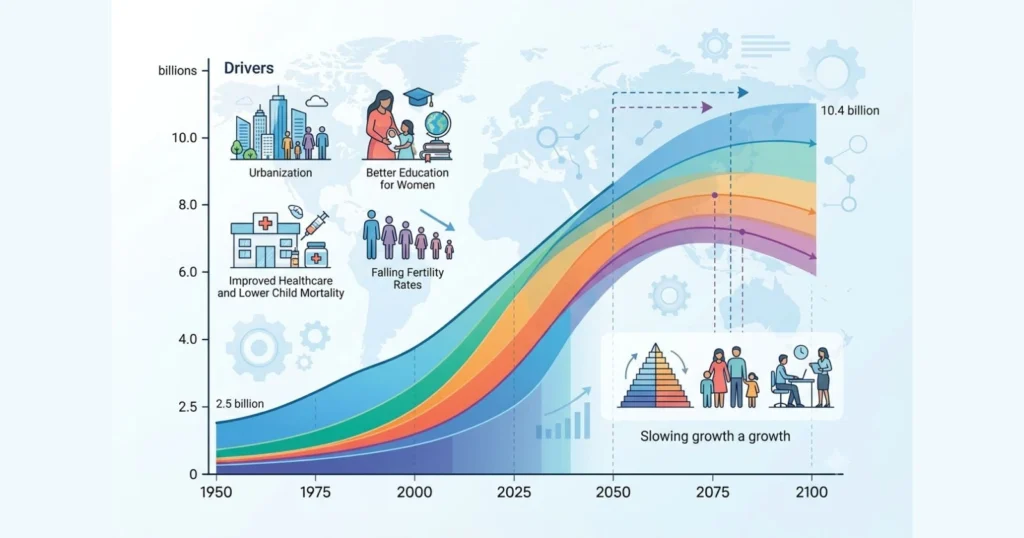
The world population is projected to peak at approximately 10.3 billion people around 2084, according to the UN’s medium fertility scenario, before beginning a gradual decline to roughly 10.2 billion by 2100.
That said, “2084” is not a fixed date carved in stone. It is the midpoint of a wide probability range. The UN itself states there is an 80 percent likelihood that global population growth ends sometime this century, with the actual peak occurring anywhere between the mid 2060s and the year 2100.
For most of human history, the global population only moved in one direction, and that direction was up. Today, that assumption is being retired. According to the United Nations World Population Prospects 2024 revision, the number of people on Earth is now expected to reach its highest point sometime in the mid 2080s, top out at around 10.3 billion, and then begin a slow, steady decline for the first time in modern history.
This is not a fringe theory. It is the conclusion of the UN Population Division, the same body whose estimates guide governments, investors, insurers, and public health agencies around the world. This article breaks down exactly when the peak is expected, why the timeline keeps shifting earlier, which countries have already peaked, and what a shrinking global population could mean for the rest of the century.
How the Peak Year Has Shifted Over Time
Population forecasting is not static. Every time the UN releases a new revision of the World Population Prospects, roughly every two to three years, the numbers get revised based on updated birth rates, death rates, and migration data. Over the last decade, nearly every revision has pulled the peak year earlier and lowered the expected peak size.
| UN Report Edition | Projected Peak Year | Projected Peak Population |
|---|---|---|
| 2019 Revision | Around 2100 | Nearly 11 billion |
| 2022 Revision | 2086 | About 10.4 billion |
| 2024 Revision | 2084 | About 10.3 billion |
The trend line is clear. Each new dataset points to an earlier peak and a smaller ceiling. The main reason is that fertility rates are falling faster than demographers expected, particularly in China and across several fast-growing regions of sub-Saharan Africa.
Why the Timeline Keeps Moving Earlier
A handful of forces are driving this shift, and they are not evenly distributed across the planet.
- China’s fertility collapse. China’s fertility rate has dropped to roughly 1.0 births per woman, one of the lowest rates ever recorded for a country of its size. Since China still holds a massive share of the global population, even small changes there move the whole global figure.
- Faster than expected declines in sub-Saharan Africa. Earlier UN models assumed Africa’s birth rate would fall slowly. The 2024 data shows the decline happening faster than projected, particularly in countries like Nigeria, where the 2100 population estimate has been revised down by hundreds of millions compared to forecasts from just over a decade ago.
- Global fertility below replacement in most countries. As of the most recent data, the average number of births per woman needed to keep a population stable without migration is 2.1. More than half of all countries and territories are now below that threshold.
- Rising life expectancy adds people at the older end, not the younger end. Longer lives keep total population higher for longer, but they do not offset the shrinking number of births, so the net effect still points toward an earlier peak.
The Global Numbers at a Glance
| Milestone | Population | Approximate Year |
|---|---|---|
| Current global population | 8.2 billion | 2024 |
| The population reaches 9 billion | 9 billion | 2037 |
| The population reaches 10 billion | 10 billion | 2061 |
| Peak population | About 10.3 billion | Mid 2080s |
| Population by the end of the century | About 10.2 billion | 2100 |
Between now and the peak, the world is still expected to add roughly two billion more people, a number larger than the entire population of Africa and Europe combined today. So while the “peak population” headline sounds like a slowdown story, the next 50 to 60 years will still bring significant growth before the trend reverses.
Why Growth Continues Even as Birth Rates Fall
This is one of the most misunderstood parts of population science. Global fertility is already below the level required to keep population size constant in the long run, sitting at roughly 2.25 births per woman as of the latest data, down from 3.31 in 1990. Yet the total population keeps climbing for decades. Why?
The answer is a concept demographers call population momentum. Even when the average number of children per woman falls, population size keeps rising if there is a large number of women currently in their reproductive years. The UN estimates that this momentum effect, driven by the relatively young age structure inherited from past decades of higher fertility, will account for close to 80 percent of all population growth between now and the mid 2050s.
In simple terms, the world is not growing because families are getting bigger. It is growing because there are more people of childbearing age alive today than ever before, a direct legacy of high birth rates from the 1970s through the 2000s.
Which Countries Have Already Peaked
Population peaking is not a single global event. It is happening in waves, country by country, and many nations are already well past their own peak.
According to the 2024 UN data, roughly 63 countries and territories, home to about 28 percent of the world’s population, have already reached their population peak. This group includes some of the largest economies on the planet.
- China. Now in decline after decades as the world’s most populous country. Its fertility rate has fallen to roughly 1.0 births per woman.
- Japan. Peaked in 2010 and has been shrinking longer than any other country. Its population is projected to fall from around 124 million today to about 77 million by 2100.
- Germany. Among the group of countries where population size is now trending downward.
- Russia. Facing a long-term decline driven by low fertility.
A second wave of roughly 48 countries, representing about 10 percent of the global population, are projected to peak sometime between 2025 and 2054. This group includes Brazil, Iran, Turkey, and Vietnam.
A third and final group of 126 countries, including India, Indonesia, Nigeria, Pakistan, and the United States, is expected to keep growing beyond 2054, with some of these nations not peaking until the second half of the century, or possibly not at all before 2100.
Countries Still Growing Rapidly
While much of the developed world is aging and shrinking, a small group of countries is heading in the opposite direction. Nine countries, including Angola, the Central African Republic, the Democratic Republic of Congo, Niger, and Somalia, are projected to double their populations between 2024 and 2054.
Sub-Saharan Africa as a whole is projected to grow by roughly 79 percent by 2054, reaching approximately 2.2 billion people, and could climb to around 3.3 billion by the end of the century. That would account for more than one-fifth of all global population growth over the remainder of the century.
This growth is reshaping the ranking of the world’s most populous nations. Nigeria and the Democratic Republic of Congo are projected to eventually overtake the United States in population size, and Tanzania could enter the list of the ten most populous countries by 2100.
What Happens After the Peak
Once the global population begins its decline after the mid 2080s, the drop is expected to be gradual rather than sudden, easing from roughly 10.3 billion down to about 10.2 billion by 2100. That is a decline of only about 1 percent over 15 years at the global level, but the picture looks very different depending on where you live.
For countries that have already peaked, the decline can be much steeper. The group of 63 countries that peaked before 2024 is projected to see its combined population fall by 14 percent over the next 30 years. China alone is expected to lose more people than any other country, with a projected decline of around 204 million people by 2054 and a loss of more than half its current population by the year 2100, a level not seen since the late 1950s.
The Aging of the Global Population
A shrinking population and an aging population go hand in hand, and the age data may be even more consequential than the raw population totals.
- Global life expectancy at birth reached 73.3 years in 2024, up from 70.9 years during the pandemic low point, and is projected to rise to around 77.4 years by the mid 2050s.
- By the late 2050s, more than half of all deaths worldwide will occur at age 80 or older, compared with only 17 percent of deaths in 1995.
- By the late 2070s, the number of people aged 65 and older is projected to overtake the number of children under 18 worldwide.
- People aged 80 and older are projected to outnumber infants under age 1 as early as the mid 2030s.
- The number of women of reproductive age, roughly 15 to 49 years old, is expected to keep growing until the late 2050s, peaking near 2.2 billion, before beginning to fall.
Regional Fertility and Life Expectancy Snapshot
| Region or Group | Fertility Rate Trend | Life Expectancy Trend |
|---|---|---|
| High income and East Asia | Well below replacement, often near or below 1.5 | Rising, among the highest globally |
| Europe | Below replacement across nearly every country | Rising steadily |
| Latin America | Approaching or below replacement in most countries | Rising, converging toward the global average |
| South Asia | Near replacement level and falling | Rising, gap with wealthy nations is narrowing |
| Sub-Saharan Africa | Above replacement but falling faster than earlier forecasts assumed | Rising but still roughly 7 years below the global average |
Why These Projections Matter
The shift from perpetual growth to an eventual population decline is not just a demographic curiosity. It touches nearly every major policy and economic question of the next century.
- Labor markets and retirement systems. Countries with aging, shrinking populations face growing pressure on pension systems and a shrinking pool of working-age taxpayers supporting a larger elderly population.
- Healthcare demand. As the share of people aged 80 and older grows, demand for long-term care, chronic disease management, and geriatric medicine will rise sharply in nations that have already peaked.
- Economic growth models. Much of modern economic theory assumes a growing population and a growing labor force. Countries entering decline will need new strategies built around productivity and automation rather than sheer population size.
- Global power balance. As some nations shrink and others, particularly in sub-Saharan Africa, continue to grow rapidly, the relative economic and political weight of regions is likely to shift over the coming decades.
- Migration policy. Countries facing population decline may increasingly rely on immigration to sustain their workforce, while countries with rapid population growth may see more emigration pressure if job creation does not keep pace.
A Brief History of Global Population Growth
To understand why a peak followed by a decline is such a significant shift, it helps to look back at how the world got to 8.2 billion people in the first place.
- It took all of human history until around 1800 for the world population to reach roughly 1 billion people.
- The second billion arrived in about 130 years, by 1930.
- The third billion took just 30 years, reached by 1960.
- Growth accelerated further through the mid-20th century, adding a billion people roughly every 12 to 15 years during the 1970s, 1980s, and 1990s.
- The world crossed 8 billion people in 2022, only about 11 years after hitting 7 billion in 2011.
Against that backdrop of accelerating growth for nearly two centuries, a slowdown followed by an outright decline represents one of the most significant demographic turning points in recorded history. The rate of global population growth has already been slowing since its peak in the late 1960s, when the world was adding well over 2 percent to its population each year. Today, that growth rate has fallen to under 1 percent annually, and it is expected to keep falling toward zero as the century progresses.
How UN Projections Compare to Other Models
The UN is not the only organization that models future population trends, and it is worth noting that not every model agrees on the exact timing or size of the peak.
- The Institute for Health Metrics and Evaluation, IHME, based at the University of Washington, has previously published projections suggesting an earlier and lower peak than the UN’s medium scenario, in part because it assumes faster gains in female education and contraceptive access, both of which tend to lower fertility rates more quickly.
- Independent research groups and academic demographers have generally converged on the same broad conclusion as the UN, even when their exact peak years differ: global population growth is slowing sharply, and a peak sometime this century is highly likely.
- The UN’s own track record is a key reason its figures are treated as the global benchmark. Its estimates are grounded in data from more than 1,900 national censuses and are updated every two to three years as fresh census and survey data become available, which is why the projected peak has been revised twice in the last four years alone, first from around 2100 to 2086, then from 2086 to 2084.
The consistency across different modeling approaches, even with some variation in the exact year, adds confidence to the underlying conclusion. The debate among demographers today is largely about when and how high the peak will be, not whether one will happen at all.
Regional Population Shifts to Watch
Beyond the global headline number, the geographic redistribution of population may end up being just as significant as the peak itself.
- Asia’s share of the global population is expected to shrink relative to Africa. As China and other East Asian nations decline in size, Africa’s share of the world’s people is projected to rise substantially, becoming the primary source of global population growth for the remainder of the century.
- Urbanization will continue regardless of national population trends. Even in countries with shrinking total populations, cities are generally expected to keep growing as rural populations continue to migrate toward urban centers.
- Working-age population trends will diverge sharply by region. Around 100 countries are expected to see their working-age population, ages 20 to 64, grow faster than their total population through 2054, creating a potential window for economic growth often referred to as a demographic dividend, while other nations face a shrinking workforce over the same period.
Is the Peak Certain?
No population projection is a guarantee. These are scenario-based estimates built on assumptions about future fertility, mortality, and migration trends, not hard predictions. The UN itself frames the 2084 figure as the medium variant, one of several possible scenarios, and states that the probability of the world population peaking within this century sits at around 80 percent, with the actual peak year falling anywhere between the mid 2060s and the year 2100.
That said, the direction of travel across every recent UN revision has been consistent. Each new dataset has moved the expected peak earlier and lowered the expected peak size, not later or higher. This is a strong signal that the broader trend, an eventual global population peak sometime in the second half of this century, is well supported by the underlying fertility data, even if the exact year remains uncertain.
Key Takeaways
- The world population is projected to peak at about 10.3 billion around 2084, based on the UN’s medium scenario.
- The population is still expected to grow by roughly two billion people between now and the peak.
- Sixty-three countries, representing about 28 percent of the global population, have already peaked, including China, Japan, Germany, and Russia.
- A second wave of 48 countries is expected to peak between 2025 and 2054.
- The remaining 126 countries, including India, Nigeria, and the United States, are projected to keep growing past 2054.
- After the peak, the global population is expected to decline gradually to around 10.2 billion by 2100.
- Population momentum, not high birth rates, is the main driver of remaining global growth.
- The global population is aging rapidly, with those 65 and older projected to outnumber children under 18 by the late 2070s.
Frequently Asked Questions
When will the world’s population peak?
The UN projects the peak will occur around 2084, in the mid 2080s, at approximately 10.3 billion people.
Has any country’s population already peaked?
Yes. As of the latest UN data, 63 countries and territories, including China, Japan, Germany, and Russia, have already reached their population peak and are now in decline.
Will the world population ever grow again after it peaks?
Under the UN’s medium scenario, no. Once the peak is reached in the mid 2080s, the global population is projected to decline gradually through the end of the century, reaching around 10.2 billion by 2100.
Why does the peak year keep changing in UN reports?
Each new UN revision incorporates updated fertility and mortality data. Since fertility rates in China and parts of Africa have fallen faster than previously assumed, recent revisions have consistently pushed the projected peak earlier and lowered the expected peak size.
Which country will have the largest population by 2100?
India is expected to remain the most populous country for much of the century, though rapid growth in African nations, including Nigeria and the Democratic Republic of Congo, could reshape the rankings by 2100.
What is population momentum?
Population momentum refers to continued population growth caused by a large number of people currently in their reproductive years, even after fertility rates fall to or below replacement level. It is expected to account for around 79 percent of global population growth through the mid 2050s.
Sourcing note: All figures in this article are drawn from the United Nations World Population Prospects 2024 revision, published by the UN Department of Economic and Social Affairs, Population Division. Figures are rounded for readability. Projections represent the medium fertility variant and are subject to revision in future UN reports.