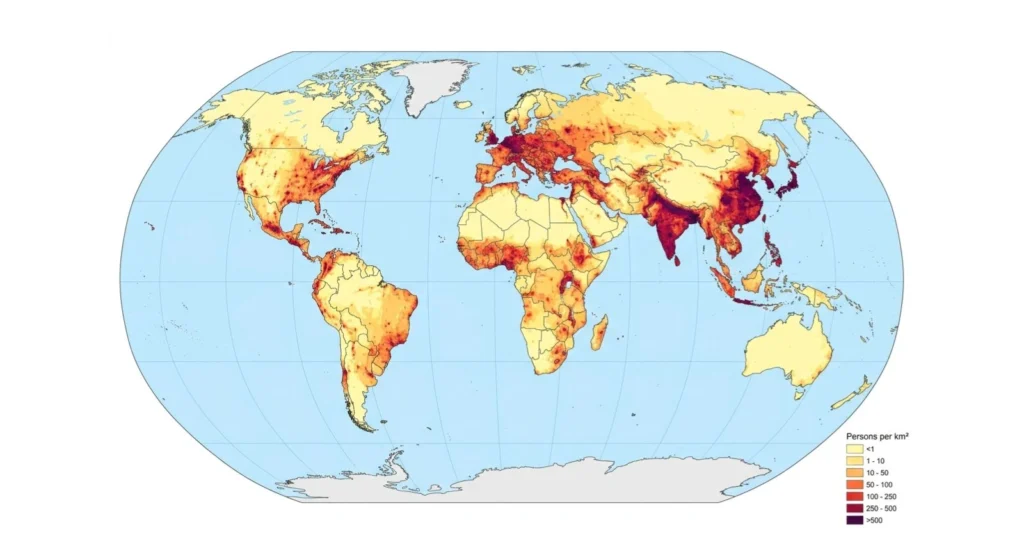
The planet is home to roughly 8.3 billion people in 2026, but that number alone tells only part of the story. What matters just as much is where those people actually live. Some nations pack tens of thousands of residents into a single square kilometer, while others have entire regions where a person could walk for hours without seeing another soul. This gap is what demographers call population density, and it shapes everything from housing prices and traffic congestion to farming output and public health policy.
In this article, we break down world population density in full detail. You will find the global average, the most crowded countries on Earth, the emptiest ones, regional patterns across continents, and the forces that explain why humans cluster the way they do. We also built a fully interactive, sortable table covering every country and territory so you can explore the data yourself, from the most dense to the least dense and back again.
What Is Population Density and How Is It Measured
Population density is a simple ratio. It is calculated by dividing a country’s total population by its land area, usually expressed as people per square kilometer (people/km²) or people per square mile.
The formula looks like this:
Population Density = Total Population ÷ Land Area
A few important notes on methodology that affect how the numbers should be read:
- Most official figures, including the ones used in this article, calculate density using land area only. Large inland water bodies such as lakes and rivers are typically excluded, though practices vary slightly by source.
- National density figures are averages. They can hide enormous internal variation. Egypt, for example, has a modest national density, yet the vast majority of its population is packed along the narrow Nile Valley, where local density can rival that of a major city.
- Density is different from population size. China and India are the two most populous nations on the planet, yet neither ranks among the ten most densely populated. Their enormous land area spreads their huge populations out, while tiny nations like Monaco or Macao pack far fewer people into a fraction of the space and end up far denser on paper.
World Population Density in 2026: The Global Numbers
As of 2026, the world’s population stands at approximately 8.3 billion people spread across a combined land area of roughly 130 million square kilometers among all countries and territories. That works out to a global average density of about 64 people per square kilometer.
Here is a snapshot of where the world stands today:
| Metric | Figure (2026) |
|---|---|
| World population | About 8.3 billion |
| Global average density | About 64 people/km² |
| Share of population living in urban areas | 58.5% |
| Projected urban share by 2050 | 68% |
| The year population is projected to hit 9 billion | 2037 |
| The year population is projected to hit 10 billion | 2058 |
| Projected peak population | About 10.3 billion around 2084 |
The world’s population is still growing, but the rate of growth has been slowing for decades. According to the United Nations World Population Prospects, annual growth peaked in the 1960s at over 2% per year and has since fallen closer to 0.9%. That slowdown means density will keep climbing, but at a gentler pace than in the twentieth century.
Population Density by Continent
Density varies enormously by region, largely as a function of geography, climate, and historical patterns of settlement.
| Region | Average Density (people/km²) | Notes |
|---|---|---|
| Asia | About 155 | Home to more than half the world’s population |
| Africa | About 54 | Fastest growing continent, still largely rural |
| Europe | About 34 | Dense in the west, sparser in the north and east |
| Latin America and the Caribbean | Varies widelyThe | Caribbean subregion averages over 200 |
| North America | Low | Large land area, moderate population |
| Oceania | Lowest | Australia and New Zealand average about 4 |
Southern Asia is the single densest subregion on the planet, averaging around 329 people per square kilometer, driven by Bangladesh, India, and Pakistan. The Caribbean follows at roughly 202 people per square kilometer, a result of small island nations with limited land. At the opposite end, Australia and New Zealand average just about 4 people per square kilometer, among the lowest of any subregion in the world.
World Population Density by Country, 2026
All 234 countries and territories. Click any column header to sort, or use the buttons below to jump straight to the most or least densely populated nations.
| # | Country / Territory | Population | Land Area (km²) | Density (people/km²) |
|---|
The Most Densely Populated Countries in the World
Small size, not large population, is usually what drives a country to the top of the density rankings. City states, island nations, and micro territories dominate this list because they combine a sizable population with an extremely limited land footprint.
| Rank | Country or Territory | Population Density (people/km²) |
|---|---|---|
| 1 | Monaco | 25,562 |
| 2 | Macao | 24,106 |
| 3 | Singapore | 8,437 |
| 4 | Hong Kong | 7,027 |
| 5 | Gibraltar | 4,087 |
| 6 | Bahrain | 2,205 |
| 7 | Maldives | 1,772 |
| 8 | Malta | 1,716 |
| 9 | Bangladesh | 1,366 |
| 10 | Sint Maarten | 1,307 |
| 11 | Bermuda | 1,289 |
| 12 | Holy See (Vatican City) | 1,265 |
| 13 | State of Palestine | 946 |
| 14 | Mayotte | 927 |
| 15 | Barbados | 657 |
A few things stand out in this list. Monaco, a two-square-kilometer city-state on the French Riviera, holds the top spot with more than 25,000 people per square kilometer, a figure so extreme it is best compared to a dense city neighborhood rather than a country. Macao, a special administrative region of China built largely on gaming and tourism, is not far behind at over 24,000 people per square kilometer.
Bangladesh is the notable exception on this list. Unlike the other entries, it is not a microstate or city territory. With over 177 million people living in a land area smaller than the US state of Iowa, Bangladesh is the most densely populated large country on Earth, and its density figure of 1,366 people per square kilometer illustrates just how tightly its population is concentrated along the Ganges Delta.
The Least Densely Populated Countries in the World
At the other extreme are countries with enormous land area, harsh climates, or both, resulting in vast stretches of nearly empty territory.
| Rank (from lowest) | Country or Territory | Population Density (people/km²) |
|---|---|---|
| 1 | Greenland | 0.1 |
| 2 | Falkland Islands | 0.3 |
| 3 | Mongolia | 2 |
| 4 | Western Sahara | 2 |
| 5 | Canada | 4 |
| 6 | Australia | 4 |
| 7 | Iceland | 4 |
| 8 | Libya | 4 |
| 9 | Namibia | 4 |
| 10 | Guyana | 4 |
| 11 | Suriname | 4 |
| 12 | French Guiana | 4 |
| 13 | Botswana | 5 |
| 14 | Mauritania | 5 |
| 15 | Niue | 7 |
Greenland tops this list with essentially no measurable density, a result of massive ice-covered terrain hosting only around 56,000 residents. Mongolia, the emptiest full-sized nation on the list, has just 2 people per square kilometer despite covering more than 1.5 million square kilometers, largely because of its vast steppe landscape and harsh continental climate.
Canada and Australia are worth highlighting separately. Both are wealthy, highly urbanized, developed nations, yet both average just 4 people per square kilometer nationally. The explanation is the same in both cases. The vast majority of the population is clustered in a small number of cities near the coasts or borders, while enormous interior and northern regions remain sparsely inhabited due to climate and terrain.
Big Countries With Surprisingly Low Density
It is a common misconception that the world’s most populous countries are also the most crowded. In reality, several of the largest nations by population rank quite low on the density scale simply because their land area is so vast.
- Russia has 143 million people but only 9 people per square kilometer, the result of the largest land area of any country on Earth, most of it in Siberia.
- Brazil holds over 213 million people yet averages just 26 people per square kilometer, thanks to the sparsely populated Amazon interior.
- United States houses 349 million people across 9.1 million square kilometers, translating to a modest 38 people per square kilometer.
- China, despite having over 1.4 billion residents, averages only about 150 people per square kilometer nationally because so much of its western and northern territory is desert, mountain, or plateau.
This pattern reveals an important truth about density. National averages can be misleading, since the real story is almost always about internal distribution rather than the raw total.
Small Countries, Enormous Crowding
On the flip side, some countries achieve extreme density without necessarily being wealthy or urbanized in a first-world sense.
- Bangladesh, discussed above, remains the standout example of a large population crammed into limited farmable land.
- Rwanda averages 604 people per square kilometer, among the highest in Africa, a legacy of fertile volcanic highlands supporting dense agricultural settlement.
- Taiwan reaches 650 people per square kilometer, driven by a mountainous interior that pushes most of its population onto a narrow western coastal plain.
- South Korea sits at 531 people per square kilometer, a result of intense urban concentration around Seoul and other major metro areas, combined with mountainous terrain covering much of the country.The
- Netherlands averages 547 people per square kilometer, the densest country in mainland Europe, shaped by centuries of land reclamation and one of the most urbanized populations on the continent.
Why Population Density Varies So Much Between Countries
Several overlapping factors explain why humans settle so unevenly across the planet.
- Geography and climate. Fertile river valleys, temperate coastlines, and arable plains attract dense settlement, while deserts, ice sheets, mountains, and dense rainforest tend to repel it.
- Historical settlement patterns. Regions with long agricultural histories, such as the Nile Valley, the Ganges Delta, and parts of East Asia, developed high density centuries or millennia ago and have remained dense ever since.
- Economic opportunity. Jobs, infrastructure, and services pull people toward cities and coastal regions, which is why urban density keeps rising even in countries with a low national average.
- Land area versus population size. As shown above, a country can have a huge population and still be sparsely populated overall if its territory is large enough, and vice versa.
- Government policy and land use. Some countries actively cap land reclaimed for housing, protect agricultural zones, or set strict urban growth boundaries, all of which influence measured density.
- Migration trends. Countries with strong net migration inflows, including several Gulf states, can see density climb quickly even without high birth rates.
Population Density and Quality of Life
Density on its own does not determine living standards. Singapore, Hong Kong, and the Netherlands are all extremely dense and also extremely wealthy, with well-developed infrastructure absorbing the pressure of crowding. Meanwhile, some of the least dense countries, including parts of Sub-Saharan Africa and Central Asia, face real development challenges related to sparse infrastructure and difficulty delivering services across large distances.
That said, rapid, unplanned density increases can strain a country’s systems. Fast-growing megacities in the developing world are adding urban residents faster than housing, sanitation, and transportation networks can expand, which is a central challenge facing planners in South Asia and Sub-Saharan Africa over the coming decades.
Key patterns worth noting:
- Urbanization and density are related but distinct. A country can be highly urbanized (most people living in cities) while having a low overall national density if its rural regions are vast and empty, such as Australia.
- Dense, well-managed cities can actually reduce per capita environmental impact through shared infrastructure, shorter commutes, and efficient land use, a point widely noted by urban economists.
- Poorly managed density growth, on the other hand, tends to produce overcrowded housing, strained public services, and rising informal settlements.
The Future of Global Population Density
The global population is expected to keep climbing for at least another six decades before it likely levels off. Based on United Nations medium-fertility projections:
- The world population is projected to cross 9 billion around 2037.
- It is projected to reach 10 billion by around 2058.
- The global population is expected to peak near 10.3 billion around 2084, before beginning a slow decline.
Nearly all of this remaining growth will occur in a small number of countries. India, Nigeria, the Democratic Republic of the Congo, Pakistan, Ethiopia, Tanzania, Egypt, and Indonesia are together expected to account for roughly half of global population growth between now and 2050. Since most of these countries already have high or rapidly rising density, this means the world’s most crowded regions are likely to get considerably more crowded before any global plateau arrives.
At the same time, urbanization will keep accelerating. Today, about 58.5% of humanity lives in urban areas. That share is projected to reach 68% by 2050, adding an estimated 2.5 billion urban residents worldwide, with close to 90% of that growth concentrated in Asia and Africa. Meanwhile, several developed nations, including Japan, several Eastern European states, and eventually China, are expected to see their national populations shrink even as urban density within their major cities continues to hold steady or rise, a divergence that will make national density figures increasingly less representative of how most people in those countries actually live.
Explore the Full Country-by-Country Population Density Table
Below the article is a fully interactive table covering every country and territory in the world, including tiny dependencies rarely covered elsewhere. You can sort it from the most densely populated country down to the least, or flip the order to start from the emptiest nations on Earth. Each entry includes population, land area, and calculated density so you can compare any country against another instantly.
Final Thoughts
Population density is one of the clearest windows into how humanity actually occupies the planet. Raw population totals tell you how many people exist, but density tells you where they live, how much pressure their environment is under, and what kind of infrastructure challenges or advantages a country is likely to face. From Monaco’s extreme crowding to Mongolia’s vast emptiness, the range across just 234 countries and territories is a reminder that the story of human settlement is still, in large part, a story about geography.
Data sources: United Nations World Population Prospects (2024 Revision), Worldometer country population and density figures, and UN World Urbanization Prospects (2025 Revision). Figures reflect 2026 estimates and are rounded for readability.
Frequently Asked Questions
What is the world’s population density in 2026?
The global average is approximately 64 people per square kilometer, based on a world population of about 8.3 billion spread across roughly 130 million square kilometers of land.
Which country has the highest population density?
Monaco has the highest population density in the world, at approximately 25,562 people per square kilometer, followed closely by Macao at around 24,106 people per square kilometer.
Which country has the lowest population density?
Greenland has the lowest measurable density, at roughly 0.1 people per square kilometer, followed by the Falkland Islands and Mongolia.
What is the most densely populated large country?
Bangladesh is the most densely populated country, with a large population, at approximately 1,366 people per square kilometer, driven by its position along the fertile but limited Ganges Delta.
Why do China and India have relatively low population density despite being the most populous countries?
Both countries have enormous land areas, which spreads out their large populations. China averages about 150 people per square kilometer and India about 497, both far below many smaller, more compact nations.
Is high population density always bad for a country?
No. Density itself is neutral. Countries like Singapore, the Netherlands, and Hong Kong combine very high density with strong infrastructure and high living standards. Problems tend to arise when density grows faster than a country’s ability to build supporting infrastructure.
How is population density expected to change in the future?
Global density will keep rising as population grows toward a projected peak of about 10.3 billion around 2084. Growth will be concentrated in a handful of countries, mainly in Africa and South Asia, while urban density worldwide is projected to keep increasing as the urban population share rises from 58.5% today to roughly 68% by 2050.