
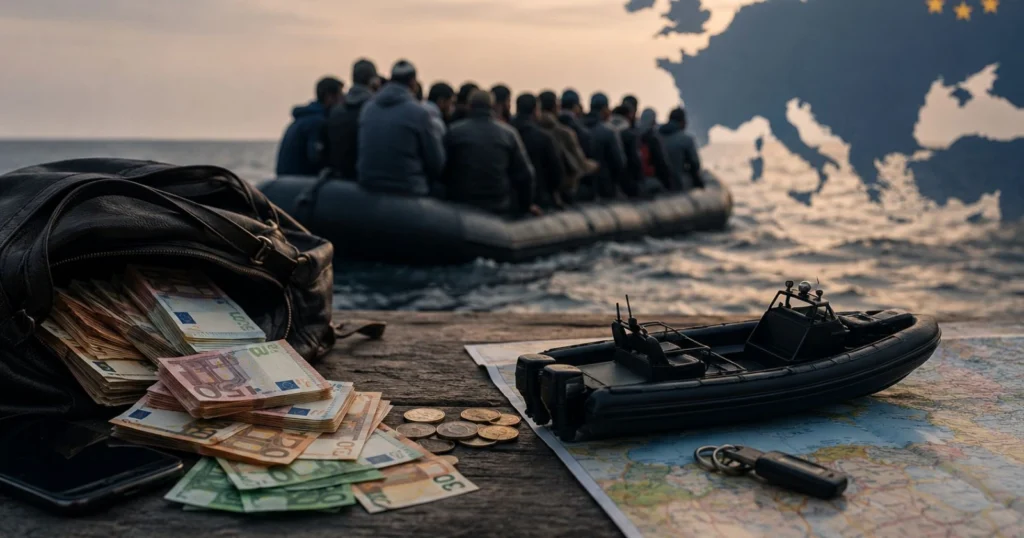
Long before a single migrant enters the water near Ceuta, a business transaction has usually already taken place. Investigators, migration researchers, and European law enforcement agencies increasingly describe the surge of crossings from Morocco into Spain not as a spontaneous rush but as the product of organized networks that recruit, price, and market illegal crossings much like any other commercial service, only with human lives as the product.
As tens of thousands of people poured into the Spanish enclave this week, attention has turned toward the machinery behind the crisis: how smugglers find their customers, what they charge, and why authorities are struggling to dismantle networks that adapt faster than the agencies chasing them.
Social Media Has Become the New Recruitment Office
For years, smuggling networks relied on word of mouth, contacts passed between relatives, and informal brokers operating out of coastal towns like Fnideq and Tetouan. That model has not disappeared, but it has been supercharged by social media.
According to reporting from InfoMigrants and the Spanish outlet El Español, platforms such as TikTok and Instagram have become central tools for encouraging young Moroccans to attempt the swim to Ceuta, with accounts posting footage that romanticizes successful crossings and frames the journey as an achievable rite of passage rather than a life-threatening gamble.
One account cited in coverage of the crisis, known as @haragaa_ceuta1, has posted videos showing migrants celebrating after reaching Spanish territory. Such accounts typically have a short lifespan by design. Content creators frequently delete their profiles and restart under new names once a video gains traction or draws scrutiny, making it difficult for platforms or investigators to track a single account over time.
Research reviewed by InfoMigrants found that some videos go further than simple celebration clips, offering what amounts to step-by-step guidance on equipment, timing, and how to avoid detection by Moroccan border patrols.
Why the Videos Work as Marketing
Migration researchers point to a simple psychological mechanism behind the effectiveness of this content. A video of someone who successfully completed the crossing functions as social proof, a persuasive signal that the risk is worth taking because someone just like the viewer already succeeded.
Europol’s own threat assessments have picked up on this shift in tactics. In a recent report from the agency’s Migrant Smuggling Center, investigators noted that criminal networks have begun studying the same techniques used by legitimate social media influencers, in some cases drawing direct inspiration from online content creator academies to learn how to attract and hold the attention of prospective clients.
What a Crossing Actually Costs
Pricing across the Morocco to Spain corridor varies significantly depending on the route, the method of travel, and how far into Europe the migrant intends to go. Not every crossing into Ceuta itself carries a direct cash price, since many of those who swim or scale the breakwater fence are acting on loosely organized group momentum rather than paying a formal broker. However, the broader smuggling economy that surrounds the region, including onward travel deeper into Europe, follows a far more structured commercial model.
A case dismantled by Spain’s Guardia Civil in the Murcia region in 2025 illustrates how organized the pricing can become once a network is fully operational. Investigators found that the group charged Moroccan migrants approximately 3,000 euros per person to fly them into Romania before transporting them by truck and van through EU territory into Spain, completing more than 50 trips over two years with groups ranging between 20 and 50 migrants at a time.
| Smuggling Route or Method | Approximate Cost per Person | Method of Transport | Source |
|---|---|---|---|
| Air to Romania, then truck into Spain | Around 3,000 euros | Commercial flights, then land transport | Guardia Civil, via Euronews |
| Speedboat crossings via Almería | Not publicly disclosed | High speed vessels | Europol taskforce report |
| Direct swim or breakwater crossing into Ceuta | Often minimal or no direct fee | Open water swimming, inflatable tubes | Field reporting, InfoMigrants |
| Cross-border network, Spain to France and UK to Spain | Not publicly disclosed | Vehicle-based transport | Europol, French and Spanish police |
The table reflects a pattern that migration analysts frequently point to: the closer a smuggling operation gets to full logistical control, including flights, documentation, and coordinated vehicle transport, the more expensive and structured the pricing tends to be. By contrast, the mass swims into Ceuta appear to rely less on paid brokers and more on informal coordination amplified through social media, group momentum, and a widely circulated belief, described by Spanish officials as a deliberate distortion, that a recent court ruling made sea arrivals untouchable.
The Logistics Behind the Scenes
Beyond recruitment and pricing, smuggling networks operating along this corridor maintain a surprisingly diversified set of logistical arms. According to an organized crime profile compiled by the Organized Crime Index and its Africa-focused partner ENACT, Moroccan smuggling networks are frequently led by Moroccan nationals but rely heavily on Sub-Saharan intermediaries, particularly from Gambia and Senegal, to handle recruitment among West African migrant communities. These networks are described as flexible and evolving, often overlapping with drug trafficking and document fraud operations rather than operating as standalone smuggling businesses.
Frontex, the European Union’s border and coast guard agency, has documented a similar pattern along what it calls the Western Mediterranean Route, noting that the presence of established diaspora communities across Europe creates a pull factor of its own.
Relatives who successfully migrated years earlier often become informal points of contact, connecting new migrants with smugglers considered trustworthy within their home communities. Frontex has also observed a geographic shift in recent years, with some smuggling operations relocating from Morocco toward Algeria, where border controls are perceived as less stringent.
Law Enforcement Is Fighting Back, With Mixed Results
European and international agencies have ramped up efforts to dismantle these networks, though officials acknowledge the fight is far from settled. In November 2025, Interpol and Europol jointly coordinated a three-day operation under Project Himaya, working alongside technology partners including Meta, along with researchers from S2W and the University of Malta.
Officers from participating countries, including Morocco, Spain, France, Italy, Libya, Tunisia, and the United Kingdom, extracted data from websites, social media platforms, and messaging apps, ultimately identifying 269 unique user handles and URLs connected to cyber-enabled migrant smuggling activity.
Recent Arrests and Dismantled Networks
Spanish authorities have also notched a series of targeted busts. In one operation, 24 individuals of Algerian, Moroccan, and Spanish nationality were arrested in Almería in connection with a speedboat smuggling network with ties to criminal cells in Marseille, Perpignan, and La Jonquera, part of a broader Europol taskforce focused on the Western Mediterranean. In a separate case, Europol supported French and Spanish police in dismantling a two-way smuggling network believed to have moved approximately 1,000 migrants of Algerian and Moroccan origin between Spain and France, with one arrest involving a British national caught transporting migrants across the English Channel.
Despite these operations, agencies acknowledge that the decentralized, digitally native structure of modern smuggling makes long-term disruption difficult. Europol’s most recent annual threat report on migrant smuggling describes a criminal landscape in which networks increasingly operate through borderless digital spaces, approaching prospective clients through direct messages and social platforms while offering vague promises of employment or travel assistance before establishing more controlling, and often coercive, relationships once payment or commitment has been secured.
Related Article:
- Why Tens of Thousands of Migrants Stormed Into Spain’s Ceuta in a Single Day
- Inside the Night Ceuta’s Border Fell: 60,000 Migrants, Dozens Dead
- Europe’s 2026 Migration Crisis: A Country by Country Snapshot
- Ranking Europe’s Toughest and Softest Migration Policies in 2026
Diplomatic Response Adds Another Layer of Pressure
The current Ceuta crisis has also become a diplomatic flashpoint tied directly to the smuggling narrative. Morocco’s embassy in Madrid has publicly placed blame on criminal organizations, stating that such networks exploit vulnerable people and fuel false expectations while exposing migrants to serious risk, and stressing that the Moroccan government neither encourages nor promotes irregular migration by its citizens. Spanish officials, including Prime Minister Pedro Sánchez, have echoed that framing, arguing that trafficking networks deliberately twisted a narrow legal ruling into a false rumor that sea crossings guaranteed safe passage.
The European Union and Morocco have previously attempted to formalize cooperation against these networks, including a partnership renewed in 2022 following violent smuggling-related incidents at the border, and further commitments made during a high-level meeting between Spanish and Moroccan officials in December 2025 focused on strengthening joint efforts against irregular immigration, human smuggling, and document forgery.
The EU has also committed more than 500 million euros to Morocco for border management and police cooperation between 2021 and 2027, underscoring how central this single land corridor has become to broader European migration policy.
Why the Networks Keep Adapting
What emerges from law enforcement reporting, migration research, and firsthand accounts is a picture of an ecosystem built for resilience. Smuggling networks along the Morocco-to-Spain route are not a single organized crime syndicate but a loose web of recruiters, transport coordinators, document forgers, and, increasingly, social media content creators, each capable of operating independently while feeding into the same overall flow of people. When one arrest takes down a speedboat operation in Almería, a recruitment account on TikTok can still be quietly pulling in new interest hundreds of miles away in Fnideq. When one account is banned or deleted, another appears under a new name within days.
For now, officials on both sides of the Strait of Gibraltar say the fight against these networks will require sustained cooperation rather than isolated crackdowns, particularly as smuggling groups continue to borrow tactics from mainstream digital marketing to stay one step ahead of the platforms and police trying to shut them down. As Ceuta works to recover from its latest and largest surge yet, the networks that helped fuel it are already adjusting their next campaign.