Tuvalu’s national statistics office lists the country’s population growth rate as negative 1.68%, even as United Nations projections used by other data providers show Tuvalu’s population still edging up slightly year to year. Both figures describe the same tiny nation of roughly 9,300 to 9,600 people, and the contradiction between them says something real: Tuvalu’s population is caught between modest natural increase and a net migration outflow substantial enough, in a country this small, to tip the overall trend into decline. In 2023 alone, Tuvalu’s net migration rate was estimated at negative 323 people, equivalent to more than 3% of the entire national population leaving in a single year.
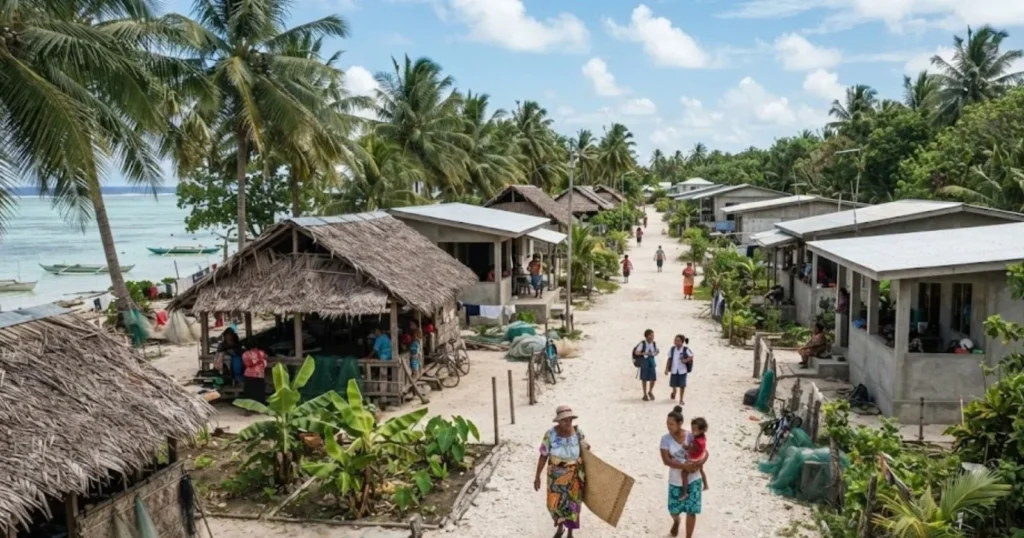
Spread across three reef islands and six true atolls totaling just 26 to 30 square kilometers of land, Tuvalu is one of the smallest sovereign nations on Earth by both population and land area. Roughly 60% of that population lives on a single atoll, Funafuti, home to the capital. Understanding whether Tuvalu’s outer island communities, and ultimately the nation itself, can remain demographically viable requires looking past the population count to the deeper story of concentration, migration and environmental constraint playing out across the country’s nine inhabited islands.
Tuvalu Population at a Glance
| Metric | Figure | Year / Source |
|---|---|---|
| Total population | 9,325–9,564 | 2025–2026, varying source |
| Total land area | 26–30 km² | UN Statistics Division / SPC |
| Population density | ~312 per km² | 2026 estimate |
| National population growth rate | –1.68% (SPC) to slightly positive (UN WPP) | 2025–2026, source-dependent |
| Net migration rate | ~–323 people | 2023 estimate |
| Funafuti’s share of national population | ~60% | 2017 Census |
| Funafuti population | 6,320–6,602 | 2017–2022 |
| Median age | 24.1–25.2 years | 2026 estimate |
| Total fertility rate | Estimated near or above replacement level | Recent estimates |
| Life expectancy | 67.6 years | 2026 estimate |
| Next scheduled census | 2027 | Tuvalu National Statistics Office |
Where Tuvalu’s Population Lives
Tuvalu comprises nine main islands, three reef islands and six true coral atolls, stretched across a narrow band of ocean between roughly 5 and 10 degrees south latitude. Funafuti, the capital atoll, has held approximately 60% of Tuvalu’s national population since at least the 2017 census, when it recorded 6,320 residents out of a national population of roughly 10,500. The remaining islands, including Nanumea, Nukufetau, Vaitupu and others, share the balance of the population, generally in communities numbering in the hundreds to low thousands each.
This concentration on Funafuti mirrors patterns seen elsewhere in the Pacific, such as South Tarawa in Kiribati, where a single atoll or urban center draws a disproportionate share of a small nation’s population because of concentrated government services, schools, healthcare, and the only meaningful international airport and port facilities in the country.
Tuvalu’s Age Structure
Tuvalu’s median age of roughly 24 to 25 years places it among the more moderately young populations of the Pacific, older than higher-fertility Melanesian nations like Vanuatu or Solomon Islands but younger than more demographically mature economies. Life expectancy of 67.6 years remains below the global average of roughly 73.8 years, a gap partly attributable to limited specialist healthcare capacity on a set of small, remote islands where serious medical cases are often referred overseas, typically to Fiji.
Population Growth and Fertility
Tuvalu’s population trajectory is genuinely ambiguous depending on which data source is used. The Pacific Community’s Statistics for Development Division lists Tuvalu’s current population growth rate at negative 1.68%, implying the country is shrinking.
United Nations World Population Prospects-based estimates, by contrast, show Tuvalu’s population inching upward slightly year to year, from approximately 9,492 in mid-2025 to 9,362 by mid-2026 in some compilations, figures that themselves show only marginal net change rather than consistent growth. This is not simply a data quality problem of the kind seen in larger, harder-to-count nations like Papua New Guinea; it reflects the genuine difficulty of measuring population change precisely in a country this small, where a single planeload of emigrants or returnees can meaningfully shift the annual growth rate.
Migration and the Tuvaluan Diaspora
Migration is unambiguously the dominant force shaping Tuvalu’s demographic trajectory. The estimated net migration rate of negative 323 people in 2023 represents more than 3% of Tuvalu’s entire population leaving the country in a single year, a scale of outflow that, if sustained, would be equivalent to a mid-sized country losing millions of residents annually.
Labor migration to New Zealand and Fiji, family reunification, and educational migration are the primary drivers, with New Zealand’s Pacific Access Category providing one of the more significant formal migration pathways available to Tuvaluan citizens.
Climate and Habitability
Tuvalu is frequently cited in global climate discussions because of its combination of extremely low elevation, none of its islands rising more than a few meters above sea level, and its extreme population density on Funafuti, where “extremely high coastal population densities,” in the words of Pacific climate researchers, compound direct exposure to coastal erosion, storm surge, saltwater intrusion into groundwater, and changing rainfall patterns.
Scientific literature on Tuvalu documents these physical changes as already observable phenomena rather than only future projections, though the pace and ultimate scale of longer-term sea level rise impacts on habitability remain genuinely uncertain and should not be presented as settled fact in either direction.
Infrastructure and Basic Services
As in Kiribati, Tuvalu’s government services, and correspondingly its infrastructure investment, concentrate heavily on Funafuti, reinforcing the atoll’s demographic dominance. Outer islands generally have more limited healthcare facilities, requiring referral to Funafuti or overseas for anything beyond basic care, and inter-island transport depends on a small government-operated ferry fleet and limited domestic air services, both of which are vulnerable to weather disruption and maintenance constraints given Tuvalu’s extremely limited economic base.
Can Outer Island Communities Remain Viable?
The core sustainability question facing Tuvalu is not whether the nation as a whole will disappear in the near term, but whether its eight outer island communities can retain enough population, and enough of a working-age population specifically, to remain functioning communities rather than becoming increasingly emptied out as residents move to Funafuti or emigrate abroad entirely.
Population data comparing Funafuti and the outer islands across census years from 1973 to 2017 show a long-term pattern of relative concentration on Funafuti, even as researchers have also documented temporary reverse migration, from Funafuti back to outer islands, during specific emergencies such as the COVID-19 pandemic period, when reduced international and inter-island travel combined with public health concerns to shift some residents back toward outer island communities, at least temporarily.
Tuvalu’s Future Demographic Outlook
Tuvalu’s next Population and Housing Census, scheduled for 2027, will provide the clearest picture yet of which of the conflicting current estimates, modest growth or modest decline, more accurately describes the country’s trajectory. What is not in dispute is that migration, not fertility, will remain the dominant variable.
Whether Tuvalu’s population stabilizes, continues its outward drift, or reverses depends heavily on factors outside the country’s direct control: the availability and terms of migration pathways to New Zealand and Australia, and the pace of climate adaptation investment aimed at making both Funafuti and the outer islands more resilient places to remain.
Key Findings
- Tuvalu’s population growth rate is reported as negative 1.68% by the Pacific Community, even as UN-based estimates show only marginal year-to-year change, reflecting genuine measurement difficulty in a country this small.
- Net migration removed an estimated 323 people from Tuvalu in 2023 alone, more than 3% of the entire national population in a single year.
- Funafuti, the capital atoll, has held approximately 60% of Tuvalu’s national population since at least the 2017 census, concentrating government services and infrastructure investment.
- Tuvalu’s entire population of roughly 9,300 to 9,600 people occupies just 26 to 30 square kilometers of land, one of the smallest land areas of any sovereign nation.
- Life expectancy of 67.6 years remains below the global average, linked partly to limited specialist healthcare capacity requiring overseas referral for serious cases.
- Documented physical impacts of climate change, including coastal erosion and saltwater intrusion, are already observed in Tuvalu, though longer-term habitability projections carry genuine scientific uncertainty.
- Tuvalu’s next census, scheduled for 2027, will help resolve the current ambiguity between competing growth and decline estimates for the national population.
Frequently Asked Questions
1. What is Tuvalu’s population?
Tuvalu’s population is estimated at roughly 9,300 to 9,600 people as of 2025-2026, depending on the data source used.
2. Where do most Tuvaluans live?
Approximately 60% of Tuvalu’s population lives on Funafuti, the capital atoll, based on the 2017 census, with the remainder spread across eight outer islands.
3. Is Tuvalu’s population growing?
This is genuinely disputed between data sources. The Pacific Community reports a population growth rate of negative 1.68%, while UN-based projections show only marginal year-to-year change, reflecting how sensitive population statistics are in a country this small.
4. Why do Tuvaluans migrate?
Tuvaluans migrate primarily for labor opportunities, education and family reunification, with New Zealand and Fiji as the main destinations, supported by formal pathways like New Zealand’s Pacific Access Category.
5. How does climate change affect Tuvalu?
Tuvalu’s low elevation, generally under a few meters, and dense coastal settlement on Funafuti make it highly exposed to coastal erosion, storm surge and saltwater intrusion, impacts that researchers have already documented, though longer-term projections about habitability remain uncertain.
6. Can Tuvalu’s outer islands remain populated?
This is an open question. Long-term data show a pattern of population concentrating on Funafuti at the expense of outer islands, though some temporary reverse migration has occurred during specific events like the COVID-19 pandemic.
7. What is Tuvalu’s median age?
Tuvalu’s median age is estimated at 24.1 to 25.2 years as of 2026, placing it among the more moderately young populations in the Pacific.
8. How many islands make up Tuvalu?
Tuvalu comprises nine main islands: three reef islands and six true coral atolls.
9. What is Tuvalu’s life expectancy?
Life expectancy at birth in Tuvalu is estimated at 67.6 years, below the global average, partly due to limited on-island specialist healthcare capacity.
10. When is Tuvalu’s next census?
Tuvalu’s next Population and Housing Census is scheduled for 2027, which should help clarify the current disagreement between growth and decline estimates for the national population.
Sources
- Pacific Community (SPC), Statistics for Development Division, Tuvalu country profile and key statistics
- United Nations, Department of Economic and Social Affairs, Population Division, World Population Prospects: The 2024 Revision
- ResearchGate, “Resident populations of Funafuti and outer islands of Tuvalu in Census years 1973-2017” (climate-resilient post-pandemic futures research)
- Wikipedia, Funafuti, Fakaifou and Teone (island and village-level population data cross-referenced against Tuvalu census sources)
- PopulationToday.com, Tuvalu net migration estimates (2023)
- StatisticsTimes.com, Tuvalu population 2026 (UN WPP-based interpolation)
- World Population Review, Tuvalu country and Funafuti city population data