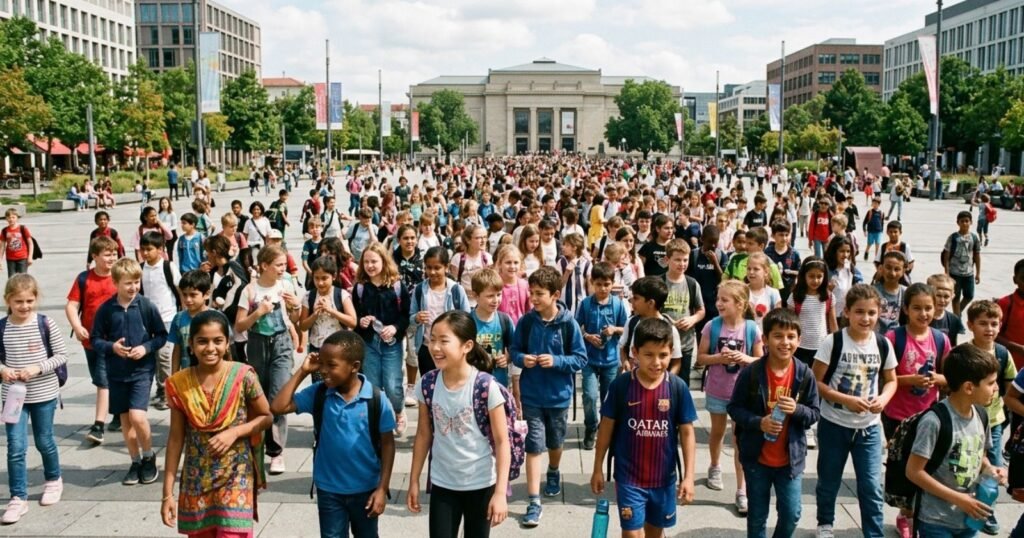
Roughly one in every four people alive today has not yet turned 15. That is close to 2 billion children spread across nearly 200 countries, but distributed nowhere near evenly. A handful of countries, led by India and Nigeria, are home to a hugely disproportionate share of the global child population, while dozens of others now have proportionally fewer children than at any point in their recorded history.
The under-15 population sits apart from the broader youth or working-age categories covered elsewhere in this series. It captures a specific, policy-relevant slice of humanity: the group still years away from entering the labor force, still dependent on schools and pediatric healthcare rather than universities or entry-level jobs. How large that group is, and where it is concentrated, shapes national budgets and long-term planning decades before those children ever cast a vote or draw a paycheck.
This piece looks specifically at the under-15 population: how large it is, how it has changed since 1950, which countries hold the most children in absolute and percentage terms, and where the global child population is headed as the century progresses.
How Many People in the World Are Under 15?
- Total number: approximately 2 billion people worldwide are under age 15, based on the UN World Population Prospects 2024 Revision.
- Percentage of global population: roughly 24.5 percent, meaning close to a quarter of everyone alive is a child by this definition.
- Boys versus girls: the split is close to even, with a slightly higher number of boys born each year globally, a pattern that persists through early childhood before evening out and eventually reversing at older ages.
- Under 5 versus ages 5 to 14: the under-5 population is somewhat smaller than the 5-to-14 population globally, reflecting the gradual slowing of birth numbers even as the total child population remains historically large.
How the Global Child Population Has Changed
| Year | Share Under 15 | Approx. Number Under 15 | Context |
|---|---|---|---|
| 1950 | ~34% | ~0.85 billion | Post-war baby boom, high global fertility |
| 1975 | ~37% | ~1.5 billion | Near the historical peak share of children globally |
| 2000 | ~30% | ~1.85 billion | Fertility decline underway across most regions |
| Today (2024/2025) | ~24.5% | ~2.0 billion | Absolute number still near record highs, share falling |
| 2050 (projected) | ~20.4% | ~1.97 billion | Absolute number roughly flat to slightly lower |
Key finding:
The share of the world’s population made up of children peaked around the mid-1970s and has been falling ever since, even though the absolute number of children kept rising for decades afterward. The two trends only recently began moving in the same direction, and the UN projects the global under-15 population will hold roughly steady, then gradually decline, over the coming decades even as total world population keeps growing.
Countries With the Largest Child Populations
| Country | Approx. Population Under 15 | Approx. Share Under 15 | Notes |
|---|---|---|---|
| India | ~360 million | ~25% | Largest child population in the world by raw number |
| China | ~230 million | ~16% | Large in absolute terms despite a low percentage share |
| Nigeria | ~90-100 million | ~44-47% | Both large in absolute number and share |
| Pakistan | ~90 million | ~35% | Rapidly growing child population |
| Indonesia | ~65 million | ~23% | Large population base drives high absolute numbers |
| DR Congo | ~55-60 million | ~45% | Among the highest child shares of any large country |
| Ethiopia | ~45-50 million | ~38% | Large and still growing child population |
| Bangladesh | ~40 million | ~23% | Declining share despite continued absolute size |
Figures are approximate, compiled from UN World Population Prospects 2024 Revision data and related demographic trackers; individual country estimates vary slightly by source and year.
The rankings by absolute number and by percentage share point to different countries for a simple reason: absolute number depends on both total population size and the share of children within it, while percentage share depends only on age structure. China, for example, ranks among the largest child populations in raw numbers purely because its total population is so large, even though children make up a relatively small share of it. Nigeria and DR Congo, by contrast, rank near the top on both measures at once.
Countries With the Youngest Child-Heavy Populations
The countries with the highest percentage of children under 15 sit almost entirely in Sub-Saharan Africa.
- High-fertility countries: Niger, the Central African Republic, Chad, and DR Congo all show child shares above 44 percent, meaning close to half their populations have not yet reached their teenage years.
- Regional patterns: West and Central Africa post the highest child shares on the continent, while East and Southern Africa trend somewhat lower, reflecting faster fertility declines in parts of those regions.
- Population momentum: because these countries already have such large child cohorts, their overall populations will keep growing for decades regardless of any near-term change in fertility, simply because so many future parents have already been born.
Why the Global Share of Children Is Falling
Four overlapping forces explain the decline, and each has been building for decades rather than emerging suddenly.
- Fertility decline: the global total fertility rate has fallen from roughly five children per woman in the 1960s to 2.25 today, directly shrinking the size of each new birth cohort relative to the population as a whole.
- Smaller families: family size preferences have shifted across nearly every world region over the past 50 years, reducing the average number of children per household even in historically high-fertility countries.
- Rising life expectancy: as more people live longer, the older segments of the population grow relative to the youngest, mechanically lowering the child share even without any change in birth numbers.
- Demographic transition: the vast majority of countries have now moved into the later stages of the demographic transition, where falling fertility, not falling child mortality, is the dominant force shaping age structure.
What a Large Child Population Means
- Education: countries with the largest child populations, particularly Nigeria, India, and DR Congo, face enormous ongoing demand for school construction, teacher training, and education budgets.
- Healthcare: maternal and child health systems in high-child-share countries must serve a population where a third or more of all residents are under 15.
- Nutrition: child malnutrition remains a serious concern in several of the highest child-share countries, where food security has not always kept pace with population growth.
- Infrastructure: rapid growth in the school-age population strains water, sanitation, and transportation infrastructure in fast-growing cities.
- Future workforce: today’s large child cohorts represent tomorrow’s working-age population, meaning the scale of the current under-15 population is a strong predictor of labor force size 15 to 20 years from now.
The Future of the World’s Child Population
- Expected global trends: the UN projects the global under-15 population will hold roughly steady in absolute terms over the next few decades before beginning a gradual decline, even as total world population keeps rising toward its projected mid-2080s peak.
- Regions where child populations will continue growing: Sub-Saharan Africa is projected to be the primary source of future growth in the global child population, even as its own child share gradually declines from today’s very high levels.
- Regions where child populations will decline: East Asia, Europe, and increasingly Latin America are projected to see continued declines in their child populations, both in absolute numbers and as a share of the total.
- Long-term implications: by the second half of this century, the geographic center of the world’s child population is expected to shift decisively toward Africa, reshaping where future demand for schools, healthcare, and eventually jobs will be concentrated.
Conclusion
Nearly 2 billion children make up close to a quarter of the people alive on earth today, but that figure obscures enormous variation underneath it. India holds the largest absolute number of children of any country, Nigeria and DR Congo hold among the highest shares, and dozens of wealthier countries now have proportionally fewer children than at any point in their history.
The global share of children has been falling for 50 years even as the absolute number kept climbing, and the UN now projects both measures will move in the same direction, roughly flat then declining, over the coming decades. Where those children live, overwhelmingly concentrated in a shrinking number of high-fertility countries, will shape the geography of schools, healthcare systems, and eventually workforces for the rest of this century.
Frequently Asked Questions
1. How many children under 15 are there in the world?
Approximately 2 billion, based on the UN World Population Prospects 2024 Revision.
2. What percentage of the world’s population is under 15?
Roughly 24.5 percent, or close to one in every four people alive.
3. Which country has the most children under 15 in absolute numbers?
India, with an estimated 360 million people under 15, the largest child population of any country.
4. Which country has the highest percentage of children under 15?
Several Sub-Saharan African countries, including Niger, the Central African Republic, and DR Congo, post child shares above 44 percent.
5. Is the number of children in the world rising or falling?
The absolute number has been roughly flat to slightly rising in recent years, while the percentage share of the total population has been falling for about 50 years.
6. When did the global share of children peak?
Around the mid-1970s, at close to 37 percent of the world’s population.
7. Why does China have a large child population despite low fertility?
Because China’s total population is so large that even a relatively small percentage share of children still produces a large absolute number.
8. What is the difference between ranking countries by number versus percentage of children?
Ranking by absolute number favors countries with very large total populations, while ranking by percentage isolates a country’s age structure regardless of total population size, and the two rankings often highlight different countries.
9. Which region will drive future growth in the global child population?
Sub-Saharan Africa, even as its own share of children gradually declines from today’s high levels.
10. How does today’s child population affect the future workforce?
Today’s under-15 population is a strong predictor of the working-age population 15 to 20 years from now, making it one of the clearest indicators of where future labor force growth will be concentrated.
Sources
- United Nations, World Population Prospects 2024 Revision, Population Division, Department of Economic and Social Affairs
- Our World in Data, “Age Structure,” based on UN World Population Prospects 2024
- World Population Review, “Children in the World by Country”
- Visual Capitalist, “Ranked: Countries With the Most Children in 2025” and “All of the World’s Births in 2025 in One Giant Chart”
- United Nations, World Population Prospects 2024: Summary of Results