
Population at a Glance
- Total population (April 2025): 23,365,274
- Population growth rate: 0.04% (2022 estimate), effectively flat
- Total fertility rate: 0.695 (most recent year, a record low), down from 1.09 in 2023 and well below the 2.1 replacement level
- Population aged 0-14: 11.66%
- Population aged 15-64 (working age): 68.86%
- Population aged 65 and older: 19.48-20%, crossing the “super-aged” threshold (20%) in 2025
- Life expectancy: 81.16 years overall (78.17 male, 84.34 female)
- Net migration rate: 0.85 migrants per 1,000 population
- Dependency ratio: projected to exceed 50% by 2026-2027, according to the National Development Council
Taiwan’s National Development Council has warned that the country is not only failing to grow its population but is failing to replenish it at even a stable level, a distinction the council specifically emphasized in its most recent projections. The number of women aged 20 to 49, the population cohort responsible for the vast majority of births, has been declining since peaking in 2005, meaning Taiwan’s shrinking birth totals reflect not just a falling fertility rate but a shrinking base of women in the primary childbearing age range, a compounding effect that makes any near-term fertility recovery mathematically more difficult regardless of rate changes alone.
Taiwan Is Entering a More Difficult Demographic Phase
Taiwan’s fertility rate fell to a record low of 0.695 in the most recent year of data, according to Taiwan’s National Development Council, a figure so far below previous projections that the council was forced to formally lower its long-term fertility assumptions. Taiwan reached “aged society” status, meaning more than 14 percent of its population is 65 or older, in 2018, and crossed into “super-aged” status, with one in five citizens a senior, in 2025. That transition took just seven years, compared with 11 years in Japan, 19 in Italy, and 36 in Germany, according to the Oxford Institute of Population Ageing, making Taiwan’s aging trajectory among the fastest ever recorded anywhere in the world.
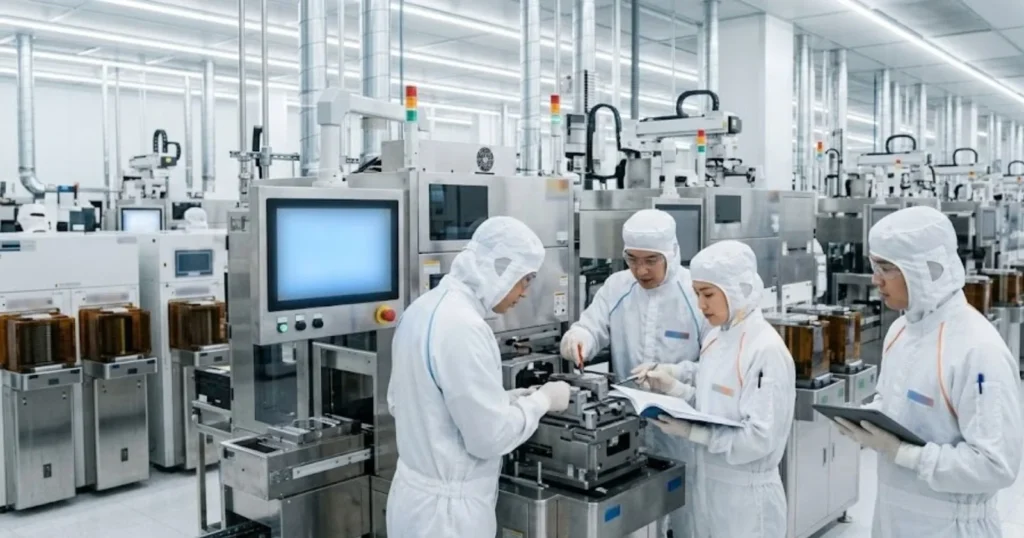
What makes Taiwan’s story distinct from the other aging economies profiled in this series is what sits on the other side of the equation: Taiwan is home to the world’s most advanced and geopolitically consequential semiconductor manufacturing base, anchored by Taiwan Semiconductor Manufacturing Company, an industry that depends on a highly specific combination of skilled engineering talent and precision manufacturing labor that a shrinking, aging population cannot straightforwardly replace.
Taiwan’s Working Age Population Is Becoming a Strategic Concern
Academic research published in the Journal of Population Research projected, using data going back to the early 2000s, that Taiwan’s labor force would begin shrinking after 2034 if fertility and labor force participation rates persisted at then-current levels, a projection that has since proven, if anything, too conservative given how much further Taiwan’s fertility rate has fallen since that research was published.
More recent workforce data illustrates the strain already emerging well before that projected 2034 threshold: Taiwan’s Ministry of Labor reported 276,000 job vacancies nationwide at the end of March 2025, with persistent shortages reported throughout the year across manufacturing, hospitality, retail, construction, and childcare sectors.
A particularly striking data point underscores how underused Taiwan’s existing older workforce remains: in 2021, only 49.2 percent of Taiwanese aged 55 to 64 remained active in the labor force, a considerably lower share than in comparably aging Japan or South Korea, according to research from Academia Sinica’s Institute of Sociology, suggesting Taiwan has meaningful unrealized capacity to expand its effective labor supply through improved retention and re-employment of its existing older population before needing to rely solely on younger workers or immigration.
Low Fertility Is Creating Smaller Future Labor Cohorts
Taiwan’s fertility rate has remained below replacement level continuously since 1985, according to research from Academia Sinica, falling from replacement level in 1983 through a range of 1.7 to 1.8 in the late 1980s and 1990s, down to approximately 1.48 by 2001, and further still to around 1.0 in recent years before reaching the current record low of 0.695.
This four-decade trajectory of sustained sub-replacement fertility means Taiwan’s working-age population contraction, when it fully arrives, will not be a sudden shock but the culmination of a demographic process that has been unfolding, largely without effective reversal despite various policy interventions, for close to two generations.
A specific demographic imbalance compounds Taiwan’s fertility challenge directly: demographer Yang at Academia Sinica has documented a surplus of approximately 400,000 to 450,000 Taiwanese men of marrying age who are structurally unlikely to find domestic partners, because cultural marriage norms in Taiwan favor men marrying women younger than themselves, a pool that has shrunk considerably due to falling fertility in the generations born after these men.
Since 2012 alone, Taiwan’s population of women of childbearing age has decreased by approximately 500,000, according to the same research, illustrating how the fertility decline is now actively reducing the very population base needed for any future fertility recovery.
Why Demographics Matter So Much to Taiwan’s Semiconductor Economy
Taiwan’s semiconductor sector faces an estimated shortage of over 30,000 workers, according to Darson Chiu, director-general of the Confederation of Asia-Pacific Chambers of Commerce and Industry, a gap that sits alongside broader youth unemployment figures that appear paradoxical at first glance: unemployment for those aged 20 to 24 stood at approximately 11.7 percent and for those aged 25 to 29 at approximately 5.85 percent in late 2025, both notably higher than Taiwan’s low headline national unemployment rate.
This is not primarily a story of too few workers in the aggregate; it is a story of mismatched skills and mismatched sectors, with the Institute for Security and Development Policy describing Taiwan’s semiconductor talent shortage as coexisting directly with elevated youth unemployment around 12 percent, reflecting an education system that Taiwanese policymakers themselves have acknowledged is not yet producing enough highly qualified STEM and PhD-level graduates even as it produces an oversupply of graduates in fields less aligned with industry demand.
It is important not to overstate demographics as the sole determinant of Taiwan’s semiconductor competitiveness: the sector’s global position rests on decades of accumulated manufacturing expertise, capital investment, and specialized supply chain infrastructure that a shrinking population does not directly erode. What Taiwan’s demographic trajectory does threaten is the pipeline of new skilled talent needed to staff continued industry expansion and generational knowledge transfer as experienced engineers retire.
Can Productivity and Automation Offset Fewer Workers?
Taiwanese semiconductor companies have responded to the talent shortage partly through increased automation, a shift that the Rest of World’s 2025 reporting notes has itself changed the nature of labor demand within the industry, pushing hiring needs further toward high-skilled engineering and technical roles rather than lower-skilled manufacturing positions.
TSMC has also expanded its geographic footprint beyond Taiwan specifically to address workforce constraints, building fabrication facilities in the United States, Japan, and Europe partly to access labor pools outside Taiwan’s own shrinking domestic base, a strategy that simultaneously addresses geopolitical diversification pressures and demographic labor constraints.
Taiwan’s Migrant Workforce Has a Different Role
Taiwan hosts approximately one million immigrants; according to demographer research cited by Domino Theory’s 2026 reporting, the substantial majority, roughly 850,000, work as migrant laborers from Southeast Asia in manufacturing, caregiving, fishing, and construction roles rather than in Taiwan’s high-skill semiconductor engineering workforce specifically.
This distinction matters considerably: Taiwan’s broader labor shortage across ordinary sectors, evidenced by the 276,000 reported job vacancies, is being addressed substantially through expanded migrant worker access, including recent government approval of broader migrant labor access in hospitality roles facing persistent shortages.
Taiwan’s Employment Gold Card program, aimed specifically at attracting high-skilled foreign professionals rather than general labor migrants, has drawn over 15,000 participants, a meaningful but, according to Chiu’s assessment, still relatively small contribution relative to the scale of Taiwan’s high-skill industry talent needs.
Regional Population Concentration and Industrial Clusters
Hsinchu, home to Taiwan’s Science Park and the epicenter of its semiconductor industry, offers a striking regional exception to Taiwan’s national fertility collapse. Rest of World’s December 2025 reporting documented that Hsinchu’s tech workers earn approximately 1.85 million New Taiwan dollars annually, more than triple salaries in the rest of Taiwan, and that this combination of high pay and substantial employer-provided childcare support, including on-site kindergartens built by TSMC and MediaTek and family-friendly policies including flexible and remote work arrangements for parents, has produced comparatively higher birth rates among Hsinchu’s tech workforce than the national trend.
TSMC itself publicly noted that its employees were behind 1.8 percent of Taiwan’s total newborns in 2023, a statistic the company highlighted with evident pride, illustrating how concentrated economic opportunity and employer-provided family support can meaningfully affect fertility outcomes at a very local, sector-specific scale even amid a severe national decline.
Taiwan’s Aging Population Will Increase Care Demand
Taiwan’s dependency ratio, the combined share of children and elderly relative to the working-age population, is projected by the National Development Council to exceed 50 percent by 2026 to 2027, meaning for every two working-age Taiwanese, there will be more than one dependent to support, a ratio that will continue climbing as Taiwan’s already-super-aged population share keeps growing.
This trajectory places substantial and growing pressure on Taiwan’s healthcare and long-term care infrastructure, a challenge Taiwan shares directly with Japan and South Korea, both covered in companion articles in this series, though Taiwan’s compressed seven-year transition from aged to super-aged society gives it considerably less time to build out the necessary eldercare capacity than Japan’s more gradual, though still rapid, equivalent transition.
Can Immigration and Talent Attraction Change the Demographic Outlook?
Taiwan’s demographer community, including Academia Sinica’s Yang, has increasingly characterized immigration as, in Yang’s own words, “the only solution” to sustaining Taiwan’s economy and maintaining a workable dependency ratio, given the apparent irreversibility of Taiwan’s ultra-low fertility trajectory at this stage. The United Nations defines a sustainable worker-to-dependent ratio as three working adults to one dependent, a benchmark that Taiwan’s current and projected trajectory, with dependency approaching and exceeding 50 percent by 2026-2027, is on track to fall well short of without substantial policy intervention.
Taiwan’s political environment around large-scale immigration remains considerably more cautious than Singapore’s actively managed immigration model documented elsewhere in this series, though the steady expansion of both general migrant worker access and the more targeted Employment Gold Card program suggests gradual, incremental liberalization is already underway even without a wholesale policy shift.
Taiwan Compared With South Korea, Japan and China
Taiwan’s fertility rate of 0.695 sits close to South Korea’s 0.75, documented in this series’ companion article, both among the lowest ever recorded globally, while considerably below Japan’s 1.14 and China’s approximately 1.0. Taiwan’s compressed seven-year transition from aged to super-aged society is faster even than Japan’s already-rapid 11-year equivalent transition, positioning Taiwan, alongside South Korea, at the most extreme end of East Asia’s shared demographic trajectory.
Where Taiwan diverges most notably from these comparisons is the specific strategic stakes attached to its labor shortage: Taiwan’s semiconductor industry occupies a uniquely consequential position in global technology supply chains, giving its demographic-driven talent constraints a degree of international economic and geopolitical significance that extends well beyond Taiwan’s own borders in a way not directly paralleled by South Korea’s or Japan’s broader, less singularly concentrated aging-workforce challenges.
Taiwan’s Demographic Outlook Through 2050
Taiwan’s National Development Council projects the country will continue to have the world’s lowest fertility rate through at least 2035, according to Oxford Institute of Population Ageing analysis of NDC projections, a trajectory the council has revised toward greater pessimism following the most recent fertility rate of 0.695. Academic labor force projections, while based on somewhat older data, consistently point toward Taiwan’s working-age population falling below current levels sometime after the mid-2030s absent substantial changes to fertility, labor force participation, or immigration policy.
Given the semiconductor industry’s centrality to Taiwan’s economy and its outsized strategic importance to global technology supply chains, the interaction between Taiwan’s accelerating demographic transition and its capacity to sustain the specialized workforce that industry requires is likely to remain one of the most closely watched intersections of demography and industrial policy anywhere in the world over the coming decade.
Frequently Asked Questions
1. Why is Taiwan’s population declining?
Taiwan’s population growth has stalled, and its underlying demographic base is weakening due to a fertility rate that has remained below replacement level since 1985 and fell to a record low of 0.695 in the most recent year of data, combined with a declining number of women in the primary childbearing age range since 2005.
2. What is Taiwan’s fertility rate?
Taiwan’s total fertility rate reached a record low of 0.695 in the most recent year of National Development Council data, down from 1.09 in 2023, placing it among the lowest fertility rates ever recorded globally, close to South Korea’s.
3. Is Taiwan’s workforce shrinking?
Taiwan’s working-age population is projected by academic research to fall below current levels sometime after the mid-2030s if fertility and labor force participation trends persist, while near-term labor shortages are already evident, with 276,000 reported job vacancies as of March 2025.
4. How could demographics affect Taiwan’s semiconductor industry?
Taiwan’s semiconductor sector faces an estimated shortage of over 30,000 workers, driven by a mismatch between the specialized engineering and STEM talent the industry requires and the graduates Taiwan’s education system currently produces, a gap compounded by the country’s shrinking overall population of working-age adults.
5. Can automation offset Taiwan’s labor shortage?
Taiwanese semiconductor companies have expanded automation, which shifts labor demand toward higher-skilled engineering roles, and companies including TSMC have also expanded fabrication operations to the United States, Japan, and Europe partly to access labor pools beyond Taiwan’s shrinking domestic base.
6. Does Taiwan rely on foreign workers?
Yes, though in two distinct ways: approximately 850,000 of Taiwan’s roughly one million immigrants work as general migrant laborers in manufacturing, caregiving, and construction, while a smaller, more targeted Employment Gold Card program has attracted over 15,000 high-skilled foreign professionals specifically for advanced industry roles.
7. Which parts of Taiwan have the largest semiconductor workforce?
Hsinchu, home to Taiwan’s Science Park, is the epicenter of the country’s semiconductor industry, with tech workers there earning more than triple the salaries found in the rest of Taiwan, a combination of high pay and employer-provided childcare that has produced comparatively higher birth rates locally than Taiwan’s severe national fertility decline.
8. How does Taiwan compare with South Korea?
Taiwan’s fertility rate of 0.695 sits close to South Korea’s 0.75, both among the lowest ever recorded, though Taiwan’s transition from aged to super-aged society, completed in just seven years, has moved even faster than the equivalent transitions in Japan, South Korea, or other comparably aging economies.
9. What will Taiwan’s population look like in 2050?
Taiwan’s National Development Council projects the country will maintain the world’s lowest fertility rate through at least 2035, with the working-age population expected to fall below current levels sometime after the mid-2030s absent substantial policy changes to fertility, labor force participation, or immigration.
Sources
- CIA World Factbook, Demographics of Taiwan, 2022-2025 estimates.
- Taiwan National Development Council, population and fertility projections, reported via Taipei Times, August 2026.
- Oxford Institute of Population Ageing, “Population Ageing in Taiwan and the Role of AI to Address the Challenges,” May 2025.
- Academia Sinica, Institute of Sociology, “Labor Shortage and Gender Inequality in Taiwan,” 2024 research paper.
- Rest of World, “Taiwan birth rate bucks trend in Hsinchu semiconductor hub,” December 2025.
- Domino Theory, “Taiwan Is Running Out of Children,” April 2026.
- Institute for Security and Development Policy, “Taiwan’s Labor Shortages in Key Sectors and the Skill Mismatch,” June 2026.
- Medium (Pallas), “Taiwan’s Labor Shortage Is Not Just About Low Birth Rates or Greedy Employers,” May 2026, citing Taiwan Ministry of Labor vacancy data.
- Journal of Population Research (Springer), “Below-replacement fertility and prospects for labour force growth in Taiwan.”