
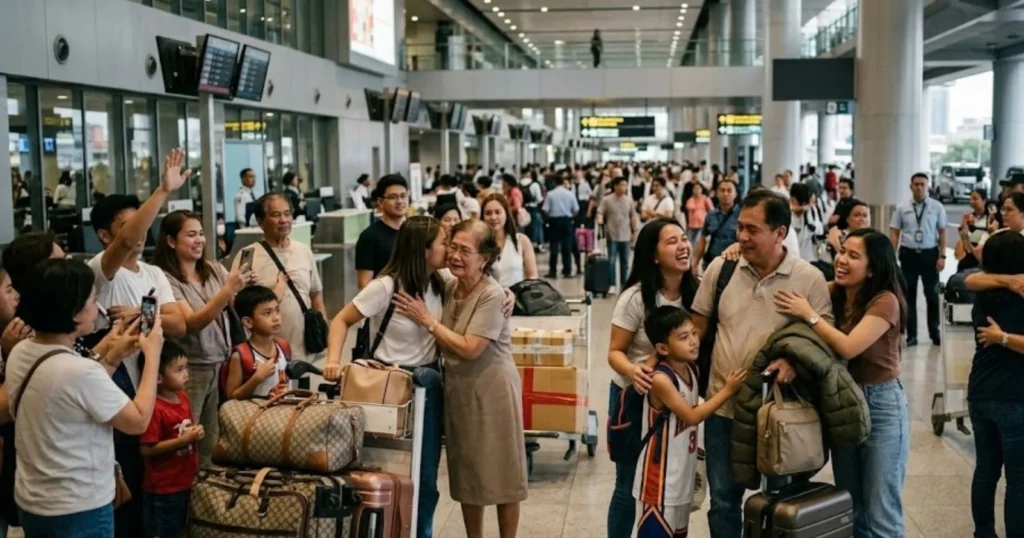
The Philippines Has Built One of the World’s Most Significant Labor Diasporas
Diaspora at a Glance
- Deployed Overseas Filipino Workers (2024): approximately 2.19 million, up 1.5% from 2.16 million in 2023
- Broader overseas Filipino population (workers plus long-term migrants): estimated 10 to 12 million
- Total remittances (2025): $35.63 billion in cash remittances, a record high, up 3.3% from $34.49 billion in 2024
- Remittances as share of GDP (2025): 7.3%
- Female share of OFWs (2024): 57.2%, or approximately 1.25 million
- Primary destination region: Asia, 74.5% of departures in 2024
- Overseas contract workers (with existing employment contracts) as share of total OFWs: 97.9%
Sources: Philippine Statistics Authority (PSA), 2024 Survey on Overseas Filipinos; Bangko Sentral ng Pilipinas (BSP), 2025 remittance data; Overseas Workers Welfare Administration (OWWA).
Overseas Filipino workers sent home a record $35.63 billion in cash remittances in 2025, according to the Philippine central bank, equivalent to 7.3 percent of the entire Philippine economy. Behind that figure sits a population of roughly 2.19 million officially deployed OFWs, and an estimated 10 to 12 million Filipinos living and working overseas when longer-term migrants and permanent emigrants are included, according to the Overseas Workers Welfare Administration. Few countries anywhere have built an economic and demographic relationship with labor migration as extensive, or as institutionally organized, as the Philippines has over the past five decades.
This is not incidental migration. It is a deliberately constructed labor export system, supported by dedicated government agencies, bilateral labor agreements, and a domestic economy that has come to depend on remittance income at a scale most countries would consider a structural vulnerability rather than a stable pillar.
How Many Filipinos Live and Work Abroad?
Precision matters here because different figures answer different questions. The PSA’s official OFW count of 2.19 million for 2024 measures Filipinos who worked abroad during a specific reference period, primarily on temporary employment contracts.
The OWWA’s broader estimate of 10 to 12 million overseas Filipinos includes this contract workforce alongside longer-settled emigrants, naturalized citizens of other countries, and permanent residents abroad, a population built up cumulatively over decades of migration rather than measured in a single survey period.
Deployment data further breaks the workforce into land-based and sea-based categories. In 2024, deployed land-based rehires reached 1,591,696, land-based new hires totaled 378,444, and sea-based workers, predominantly seafarers, a globally significant Filipino specialization, numbered 504,057, for a combined annual deployment figure of 2,474,197, according to OWWA data presented at a 2025 World Bank forum. These deployment figures track annual outflows and reflect a different measurement approach than the PSA’s survey-based OFW stock estimate, which is why the two numbers do not align precisely.
Where Filipino Migrants Live and Work
Asia remained the dominant destination for OFWs in 2024, accounting for 74.5 percent of total departures, followed by Europe at 10.6 percent, North and South America combined at 9.2 percent, Australia at 4.4 percent, and Africa at 1.3 percent. Within Asia, Gulf states have historically absorbed a large share of Filipino labor migration, alongside significant deployment to other Asian economies including Hong Kong, Singapore, and Japan.
On the remittance side, which reflects a somewhat different geographic pattern shaped by wage levels and the presence of longer-settled Filipino communities, the United States remained the largest single source of cash remittances to the Philippines in 2025, according to Bangko Sentral ng Pilipinas data, followed by Singapore and Saudi Arabia, with Japan, the United Kingdom, and the UAE also ranking among the top sources. Malaysia recorded the smallest OFW population share among major destinations tracked by the PSA, at just 1.7 percent of the total OFW count in 2024.
Top Remittance Source Countries (2025)
| Rank | Country |
|---|---|
| 1 | United States |
| 2 | Singapore |
| 3 | Saudi Arabia |
| — | Japan, United Kingdom, UAE (also major sources) |
Why Filipinos Seek Work Overseas
The economic logic behind Filipino labor migration rests on a persistent and substantial wage gap between domestic Philippine employment and comparable positions abroad, particularly in the Gulf states, East Asia, and North America. This gap has been sustained across multiple economic cycles since organized labor export policy began in the 1970s under the Marcos administration, originally conceived as a temporary measure to address domestic unemployment and generate foreign currency, but which became a permanent and institutionalized feature of the Philippine economy.
Beyond wages, Filipino migration has been sustained by extensive migration networks, family and community connections that ease the transition for new migrants, strong English-language proficiency that provides a competitive advantage in international labor markets, and a long-established reputation among employers in specific sectors, notably maritime shipping, healthcare, and domestic service, that has made Filipino workers a preferred hiring pool globally.
The Economic Importance of Remittances
Remittances have grown into one of the most significant pillars of the Philippine economy, reaching $35.63 billion in cash remittances in 2025, equivalent to 7.3 percent of GDP and 6.4 percent of gross national income. Personal remittances, a broader measure including goods sent home and informal transfer channels alongside formal cash transfers, reached even higher totals.
The scale of this dependency has been remarkably stable in recent years: remittances stood at $36.14 billion in 2022, equivalent to 8.9 percent of GDP, $37.21 billion in 2023 at 8.5 percent of GDP, and $38.34 billion in 2024 at 8.3 percent of GDP, according to OWWA data, with the modest year-to-year decline in GDP share reflecting overall Philippine economic growth outpacing remittance growth rather than any weakening in the remittance flow itself.
The Philippine central bank’s own research highlights persistent structural challenges in how this remittance income is used: approximately 70 percent of remittance receipts go toward daily household needs, while less than 15 percent reaches savings or investment vehicles, according to World Bank forum data presented by the Overseas Workers Welfare Administration. Transfer costs also remain a meaningful drag on remittance value, with sending $200 to the Philippines still costing migrants roughly 5 to 6 percent on average, nearly double the United Nations Sustainable Development Goal target of 3 percent.
Who Migrates From the Philippines?
Women have made up the majority of OFWs in every recent survey year, reaching 57.2 percent, or approximately 1.25 million workers, in 2024, up from 55.6 percent in 2023. Occupationally, elementary occupations, which include domestic work and other lower-skilled service roles, accounted for the largest single category at 43.6 percent of OFWs in 2024, followed by plant and machine operators and assemblers at 15.4 percent, and service and sales workers at 12.7 percent.
Age patterns differ meaningfully by gender: women OFWs are concentrated most heavily in the 30 to 34 age bracket, while male OFWs skew notably older, with the largest share aged 45 and above, according to Statista compilations of Philippine labor migration data, a pattern that likely reflects differences in occupational categories and career trajectories between male-dominated sectors such as seafaring and construction and female-dominated domestic and caregiving work.
The Social Cost of Long Distance Family Separation
Extended family separation is a defining feature of the OFW experience for a large share of Filipino migrant workers, particularly those on multi-year overseas contracts in the Gulf states and elsewhere in Asia. Research and policy discussion around this phenomenon in the Philippines has focused on children growing up with one or both parents working abroad, adaptations in household caregiving arrangements, often shifting to grandparents or other extended family members, and the broader social and emotional adjustments required of both migrants and the families who remain in the Philippines. These are well-documented patterns discussed extensively in Philippine policy and academic literature, though the specific psychological and developmental effects on individual families vary considerably and should not be generalized as uniformly positive or negative.
The Philippines’ Labor Export Model
The institutional infrastructure supporting Filipino overseas employment is unusually extensive by global standards. The Department of Migrant Workers and the Overseas Workers Welfare Administration manage deployment processes, worker welfare programs, and reintegration support for returning OFWs.
The Commission on Filipinos Overseas runs diaspora engagement initiatives, including the BaLinkBayan portal connecting overseas Filipino communities to investment, philanthropy, and returning-talent programs, and a scientist and technologist return program that attracted 236 participants for 348 projects between 2007 and 2019, drawing primarily from North America and Asia.
More recent government initiatives have focused on improving the financial infrastructure supporting remittances and diaspora engagement, including Project Nexus, aimed at cheaper and faster cross-border transfers, and continued expansion of digital payment infrastructure, with digital payments accounting for 52.8 percent of the volume of retail transactions in the Philippines by 2023, surpassing the central bank’s own 50 percent target for that year.
Will the Overseas Filipino Workforce Continue Growing?
The trajectory of Filipino overseas employment depends on several interacting factors that are not purely demographic. Continued strong labor demand from aging societies in East Asia, including Japan, South Korea, and Taiwan, and sustained Gulf state demand tied to infrastructure and services sectors both point toward continued or growing demand for Filipino labor in the near term.
Automation and shifting labor market conditions in some traditional destination sectors could moderate demand for certain occupational categories over time, though the Philippines’ strong position in specialized fields such as maritime shipping and healthcare has proven relatively resilient across economic cycles to date.
Domestically, whether the Philippine economy successfully diversifies its own labor market and reduces its degree of remittance dependency, a policy goal expressed by Philippine officials but not yet reflected in declining remittance-to-GDP ratios beyond modest recent fluctuations, will shape how central overseas employment remains to the broader Philippine economic model over the coming decades.
Frequently Asked Questions
1. How many Filipinos live abroad?
Estimates vary by definition: the Philippine Statistics Authority counted approximately 2.19 million deployed Overseas Filipino Workers in 2024, while the Overseas Workers Welfare Administration estimates the broader overseas Filipino population, including longer-term migrants and settled emigrants, at 10 to 12 million.
2. Which country has the most Filipinos overseas?
Asia hosts the largest share of OFWs by deployment, accounting for 74.5 percent of departures in 2024. For remittance-sending purposes, the United States is the single largest source country, followed by Singapore and Saudi Arabia.
3. How many OFWs are there?
The Philippine Statistics Authority estimated 2.19 million Overseas Filipino Workers in 2024, a 1.5 percent increase from 2.16 million in 2023, of whom 97.9 percent held existing employment contracts abroad.
4. How much do Filipino migrants send home?
Cash remittances from overseas Filipinos reached a record $35.63 billion in 2025, equivalent to 7.3 percent of the Philippines’ gross domestic product, according to the Bangko Sentral ng Pilipinas.
5. Why do Filipinos work abroad?
Filipino labor migration is driven primarily by substantial wage differentials between domestic and overseas employment, supported by strong English-language skills, established migration networks, and an institutionalized labor export system dating to the 1970s.
6. Which jobs do Filipino migrants commonly perform?
Elementary occupations, including domestic work, made up the largest single category at 43.6 percent of OFWs in 2024, followed by plant and machine operators and assemblers at 15.4 percent, and service and sales workers at 12.7 percent. Filipino seafarers also represent a globally significant specialized workforce.
7. Are OFWs permanent migrants?
Most OFWs are temporary contract workers rather than permanent migrants: 97.9 percent of the PSA’s 2024 OFW count held existing overseas employment contracts, distinct from the smaller population of Filipinos who have permanently emigrated and settled abroad.
8. Will Filipino migration continue growing?
Overseas Filipino Worker deployment has grown steadily in recent years, from 2.16 million in 2023 to 2.19 million in 2024, and remittances reached a record high in 2025, suggesting continued strong demand for Filipino labor abroad, though long-term trends will depend on labor market conditions in destination countries and the pace of Philippine domestic economic diversification.
Sources
- Philippine Statistics Authority (PSA), Results of the 2024 Overseas Filipino Workers Survey, December 2025.
- Bangko Sentral ng Pilipinas (BSP), 2025 Overseas Filipino remittance data, reported via Gulf News, January 2026.
- Overseas Workers Welfare Administration (OWWA), “From Cash to Catalysts: Philippine Strategies on Remittances and Diaspora,” presented at World Bank forum, 2025.
- Commission on Filipinos Overseas (CFO), Philippines Facts and Figures, Diaspora for Development compilation, 2024.
- Statista, compilation of BSP remittance-by-country and OFW demographic data, 2024-2025.