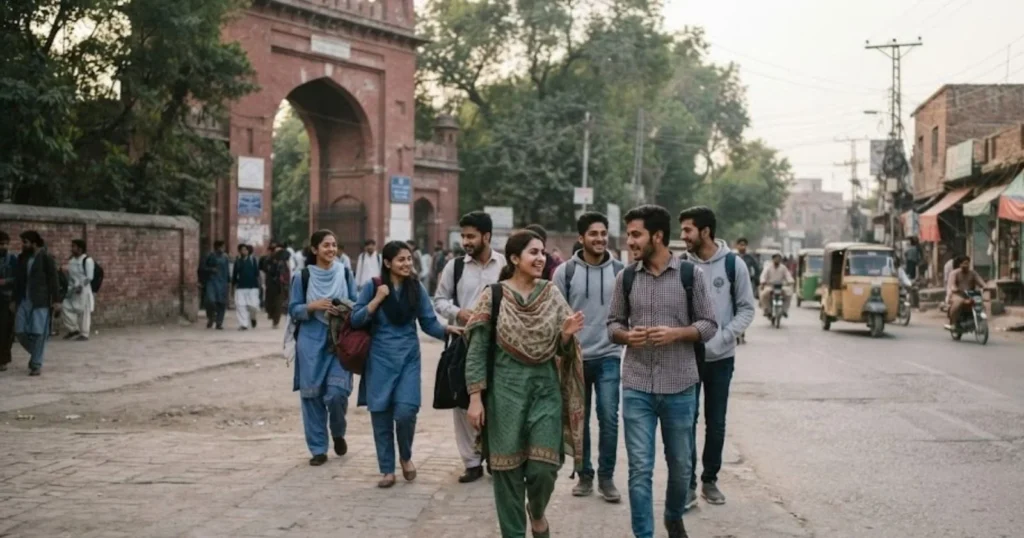
Pakistan is one of the youngest large countries in the world. The Pakistan Economic Survey 2025 to 26 reports a population of about 252.09 million in 2025, growing at 2.07 percent a year, with 26.56 percent of residents, about 66.96 million people, aged 15 to 29. The earlier 7th Population and Housing Census (2023) counted 241.49 million people, with growth of 2.55 percent a year between 2017 and 2023.
How Young Is Pakistan’s Population?
Youth is defined here as ages 15 to 29, which is the range used in the Economic Survey. The United Nations uses 15 to 24. Both are shown where available.
| Indicator | Value | Source and year |
|---|---|---|
| Population | 241.49 million | Census 2023 |
| Population estimate | 252.09 million | Economic Survey 2025 to 26 (projection for 2025) |
| Annual growth | 2.55% (2017 to 2023), 2.07% (2025) | Census; Economic Survey |
| Share aged 15 to 29 | About 26% (2023), 26.56% (2025) | Economic Survey |
| Youth number, 15 to 29 | About 66.96 million | Economic Survey 2025 to 26 |
| Working age share (15 to 59) | About 53.8% (2024 to 25 edition), about 57% (2025 to 26 edition) | Economic Survey |
| Share under age 40 | Nearly 79% | Census 2023, as reported |
The share of youth and the absolute number rise together while fertility remains high. Fertility fell from above 5 in the 1990s but was still about 3.6 in the 2017 to 18 PDHS, well above replacement. Population growth of about two percent a year doubles a population in roughly 35 years, which is why even modest changes in growth rates matter for planning.
Census counts and estimates differ in method. The census reflects a head count on a reference date, with known disputes about coverage in some districts. Estimates are projections prepared by the National Institute of Population Studies, and revisions follow each census.
Why Pakistan’s Youth Population Matters for State Capacity
State capacity is not a vague synonym for governance. It includes the administrative ability to register people, tax them, educate them, treat them, and house them. Demographic scale affects each function.
| Function | Demographic pressure | Capacity question |
|---|---|---|
| Education delivery | Large school-age cohorts | Can schools, teachers and learning materials expand? |
| Healthcare access | Maternal, child and adolescent care | Are clinics, staff and drugs available? |
| Civil registration | Births, identity documents | Can citizens obtain identity and benefits? |
| Employment services | Entry of new workers | Do labor markets and skills systems work? |
| Tax collection | Wider base needs formalization | Can revenue rise with population? |
| Infrastructure and municipal services | Urban growth | Can cities plan housing, water and transport? |
Population size creates both demand and potential human resources. A country with a large working-age population has more potential output, but only if institutions turn people into productive workers and taxpayers.
Can Pakistan Educate Its Growing Population?
Education is the central test. The Economic Survey 2025 to 26 reports that about 28 percent of school-age children are out of school, and other estimates put the number at around 25 million. The Pakistan Education Statistics report for 2023 to 24, as cited in media analysis, found that a large share of enrolled children drop out between primary and middle school.
Learning is a second problem. Even among children in school, many cannot read or do arithmetic at grade level, and public spending on education as a share of national income has fallen in recent years, according to analysis of the Survey data. Gaps by sex and region are wide: girls in rural Balochistan and Khyber Pakhtunkhwa have lower enrollment and completion than boys or than urban girls in Punjab.
| Barrier | Evidence | Effect |
|---|---|---|
| School access | Out-of-school children: around 25 million | Lower literacy and skills |
| Teacher supply | Shortages and uneven quality | Weak learning |
| Poverty | Costs, child work | Dropout |
| Gender norms | Lower girls’ enrollment in some districts | Lower female participation later |
| Infrastructure | Missing facilities, distance | Absenteeism |
| Flood damage | 2022 floods damaged many schools | Learning loss |
Enrollment is not learning, and learning is not job readiness. The policy implication is that raising foundational literacy and keeping children in school through the secondary level matters more for the dividend than adding seats alone.
Youth Employment and the Limits of a Demographic Dividend
The Labour Force Survey 2024 to 25 and the Economic Survey 2025 to 26 show a labor market that is adding jobs but not fast enough. Employment grew from 67.25 million in 2020 to 2021 to 77.2 million in 2024 to 2025, a gain of about ten million, yet unemployment rose to 7.1 percent, with roughly 5.9 million people jobless in the Survey count. Youth unemployment for ages 15 to 24 was reported at 12.6 percent and for ages 15 to 29 at 11.5 percent in the LFS 2024 to 25.
Headline unemployment understates the issue because informal work is widespread. Many workers are in agriculture, small trade, and services with low pay and no contracts. Skills mismatch exists as well: graduates may not find roles that fit their training, while employers report difficulty finding technical skills.
| Measure | Value | Note |
|---|---|---|
| Overall unemployment | 7.1% | Economic Survey 2025 to 26 |
| Youth unemployment (15 to 24) | 12.6% | LFS 2024 to 25, as reported |
| Youth unemployment (15 to 29) | 11.5% | LFS 2024 to 25, as reported |
| Employed persons | 77.2 million | LFS 2024 to 25 |
| Registered overseas workers, 2025 | 762,499 | Bureau of Emigration, 69.5% to Saudi Arabia |
Overseas employment is a safety valve. Hundreds of thousands of workers register for foreign jobs each year, mostly in Gulf states, and remittances are a major source of foreign exchange. Dependence on emigration reflects limited domestic job creation, and it also carries risks if destination demand changes.
Population Growth and Public Health Capacity
Rapid growth raises demand for maternal and child health, nutrition, reproductive healthcare, and disease prevention. The World Bank has reported that nearly 40 percent of children under five are stunted, a sign of chronic undernutrition with long-term effects on learning and productivity.
Population growth does not determine health outcomes by itself. Service coverage and financing matter. Lady health worker programs expanded primary care reach in rural areas, and immunization and family planning services have grown, but gaps remain. Contraceptive use is moderate, with unmet need for family planning documented in the PDHS.
| Health area | Evidence | Policy gap |
|---|---|---|
| Child nutrition | About 40% stunting | Food access, maternal health |
| Maternal health | High maternal mortality relative to peers | Skilled birth attendance |
| Reproductive health | Unmet need for contraception | Access, counseling |
| Disease prevention | Immunization gaps in some districts | Outreach |
| Health financing | Low public spending | Out-of-pocket costs |
Provincial and Rural-Urban Differences
Pakistan’s provinces differ in size, income, fertility, and service delivery. The 2023 census counted Punjab at 127.69 million, Sindh at 55.70 million, Khyber Pakhtunkhwa at 40.85 million, Balochistan at 14.89 million, and the Islamabad Capital Territory at 2.36 million. The Economic Survey 2025 to 26 projects 2025 populations of 133.36 million for Punjab, 58.27 million for Sindh, 42.68 million for Khyber Pakhtunkhwa, and 15.22 million for Balochistan.
| Province or area | Census 2023 (millions) | Projection 2025 (millions) | Features |
|---|---|---|---|
| Punjab | 127.69 | 133.36 | Largest, most urbanized, industrial and agricultural base |
| Sindh | 55.70 | 58.27 | Karachi as economic center, wide rural urban gap |
| Khyber Pakhtunkhwa | 40.85 | 42.68 | Higher fertility, mountain districts, Afghan border |
| Balochistan | 14.89 | 15.22 | Largest by area, sparse population, weakest services |
| Islamabad Capital Territory | 2.36 | not listed here | Federal capital |
Urbanization is about 38.8 percent in the 2023 census, and large cities have grown rapidly. Karachi was counted at about 20.4 million and Lahore at about 13.0 million. Provincial gaps in education, health, and fertility are large, and district-level data matter because averages hide wide differences.
Fiscal Capacity and the Cost of Expanding Services
Revenue limits spending. Pakistan’s tax-to-GDP ratio is low by regional standards, and a large share of revenue goes to debt service. Under the National Finance Commission award, federal and provincial governments share revenue, with provinces responsible for most education and health spending after the 18th Amendment.
Media analysis of the Economic Survey data reports that public education spending has fallen to a low share of GDP. Whatever the exact figure, the pattern is that spending per child is limited while cohorts grow. Debt servicing consumes a large part of federal revenue and constrains development spending.
| Fiscal factor | Pressure | Implication |
|---|---|---|
| Low tax base | Limited revenue | Service expansion constrained |
| Debt service | Large share of revenue | Less for health and schools |
| Federal-provincial split | Provinces deliver services | Capacity varies by province |
| Informal economy | Hard to tax | Need documentation |
| Disaster costs | 2022 floods | Reconstruction spending |
This section separates established fiscal data from analysis. The demographic point is that each new cohort of children needs education, and unfunded growth in cohorts lowers spending per child.
Urbanization, Housing, Water, and Infrastructure
Urban growth creates demand for housing, transport, sanitation and water. Karachi, Lahore, Faisalabad, Rawalpindi and Peshawar all face congestion, water shortages and informal settlements. Projected urban growth is not the same as measured current conditions: surveys show large shares of urban residents lacking safely managed sanitation or reliable piped water, particularly in informal areas.
| Infrastructure | Pressure | Constraint |
|---|---|---|
| Housing | Large deficit, informal settlements | Land, finance |
| Water | Aquifer depletion, contamination | Governance, tariffs |
| Sanitation | Sewage treatment gaps | Capital |
| Transport | Congestion | Municipal capacity |
| Power | Reliability | Circular debt |
Gender and the Underused Potential of Young People
Girls and women are the largest underused resource. Female enrollment is lower at secondary levels in many districts, and female labor force participation is far below the male rate, at roughly a quarter or less in recent surveys. Barriers include safety, transport, early marriage, social norms, and a lack of suitable jobs.
Raising female education and participation would add workers, raise household income, and lower fertility over time. Evidence from other countries suggests that girls’ education is among the most effective investments for health and demographic outcomes. Pakistan’s variation across districts provides local evidence that supportive environments make a difference.
Policy Priorities for Converting Youth Into Human Capital
| Priority | Mechanism | Evidence status |
|---|---|---|
| Education quality | Foundational literacy, teacher training | Strong in general |
| Keeping children in school | Cash support, girls’ schooling | Mixed local evidence |
| Job creation | Export manufacturing, agriculture, services | Depends on macro stability |
| Skills development | Technical and vocational training, apprenticeships | Varies by program |
| Public health | Nutrition, family planning, primary care | Strong |
| Women’s participation | Safe transport, childcare, jobs | Promising |
| Institutional effectiveness | Tax administration, local government | Gradual |
Government programs such as youth skills and business loan schemes aim to help, and their results should be assessed with evaluation data before being described as successes.
Pakistan’s Demographic Outlook Through 2050
The Economic Survey notes that population is expected to keep growing through 2050 under national projections, and United Nations projections place Pakistan among the most populous countries, with fertility the key variable. Faster fertility decline would slow growth and raise the working-age share sooner, while slower decline would increase pressure on services.
| Scenario | Fertility path | Policy path | Outcome |
|---|---|---|---|
| Faster transition | Falls toward replacement by the 2040s | Girls’ education, family planning | Larger working-age share, lower pressure |
| Moderate transition | Gradual decline | Partial reform | Continued strain |
| Slow transition | High fertility persists | Weak service delivery | Rising dependency and pressure |
Demographic growth is not a predetermined economic or political outcome. Claims that a youth bulge causes instability are not supported as a general rule, and outcomes depend on jobs, institutions, and inclusion.
Frequently Asked Questions
1. How large is Pakistan’s youth population?
About 66.96 million people aged 15 to 29, or 26.56 percent of the population, in the Economic Survey 2025 to 26 estimate.
2. Can Pakistan benefit from its demographic dividend?
Yes, if jobs, education, health, and institutions improve enough to employ the growing workforce productively.
3. Why is education central to Pakistan’s demographic future?
Learning determines skills and productivity, and about 28 percent of school-age children are out of school.
4. How does population growth affect government capacity?
It raises demand for services faster than revenue and staff can grow.
5. Which policy changes could improve youth outcomes?
Better foundational learning, job creation, nutrition and health services, female participation, and stronger public administration.
6. What is Pakistan’s population?
241.49 million in 2023 census and about 252.09 million in the 2025 projection.
7. What is Pakistan’s unemployment rate? 7
.1 percent in the Economic Survey 2025 to 26, with youth rates higher.
8. Which province is largest? Punjab, with 127.69 million in 2023.
9. Does a youth bulge cause instability?
There is no automatic link. Outcomes depend on opportunity and governance.
10. How fast is Pakistan growing?
About 2.07 percent a year in the 2025 estimate, down from 2.55 percent in the 2017 to 2023 intercensal period.
Sources and Data Notes
- Pakistan Bureau of Statistics, 7th Population and Housing Census 2023; Labour Force Survey 2024 to 25.
- Ministry of Finance, Pakistan Economic Survey 2024 to 25 and 2025 to 26.
- National Institute of Population Studies, Pakistan Demographic and Health Survey 2017 to 18.
- World Bank, UNICEF, UNFPA and ILO reports on Pakistan.
- Data note: Economic Survey editions use different working-age definitions. Education spending shares come from secondary analysis and should be verified.