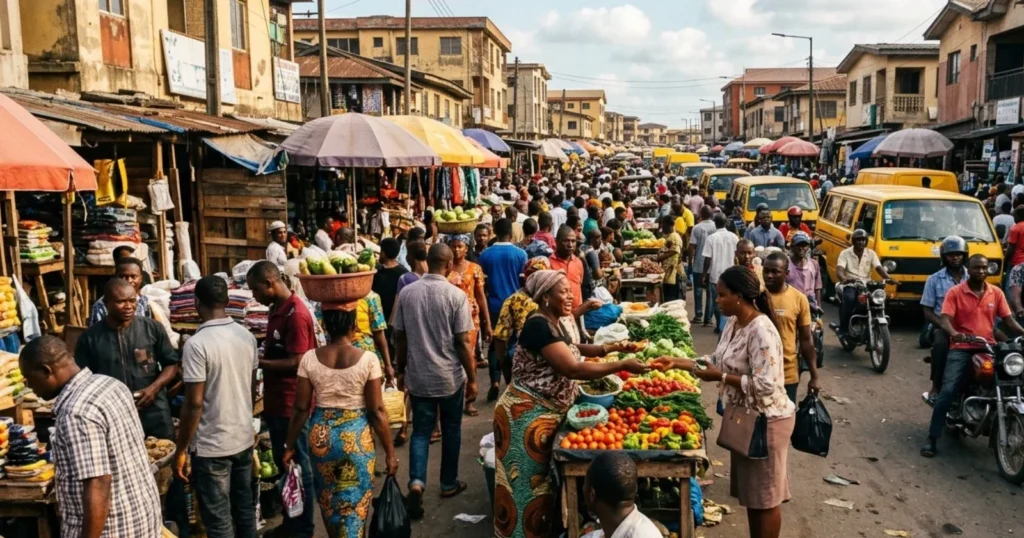
Nigeria’s population reached approximately 237.5 million in 2025, according to World Bank estimates, growing at roughly 2.1 percent annually and adding close to 5 million people every year. That makes Nigeria the sixth most populous country on Earth and, by a wide margin, the most populous in Africa.
But the number that matters most for understanding Nigeria’s economic future is not the total, it is the median age: 18 to 19 years, meaning half the country is younger than that. A population this large and this young represents simultaneously one of the largest consumer markets on the continent and one of the most demanding infrastructure and job-creation challenges any government currently faces.
Nigeria’s Population Is Growing Rapidly
Nigeria’s population growth trajectory has been sustained and rapid for decades. The World Bank reports a 2025 population of about 237.5 million and annual population growth of about 2.1 percent, a rate that, if sustained, would add tens of millions of people to Nigeria’s population within a single decade.
Nigeria’s population has grown from 108 million in 1999 to roughly 206 million by 2020 and past 237 million by 2025, and most projections point toward a population exceeding 400 million by 2050, which would make Nigeria the world’s third most populous country, behind only India and China.
Nigeria Population Growth
| Year | Population |
|---|---|
| 1999 | 108 million |
| 2020 | 206 million |
| 2025 | 237.5 million |
| 2050 (projected) | ~400 million+ |
Nigeria Has an Exceptionally Large Young Population
Nigeria’s age structure is among the youngest of any large country in the world. Estimates place the median age at roughly 18 to 19 years, with the under-15 population share around 43 to 52 percent depending on the source and year, and the working-age population (15-64) at roughly 45 percent. The elderly population, aged 65 and above, remains a small fraction of the total, around 3 percent, reflecting both high fertility and comparatively modest life expectancy, estimated at roughly 53 to 55 years.
Nigeria Key Facts
| Metric | Figure | Year |
|---|---|---|
| Population | 237.5 million | 2025 |
| Annual growth rate | 2.1% | 2025 |
| Median age | 18-19 years | 2025-2026 |
| Fertility rate | 4.3-4.5 | 2023-2025 |
| Urban population share | 55.8% | 2026 |
| Life expectancy | ~53-55 years | 2024-2025 |
This youthful structure means Nigeria carries substantial population momentum: even if fertility continues its gradual decline, the sheer size of the young cohorts already born will keep driving population growth for decades, since those cohorts will move through their own childbearing years regardless of how much fertility rates themselves fall.
Population Growth and Economic Growth Are Not the Same Thing
A country’s population size is not, by itself, a measure of economic strength or market opportunity. Nigeria’s rapid population growth has occurred alongside per capita GDP growth that has, at various points over the past decade, lagged behind population growth itself, meaning average income per person has not always risen even as the total economy has grown in absolute terms.
Distinguishing population scale from per capita development matters directly for how Nigeria’s demographic trajectory should be interpreted: a market of 237 million people is not automatically a market of 237 million consumers with meaningful purchasing power, and the two concepts, demographic scale and economic capacity, need to be assessed separately rather than treated as interchangeable.
Nigeria’s Working Age Population Is Expanding
Nigeria’s working-age population, roughly 45 percent of the total and growing in absolute terms even as its share fluctuates, represents both Nigeria’s greatest economic asset and its most pressing policy challenge. Labor force participation, formal employment generation and productivity growth all need to expand fast enough to absorb the millions of young Nigerians entering the workforce each year, a pace few economies globally have managed to sustain. Informal employment remains widespread across the Nigerian economy, and unemployment and underemployment, particularly among youth, have remained persistent structural challenges even during periods of aggregate economic growth.
Nigeria’s Population Is Becoming Increasingly Urban
Nigeria’s urban population share has risen from roughly 50 percent in 2020 to about 55.8 percent by 2026, driven by both natural urban population growth and continued rural-to-urban migration. Lagos anchors Nigeria’s urban system by a wide margin, with metropolitan population estimates ranging from roughly 16 million to over 20 million depending on the boundary definition used, making it one of the largest urban agglomerations in the world and, on some projections, likely to exceed 30 million residents by 2050. Kano, Ibadan, Port Harcourt, Kaduna, Benin City and Maiduguri round out Nigeria’s tier of major urban centers, each serving as regional economic hubs attracting migrants from surrounding rural areas.
A Huge Population Creates a Huge Consumer Market
Nigeria’s population scale does translate into genuine market opportunity, particularly for goods and services aligned with a young, increasingly urban population. Mobile telecommunications and digital financial services have expanded rapidly in Nigeria over the past decade, reflecting both large potential user bases and relatively low fixed infrastructure costs compared with traditional banking and retail expansion.
Consumer goods, food and beverage companies, and increasingly digital commerce platforms have identified Nigeria as a priority market specifically because of its population scale, even as per capita income constraints mean the addressable high-spending consumer segment remains considerably smaller than the total population would suggest.
Infrastructure Must Expand Alongside Population
Nigeria’s rapid population and urban growth places sustained pressure on infrastructure across every major category. Electricity generation and distribution capacity has struggled to keep pace with demand for decades, a constraint widely cited as one of the most significant barriers to Nigerian industrial and economic development.
Transport infrastructure, housing supply, water and sanitation systems, and healthcare and education capacity all face similar pressure from a population growing by millions annually, with urban centers such as Lagos experiencing acute housing shortages, informal settlement growth and severe traffic congestion as infrastructure investment has not kept pace with population growth.
Nigeria’s Demographic Dividend Depends on Productivity
The concept of a demographic dividend, economic gains realized when a large working-age population is productively employed, applies to Nigeria in theory but remains substantially unrealized in practice. Nigeria’s dependency ratio remains relatively high due to the large under-15 population share, meaning the working-age population currently supports a substantial dependent population even before accounting for underemployment within the working-age group itself.
Converting Nigeria’s demographic scale into an economic dividend would require sustained formal-sector job creation, continued fertility decline to gradually reduce the dependency burden, and substantial investment in education and skills development, conditions that have not yet aligned at the scale Nigeria’s population growth requires.
Nigeria’s Long Term Population Outlook
Most projections, including those built on UN medium-variant assumptions, place Nigeria’s population above 400 million by 2050, with continued gradual fertility decline, from around 4.3 to 4.5 children per woman currently toward roughly 3.7 by 2043 on some projections, not enough to prevent substantial further population growth given Nigeria’s existing age structure and population momentum.
Urbanization is projected to continue rising as well, potentially reaching close to 80 percent by 2050 on some projections, up from roughly 56 percent in 2025, implying that the bulk of Nigeria’s population growth over the coming decades will occur in and around its cities rather than in rural areas.
Conclusion
Nigeria’s population trajectory sets the country apart from nearly every other large economy in the world: rapid growth, an exceptionally young age structure, and a scale that will make it one of the most populous nations on Earth within a generation. That scale creates genuine opportunity, a large and growing consumer base, a vast working-age population, and outsized regional economic weight, but none of it converts automatically into development.
Whether Nigeria’s population becomes Africa’s largest sustained market or continues to strain infrastructure and job creation beyond what current investment supports will depend on choices about productivity, education and formal employment that population statistics alone cannot make.
Key Findings
- Nigeria’s population reached approximately 237.5 million in 2025, growing at roughly 2.1 percent annually, and is projected to exceed 400 million by 2050, potentially making it the world’s third most populous country.
- Nigeria’s median age is roughly 18 to 19 years, among the youngest of any large country globally, with the under-15 population share estimated between 43 and 52 percent depending on the source.
- Nigeria’s fertility rate remains high, between 4.3 and 4.5 children per woman as of recent estimates, though it has been gradually declining from levels above 6 children per woman in past decades.
- Lagos has grown from 1.4 million residents in 1970 to an estimated 16 to 20-plus million today, and could exceed 30 million by 2050 on some projections.
- Nigeria’s urban population share rose from roughly 50 percent in 2020 to about 55.8 percent by 2026, and is projected to approach 80 percent by 2050.
- Population growth and economic growth are distinct measures; Nigeria’s large population represents significant market potential but per capita income constraints limit the addressable high-spending consumer segment.
Frequently Asked Questions
1. How large is Nigeria’s population?
Nigeria’s population reached approximately 237.5 million in 2025, according to World Bank estimates, making it the sixth most populous country in the world and the most populous in Africa.
2. Why is Nigeria’s population growing so quickly?
A combination of a still-high fertility rate, between 4.3 and 4.5 children per woman, and a very young age structure, with a median age around 18 to 19 years, sustains substantial population momentum even as fertility gradually declines.
3. Can Nigeria benefit from a demographic dividend?
Nigeria’s large working-age population represents genuine economic potential, but realizing an actual demographic dividend requires substantial formal-sector job creation, education investment and productivity growth that have not yet aligned at the scale the country’s population growth requires.
4. What is Nigeria’s median age?
Nigeria’s median age is estimated at roughly 18 to 19 years as of the mid-2020s, meaning half the population is younger than that age.
5. How big is Lagos?
Estimates for Lagos metropolitan population range from roughly 16 million to over 20 million depending on the boundary definition used, making it one of the largest urban agglomerations in the world, with some projections suggesting it could exceed 30 million residents by 2050.
6. Is Nigeria’s population growth good for its economy?
Population growth creates market and labor force potential, but it is not automatically synonymous with economic development; per capita income growth has not always kept pace with population growth in Nigeria, meaning economic benefits depend on productivity and job creation rather than population scale alone.
7. How urban is Nigeria becoming?
Nigeria’s urban population share rose from roughly 50 percent in 2020 to about 55.8 percent by 2026, and some projections suggest urbanization could approach 80 percent by 2050.
8. What is Nigeria’s population projected to be by 2050?
Most projections place Nigeria’s population above 400 million by 2050, which would make it the world’s third most populous country behind India and China.
9. What are Nigeria’s biggest infrastructure challenges tied to population growth?
Electricity generation and distribution, housing supply, transport infrastructure and healthcare and education capacity all face sustained pressure from Nigeria’s rapid population and urban growth, particularly in major cities like Lagos.
10. How does Nigeria’s population compare with other African countries?
Nigeria is Africa’s most populous country by a wide margin, with roughly double the population of Ethiopia and more than double that of DR Congo, the continent’s next largest countries by population.
Sources
- World Bank Open Data, Nigeria country indicators
- Wikipedia/Demographics of Nigeria, compiled from CIA World Factbook and UN sources
- United Nations Population Fund (UNFPA), Nigeria Population 2025 data sheet
- Institute for Security Studies (ISS) African Futures, Nigeria Current Path projections
- Worldometer, Nigeria Population and Demographics, based on UN World Population Prospects 2024 Revision