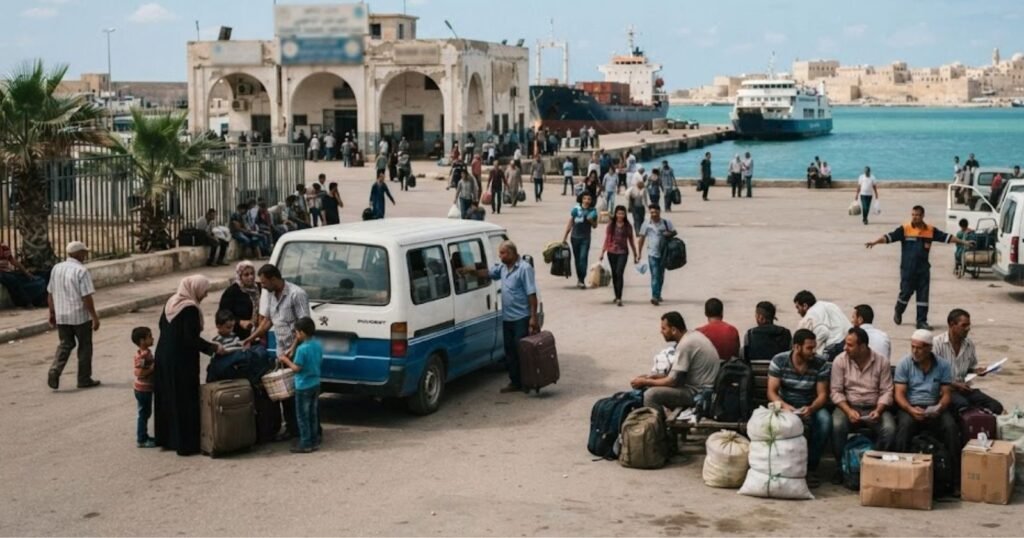
Libya has not conducted a comprehensive national census since 2006, meaning every population figure cited for the country today rests on nearly two decades of estimation, projection, and survey-based modeling rather than a fresh headcount. Layered on top of that underlying uncertainty is a migrant population that IOM’s Displacement Tracking Matrix put at 936,134 people as of the January–February 2026 reporting round, drawn overwhelmingly from Sudan, Niger, Egypt, and Chad, a population equivalent to roughly 12% of Libya’s own resident total.
Key Findings
- Libya has not conducted a comprehensive national census since 2006, meaning all current population figures rely on estimation and modeling rather than a fresh headcount, introducing substantial and explicitly acknowledged uncertainty.
- IOM’s Displacement Tracking Matrix identified 936,134 migrants in Libya as of January–February 2026, equivalent to roughly 12% of the country’s resident population, drawn predominantly from Sudan (36%), Niger (20%), Egypt (19%), and Chad (9%).
- Approximately 90% of Libya’s land area, concentrated in the Saharan interior including the Fezzan region, holds fewer than 700,000 residents, while the vast majority of the population is concentrated along a narrow Mediterranean coastal strip.
- As of February 2024, nearly 147,000 people were internally displaced within Libya, split between conflict-related displacement (approximately 107,000) and disaster-related displacement (approximately 40,000) following 2023–2024 flooding.
- UN medium-variant projections suggest Libya’s population will grow to approximately 8.5 million by 2050 and 9.5 to 9.8 million by 2100, assuming continued political stabilization, an assumption carrying more uncertainty than in most other countries in this demographic cluster.
Libya’s Population at a Glance
Libya’s population was estimated at approximately 7.46 to 7.54 million as of 2025–2026, according to closely converging estimates: Worldometer’s mid-2025 figure is 7,458,555, its 2026 update cites a population passing 7.5 million, and World Population Review’s 2026 estimate is 7,539,851. Wikipedia’s compilation notes a UN estimate of 7,420,000 as of January 1, 2025, alongside a total ethnic Libyan population, including the diaspora.
Worldpopulationclock.net’s 2026 assessment is direct about the underlying data challenge, noting the population figure “draws on the UN World Population Prospects 2024 revision and Libyan Bureau of Statistics estimates, with substantial uncertainty due to the disruption of comprehensive census activity since 2006.”
Population density is very low at approximately 4 people per square kilometer, according to Worldometer, a reflection of Libya’s enormous land area of 1,759,540 square kilometers, the vast majority of which lies within the sparsely populated Sahara.
Key Facts
| Metric | Figure | Year |
|---|---|---|
| Total population | 7.42–7.54 million | 2025–2026 |
| Annual population growth rate | 1.65% | 2022 |
| Median age | 27.7–30 years | 2025–2026 |
| Total fertility rate | 2.35–2.5 children/woman | 2023–2026 |
| Life expectancy at birth | 69.3–73.3 years | 2022–2026 |
| Population density | 4 people/km² | 2025–2026 |
| Urban population share | 77.5%–92.3% | 2025–2026 |
| Immigrant share of population | 12.2% | 2024 |
| Migrant population (IOM DTM) | 936,134 | Jan–Feb 2026 |
Libya’s Unusual Population Geography
Libya’s population is concentrated overwhelmingly along a narrow Mediterranean coastal strip, leaving the vast majority of the country’s territory nearly empty. Worldpopulationclock.net describes this pattern directly: “The Libyan coastal strip from Tripoli through Misrata, Sirte, Benghazi, and Tobruk holds the vast majority of the Libyan population. The vast Saharan interior, including the Fezzan region in the south, holds less than 700,000 residents across roughly 90 percent of Libyan territory.”
This concentration explains the apparent contradiction between Libya’s very low national population density (4 people per square kilometer) and its very high urbanization rate, estimates range from 77.5% (Worldometer, 2025) to 92.27% (World Population Review, 2026), since nearly the entire population is concentrated into a narrow, heavily urbanized band along the coast, while the Saharan south remains almost uninhabited.
Migration as a Major Demographic Factor
Understanding Libya’s population requires separating several distinct groups that are often conflated in general reporting: resident Libyan citizens, international migrants (predominantly labor migrants from other African countries), internally displaced Libyans, and refugees or asylum seekers.
IOM’s Displacement Tracking Matrix (DTM) is the most authoritative source specifically tracking the migrant component: its Round 61 report, covering January–February 2026, identified 936,134 migrants across Libya, describing the country as continuing “its role as a transit and migration hub within regional and trans-Mediterranean migration pathways.” This figure represented “a slight decrease of less than one per cent compared to the previous round (939,638 in November–December 2025)”, indicating a relatively stable, rather than rapidly fluctuating, migrant population in the most recent reporting periods.
The composition of this migrant population is well documented by DTM data: 84% originated from North Africa (56%) and West Africa (28%), with smaller shares from Central Africa (10%), Asia (3%), and the Middle East (3%). Four nationalities, Sudanese (36%), Nigerien (20%), Egyptian (19%), and Chadian (9%), collectively account for the vast majority of the migrant population.
DTM’s Round 60 report noted that “economic hardship, particularly unemployment, low wages, and high living costs, remains the dominant driver among male migrants and migrants from sub-Saharan Africa,” while also noting that “conflict related arrivals, especially from Sudan, also increased during this period”, indicating that Libya’s migrant population reflects a mix of economic and conflict-driven motivations that has shifted somewhat as the conflict in neighboring Sudan has intensified.
Migrant Population Composition (DTM Round 61, Jan–Feb 2026)
| Origin | Share of Migrant Population |
|---|---|
| Sudan | 36% |
| Niger | 20% |
| Egypt | 19% |
| Chad | 9% |
| Other nationalities | 16% |
Libya as a Destination and Transit Country
DTM’s reporting explicitly frames Libya’s dual role, noting the country “continued to host a large and relatively stable migrant population, consolidating its role as a transit and migration hub within regional and trans-Mediterranean migration pathways.” This dual function, Libya as both a destination for labor migrants seeking employment within the country and as a transit point for onward movement toward Europe, distinguishes it from most other countries in this demographic cluster and explains why migrant numbers have remained relatively large and stable even amid ongoing political instability: demand for migrant labor persists domestically even as the transit function toward Europe continues in parallel. DTM’s Round 60 findings note “continued demand for migrant labour in construction, agriculture, services, and domestic work” as a factor “strongly” shaping where migrants settle within the country, primarily Tripoli, Benghazi, and Misrata.
How Migration Changes Population Estimates
The scale of Libya’s migrant population, equivalent to roughly 12% of the country’s own resident population, according to Wikipedia’s 2024-dated immigrant-share figure, combined with the absence of a comprehensive census since 2006, creates genuine and significant uncertainty in any total population figure cited for the country.
Worldpopulationclock.net’s candid acknowledgment of “substantial uncertainty due to the disruption of comprehensive census activity since 2006” should be read as a caution applicable to every population statistic in this article: Libya’s population figures represent the best available estimates from UN and Libyan Bureau of Statistics sources, not confirmed enumerations, and readers should treat precise figures with appropriate caution given the underlying data limitations.
Population Distribution and Major Cities
Estimates of Tripoli’s population vary depending on whether the figure refers to the city proper or the broader metropolitan area. World Population Review’s 2026 estimate cites a Tripoli metropolitan area population of 1,506,832, comprising 19.98% of Libya’s total population, while worldpopulationclock.net’s separate estimate cites Tripoli as “the largest Libyan city, with approximately 1.3 million residents” at the district level, serving as “the political capital under the Government of National Unity.” Both figures agree that Tripoli represents by far the largest concentration of Libya’s population, whichever precise boundary definition is used.
Major City and Regional Population Table
| Location | Population Estimate | Description |
|---|---|---|
| Tripoli (district) | approx. 1,300,000 | Political capital, Government of National Unity |
| Tripoli (metropolitan area) | approx. 1,506,832 | Broader urban agglomeration, 19.98% of national population |
| Fezzan region and Saharan interior | under 700,000 | Roughly 90% of Libyan territory |
Sources: worldpopulationclock.net; World Population Review.
Conflict, Displacement, and Demographic Change
Libya’s internal displacement, driven by over a decade of intermittent conflict since 2011, is a distinct phenomenon from the international migrant population described above, and the two should not be conflated. The Libya Crisis Response Plan 2025–2026 reports that as of February 2024, nearly 147,000 people were internally displaced, including roughly 107,000 displaced by conflict and 40,000 displaced by natural disasters, specifically the September 2023 Storm Daniel floods and subsequent 2024 flash floods in Alkufra.
The same report notes ongoing instability even after a UN-brokered ceasefire in October 2020, citing that “in May 2025, Tripoli witnessed its worst militia infighting in years”, a reminder that Libya’s political and security situation remains unresolved, with direct implications for both internal displacement and the country’s broader capacity to conduct reliable demographic data collection, including a long-overdue census.
Notably, IOM’s rapid assessment following the May 2025 Tripoli clashes specifically examined the impact on the city’s migrant population, illustrating how closely Libya’s conflict dynamics and its migrant population are intertwined in practice, even though they represent conceptually distinct demographic categories.
Labor Markets and Migrant Workers
DTM’s March 2026 report on “Labour Market Participation, Rights, and Challenges for Migrants in the Service Sector” documented structured interviews with migrant workers across hospitality, domestic work, retail, and sanitation between May and December 2025, finding that migrants reported “persistent challenges including financial hardship, lack of documentation, limited healthcare access, and unstable living and working conditions.” This detailed labor-market research reflects the scale and complexity of migrant labor integration within Libya’s economy, a dimension of the country’s demographics that extends well beyond simple population counting into questions of labor rights, documentation status, and access to basic services.
Libya’s Population Outlook
Worldpopulationclock.net’s projection, drawing on the UN World Population Prospects 2024 revision, suggests Libya’s population will reach approximately 7.3 million by 2030, around 8.5 million by 2050, and approximately 9.5 million by 2100. Our World in Data’s independent medium-variant projection is broadly consistent, estimating a rise from 7.306 million in 2023 to 9.784 million by 2100.
Worldpopulationclock.net is explicit that this trajectory “assumes continued moderate fertility, gradual mortality improvements, assuming some political stabilization, and a continued role as a regional migration corridor”, a set of assumptions that, given Libya’s ongoing political fragmentation, carries meaningfully more uncertainty than equivalent long-range projections for more politically stable countries in this demographic cluster.
Population Growth and Projection Table
| Year | Population | Basis |
|---|---|---|
| 2022 | 7,137,931 | CIA World Factbook-derived estimate |
| 2023 | 7,306,000 | Our World in Data / UN WPP |
| 2025 | 7,420,000–7,458,555 | UN estimate / Worldometer |
| 2026 | 7,499,569–7,539,851 | Worldometer / World Population Review |
| 2030 | approx. 7,300,000 | worldpopulationclock.net projection |
| 2050 | approx. 8,500,000 | UN medium-variant projection |
| 2100 | 9,500,000–9,784,000 | UN medium-variant projection (range across sources) |
Conclusion
Libya’s population data illustrate, more clearly than perhaps any other country in this demographic cluster, why migration measurement and political stability are inseparable from basic demographic accuracy. Without a comprehensive census since 2006, and with a migrant population exceeding 900,000 people, equivalent to roughly 12% of the resident total, every population figure cited for Libya carries an unusual degree of acknowledged uncertainty.
What the available data do make clear is the outline of the picture: a population overwhelmingly concentrated along a narrow coastal strip, a substantial and relatively stable migrant workforce drawn primarily from Sudan, Niger, Egypt, and Chad, and continued internal displacement linked to unresolved political conflict. Understanding where Libya’s population is headed will likely depend as much on the country’s political trajectory over the coming years as on any purely demographic trend.
Frequently Asked Questions
1. What is Libya’s current population?
Libya’s population was estimated at approximately 7.42 to 7.54 million as of 2025–2026, according to UN Population Division and Libyan Bureau of Statistics-based estimates, though with acknowledged uncertainty due to the absence of a full census since 2006.
2. How many migrants live in Libya?
IOM’s Displacement Tracking Matrix identified 936,134 migrants in Libya as of the January–February 2026 reporting round, representing roughly 12% of the country’s total resident population.
3. Why does migration matter to Libya’s demographics?
Libya functions as both a destination for labor migrants, drawn by demand in construction, agriculture, services, and domestic work, and a transit country for onward movement toward Europe, making migration a central rather than peripheral factor in the country’s population dynamics.
4. Is Libya mainly a destination or transit country?
Both. IOM’s reporting describes Libya as consolidating its role as “a transit and migration hub within regional and trans-Mediterranean migration pathways,” while also hosting substantial numbers of migrants working within the domestic economy.
5. How does conflict affect Libya’s population?
Ongoing instability since 2011, including a resurgence of militia clashes in Tripoli in May 2025, has contributed to internal displacement, approximately 147,000 people as of February 2024, and has disrupted the country’s ability to conduct a comprehensive census since 2006.
6. Where do most of Libya’s migrants come from?
Primarily Sudan (36%), Niger (20%), Egypt (19%), and Chad (9%), according to IOM’s most recent Displacement Tracking Matrix data, with the large majority originating from North Africa and West Africa combined.
7. What is the population of Tripoli?
Estimates range from approximately 1.3 million (district level) to 1.5 million (broader metropolitan area), representing roughly 17%–20% of Libya’s total national population.
8. How urbanized is Libya?
Very highly urbanized, with estimates ranging from 77.5% to 92.3% depending on source and year, reflecting the concentration of Libya’s population along the narrow Mediterranean coastal strip.
9. Why hasn’t Libya conducted a recent census?
Political instability and conflict since 2011 have disrupted comprehensive census activity, with the country’s last full census dating to 2006, meaning current population figures rely on estimation and modeling rather than a direct headcount.
10. What is Libya’s population projected to be by 2050?
UN medium-variant projections suggest a population of approximately 8.5 million by 2050, though this assumes continued political stabilization, an assumption that carries meaningfully more uncertainty given Libya’s ongoing political fragmentation than equivalent projections for more stable countries.
Sources
- UN Department of Economic and Social Affairs, Population Division, World Population Prospects (2024 Revision)
- International Organization for Migration (IOM), Displacement Tracking Matrix (DTM), Libya Migrant Reports, Rounds 56, 58, 60, and 61 (2025–2026)
- IOM, Libya Crisis Response Plan 2025–2026
- Wikipedia, “Demographics of Libya”
- Worldometer, Libya Population and Demographics (UN WPP 2024 Revision elaboration)
- World Population Review, Libya population and city data
- Our World in Data, Libya Population and Demography Country Profile
- worldpopulationclock.net, Libya Population 2026 tracker and demographic analysis
- populationpyramids.org, Libya demographic transition and life expectancy projections