Key Findings
- Guinea’s population reached approximately 15.2 to 15.4 million in 2026, growing at a rate of roughly 2.7% to 4.7% a year depending on the measurement source.
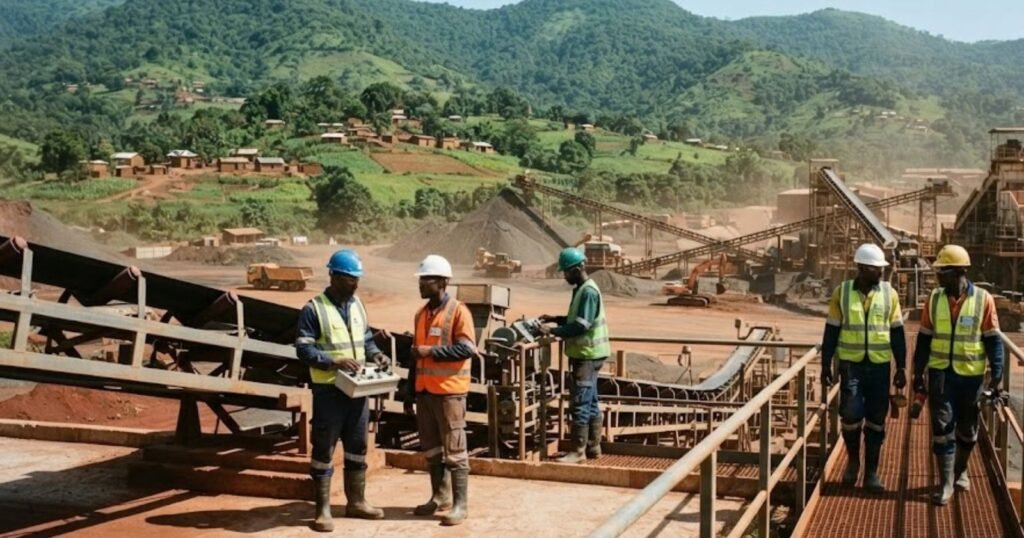
- Guinea holds the world’s largest bauxite reserves and is home to Simandou, one of the largest undeveloped iron ore deposits in the world, now moving toward production.
- Real GDP growth reached an estimated 5% to 6% in 2024, driven substantially by bauxite and gold output, even as agriculture continues to employ the majority of the population.
- Roughly 40% to 41% of Guineans were under 15 as of 2025, with fertility estimated between 4.5 and 4.85 children per woman, among the higher rates in West Africa.
- Conakry’s urban density reaches an estimated 7,410 people per square kilometer, versus roughly 44 people per square kilometer outside the country’s urban centers.
- Urbanization has accelerated to an estimated 33.1% to 40% of the population, with rapid growth straining housing, water, and transportation infrastructure in Conakry.
- Whether mining revenue, including the substantial new revenue expected from Simandou, translates into broad-based improvements in health, education, and income remains Guinea’s central open development question.
Guinea’s population reached approximately 15.2 to 15.4 million in 2026, growing at one of the faster rates in West Africa, somewhere between 2.7% and 4.7% a year depending on the measurement window. Beneath that growth sits an economic story with few parallels elsewhere in the region: Guinea holds the world’s largest bauxite reserves, the primary ore used to produce aluminum, alongside major iron ore deposits at Simandou, one of the largest undeveloped iron ore projects on Earth, and significant gold reserves.
The question this article works through is whether that resource wealth is translating into broad-based gains for a population that remains overwhelmingly young, still largely rural, and still waiting for mining revenue to show up meaningfully in health, education, and household income indicators. Guinea’s 2025-26 growth trajectory, running well above 5% GDP growth by World Bank estimates, makes this one of the more consequential open questions in West African development economics.
Guinea’s Demographic Snapshot
| Metric | Figure | Year |
|---|---|---|
| Total population | 15.2 to 15.4 million | 2025-26 |
| Annual growth rate | 2.7% to 4.7% | 2025-26 |
| Median age | 18.3 to 19.5 years | 2025-26 |
| Total fertility rate | 4.5 to 4.85 children per woman | 2022-26 |
| Population under 15 | 40.5% to 41.2% | 2025 |
| Urban population share | 33.1% to 40% | 2025-26 |
| Population density | 61 to 63 people per km² | 2025-26 |
| Life expectancy at birth | 63.9 years | 2022 |
| Conakry metropolitan population | approximately 2.2 million | 2026 |
| Real GDP growth | 5% to 6% | 2024 |
Guinea’s population has grown at a genuinely fast pace by any measure: from 4.66 million at the 1983 census to 17.52 million by a 2025 estimate cited in Wikipedia’s demographic compilation, though that specific figure runs higher than the roughly 15.2 to 15.4 million cited by UN-based sources, illustrating the same kind of methodological spread seen across several West African countries where the most recent full census results have not yet been fully reconciled with UN modeled projections.
Guinea’s Young Population
Guinea’s age structure follows the now-familiar West African pattern of a broad-based population pyramid: 40.5% to 41.2% of the population was under 15 as of 2025, while just 3.5% to 3.9% was 65 or older. The median age has moved only modestly, rising by roughly 2.4 years since 1970 according to PopulationPyramids.org’s analysis, which specifically notes that Guinea’s population has tripled since 1970, from 4.0 million to over 14 million, driven by both natural increase and the pull of mining-sector development toward specific regions.
Guinea’s total fertility rate has been reported at 4.85 children per woman by the CIA World Factbook for 2022, while WorldPopulationClock.net’s 2026 comparative analysis placed it at approximately 4.5, still among the higher rates in West Africa and notably higher than neighboring Sierra Leone’s estimated 4.1 and Liberia’s estimated 4.2 to 4.4.
Population Distribution and Conakry
Guinea’s population density averages a modest 61 to 63 people per square kilometer nationally, but this figure masks sharp regional variation tied closely to the country’s economic geography. Conakry, the capital, exhibits an urban density of roughly 7,410 people per square kilometer according to Grokipedia’s demographic compilation, dramatically higher than the roughly 44 people per square kilometer found outside Guinea’s urban centers.
Coastal Maritime Guinea, where Conakry sits, and the mining hubs of Upper Guinea, including Siguiri and Kouroussa, support Guinea’s highest population densities outside the capital, driven by both port access and mining-sector economic activity, in sharp contrast to the more sparsely populated forested highlands of the Guinea Highlands region in the country’s southeast.
Conakry’s metropolitan population reached an estimated 2.2 million by 2026, representing roughly 14% of Guinea’s entire national population concentrated in a single metropolitan area, a level of urban primacy consistent with patterns seen elsewhere in West Africa’s coastal capitals.
Fertility and Demographic Transition
Guinea’s fertility decline has proceeded more slowly than in some West African neighbors, including Burkina Faso and Sierra Leone, a pattern reflected in Guinea’s comparatively high estimated fertility rate relative to the regional average. Life expectancy has improved substantially over the long run, reaching 63.9 years by 2022, with UN medium-variant projections putting it at 64.7 years by 2050 and 70.6 years by 2100, reflecting continued, gradual gains in healthcare access.
Guinea’s continued high fertility, combined with steadily improving child survival, ensures substantial population momentum over the coming decades regardless of how quickly fertility itself declines from current levels, a dynamic shared across much of West Africa but reinforced in Guinea’s case by the relatively slower pace of its fertility transition to date.
Guinea’s Natural Resource Economy
Guinea holds the world’s largest bauxite reserves, the ore refined into alumina and ultimately aluminum, extracted primarily by the Compagnie des Bauxites de Guinée and the Société Minière de Boké, a joint venture widely known as SMB-Winning. Bauxite extraction drives a substantial share of Guinea’s export revenue and foreign direct investment, and the sector has continued to expand as global demand for aluminum, including for use in electric vehicles and renewable energy infrastructure, has grown.
The Simandou iron ore project represents an even larger potential shift in Guinea’s resource economy. Widely described as one of the largest undeveloped iron ore deposits in the world, Simandou has moved closer to production-stage development with significant Chinese and international investment committed, and its eventual full operation is expected to materially alter Guinea’s GDP and export profile, potentially rivaling or exceeding the economic significance of the bauxite sector.
Guinea’s real GDP growth has been relatively robust by regional standards, with World Bank estimates putting growth in the range of 5% to 6% for 2024, underpinned substantially by bauxite and gold output, even as agriculture continues to employ the majority of Guinea’s population and contributes an estimated 20% to 25% of GDP, with rice, cassava, maize, groundnuts, and cashews among the country’s key crops.
Can Resource Wealth Support a Growing Population?
The central question shaping Guinea’s development trajectory is whether mining-driven GDP growth translates into improved outcomes for a population that remains overwhelmingly young, with 40% or more under the age of 15, and largely dependent on agriculture with limited mechanization and significant vulnerability to climate variability. Resource extraction, by its nature, tends to generate substantial export revenue and government income without necessarily generating proportional formal employment, a pattern documented across resource-dependent African economies more broadly.
Guinea’s urbanization rate, estimated at somewhere between 33.1% and 40% depending on the source, has accelerated in recent years, with over 6 million residents now living in urban areas according to Grokipedia’s compilation, a trend at least partly connected to mining-sector economic activity drawing migrants toward Conakry and secondary mining towns, even as most of Guinea’s population growth continues to occur within a still-largely agricultural rural economy.
Urbanization and Economic Concentration
Rapid expansion in Conakry has strained housing, water supply, and transportation systems, producing informal settlements and overburdened services, a pattern consistent with resource-driven urban growth elsewhere in West Africa. Environmental pressures have followed alongside this growth: urban sprawl has contributed to deforestation, soil erosion, and loss of agricultural land around Conakry, while unregulated mining towns in Upper Guinea have added pollution and resource depletion concerns that will require sustainable planning to manage as the mining sector, and Simandou in particular, continues to expand.
Future Population and Economic Scenarios
Guinea’s population is set to continue growing substantially over the coming decades, driven by both continued fertility above replacement level and population momentum from the country’s already-large youth cohorts. Whether that growth translates into a genuine demographic and economic dividend will depend heavily on how effectively Guinea’s government channels mining revenue, particularly the substantial new revenue expected from Simandou’s eventual full operation, into education, healthcare, and infrastructure investment that reaches beyond Conakry and the mining regions of Upper Guinea.
The scale of the Simandou project alone suggests Guinea’s economic profile could shift meaningfully over the coming decade, but translating that shift into improved outcomes for a population still concentrated in subsistence agriculture, with limited mechanization and significant exposure to climate variability, remains the central unresolved question shaping the country’s long-term demographic and development trajectory.
Frequently Asked Questions
1. What are Guinea’s main demographic characteristics?
Guinea’s population reached approximately 15.2 to 15.4 million as of 2025-26, with a median age of roughly 18.3 to 19.5 years, a total fertility rate estimated between 4.5 and 4.85 children per woman, and an urban population share of about 33% to 40%.
2. How fast is Guinea’s population growing?
Estimates place Guinea’s annual population growth rate between 2.7% and 4.7% depending on the source and measurement window, reflecting both high fertility and, in some estimates, migration toward mining and urban areas.
3. What natural resources does Guinea have?
Guinea holds the world’s largest bauxite reserves, the ore used to produce aluminum, along with significant gold deposits and the Simandou project, one of the largest undeveloped iron ore deposits in the world, now advancing toward production.
4. Can mining support Guinea’s growing population?
Mining has driven strong GDP growth, estimated at 5% to 6% in 2024, but resource extraction tends to generate government revenue and exports without proportional formal employment, leaving open the question of whether that growth translates into improved health, education, and income outcomes for Guinea’s still largely rural, agriculture-dependent population.
5. What is Guinea’s fertility rate?
Estimates place Guinea’s total fertility rate between 4.5 and 4.85 children per woman as of the mid-2020s, among the higher rates in West Africa and notably above neighboring Sierra Leone and Liberia.
6. How large is Conakry, Guinea’s capital?
Conakry’s metropolitan population reached an estimated 2.2 million by 2026, representing roughly 14% of Guinea’s total population, with an urban density of approximately 7,410 people per square kilometer.
7. What is the Simandou project?
Simandou is one of the largest undeveloped iron ore deposits in the world, located in Guinea, and it has moved closer to production-stage development with significant Chinese and international investment, with its eventual operation expected to materially alter Guinea’s GDP and export profile.
8. How urbanized is Guinea?
Estimates place Guinea’s urban population share between 33.1% and 40% as of 2025-26, with rapid growth concentrated in Conakry and secondary mining towns in Upper Guinea, straining housing and infrastructure in both.
9. Where does most of Guinea’s population live?
Guinea’s population concentrates most heavily in coastal Maritime Guinea around Conakry and in mining hubs across Upper Guinea, such as Siguiri and Kouroussa, while the forested Guinea Highlands in the southeast remain comparatively sparsely populated.
10. What percentage of Guineans work in agriculture?
Agriculture continues to employ the majority of Guinea’s population and contributes an estimated 20% to 25% of GDP, with rice, cassava, maize, groundnuts, and cashews among the country’s key crops, even as mining drives a growing share of export revenue.
Sources
- United Nations, Department of Economic and Social Affairs, Population Division, World Population Prospects: The 2024 Revision
- World Bank, Guinea GDP growth and economic data
- Wikipedia, Demographics of Guinea
- Worldometer, Guinea Population and Demographics 2026
- Countrymeters, Guinea Population 2026
- Grokipedia, Demographics of Guinea
- PopulationPyramids.org, Guinea Population Pyramid 2025
- Africa Research, Guinea statistics: population, economy, trade and telecom