Roughly one in ten people living in Côte d’Ivoire was born outside the country, a migration share that makes it the most significant migrant destination in West Africa, and a demographic fact more consequential for understanding the country’s economy than its total population figure alone. That population, meanwhile, has grown from 2.63 million in 1950 to an estimated 32.7 to 33.5 million in 2025–2026, a more than twelvefold increase, driven by a combination of persistently high fertility and one of the region’s largest sustained immigration corridors.
Key Facts & Findings
- Côte d’Ivoire hosts an estimated 2.2 million or more migrants, roughly 10% of its total population, making it the leading migrant destination in West Africa.
- People of Burkinabè origin or descent numbered over 4 million in the 2021 census, concentrated in Abidjan and the cocoa-producing western regions.
- Abidjan’s metropolitan population reached approximately 6.06 million in 2025, growing faster (3.24% annually) than the national average and now housing close to 19% of the country’s total population.
- Fertility has fallen by roughly 45% since 1960 (from 7.69 to 4.23 children per woman) but has slowed its decline in recent years, remaining above 4 births per woman as of 2024.
- Over 64% of refugees and asylum seekers in Côte d’Ivoire as of mid-2024 originated from Burkina Faso, reflecting worsening Sahel insecurity feeding directly into Ivorian demographic and labor market trends.
Côte d’Ivoire’s Population Today
Estimates for Côte d’Ivoire’s current population cluster in a fairly narrow range compared to some neighboring countries, reflecting relatively better recent census coverage. The 2021 national census (RGPH) recorded a population of 29,389,150, an actual headcount rather than an estimate.
World Bank WDI mid-year estimates put the 2025 population at 32,711,547, while Trading Economics’ compilation, citing the same national statistics source, gives 32.7 million for 2025 and a projected 32.80 million by the end of 2026. Worldpopulationclock.net’s live estimate for 2026, based on Institut National de la Statistique (INS) data combined with UN WPP 2024 methodology, puts the figure somewhat higher, at approximately 33.5 million.
The growth rate has remained high and fairly steady: 2.19% in a 2022 CIA-sourced estimate, with 2023 natural change data showing 997,000 births against 238,700 deaths, a natural increase of 758,300 in a single year, even before accounting for net migration.
Key Facts
| Metric | Figure | Year |
|---|---|---|
| Total population (2021 census) | 29,389,150 | 2021 |
| Total population (WDI/UN mid-year estimate) | 32.7–33.5 million | 2025–2026 |
| Annual population growth rate | approx. 2.2% | 2022 |
| Median age | 18.5 years | 2026 |
| Total fertility rate | 4.1–4.6 children/woman | 2024–2026 |
| Population under age 15 | 38.5%–40.9% of total | 2022–2024 |
| Immigrant share of population | 9.0%–10.0% | 2024–2025 |
| Life expectancy at birth | 62.3–62.4 years | 2022–2026 |
| Urban population share | 49.5% | 2026 |
| Projected population | 36.5 million | 2030 |
A Population Shaped by Migration
Côte d’Ivoire hosts one of the largest migrant populations in West Africa in both absolute and proportional terms. SIHMA’s compilation of regional migration data found that of 7.64 million migrants in the wider region by mid-2020, Côte d’Ivoire alone hosted 2,564,857, about 9.7% of its own population at the time. Grokipedia’s more recent demographic summary puts the figure at over 2.2 million migrants as of recent IOM reporting, or roughly 10% of the total population, with foreign nationals concentrated overwhelmingly among neighboring West African countries.
The largest single group is Burkinabè: Wikipedia’s entry on Burkinabè in Ivory Coast cites a 2021 census figure of 4,045,594 people of Burkinabè origin or descent, a striking number that, if taken at face value alongside the national 2021 census total of 29.4 million, would suggest people of Burkinabè background made up close to 14% of the country’s population, concentrated in Abidjan, Bouaké, and the rural cocoa-producing regions of Bas-Sassandra and Sassandra-Marahoué.
This migration corridor has deep historical roots, dating to labor recruitment for cocoa and coffee cultivation under President Félix Houphouët-Boigny after independence, and it has intensified again in recent years: as of June 2024, over 64% of refugees and asylum seekers in Côte d’Ivoire originated from Burkina Faso, reflecting worsening insecurity linked to Sahel conflict and instability.
In July 2025, Côte d’Ivoire granted formal refugee status to more than 70,000 asylum seekers, including approximately 69,000 Burkinabè and 1,500 Malians, marking a significant shift toward legal protection for a population that had often lived in the country informally.
Migration Snapshot
| Category | Figure | Reference Period |
|---|---|---|
| Total migrants (IOM estimate) | over 2,200,000 | 2024 |
| Immigrant share of national population | approx. 10% | 2024–2025 |
| People of Burkinabè origin/descent | 4,045,594 | 2021 census |
| Share of refugees/asylum seekers from Burkina Faso | over 64% | June 2024 |
| Newly granted refugee status (Burkinabè and Malian) | over 70,000 | July 2025 |
This scale of immigration means Côte d’Ivoire’s demographic and economic story cannot be told through natural population growth alone. Migrant labor, particularly from Burkina Faso and Mali, underpins much of the agricultural workforce behind cocoa production; the country remains the world’s largest cocoa producer and contributes meaningfully to GDP both directly and through the remittances and spending associated with a large resident foreign-born population.
Abidjan and Rapid Urbanization
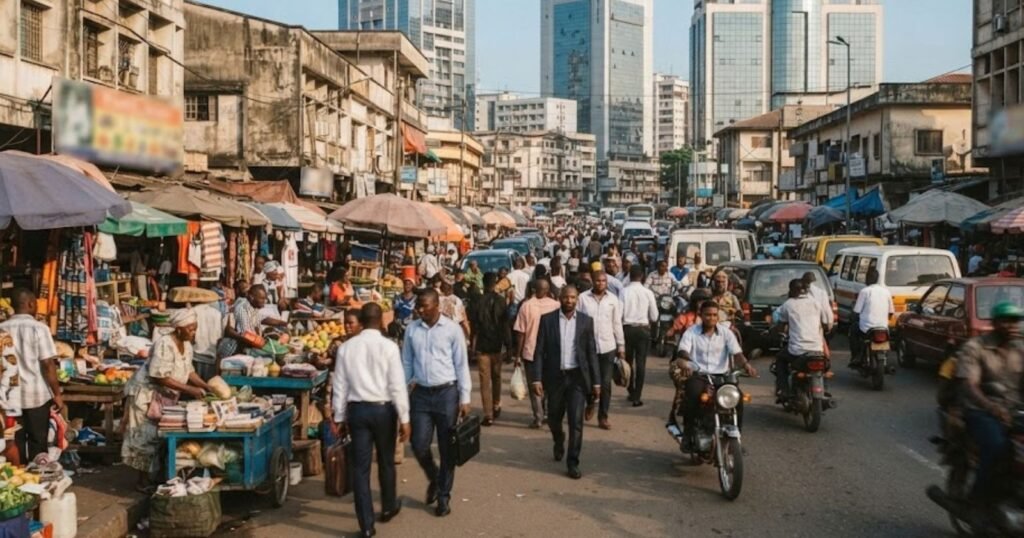
Abidjan, Côte d’Ivoire’s economic capital, is one of West Africa’s most populous urban areas. Macrotrends’ metro-area population series puts Abidjan at 6,057,000 in 2025, up from 5,867,000 in 2024, a 3.24% annual increase that is outpacing the national growth rate and consistent with continued rural-to-urban and cross-border migration into the city. At this size, Abidjan alone accounts for close to 19% of Côte d’Ivoire’s total national population, concentrated in a single metropolitan area.
Nationally, 49.5% of Côte d’Ivoire’s population was urban as of 2026, according to worldpopulationclock.net’s estimate, meaning the country is close to the halfway point of the urban transition, with growth in cities like Abidjan consistently outpacing rural population growth. Housing, transport, and sanitation infrastructure in and around Abidjan face sustained pressure from this combination of natural population growth, internal rural-to-urban migration, and continued immigration from the Sahel.
The Country’s Young Workforce
Côte d’Ivoire’s age structure remains firmly youthful: 38.5%–40.9% of the population is under age 15 depending on the year and source, and the median age stood at just 18.5 years in 2026 estimates, meaning over half the population is under 19. Wikipedia’s compilation of 2022 CIA-sourced data put the under-15 share at 38.53% and the 65-plus share at just 2.85%, an age structure broadly typical of West African countries still relatively early in their demographic transition, though somewhat further along than Somalia’s or Niger’s.
This expanding, overwhelmingly young workforce is entering the labor market at a moment when the country’s economy has been among the more dynamic in the region, having enjoyed robust and stable economic growth since 2012 and functioning as Francophone West Africa’s economic hub, according to World Bank assessments cited by SIHMA. Whether that economic dynamism can continue to absorb both a growing domestic youth cohort and sustained immigration from neighboring countries is one of the central questions for the country’s coming decade.
Population Growth and Economic Growth
Separating the contribution of population growth from other drivers of Côte d’Ivoire’s economic expansion is beyond what demographic data alone can establish, and this article does not attempt to assign a precise causal weight between them. What the data can show is the scale of labor supply growth: with a fertility rate of 4.1–4.6 children per woman as of 2024–2026 and continued net immigration, Côte d’Ivoire’s working-age population is expanding both from within (via demographic momentum from high past fertility) and from outside (via continued labor migration), a combination that is comparatively unusual in this cluster of countries, most of which rely on natural increase alone.
Fertility and Demographic Transition
Côte d’Ivoire’s fertility rate has fallen substantially from historical highs but remains well above replacement level. Demographer.org’s compilation of World Bank WDI data shows the rate falling from 7.69 births per woman in 1960 to 4.23 in 2024, a decline of roughly 45% over six decades, though the pace of decline has slowed in recent years, with the rate remaining above 4 births per woman throughout the WDI series through 2024. Populationpyramids.org classifies Côte d’Ivoire as being in “Stage 2: Early Transition” of the demographic transition model, characterized by falling death rates alongside still-high birth rates, the same stage assigned to Senegal, Cameroon, and several other West and Central African countries in this cluster.
Life expectancy has improved to approximately 62.3–62.4 years as of the mid-2020s, though this remains among the lower figures in this demographic cluster, and infant mortality, at 55.67 deaths per 1,000 live births in 2022 estimates, remains comparatively high; both indicators suggesting continued room for health-system improvement even as fertility gradually declines.
Regional Population Differences
Côte d’Ivoire’s population is distributed unevenly between the economically dominant south, anchored by Abidjan, and the agricultural interior and north, which retains higher fertility rates and lower urbanization. The western mining regions near Tengrela and the cocoa-producing areas of Bas-Sassandra and Sassandra-Marahoué host large concentrations of migrant agricultural labor, distinguishing these regions demographically from the more urbanized coastal south.
Future Population Outlook
Population Growth and Projection Table
| Year | Population | Basis |
|---|---|---|
| 1950 | 2,630,000 | UN WPP historical estimate |
| 1980 | 8,034,000 | UN WPP historical estimate |
| 2000 | 16,455,000 | UN WPP historical estimate |
| 2021 | 29,389,150 | National census (RGPH) |
| 2025 | 32,711,547–32,700,000 | World Bank WDI / UNFPA |
| 2026 | 32,800,000–33,500,000 | Trading Economics / worldpopulationclock.net |
| 2030 | approx. 36,500,000 | Projection (worldpopulationclock.net) |
Worldpopulationclock.net’s projection places Côte d’Ivoire’s population at approximately 36.5 million by 2030, assuming continued moderate fertility decline and ongoing health improvements, an increase of roughly 9–11% over the 2025–2026 estimate within just four to five years. Longer-range UN medium-variant projections suggest life expectancy will rise to 65.9 years by 2050, according to populationpyramids.org’s analysis, alongside continued but slowing population growth.
Conclusion
Côte d’Ivoire’s population data tell a story that is only half about natural growth. The other half is migration: a sustained, historically rooted labor corridor from Burkina Faso and Mali that has made roughly one in ten Ivorian residents foreign-born, and that now increasingly includes displacement-driven arrivals fleeing Sahel insecurity.
With fertility still above 4 children per woman, Abidjan absorbing a disproportionate share of national growth, and continued strong immigration, Côte d’Ivoire’s demographic trajectory over the coming decade will likely be shaped as much by regional stability in the Sahel as by any purely domestic demographic trend.
Frequently Asked Questions
1. How many people live in Ivory Coast?
Côte d’Ivoire’s population was estimated at approximately 32.7 to 33.5 million in 2025–2026, according to World Bank and national statistics data, up from a confirmed 2021 census count of 29,389,150.
2. Why is Côte d’Ivoire’s population growing?
Growth is driven by a combination of continued high fertility (4.1–4.6 children per woman) and one of West Africa’s largest sustained immigration corridors, primarily from Burkina Faso and Mali.
3. How important is migration to Côte d’Ivoire’s demographics?
Very significant, an estimated 9%–10% of the population is foreign-born, and people of Burkinabè descent alone numbered over 4 million in the 2021 census, making Côte d’Ivoire the top migrant destination in the region.
4. What is the population of Abidjan?
Abidjan’s metropolitan area population reached approximately 6.06 million in 2025, according to Macrotrends’ city population series, representing close to 19% of Côte d’Ivoire’s total national population.
5. Is Côte d’Ivoire’s fertility rate declining?
Yes, from 7.69 children per woman in 1960 to 4.23 in 2024, according to World Bank WDI data, though the pace of decline has slowed in recent years compared to the historical trend.
6. How many migrants live in Côte d’Ivoire?
Estimates from the International Organization for Migration put the figure at over 2.2 million as of recent reporting, or roughly 10% of the national population.
7. What is Côte d’Ivoire’s median age?
Approximately 18.5 years as of 2026, according to UN Population Division-based estimates, reflecting a still very youthful population.
8. How urbanized is Côte d’Ivoire?
About 49.5% of the population was urban as of 2026, with Abidjan alone accounting for the large majority of that urban growth.
9. What is Côte d’Ivoire’s population projected to be by 2030?
Projections suggest approximately 36.5 million by 2030, an increase of roughly 9%–11% over the 2025–2026 population.
10. Where do most migrants in Côte d’Ivoire come from?
The largest groups come from Burkina Faso and Mali, drawn historically by agricultural labor opportunities, particularly in cocoa cultivation, and more recently by displacement linked to Sahel insecurity.
Sources
- Institut National de la Statistique de Côte d’Ivoire, Recensement Général de la Population et de l’Habitat (RGPH) 2021
- World Bank, World Development Indicators, Côte d’Ivoire population, fertility, growth rate
- UN Department of Economic and Social Affairs, Population Division, World Population Prospects (2024 Revision)
- International Organization for Migration (IOM), migrant population estimates (as compiled by Grokipedia)
- SIHMA (Scalabrini Institute for Human Mobility in Africa), African Migration Statistics, Côte d’Ivoire
- Wikipedia, “Burkinabès in Ivory Coast” and “Demographics of Ivory Coast”, population, migration, and age-structure data
- Trading Economics, Ivory Coast Population
- Macrotrends, Abidjan Metro Area Population
- worldpopulationclock.net, Côte d’Ivoire Population 2026 tracker
- populationpyramids.org, Côte d’Ivoire demographic transition and life expectancy projections
- demographer.org, Côte d’Ivoire Demographics 2026 compilation