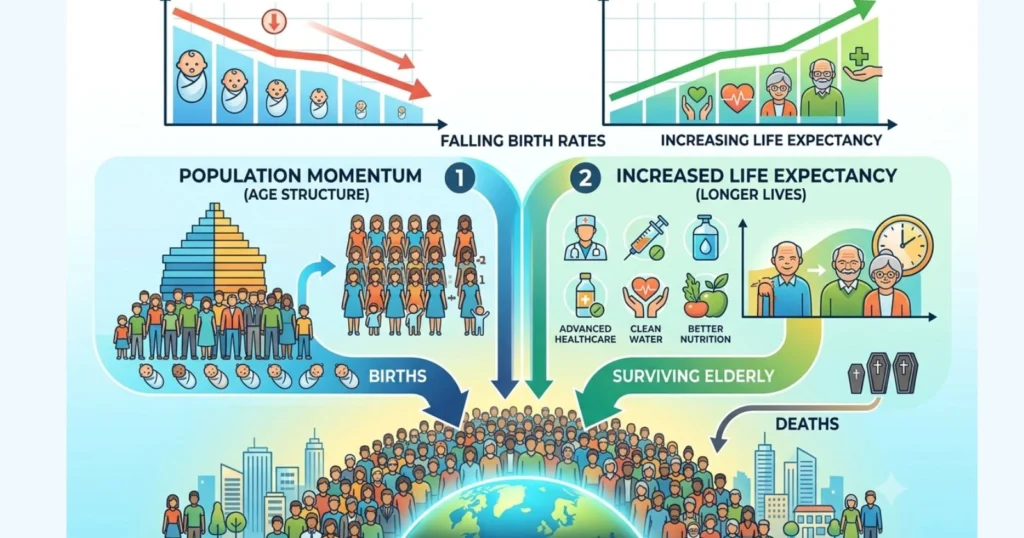
It sounds like a contradiction. Headlines warn of a global “baby bust.” Fertility rates are falling in nearly every region of the world. Yet the number of people on Earth keeps climbing, year after year, with no sign of an immediate halt. As of mid 2026, the world is home to roughly 8.3 billion people, and that number is still increasing by close to 69 million a year, according to United Nations estimates.
So how can both things be true at once? How can birth rates fall for more than fifty years in a row while total population size keeps setting new records?
The answer lies in demographic mechanics that are not always intuitive. Population growth is not driven purely by the fertility rate in any single year. It is shaped by the size and age structure of the population that already exists, by how long people live, and by how many women of childbearing age are currently alive. This article breaks down the data behind this apparent paradox and explains exactly why the world keeps growing even as birth rates keep dropping, and when that growth is finally expected to stop.
The Core Paradox in Numbers
Before unpacking the causes, it helps to see the scale of the trend in one place.
| Metric | 1970 | 1990 | 2024 | 2026 (current) |
|---|---|---|---|---|
| Global fertility rate (births per woman) | 4.8 | 3.3 | 2.25 | approximately 2.2 |
| World population | 3.7 billion | 5.3 billion | 8.2 billion | 8.3 billion |
| Annual population growth rate | approximately 2.1% (peak, late 1960s) | approximately 1.8% | approximately 0.9% | approximately 0.83% |
| Annual net population increase | over 70 million | around 90 million | around 71 million | around 69 million |
Source data compiled from United Nations World Population Prospects 2024 (medium variant projections).
Two things stand out immediately. First, the fertility rate has fallen by more than half since 1970, from 4.8 children per woman to about 2.2 today. Second, despite that steep decline, the population has more than doubled over the same period, from 3.7 billion to 8.3 billion, and it is still adding tens of millions of people every single year.
Fertility Rates Are Falling, but They Have Not Reached the Tipping Point Yet
The global fertility rate now stands at roughly 2.25 births per woman, down from 3.3 in 1990 and 4.8 in 1970. This is a genuinely historic decline. More than half of all countries and territories worldwide, 131 out of 237 according to the United Nations, now have fertility rates below 2.1, the level generally considered necessary for a population to replace itself over time without migration.
However, the global average fertility rate is still slightly above replacement level. As long as the average number of births per woman remains above roughly 2.1, and as long as there are enough women of childbearing age to translate that rate into actual births, the population as a whole will keep growing, even if growth is slowing down.
The United Nations projects that the global fertility rate will not fall to the replacement level of 2.1 until around 2036. Until that point, births will continue to outnumber deaths on a global scale, even if the gap between the two keeps narrowing.
It is also important to separate two related but distinct ideas.
- A falling fertility rate means each woman is having fewer children on average than women did in previous generations.
- A falling population means the total number of people is going down.
These are not the same thing, and a country or the world as a whole can experience the first without experiencing the second for decades. This gap between the two trends is the central reason behind the apparent paradox.
Population Momentum Is the Single Biggest Driver
The most important concept for understanding this paradox is something demographers call population momentum. It refers to the built-in growth that continues even after fertility rates drop, because of the age structure that past decades of higher fertility left behind.
Here is the mechanism in plain terms. Because fertility rates were much higher in previous decades, the world today has an unusually large number of people in their reproductive years, roughly ages 15 to 49. Even if each of these individuals has fewer children than their parents did, the sheer number of people in that age bracket means the total number of births each year remains high.
The data illustrates this clearly.
- The number of women of reproductive age globally is projected to grow from nearly 2.0 billion in 2024 to a peak of around 2.2 billion in the late 2050s.
- This growth in the pool of potential parents is enough to keep driving population increase even as the fertility rate itself approaches or dips below replacement level.
- According to UN projections, this demographic momentum will account for approximately 79 percent of total global population growth through 2054, adding an estimated 1.4 billion people to the planet.
In other words, roughly four out of every five people added to the world’s population between now and the middle of the century will be born not because fertility rates are rising, but because there are simply more people of childbearing age alive today than at any point in human history. The engine of growth is not the birth rate itself. It is the number of engines, meaning the number of people capable of having children.
This is why demographers often compare global population trends to a large ship. Even after the engines are cut, a ship the size of a supertanker keeps moving forward for a long distance simply because of the momentum it has already built up. Population works the same way.
Births Still Outnumber Deaths by a Wide Margin
A second, more direct explanation is simply arithmetic. The population grows whenever the number of births in a year exceeds the number of deaths, plus or minus net migration. Even with fertility rates falling, the raw number of births each year remains far higher than the number of deaths.
- In 2024, there were approximately 132 million births worldwide.
- In that same year, there were approximately 63 million deaths worldwide.
- That leaves a natural increase of roughly 69 million more people through births than deaths, closely matching the total net population growth for the year.
The number of annual births has actually been remarkably stable for decades, even as the fertility rate has fallen. Global births peaked in 2012 at around 146 million, and the United Nations projects a second, smaller peak of about 136 million around 2040, before a gradual decline toward roughly 111 million by 2100. The reason births have stayed high despite falling fertility is again the size of the population of potential parents. A smaller fertility rate applied to a much larger base population can still produce a similar or even larger number of total births.
Meanwhile, the annual number of deaths, while rising gradually as the world’s population ages, is still well below the number of births. Deaths are projected to increase steadily, potentially exceeding 120 million per year by 2100, at which point global deaths and births are expected to move much closer together, setting the stage for population decline.
Rising Life Expectancy Is Adding People on the Other End of the Equation
Falling birth rates get most of the public attention, but rising life expectancy is quietly doing just as much work to keep the population growing. People are living significantly longer than they used to, which means fewer people are leaving the population through death relative to the number entering it through birth.
- Global life expectancy at birth reached approximately 73.3 to 73.8 years in the mid 2020s, up from around 64 years in 1990.
- Life expectancy is projected to keep rising, reaching approximately 77.4 years by 2054 and as high as 81.7 years by 2100.
- This increase is expected to contribute to population growth or to slow population decline in nearly all countries and areas over the coming decades.
Improvements in nutrition, sanitation, vaccination, and medical care have dramatically reduced mortality at every age, especially among infants and children. A century ago, high fertility was partly a response to high child mortality, since families often had more children to offset the risk that some would not survive to adulthood. As child mortality has fallen worldwide, families have needed fewer births to reach their desired family size, which is itself one of the underlying causes of falling fertility rates. At the same time, longer adult lifespans mean that people who are already alive are staying in the population much longer than previous generations did, adding to total population size even when fewer children are being born.
Regional Fertility Divergence Is Still Fueling Substantial Growth
While it is true that fertility is falling almost everywhere, the pace of that decline is far from uniform. A significant share of the remaining global population growth is concentrated in a relatively small number of high-fertility countries, most of them in sub-Saharan Africa.
- More than one in ten countries worldwide, mostly in sub-Saharan Africa, still have fertility rates of four births or more per woman.
- Countries including Angola, the Central African Republic, the Democratic Republic of the Congo, Niger, and Somalia are projected to double their populations between 2024 and 2054.
- Sub-Saharan Africa as a region is projected to grow by roughly 79 percent, reaching about 2.2 billion people by 2054, and could reach as much as 3.3 billion by 2100, accounting for more than one-fifth of all remaining global population growth.
- India, now the world’s most populous country with approximately 1.46 to 1.5 billion people, continues to add population even though its fertility rate has fallen close to replacement level, again largely due to population momentum from its large youth population.
At the same time, a growing list of countries has already begun to shrink. As of the most recent United Nations data, 63 countries and areas, representing about 28 percent of the world’s population, have already passed their peak population size. This group includes China, Germany, Italy, Japan, Russia, South Korea, Spain, and Thailand. Another 48 countries, home to roughly 10 percent of the global population, are projected to peak sometime between 2025 and 2054.
South Korea currently has the lowest fertility rate in the world, at approximately 0.73 births per woman, despite the government spending more than 200 billion dollars on financial incentives aimed at raising the birth rate. China’s population is projected to fall from its current level of about 1.4 billion to as low as 633 million by the year 2100, a decline of well over half.
This regional split is the real story behind global population trends. The world is not moving uniformly toward decline. Instead, it is splitting into two distinct groups: a shrinking group of mostly wealthier, older countries and a still growing group of mostly younger, lower-income countries, with the growth in the second group currently outweighing the decline in the first.
Immigration Is Propping Up Growth in Some Wealthy Countries
Fertility and mortality are not the only forces at work. In some countries where birth rates have already fallen below replacement level, immigration is now the primary driver keeping the population from shrinking.
- Immigration is projected to be the main driver of population growth in approximately 50 to 52 countries and areas through 2054, including the United States, Canada, Australia, the United Kingdom, Qatar, and Saudi Arabia.
- Without immigration, the United States would already be on a path toward population decline, based on its fertility rate alone. Instead, the country is projected to grow from around 345 million in 2024 to as many as 421 million by the end of the century.
- At the same time, emigration is expected to accelerate population decline in about 14 countries that already have ultra-low fertility rates, as people continue to leave in search of work or opportunity elsewhere.
This means that in a meaningful share of the world’s wealthier nations, population growth or stability has effectively decoupled from the domestic birth rate entirely and now depends primarily on migration policy.
When Will Global Population Growth Actually Stop
Falling fertility rates and population momentum are pulling in opposite directions, and for now, momentum is still winning. That will not last forever. According to the medium variant projection in the United Nations World Population Prospects 2024, here is the expected trajectory.
- The world population is projected to reach 9 billion around 2037.
- The 10 billion milestone is projected for sometime between 2058 and 2061, depending on the source.
- The global population is expected to reach its peak at approximately 10.3 billion people in the mid 2080s.
- After that peak, the population is projected to decline gradually, falling to around 10.2 billion by the year 2100.
This represents a significant downward revision compared to earlier UN projections. As recently as 2013, the United Nations estimated a much lower probability that global population growth would end at all during this century. The 2024 projections show the probability of a peak occurring within the century is now considered very high, largely because fertility has fallen faster than expected in several of the world’s largest countries, particularly China, and fertility declines in parts of sub-Saharan Africa have also outpaced earlier forecasts.
Once the fertility rate falls to and stays below the replacement level for long enough, and once the current large cohort of reproductive age adults ages out of that bracket without being fully replaced by an equally large younger cohort, momentum will finally run out. At that point, and not before, the global population will begin an actual decline rather than simply slower growth.
What This Means for the World’s Age Structure
One of the most significant consequences of this transition is not the total population number itself, but how the age distribution of that population is shifting. As fertility falls and life expectancy rises, the world is aging rapidly, even while its total population continues to grow for now.
- By the late 2070s, the number of people aged 65 and older worldwide is projected to reach approximately 2.2 billion, surpassing the number of children under 18 for the first time in recorded history.
- By the mid 2030s, the number of people aged 80 and older is expected to outnumber infants under the age of one.
- In roughly 100 countries or areas, the working-age population, defined as ages 20 to 64, will continue growing through 2054, offering what demographers call a demographic dividend, a temporary window of economic opportunity created by a favorable ratio of workers to dependents.
This aging trend carries major implications for pension systems, healthcare capacity, labor markets, and economic growth in the decades ahead, regardless of whether the total headline population figure is still rising or has already begun to fall.
Key Takeaways
Bringing all of this together, the apparent contradiction between falling birth rates and a still growing global population comes down to a handful of core factors.
- The global fertility rate, while falling steadily, has not yet dropped to the replacement level of 2.1 births per woman, and is not expected to reach it until around 2036.
- Population momentum, driven by the unusually large number of people currently in their reproductive years, is responsible for the vast majority of remaining global growth, an estimated 79 percent through 2054.
- Births still significantly outnumber deaths worldwide, by roughly 69 million people a year as of the mid 2020s.
- Rising life expectancy is keeping more people alive for longer, adding to the total population size even as fewer children are born.
- Growth is highly uneven across regions, with sub-Saharan Africa still experiencing rapid increases while dozens of countries, including China, Japan, Germany, and South Korea, are already shrinking.
- Immigration has become the deciding factor in whether several wealthy, low-fertility nations grow or decline.
- Global population is projected to peak at around 10.3 billion in the mid 2080s before beginning a gradual decline, marking the first sustained global population decrease in modern human history.
The falling birth rate story and the still rising population story are not actually in conflict. They are two different chapters of the same demographic transition, playing out on different timelines. Birth rates are the leading indicator of where the population is headed. Total population size is the lagging indicator, still catching up to decades of demographic momentum built during an earlier, higher fertility era. Within the next sixty years, according to current projections, the two trends will finally converge, and for the first time in recorded history, the total number of people on Earth will begin to fall.
Data sourced from the United Nations World Population Prospects 2024 (medium variant projections), the UN Department of Economic and Social Affairs Population Division, and supporting demographic analyses published in 2025 and 2026. All figures are rounded and reflect the most recent published estimates and medium variant projections available as of mid-2026.