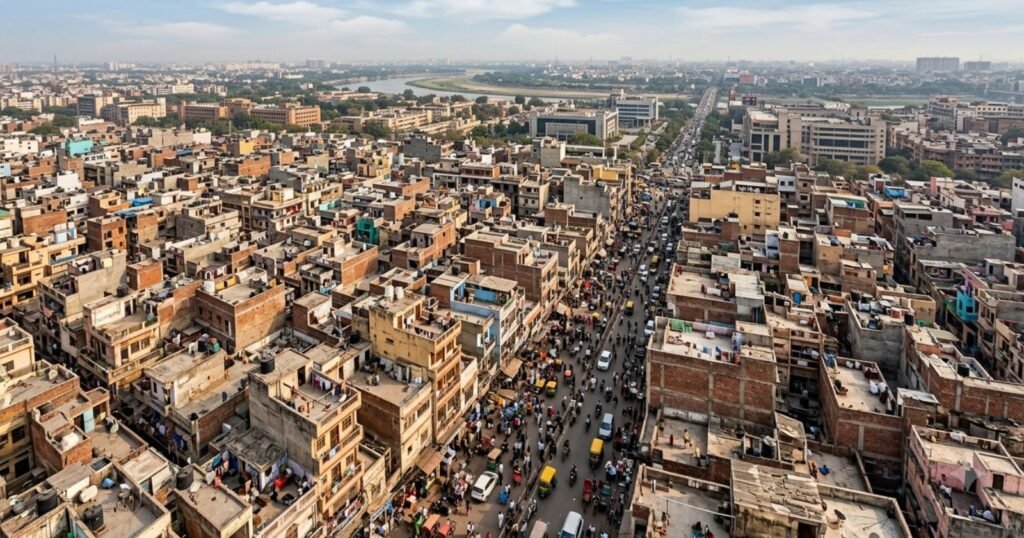
The world’s average population density is about 60 people per square kilometer. That number is true, precisely calculated, and almost completely useless for understanding where human beings actually live. It treats the Sahara Desert, the Amazon rainforest, the Himalayas and Antarctica’s ice sheets as equivalent living space to the Ganges Delta or the Nile Valley, when in reality a large fraction of Earth’s land surface holds almost nobody, while a comparatively small fraction holds most of humanity at densities the global average cannot begin to suggest. Understanding population density starts with understanding exactly how misleading its simplest, most commonly cited figure can be.
What Is World Population Density?
Population density measures the number of people living per unit of land area, conventionally expressed as people per square kilometer. It is calculated simply: total population divided by total land area. The denominator matters enormously and is not always defined consistently between sources; some density calculations use a country’s total land area including uninhabitable terrain such as deserts, ice sheets and high mountains, while others attempt to isolate only habitable or arable land, producing very different results for countries with large uninhabited interiors.
The Global Population Density at a Glance
Globally, population density stands at roughly 60 inhabitants per square kilometer, based on the world’s approximately 8.2 billion people spread across the planet’s roughly 149 million square kilometers of land area. This figure has been rising steadily as global population grows, and Asia, both because of its enormous population and its comparatively modest land area relative to that population, is the most densely populated major continent in the world.
Global Population Density, Key Figures
| Metric | Figure |
|---|---|
| Global average population density | ~60 people/km² |
| World population | ~8.2 billion |
| World land area | ~149 million km² |
| Most densely populated major continent | Asia |
| Country with highest density (10M+ population) | Bangladesh (~1,333-1,350/km²) |
| Country with lowest density (10M+ population) | Australia (~3.5/km²) |
Source: Statista, “Top fifty countries with the highest population density,” 2024-2025; StatisticsTimes.com, Countries by population density 2025.
Why Global Average Density Can Be Misleading
The 60-per-square-kilometer global figure obscures a fundamental reality of human geography: most of the planet’s land surface is essentially uninhabited, and most of humanity is concentrated onto a comparatively small fraction of it. Vast stretches of the Sahara, the Gobi and Arabian deserts, the Amazon and Congo rainforest interiors, Siberia’s tundra and taiga, the Himalayan and Andean high-altitude zones, and the polar ice sheets of Antarctica and Greenland hold population densities close to zero, dragging the global average down dramatically relative to where people actually cluster. A meaningful description of human settlement patterns requires looking past the arithmetic average entirely and toward the specific geographic and climatic conditions, water availability, arable soil, temperate climate, coastal access, that make land habitable and desirable for large-scale settlement in the first place.
Where Human Population Is Most Concentrated
Human settlement clusters overwhelmingly around a specific, recurring set of geographic features: major river valleys and deltas (the Nile, the Ganges-Brahmaputra, the Yangtze and Pearl River deltas), temperate coastlines with reliable rainfall and access to trade, and historically fertile agricultural plains capable of supporting dense populations for millennia. The Ganges-Brahmaputra Delta region alone, spanning Bangladesh and parts of eastern India, supports several hundred million people at densities exceeding a thousand per square kilometer across a comparatively modest total land area, a concentration with few parallels anywhere else on Earth.
Population Density by Region
Approximate Population Density by World Region
| Region | Relative Density Ranking |
|---|---|
| Asia | Highest among major continents |
| Europe | Moderate to high, concentrated in western and central zones |
| Africa | Lower average, but rapidly rising and highly uneven (dense river valleys vs. sparse deserts) |
| Latin America and the Caribbean | Moderate, concentrated in coastal and highland zones |
| Northern America | Comparatively low, concentrated in specific urban corridors |
| Oceania | Lowest among major regions, dominated by Australia’s vast sparsely populated interior |
Regional averages, much like the global figure, conceal enormous internal variation. Africa’s overall density remains comparatively low, but this masks both some of the world’s most densely populated small countries, such as Rwanda and Burundi, and some of its most sparsely populated vast interior zones across the Sahara and the Congo Basin.
Population Density by Country
Country-level density rankings split cleanly into two very different stories depending on whether small microstates or larger countries with substantial populations are being compared.
Most Densely Populated Countries and Territories, 2025
| Rank | Country/Territory | Density (people/km²) |
|---|---|---|
| 1 | Monaco | ~25,732-25,969 |
| 2 | Macao SAR (China) | ~22,508-23,167 |
| 3 | Singapore | ~8,539-8,596 |
| 4 | Hong Kong SAR (China) | ~6,729-6,747 |
| 5 | Gibraltar | ~3,933-4,013 |
| 6 | Bahrain | ~1,765-2,052 |
| 7 | Maldives | ~1,759 |
| 8 | Malta | ~1,713-1,731 |
Source: Visual Capitalist, “Ranked: The 20 Most Densely Populated Countries and Territories,” August 2025; StatisticsTimes.com; Academic Block, 2025.
Among countries with populations exceeding 10 million, a genuinely different, more geographically meaningful ranking applies, since it excludes microstates whose extreme densities reflect their tiny total land area rather than any broader settlement pattern.
Most Densely Populated Countries With 10 Million or More People
| Rank | Country | Density (people/km²) |
|---|---|---|
| 1 | Bangladesh | ~1,333-1,350 |
| 2 | Taiwan | ~652.7 |
| 3 | Rwanda | ~601.8 |
| 4 | Burundi | ~554.5 |
| 5 | Netherlands | ~544.9 |
Source: StatisticsTimes.com, Countries by population density 2025.
Bangladesh is roughly 385 times as dense as the least dense country with a comparable population size, Australia, among the world’s larger countries, one of the widest gaps recorded anywhere for countries of broadly similar total population scale.
Physical Geography and Population Density
Climate, terrain, water availability and soil quality remain the fundamental long-run determinants of where dense human settlement becomes possible and sustainable. Reliable freshwater access, whether from rainfall, river systems or aquifers, has shaped settlement patterns since the earliest agricultural civilizations and continues to explain much of the variation visible in modern density maps: the enormous population concentrations along the Nile, Ganges and Yangtze rivers trace directly back to the agricultural productivity those river systems have historically supported. Coastal access historically enabled trade, fishing and, more recently, the concentration of modern port-based economic activity, contributing to comparatively high densities across much of coastal East and South Asia, Western Europe and parts of Latin America. Terrain plays an equally decisive role at the opposite extreme: mountainous, arid or polar terrain has kept vast stretches of Earth’s land surface, from the Sahara to Siberia to the Andean highlands, at population densities close to zero regardless of how much total land area they occupy.
Cities and Population Density
Urban concentration radically compresses the density figures relevant to daily lived experience compared with any national average. A country’s overall density figure, even a high one like Bangladesh’s roughly 1,333 people per square kilometer, is itself an average across a mix of dense urban centers and comparatively less dense agricultural land; individual cities within that country reach far higher local densities still. This distinction, between a national average and the density actually experienced by residents of a country’s major cities, is essential context: a country can have a moderate or even low overall national density while still containing some of the world’s most crowded urban districts, since national density figures blend enormous, sparsely populated rural or wilderness areas together with tightly packed cities into a single misleading average.
How Population Density Has Changed
Global population density has risen steadily and continuously as world population has grown, from under one billion people in 1800 to over 8.2 billion today, spread across essentially the same total land area throughout that period. This rise has not been remotely uniform: it has concentrated overwhelmingly in already-dense regions and rapidly urbanizing zones, while some sparsely populated regions, parts of rural Europe and North America in particular, have seen population density stagnate or even decline over recent decades as rural populations continue shifting toward cities, a dynamic explored in depth in the companion piece on world rural population.
What Density Means for Resources and Infrastructure
High population density concentrates both opportunity and strain. Densely populated regions typically support more efficient infrastructure delivery per capita, shorter transport distances, more viable public transit, and easier provision of utilities and services, explaining why dense urban development is often associated with lower per-capita infrastructure costs despite higher absolute demand. At the same time, extreme density places acute pressure on housing affordability, land use planning, water and sanitation capacity, and food supply logistics, particularly in rapidly growing dense urban regions where infrastructure investment has struggled to keep pace with population growth. Countries and cities at the extreme high end of the density spectrum, Bangladesh, the Netherlands, Singapore and Hong Kong among them, have each developed distinctive engineering and planning responses, from the Netherlands’ extensive land reclamation and water management systems to Singapore and Hong Kong’s reliance on high-density vertical housing, illustrating that extreme density is manageable with sufficient investment and planning, even if it is rarely comfortable by default.
Key Findings
- The world’s average population density is roughly 60 people per square kilometer, a figure that conceals enormous variation, since most of Earth’s land surface holds close to no population at all.
- Monaco is the world’s most densely populated sovereign territory, at roughly 25,700 to 26,000 people per square kilometer, followed by Macao and Singapore.
- Among countries with populations exceeding 10 million, Bangladesh is by far the densest, at roughly 1,333 to 1,350 people per square kilometer, about 385 times denser than Australia, the least dense large country.
- Asia is the most densely populated major continent, driven by enormous population concentrations along its major river deltas and coastlines.
- Physical geography, water access, terrain, soil quality and coastal proximity, remains the primary long-run determinant of where dense human settlement has developed and persisted historically.
- Extreme density is manageable with sufficient infrastructure investment, as demonstrated by high-density, high-income places like Singapore, Hong Kong and the Netherlands, though it remains a serious ongoing challenge in rapidly growing, lower-income dense regions.
Frequently Asked Questions
1. What is the world’s population density?
The global average is approximately 60 people per square kilometer, based on a world population of roughly 8.2 billion spread across about 149 million square kilometers of land.
2. Where do most people live?
Most of humanity is concentrated along major river valleys and deltas, temperate coastlines, and historically fertile agricultural plains, particularly across South and East Asia, rather than being evenly spread across the planet’s land surface.
3. Which country is the most densely populated?
Monaco is the most densely populated sovereign territory in the world, at roughly 25,700 to 26,000 people per square kilometer. Among countries with populations over 10 million, Bangladesh is the densest, at roughly 1,333 to 1,350 people per square kilometer.
4. Why are some places much more crowded than others?
Physical geography is the primary long-run explanation: water availability, fertile soil, temperate climate and coastal access have historically made certain regions capable of supporting dense populations, while deserts, high mountains, polar regions and dense uncultivated forests have kept others nearly empty.
5. Is the global average population density a useful figure?
Not on its own. It treats uninhabitable deserts, ice sheets and mountain ranges as equivalent living space to densely settled river deltas and coastlines, making it a poor guide to where and how people actually live.
6. What is the difference between national density and urban density?
National density averages a country’s entire land area, including sparsely populated rural or wilderness regions, together with its cities, producing a figure much lower than the density actually experienced within that country’s major urban centers.
7. Which continent is the most densely populated?
Asia is the most densely populated major continent, a result of its enormous population combined with a comparatively modest total land area relative to that population.
8. How does population density affect infrastructure?
Higher density can lower per-capita infrastructure costs by shortening transport distances and improving the viability of public transit and utilities, but it also concentrates demand for housing, water, sanitation and food supply logistics, requiring substantial investment to manage effectively.
9. Which large countries have the lowest population density?
Among countries with populations over 10 million, Australia (about 3.5 per km²), Canada (about 4.4 per km²) and Kazakhstan (about 7.7 per km²) have the lowest population densities, reflecting their combination of large land area and comparatively small populations.
10. Is population density increasing globally?
Yes. Global population density has risen steadily alongside overall world population growth, though the increase has been highly uneven, concentrating in already-dense, rapidly urbanizing regions while some rural areas have seen density stagnate or decline.
Sources
- Visual Capitalist, “Ranked: The 20 Most Densely Populated Countries and Territories,” August 2025
- StatisticsTimes.com, “Countries by population density 2025”
- Statista, “Top fifty countries with the highest population density,” citing UN and national data
- Academic Block, “Top 10 Countries with Highest Population Density,” 2025
- World Population Review, “Countries by Population Density 2026”
- Visual Nerd, “Global Population Density Rankings 2025,” citing UN World Population Prospects 2024