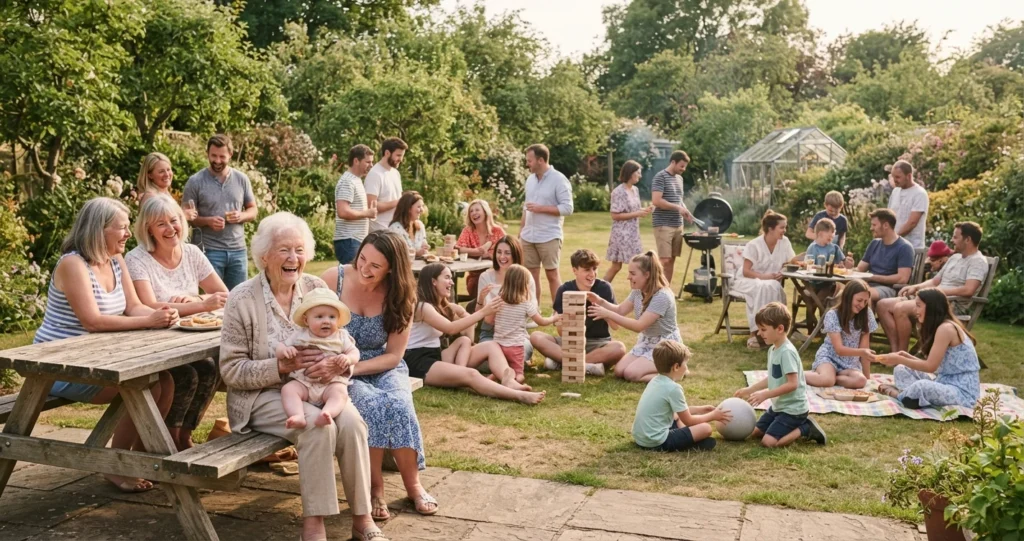
Count the generation labels in use in 2026 and seven or eight of them are alive at the same time, from the surviving Greatest Generation (born 1901 to 1927) through Generation Alpha, with the newest proposed cohort, Generation Beta, beginning in 2025. That headline is accurate and also slightly misleading. A birth cohort covering 16 or 19 years is not a family generation, and a single family needs a very specific combination of early parenthood and extreme longevity to have seven living links in one line of descent.
The distinction is the core of this article. Societies now have more overlapping cohorts than at any previous point, because life expectancy has risen from about 46 years in 1950 to 73.3 in 2024. Families, on the other hand, rarely reach seven. The arithmetic below shows why, and the household data show how many generations actually live under one roof.
Data Snapshot
| Indicator | Figure | Year | Source |
|---|---|---|---|
| World life expectancy at birth | 73.3 years | 2024 | UN WPP 2024 |
| World life expectancy at birth | About 46 years | 1950 | UN WPP |
| Oldest verified human age | 122 years | 1997 | Guinness World Records, Jeanne Calment |
| Births to mothers under 18 | 4.7 million (3.5% of births) | 2024 | UN WPP 2024 |
| US population in multigenerational households | 59.7 million (18%) | 2021 | Pew Research Center |
| Same measure | 7% | 1971 | Pew Research Center |
| Average EU household size | About 2.3 persons | 2023 | Eurostat |
How Many Human Generations Are Alive Today?
Two meanings of “generation” are in use:
- A social cohort is a group born in a range of years, such as Pew’s millennials (1981 to 1996). These span 15 to 20 years.
- A family generation is a step in a line of descent: child, parent, grandparent, great-grandparent. The average interval between steps is about 25 to 30 years.
| Cohort | Birth years | Age in 2026 |
|---|---|---|
| Greatest Generation | 1901 to 1927 | 99 and older |
| Silent Generation | 1928 to 1945 | 81 to 98 |
| Baby Boomers | 1946 to 1964 | 62 to 80 |
| Generation X | 1965 to 1980 | 46 to 61 |
| Millennials | 1981 to 1996 | 30 to 45 |
| Generation Z | 1997 to 2012 | 14 to 29 |
| Generation Alpha | 2013 to 2024 (varies) | 0 to 13 |
| Generation Beta (proposed) | 2025 to 2039 | 0 to 1 |
Pew’s boundaries run to Alpha. Several research firms propose Beta starting in 2025. The Greatest Generation is now very small, almost certainly under one million people worldwide, since its youngest members are 99. Counting it, seven cohorts are alive, and eight with Beta. No official statistical body treats these labels as categories.
What Makes Seven Generations Alive at Once Possible?
Overlap depends on three variables: the age at which each generation has its children, how long people live, and whether each person in the chain survives to see the next birth. The most important is the generation gap. The UN reports that 4.7 million births in 2024, about 3.5% of the world total, were to mothers under 18. Early childbearing shortens the gap, and only lines of descent with repeated early births can compress seven generations into 100 years.
The relevant calculation is the age the oldest person must be when the youngest is born: (number of generations minus one) multiplied by the average gap.
| Generations alive | Gap of 17 years | Gap of 20 years | Gap of 25 years | Gap of 29 years |
|---|---|---|---|---|
| 4 | 51 | 60 | 75 | 87 |
| 5 | 68 | 80 | 100 | 116 |
| 6 | 85 | 100 | 125 | 145 |
| 7 | 102 | 120 | 150 | 174 |
Age in years of the oldest family member at the moment the youngest is born.
With a gap of 29 years, close to the global mean age of childbearing, even five generations require the oldest ancestor to be 116, nearly the all-time record. Seven generations only become feasible when the average gap falls to roughly 16 or 17 years and the great-great-great-grandparent lives past 100. The record for verified human age is 122 years.
Possibility and prevalence are therefore far apart. Verified seven-generation families appear in record catalogues and family-history studies, but they are exceptions, and no national statistics agency measures their frequency.
The Generational Timeline of Modern Society
Four family generations are common in countries with high life expectancy: a child, parent, grandparent and great-grandparent. Four need the oldest to be about 87 when the youngest is born at a 29-year gap, which is within normal survival in high-income countries. Five require either earlier births or exceptional old age. Societies with young birth patterns, such as parts of sub-Saharan Africa and South Asia, have shorter gaps but lower life expectancy, so long chains remain uncommon.
How Longer Life Expectancy Extends Generational Overlap
Improvements in Survival
World life expectancy rose from about 46 years in 1950 to 64.0 in 1990 and 73.3 in 2024, and the UN projects 77.4 by 2054. More survival to old age means more shared years across generations. A child born in a high-income country today often knows grandparents into adulthood and sometimes great-grandparents.
Survival Into Advanced Old Age
Exceptional longevity is rarer. Japan had 95,119 centenarians in September 2024, about 88% of them women. A person reaching 100 is still unusual even in the country with the highest ratio, but the number has grown from just over 150 in 1963. Survival to 80 and 90 has risen far more widely, and these ages are what drive the extra years of overlap in most families.
Regional Differences in Longevity
Life expectancy in the world’s least developed countries is about 7 years below the global average, according to the UN. A child born in a long-lived society such as Japan has far better odds of knowing grandparents and great-grandparents than a child born in a country where life expectancy is in the low 60s. Health inequalities within countries also create gaps of a decade or more by income and location.
How Family Formation Shapes the Number of Living Generations
Parental age is the most powerful lever. When childbearing shifts later, as it has across most high-income countries, each family generation lasts longer and the number alive at the same time falls, even if longevity rises. In the United States the mean age at first birth rose from 21.4 in 1970 to 27.5 in 2023. Delayed childbearing offsets some of the gain from longer lives.
Family size matters in a different way. A lineage is a single line of descent, and fertility affects how many lines exist. High fertility produces many short chains, while low fertility produces fewer and thinner chains that may last longer where parents are older and survive more years.
Seven Generations Within One Family Versus Seven Generations in Society
| Question | Social cohorts | Family lineage |
|---|---|---|
| Unit | Birth range of 15 to 20 years | One chain of parents and children |
| Typical count alive (high-income country) | 6 to 8 | 3 to 4 |
| Source of evidence | Census age tables | Family studies and genealogies |
| Measured by statistical agencies | Yes, by age | Rarely |
A country can contain seven cohorts without a single family containing seven connected generations. Evidence of lineage overlap would need linked records or family surveys, and such data are limited.
Multigenerational Households Around the World
Countries With Established Multigenerational Living
UN household data show that in much of South Asia, East Asia and sub-Saharan Africa a large share of older adults live with adult children, while in Northern Europe most live alone or with a spouse. These differences reflect norms, housing and pension systems. Household composition is measured by censuses and surveys, and definitions of “multigenerational” vary by country.
Multigenerational Living in Aging Societies
The United States shows how quickly living arrangements can change. Pew Research Center found that 59.7 million Americans, or 18% of the population, lived in multigenerational households in 2021, up from 7% in 1971. Rising housing costs, immigration and an aging population contributed. Average EU household size is about 2.3 persons, so shared households are the exception in much of Europe.
Economic and Cultural Differences
Reasons for sharing a home vary: caring for older relatives, housing costs, young adults staying with parents, or cultural preference. Multigenerational living is not inherently beneficial or harmful. It can lower housing costs and provide care, but it can also bring strain over space and caregiving duties.
The Social and Economic Impact of Multiple Generations Living Together
Overlap affects caregiving, financial transfers and housing. Four-generation families allow grandparents to help with young children while adult children support aging parents, and the middle generations carry both duties. Longer overlap also means longer periods of dependence at the end of life, and a larger share of care by family members in countries with limited long-term care services. Quantitative evidence about the net effect is mixed and depends on income, health and service provision.
The Role of Fertility Decline in a Multigenerational World
More generations alive does not mean more people. Sociologists have used the term “beanpole family” for structures with many generations but few members in each. Lower fertility makes each younger generation smaller than the one before. At a total fertility rate of about 1.18, the figure for Italy in 2024, each new generation is roughly 56% as large as the previous one (1.18 divided by about 2.1). Over three generations the line shrinks to about 18% of its starting size.
| Country | Fertility rate (about, 2024) | Next generation vs previous (rate divided by 2.1) | Great-grandchildren per 100 great-grandparents’ generation |
|---|---|---|---|
| South Korea | 0.75 | 36% | 5 |
| Italy | 1.18 | 56% | 18 |
| United States | 1.6 | 76% | 44 |
| India | 2.0 | 95% | 86 |
| Nigeria | 4.4 | 210% | 920 |
The last column cubes the ratio, assuming rates stay constant. It is an illustration of arithmetic and not a forecast.
Could Eight or More Generations Coexist in the Future?
Eight family generations need seven gaps. At a 17-year gap that means a 119-year-old ancestor, at the very edge of the verified human record. Life expectancy would need to rise far beyond the UN projection of 77.4 years by 2054, and parenthood would need to move earlier. Eight social cohorts, on the other hand, are likely to be common as generation labels multiply. That is a result of naming conventions as much as demography.
What Seven Generations Alive at Once Reveals About Population Change
The strongest signal is that survival gains have outpaced the shift in childbearing. Societies today contain more overlapping cohorts than ever, but each cohort is narrower than the one before in most high-income countries. Seven generations in a single family remains an extreme case, and its significance lies in what it shows about the limits of longevity and parental age more than in how many families it describes.
Conclusion
The calculation that matters is the 17-year gap and the 102-year-old ancestor required for seven connected generations. It shows that population-level overlap, which now spans seven or eight cohorts, and family-level overlap, which usually stops at four, are separate phenomena. Longer life has stretched the first without stretching the second very much, and smaller birth cohorts mean each generation in the chain is thinner than before.
Key Findings
- Seven social cohorts (Greatest to Alpha) are alive in 2026, and eight with the proposed Generation Beta, but these are labels for 15- to 20-year birth ranges.
- A seven-generation family needs a gap of about 17 years and an ancestor aged 102 at the youngest’s birth, or 120 at a 20-year gap.
- At a 29-year gap, five generations require the oldest ancestor to be 116 at the youngest’s birth.
- US multigenerational household living rose from 7% of the population in 1971 to 18% in 2021.
- At Italy’s fertility of about 1.18, each generation is roughly 56% the size of the one before.
Frequently Asked Questions
1. How many generations are alive at once?
Seven social cohorts in 2026, from the Greatest Generation to Generation Alpha, or eight with the proposed Generation Beta. Within a family, three or four is typical.
2. Can seven generations be alive in one family?
Only with very short gaps (about 17 years) and an ancestor over 100 when the youngest is born. Such cases are documented but extremely rare.
3. Why are more generations living at once?
Life expectancy rose from about 46 years in 1950 to 73.3 in 2024, so more people survive to old age and overlap with descendants.
4. Does longer life expectancy mean larger families?
No. Survival and fertility are separate. Longer lives add years of overlap, while lower fertility reduces the number of people in each generation.
5. What is a multigenerational household?
A home with at least two adult generations, often three, depending on the census definition. Pew counts US households with two or more adult generations or grandparents and grandchildren.
6. Can eight generations coexist?
In theory, with a 17-year gap and a 119-year-old ancestor, which sits at the edge of the verified record. Eight social cohorts can coexist more easily.
7. Which countries have the most multigenerational households?
Household surveys show the highest shares of older adults living with adult children in South Asia, East Asia and sub-Saharan Africa, and the lowest in Northern Europe. Definitions vary, so ranks should be taken from one harmonized source.
8. What is the longest verified human life?
122 years, reached by Jeanne Calment, who died in 1997.
9. How does having children later affect generational overlap?
It lengthens the gap. At 29 years, five generations require an ancestor aged 116 at the youngest’s birth, so later parenthood reduces overlap.
10. Do shrinking families mean fewer generations alive?
No. They mean fewer people per generation. Lower fertility and longer lives together produce “beanpole” families with many generations and few members in each.
Sources
- United Nations Population Division, World Population Prospects 2024, key messages.
- Pew Research Center, generation definitions and multigenerational household analyses. https://www.pewresearch.org
- Ministry of Health, Labour and Welfare, Japan, centenarian statistics. https://www.mhlw.go.jp
- Eurostat, household composition statistics. https://ec.europa.eu/eurostat
- CDC National Center for Health Statistics, mean age of mother at first birth. https://www.cdc.gov/nchs/
- Guinness World Records, oldest person ever. https://www.guinnessworldrecords.com
- Istituto Nazionale di Statistica (ISTAT), births and fertility 2024. https://www.istat.it
- Statistics Korea, birth statistics 2024. https://kostat.go.kr