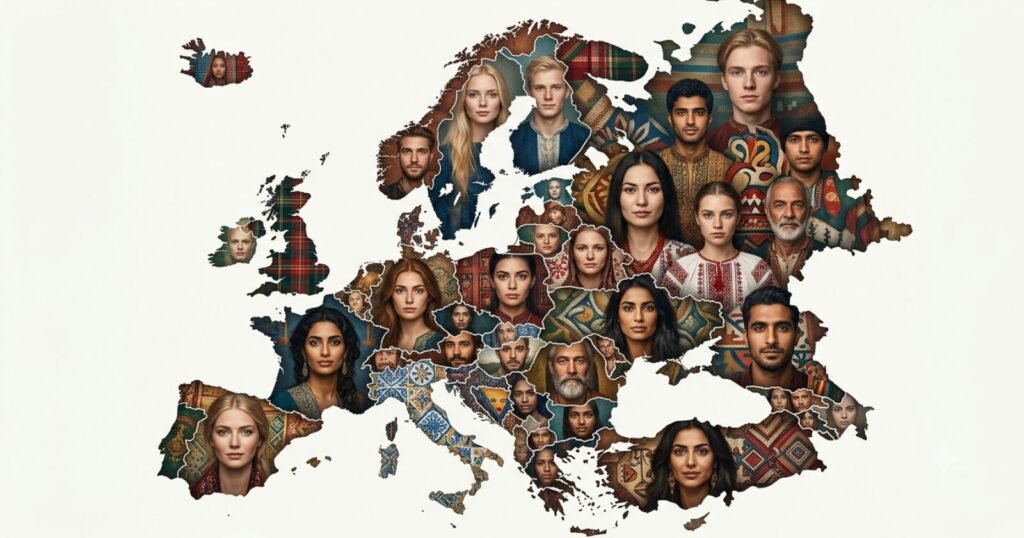
Ask how many ethnic Poles live in Europe and you can get a reasonably confident answer. Ask how many ethnic French people live in Europe and the question barely makes sense to the French statistical system itself, because France’s census has not collected ethnicity data since 1978, a deliberate choice rooted in the country’s republican model of citizenship, which treats ethnic categorization by the state as fundamentally at odds with civic equality. This is not a data gap that better methodology would fix. It is a genuine and irreducible difference in how European countries think about ethnicity itself, and understanding that difference matters more than any ranking this article could produce.
What Does Ethnicity Mean in Europe
Unlike population totals, growth rates, or age structure, which rest on relatively standardized international definitions, ethnicity has no single agreed meaning across European statistical systems. Some countries treat it as self-identified group membership, closer to a cultural or ancestral identity a person chooses to report.
Others use nationality, mother tongue, or country of birth as an imperfect practical stand-in, on the theory that these are measurable where direct ethnic self-identification is not. A meaningful number of European countries, France chief among them, do not collect ethnicity data at all, treating the very act of state ethnic classification as politically fraught given Europe’s twentieth-century history of ethnic categorization being used for persecution.
Ethnicity Versus Nationality Versus Ancestry Versus Country of Birth
These four concepts get collapsed into one in casual conversation more often than almost any other set of terms in demographic reporting, and keeping them separate is the single most important thing this article can offer.
| Concept | What It Measures | Example |
|---|---|---|
| Ethnicity | Self-identified cultural or ancestral group membership | Identifies as ethnically Polish |
| Nationality | Legal citizenship status, can change through naturalization | Holds French citizenship |
| Country of birth | Fixed biographical fact, never changes | Born in Poland |
| Ancestry | Family origin, may span several generations back | Has Polish ancestry, may hold different citizenship |
| Language | Linguistic identity or mother tongue, distinct from ethnic identity | Speaks Polish natively |
A single person can occupy every cell in a different column simultaneously, born in Poland, holding German citizenship after naturalization, identifying ethnically as Polish, and speaking German as their main daily language after decades of residence. None of these facts contradicts any other, and no single statistic in this article can capture all of them at once.
How European Countries Collect Ethnicity Data
European statistical practice splits into roughly four approaches, and which approach a country uses shapes what kind of ethnicity picture is even possible to construct for it.
- Direct census questions, used by the United Kingdom, Ireland, and several Central and Eastern European countries including Hungary, Poland, Slovakia, and Bulgaria, typically allowing self-identification with multiple response options
- Proxy measures, where countries without a direct ethnicity question use nationality, country of birth, or mother tongue as an imperfect substitute, understanding these measures capture something related but distinct from ethnic identity itself
- Sample surveys rather than full censuses, used in some countries as a middle path that allows ethnicity questions without embedding them in a mandatory nationwide count
- No collection at all, the French model, where ethnicity is treated as outside the legitimate scope of state statistics entirely, a position shared to varying degrees by a handful of other European countries
This is not a spectrum from better to worse methodology. Each approach reflects a genuine underlying political and historical position about what a state should and should not know about its citizens’ ethnic identity, and comparing a UK-style direct-question country with a French-style no-collection country produces two fundamentally different kinds of silence, one because ethnicity was asked and multiple respondents didn’t answer, one because the question was never asked at all.
Historical Evolution of Europe’s Ethnic Landscape
Europe’s current ethnic geography is the product of successive historical waves rather than any static original pattern. Pre-industrial Europe was characterized by far more localized identity than modern national categories suggest, with regional, linguistic, and religious identity often mattering more than anything resembling today’s national ethnic labels.
The nineteenth and early twentieth century wave of nation-state formation actively worked to consolidate diverse regional populations into unified national identities, often suppressing minority languages and regional identities in the process. The two world wars produced enormous, forced population displacement, most dramatically the postwar expulsion and flight of ethnic Germans from Poland, Czechoslovakia, and other Central and Eastern European states after 1945, one of the largest forced population movements in European history.
The Cold War’s division froze much of Central and Eastern Europe’s ethnic geography in place for four decades, while post-1990 migration, EU enlargement, and the free movement of people across the bloc have reshaped it substantially since, adding new layers of ethnic and cultural diversity, particularly in Western European cities, without erasing the older regional patterns beneath them.
Major Ethnic and Linguistic Populations Across Europe
Rather than ranking countries, which the data does not support given the definitional problems above, it is more useful to describe Europe’s major population groups by broad linguistic and cultural family, while being explicit that linguistic family and ethnic identity are related but not identical concepts.
| Population Group | Approximate Scale | Primary Regions |
|---|---|---|
| Slavic populations | Largest single grouping, hundreds of millions combined | Russia, Poland, Ukraine, Balkans, Czechia, Slovakia |
| Germanic populations | Second largest grouping | Germany, UK, Scandinavia, Netherlands, Austria |
| Romance populations | Major grouping across Southern and Western Europe | France, Italy, Spain, Portugal, Romania |
| Celtic populations | Smaller, concentrated regional presence | Wales, Ireland, Scotland, Brittany |
| Uralic populations | Smaller, linguistically distinct from neighbors | Finland, Estonia, Hungary |
| Baltic populations | Smaller, distinct branch of Indo-European | Latvia, Lithuania |
| Greek population | Distinct, ancient continuous presence | Greece, Cyprus |
| Albanian population | Distinct, ancient continuous presence | Albania, Kosovo, parts of North Macedonia |
| Roma population | Dispersed across nearly every European country | Concentrated in the Balkans, also Romania, Bulgaria, Hungary, Slovakia, Spain |
These are linguistic and cultural family groupings, not precise ethnic head counts, since the underlying census and survey data supporting a genuinely comparable ethnic population count simply does not exist across all of these groups on a consistent basis.
Roma Population in Europe
The Roma receive dedicated treatment in this article because they are, in the European Commission’s own description, Europe’s largest ethnic minority, and because their population estimates illustrate the data problems described above more starkly than any other group. The Council of Europe estimates 10 to 12 million Roma live in Europe overall, with approximately 6 million holding EU citizenship or residence, but these figures carry unusually wide uncertainty bands even by the standards of ethnicity data generally.
Three specific factors drive that uncertainty, some Roma lack personal identity documents and go unregistered entirely in some countries, many Roma decline to declare their ethnic identity on official forms out of a well-founded fear of discrimination, and some administrative systems have historically misrecorded Roma ethnicity as a different nationality entirely.
Estimated Roma population shares vary enormously by country, from roughly 8 to 10 percent of the population in Romania and Bulgaria, among the highest shares in Europe, to 9 percent in Slovakia and 7 percent in Hungary, down to well under 1 percent across most of Northern and Western Europe.
Spain’s Roma population, largely long-settled rather than recently arrived, is estimated at 1.5 to 3.7 percent of the national population, one of the largest Roma communities in Western Europe specifically. Roma communities across Europe continue to face measurable discrimination, with 31 percent reporting having experienced ethnic discrimination in at least one area of daily life within the preceding year according to the EU Agency for Fundamental Rights’ most recent survey.
Ethnic Minorities and Diaspora Populations
Beyond the historically rooted populations described above, Europe hosts substantial diaspora and migrant-origin communities whose presence reflects twentieth and twenty-first century migration rather than ancient settlement patterns. Turkish communities are concentrated overwhelmingly in Germany, a legacy of postwar guest worker recruitment programs. North African communities, predominantly Moroccan and Algerian in origin, concentrate in France and, to a lesser extent, Spain and Belgium.
South Asian communities, particularly of Indian, Pakistani, and Bangladeshi origin, are concentrated in the United Kingdom, reflecting Commonwealth-era migration patterns. This article deliberately uses the term diaspora or migrant-origin community rather than treating national origin as directly equivalent to ethnicity, since a person’s country of origin, their self-identified ethnicity, and their citizenship are three separate facts that can diverge substantially, particularly for second and third generation descendants born and raised entirely within their country of residence.
Ethnicity by Country, What the Data Can Actually Show
| Data Availability | Example Countries | What This Means |
|---|---|---|
| Direct census ethnicity question, detailed categories | United Kingdom, Hungary, Slovakia, Bulgaria | Reasonably granular self-identified ethnic breakdowns exist |
| Direct question, broader categories | Ireland, Poland | Ethnicity collected but with fewer response categories |
| No direct question, proxy measures only | France, and several others | Only nationality, birthplace, or language data available as imperfect substitutes |
| Limited or no systematic collection | Varies | Estimates for minority populations like Roma rely on external bodies such as the Council of Europe rather than national census data |
Where Ethnic Demography Is Changing Fastest
Rather than claim any single measure directly tracks ethnic population change, since none reliably does, this article points to a cluster of measurable proxy indicators covered in more depth elsewhere in this data series, foreign-born population share, migration flows, and the age structure of migrant-origin versus native-born populations.
Countries with the highest foreign-born population shares, Luxembourg, Malta, and Cyprus prominently among them, are seeing the fastest measurable shifts in country-of-birth and citizenship composition, which is a meaningfully different statistic from ethnic composition but is the closest reliable proxy available given the data constraints described throughout this article.
Future Ethnic Demography of Europe
Any attempt to project Europe’s future ethnic composition runs into every methodological problem already described, compounded further by time. Fertility differences between population groups, continued migration, and generational shifts in how mixed-heritage individuals and their descendants self-identify ethnically all shape future ethnic demography, but none of these inputs can be modeled with anything like the confidence demographers bring to total population, age structure, or even religious composition projections covered elsewhere in this data series.
Self-identification itself changes across generations in ways that are inherently difficult to forecast, a third-generation descendant of migrants may identify primarily with their country of birth, primarily with their family’s ethnic origin, or with some blended identity that existing survey categories were never designed to capture cleanly.
Data Limitations and Common Misinterpretations
- Ethnicity is not nationality, a person can hold citizenship of a country entirely unrelated to their self-identified ethnic group
- Foreign-born is not the same as an ethnic minority, someone born abroad may share the majority ethnicity of their country of residence, and someone born domestically may identify with a minority ethnicity
- Citizenship is not ancestry, naturalization changes legal status without changing family origin or self-identified ethnic background
- Language is not ethnicity, plenty of people speak a language natively without ethnically identifying with the group most associated with it, and vice versa
- Estimates are not census counts, figures for groups like the Roma, where systematic undercounting and non-disclosure are well documented, should be read as informed estimates with wide uncertainty bands, not precise counts
Conclusion, Europe’s Ethnic Landscape Is Increasingly Complex
Europe’s ethnic landscape resists the kind of clean ranking this data series applies to population totals, growth rates, or age structure, and that resistance is itself the most important finding in this article. The honest picture is one of genuine diversity across the continent’s historically rooted linguistic and cultural populations, layered with substantial and growing migrant-origin communities, measured through a patchwork of national statistical systems that do not agree on what ethnicity even is, let alone how to count it consistently.
Any single number claiming to state Europe’s ethnic composition should be treated with real skepticism unless it is precise about exactly which country, which methodology, and which of the distinct concepts, ethnicity, nationality, ancestry, or language, it is actually measuring.
Sources
Council of Europe
European Commission
- Roma equality, inclusion and participation in the EU
European Parliament Research Service
- Publications from 2021 to 2023
European Union Agency for Fundamental Rights
- Roma survey findings, 2024
European Commission / EU sources
- Roma population estimates
- Understanding EU action on Roma inclusion
United Kingdom Office for National Statistics
- National statistical office methodology notes
Institut national de la statistique et des études économiques (INSEE), France
- National statistical office methodology notes