
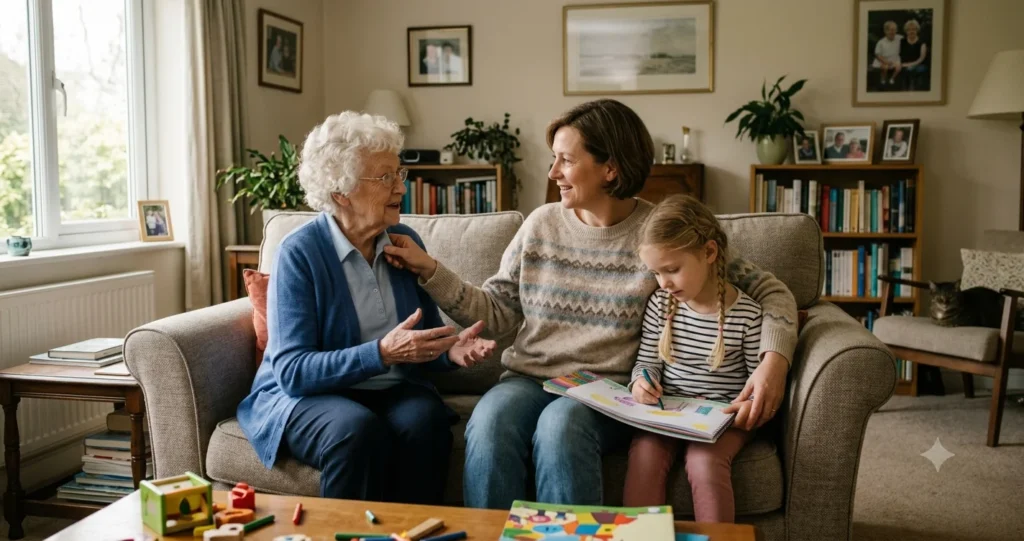
A quarter of U.S. adults now qualify as part of the “sandwich generation”, people with a living parent aged 65 or older who are also raising a minor child, providing financial support to an adult child, or both, according to a Pew Research Center survey conducted in September 2025. Among adults specifically in their 40s, the figure climbs past half: more than 50% of Americans in that age decade are sandwiched between an aging parent and their own children, making it the single most common caregiving configuration for that age group.
The sandwich generation is not a cultural label so much as a life-course demographic outcome, a direct product of longer parental survival, delayed childbearing, and extended periods of financial dependency among adult children, all converging on the same cohort of middle-aged adults at the same time. This article traces why that convergence is happening, who experiences it most, and what it costs.
Who Is the Sandwich Generation?
Pew Research Center’s operational definition, the most widely cited in the research literature, identifies sandwich generation adults as those who have a living parent aged 65 or older, and who either have a minor child, have provided financial support to an adult child in the past year, or both. This is a deliberately broad definition: it captures financial sandwiching (supporting a grown child financially while a parent also potentially needs support) as well as the more visible form of direct caregiving sandwiching (day-to-day care for both a minor child and an aging parent).
Other researchers and surveys use narrower or differently weighted definitions, which is one reason cited prevalence figures vary, from Pew’s roughly 23–25% national estimate to figures exceeding 50% when the age range is narrowed specifically to adults in their 40s.
Why Is the Sandwich Generation Becoming More Visible?
Several demographic trends are converging on the same cohort simultaneously:
- Longevity. Parents are living longer, meaning adult children spend more years with at least one living parent aged 65 or older, mechanically expanding the pool of people who could be “sandwiched” at any given time.
- Delayed parenthood. As the average age at first birth has risen across most high-income countries, adults are more likely to still have minor or dependent children at the same life stage their own parents are entering old age and needing support.
- Extended child dependency. Longer periods of education, delayed financial independence, and rising housing costs mean adult children increasingly rely on parental financial support well past age 18, the Pew data shows nearly half of sandwich generation adults provide some financial support to a grown child.
- Smaller families. Fewer siblings among adult children means eldercare responsibilities, when needed, are divided among fewer people, increasing the individual caregiving load per sandwiched adult.
What Ages Are Most Likely to Be Sandwiched?
Adults in their 40s are consistently identified as the most likely age group to be in the sandwich generation, more than half, based on the most recent Pew data, reflecting the specific life-stage overlap where school-age or young-adult children remain dependent while parents, now typically in their 70s or older, begin to need more support.
Pew’s data also shows the sandwich generation is not exclusively middle-aged: roughly 19% of those sandwiched are Millennials younger than 40, and at least 10% are older than 60, illustrating that while the 40s remain the peak, the phenomenon spans a wider age range than the stereotype suggests.
Sandwich Generation Prevalence by Group
| Group | Share in Sandwich Generation | Source Year |
|---|---|---|
| All U.S. adults | ~23–25% | Pew, 2025 |
| Adults in their 40s | Over 50% | Pew, 2025 |
| Asian adults | 31% | Pew, 2025 |
| Hispanic adults | 30% | Pew, 2025 |
| White adults | 23% | Pew, 2025 |
| Black adults | 21% | Pew, 2025 |
| Sandwich generation caregivers who are women | 60% | Pew |
Who Is Most Likely to Experience It?
Beyond age, Pew’s most recent data identifies meaningful differences by race and ethnicity: 31% of Asian adults and 30% of Hispanic adults are in the sandwich generation, compared with 23% of White adults and 21% of Black adults.
Gender differences are also well documented: 60% of sandwich generation caregivers are women, who spend on average 45 more minutes per day on caregiving tasks than men in the same position, according to Pew’s research, a pattern consistent with the broader gender imbalance documented across unpaid care work globally.
The Time and Economic Burden
Caregivers in the sandwich generation report spending, on average, roughly $10,000 and 1,350 hours annually caring for both children and aging parents combined, according to Pew-based estimates cited in caregiving research, with children typically requiring more direct financial outlay and aging parents requiring more time-intensive, labor-based care.
Nearly half of sandwich generation adults provide some form of financial support to a grown child, while about 30% say a parent needs help managing daily affairs or self-care. Nearly a third of sandwich generation caregivers report feeling constantly pressed for time, and family caregiver research more broadly finds that roughly 77% of family caregivers, a group that substantially overlaps with the sandwich generation, report significant emotional stress.
The Gender Dimension
The gender gap in sandwich generation caregiving mirrors patterns documented throughout the broader care economy: women are more likely to be primary caregivers, spend more daily hours on caregiving tasks, and report higher emotional strain from the dual responsibility.
This is consistent with global time-use data showing women perform the substantial majority of unpaid care work across virtually every measured context, from grandparent caregiving to intergenerational caregiving more broadly.
Geographic Differences
While the most granular sandwich generation data comes from the United States, the underlying demographic drivers, longevity and delayed family formation, are global trends, and similar caregiving overlaps have been documented elsewhere.
Canadian research, for instance, has identified comparable patterns among caregivers balancing responsibilities for aging parents alongside their own children or grandchildren, with one Canadian analysis projecting a need for thousands of additional home care workers in a single province by 2028 simply to maintain current service levels as the sandwiched population grows.
Countries with stronger public eldercare and childcare infrastructure tend to shift more of this burden away from unpaid family caregivers, while countries with family-centered care norms and weaker public systems concentrate more of the load directly on sandwich generation adults.
How the Sandwich Generation Could Change
The scale of the sandwich generation is directly tied to continued gains in life expectancy, further delays in childbearing, and trends in adult-child financial independence, all of which remain in motion. Continued increases in parental longevity would extend the years any given adult is likely to have a living parent aged 65 or older, while further delays in family formation would extend the years dependent children remain in the household, both trends that, if they continue, would push the sandwich generation share of the population higher rather than lower over coming decades.
Conclusion
The sandwich generation is best understood not as a lifestyle trend but as the predictable output of two demographic forces moving in the same direction at once: parents living longer, and children staying financially dependent longer.
With a quarter of U.S. adults now sandwiched, and more than half of those in their 40s, the group has moved from a niche caregiving category to one of the defining life-stage experiences of middle adulthood. As both underlying trends show few signs of reversing, the share of adults experiencing this overlap is more likely to grow than shrink in the coming decades.
Key Findings
- A quarter of U.S. adults are part of the sandwich generation as of the most recent Pew Research Center survey (September 2025), up modestly from 23% measured in 2021.
- More than half of Americans in their 40s are sandwiched between an aging parent and their own children, the highest rate of any age group.
- 31% of Asian adults and 30% of Hispanic adults are in the sandwich generation, compared with 23% of White adults and 21% of Black adults.
- 60% of sandwich generation caregivers are women, who spend an average of 45 more minutes daily on caregiving than men in the same role.
- Sandwich generation caregivers spend roughly $10,000 and 1,350 hours annually, on average, caring for both children and aging parents combined.
- Nearly 40% of sandwich generation adults say both their grown children and their aging parents rely on them for emotional support.
Frequently Asked Questions
1. What is the sandwich generation?
Middle-aged (and increasingly other) adults who have a living parent aged 65 or older and are also raising a minor child, financially supporting an adult child, or both, a definition drawn from Pew Research Center’s widely cited framework.
2. What age is most likely to be in the sandwich generation?
Adults in their 40s, among whom more than half qualify as sandwiched, according to Pew’s most recent data.
3. Why is the sandwich generation growing?
Longer parental life expectancy, delayed parenthood, and extended financial dependency among adult children are simultaneously converging on the same cohort of middle-aged adults, expanding the group experiencing dual caregiving demands.
4. Are women more likely to be sandwich caregivers?
Yes. Women make up 60% of sandwich generation caregivers and spend on average 45 more minutes per day on caregiving tasks than men in the same position.
5. How does longevity affect the sandwich generation?
Rising life expectancy increases the number of years an adult is likely to have at least one living parent aged 65 or older, directly expanding the pool of people who could be sandwiched at any given time.
6. How much does sandwich generation caregiving cost, on average?
Roughly $10,000 and 1,350 hours annually, combining financial support and caregiving time for both children and aging parents, according to Pew-based caregiving research.
7. Is the sandwich generation only middle-aged adults?
No. While adults in their 40s have the highest rate, Pew data shows about 19% of sandwiched adults are Millennials younger than 40, and at least 10% are older than 60.
8. Which racial or ethnic groups have the highest sandwich generation rates?
Asian adults (31%) and Hispanic adults (30%) have the highest rates, compared with White adults (23%) and Black adults (21%), per Pew’s most recent survey.
9. Do sandwich generation adults provide financial support to both generations?
Many do. Nearly half provide financial support to a grown child, while about 30% report a parent needs help managing daily affairs, and money often flows in both directions across generations.
10. Is there a single agreed statistical definition of the sandwich generation?
No. Pew’s widely used definition combines minor-child care with financial support to adult children, but other studies use narrower or differently weighted criteria, which is why reported prevalence figures vary across sources.
Sources
- Pew Research Center, “More than half of Americans in their 40s are ‘sandwiched’ between an aging parent and their own children,” survey conducted September 2025.
- Pew Research Center, “The Sandwich Generation,” 2013 (definitional framework).
- Family Caregiver Alliance, “Caregiver Health,” 2025.
- University of Iowa Well-Being, “Sandwiching: Parenting, Caregiving and the Mental Load We Carry,” 2025.
- Global News (Canada), reporting on sandwich generation caregiving trends and home care workforce projections.





