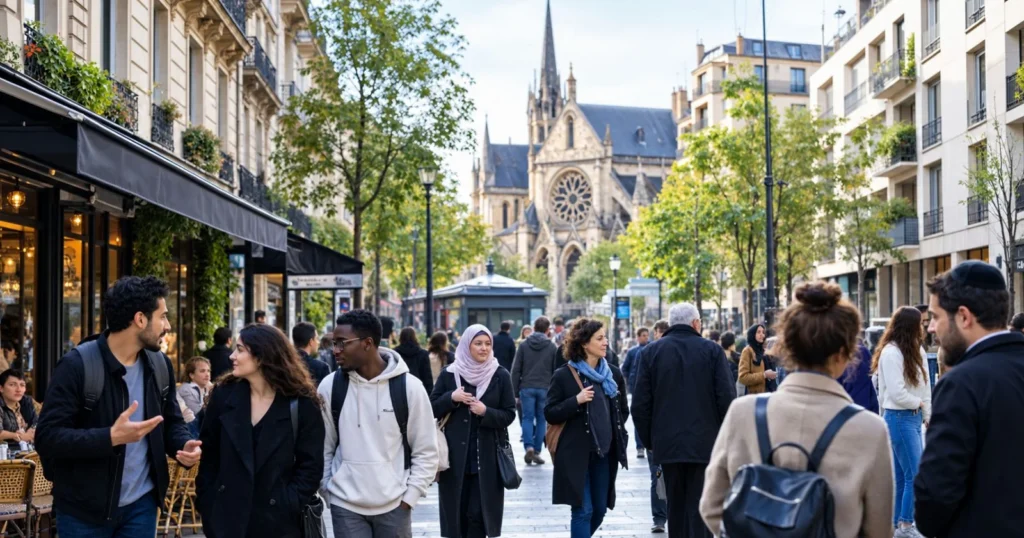
France’s religious demographics are changing as Catholic identification declines, the number of people reporting no religious affiliation grows, and Islam remains the country’s second largest religious tradition. These changes are reshaping discussions about identity, immigration, religious freedom and laïcité, the French principle governing the relationship between religion and the state.
The most important national evidence comes from the Trajectoires et Origines 2 survey, conducted by the National Institute of Statistics and Economic Studies (INSEE) and the National Institute for Demographic Studies (INED) between 2019 and 2020. Among people aged 18 to 59 living in metropolitan France, 51% reported having no religion, 29% identified as Catholic, 10% identified as Muslim and 9% reported another Christian affiliation. The findings were published in 2023 and remain a valuable reference point, but they should not be presented as a direct measurement of religious affiliation in 2026.
The country’s religious landscape cannot be understood through affiliation alone. Some people identify with a religious tradition without regularly attending services, while others practise a faith without describing themselves as strongly religious. Immigration histories, family upbringing, generational change and personal beliefs also influence how religion is transmitted.
These distinctions are especially important in France, where religious affiliation is not routinely recorded in the national census. Understanding the country’s changing religious composition therefore requires survey evidence, careful interpretation and a clear distinction between demographic findings and political debate.
What Do the Latest Statistics Reveal About Religion in France?
How Many People in France Identify With a Religion?
France does not publish a single, continuously updated official count of residents by religion. Instead, researchers use nationally relevant surveys to examine religious affiliation, practice and belief.
One of the most useful sources is the 2019 to 2020 Trajectoires et Origines 2 survey, conducted jointly by INSEE and INED. Its research examines religious identification alongside migration histories, family background, social integration and differences between generations.
The survey interviewed more than 27,000 people aged 18 to 59 living in metropolitan France. Its collection period ran from July 2019 to November 2020, with fieldwork interrupted during the COVID 19 pandemic and subsequently resumed under adapted procedures.
The study included people without a migration background, immigrants, descendants of immigrants and other groups relevant to understanding France’s population diversity. Its sampling design allowed researchers to examine religious identification across groups that are not always adequately represented in smaller general population surveys.
The study found that 51% of respondents reported no religious affiliation. Catholicism remained the largest individual religious tradition, at 29%, while Islam accounted for 10% and other Christian traditions accounted for 9%.
These results describe adults aged 18 to 59 in metropolitan France during the survey period. They do not cover every age group or every French territory, and they should not be treated as a precise estimate of the religious composition of the entire population in 2026.
What Percentage of France Identifies as Christian, Muslim or Nonreligious?
The 2019 to 2020 survey provides a consistent basis for comparing the main religious categories within its defined population.
| Religious affiliation | Share of adults aged 18 to 59 | Survey period |
|---|---|---|
| No religious affiliation | 51% | 2019 to 2020 |
| Catholic | 29% | 2019 to 2020 |
| Muslim | 10% | 2019 to 2020 |
| Other Christian affiliation | 9% | 2019 to 2020 |
Source: INSEE, Religious Diversity in France.
The percentages are rounded and should be interpreted within the survey’s population and classification system. The table does not provide a separate reliable estimate for every religious minority.
Catholicism remains the largest named religious affiliation, but the proportion of people who report no religion exceeds the proportion identifying as Catholic in this survey. This is a significant feature of France’s contemporary religious landscape.
The category of other Christians includes traditions beyond Catholicism. It should not be interpreted as a precise estimate of Protestantism alone. Similarly, the available figures do not support assigning a separate, definitive national percentage to Jewish, Buddhist, Hindu or other religious communities using the same table.
This distinction matters because a survey can identify a large overall category while containing too few respondents in a smaller group to support a precise estimate.
Why France Does Not Have a Conventional Religious Census
France’s national census does not routinely ask residents to declare their religious affiliation. This reflects the country’s statistical practices, its emphasis on individual privacy and its legal tradition concerning religion and the state.
The absence of a religious census does not mean that religious diversity cannot be studied. INSEE, INED and other research organisations collect information through surveys designed to examine beliefs, affiliation, religious practice and social background.
However, the results depend on the question asked. A question about current religious affiliation produces a different result from one asking about childhood upbringing, belief in God or attendance at religious services.
Privacy and statistical quality also matter. Religious identity is sensitive personal information, and survey participation, nonresponse and the way questions are worded can affect the estimates.
The Trajectoires et Origines 2 survey is particularly valuable because it combines religious information with demographic and social variables. Nevertheless, its age range and geographic coverage must remain clear whenever its findings are cited.
Track Real-time Population Growth @ FRANCE POPULATION CLOCK
Is France Becoming More Secular?
The Decline of Catholic Identification Across Generations
The decline of Catholic identification is one of the most significant long term changes in France’s religious demographics.
Catholicism historically occupied a central position in French education, family life, local communities and public culture. Over several generations, however, religious affiliation has become less widespread, while nonreligious identities have become more common.
The 2019 to 2020 survey provides evidence of this transformation. Catholicism accounted for 29% of adults aged 18 to 59, while more than half reported no religion.
The pattern also appears in the transmission of religious identity between generations. Among respondents raised in Catholic families, 67% continued to identify as Catholic in adulthood. The equivalent figure was 69% among those raised in other Christian traditions.
These findings indicate that childhood religious upbringing remains influential but does not determine an individual’s adult identity. Some people retain their family’s religious affiliation, others adopt another tradition, and others move away from religious identification altogether.
Catholic identification should not be confused with Catholic practice. Someone may identify culturally with Catholicism, participate in major family ceremonies or celebrate religious holidays without regularly attending Mass.
Conversely, a person may continue to practise privately without frequent participation in institutional religious life.
The decline in affiliation therefore reflects a wider transformation in the relationship between religion, family traditions and personal identity.
Younger Adults and Religious Nonaffiliation
Generational differences are central to understanding secularization in France.
Younger adults have generally grown up in a society where religious identification is less socially dominant than it was for earlier generations. Religious participation is increasingly a matter of personal choice rather than an automatic continuation of family tradition.
The INSEE and INED survey found substantial differences in religious identification according to migration background and family upbringing. Among people without a migration background, 58% reported no religion. The figure was 19% among immigrants who arrived after age 16 and 26% among descendants of two immigrant parents.
These figures are not direct comparisons between young and old age groups. They demonstrate that religious affiliation differs significantly across social and family backgrounds, which must be considered alongside age when interpreting generational change.
Religious nonaffiliation also includes people with different beliefs and practices. Some identify as atheist, others as agnostic, and some believe in a spiritual dimension without belonging to an organised religion.
Others may be indifferent to religious questions rather than actively opposed to religion.
Treating all nonreligious people as a single ideological group would therefore misrepresent the population. The category describes the absence of a declared religious affiliation, not a uniform set of personal convictions.
Religious Practice Versus Religious Identity
Religious affiliation, personal belief and participation in worship are different measures. Combining them can produce misleading conclusions.
The 2019 to 2020 survey found that only 8% of Catholics regularly attended a place of worship. The corresponding proportions were a little over 20% among Muslims, other Christians and Buddhists, and 34% among Jewish respondents.
These figures show that religious affiliation does not automatically imply regular attendance. They also demonstrate why practice should be measured separately for each tradition.
| Measure | What it captures | What it does not establish |
|---|---|---|
| Religious affiliation | The religion a person identifies with | Frequency of worship or strength of belief |
| Religious upbringing | The religious tradition in which a person was raised | Current adult affiliation |
| Worship attendance | Participation in organised religious services | All forms of private religious practice |
| Prayer | A form of personal religious practice | Formal affiliation or institutional membership |
| Personal belief | Individual convictions about God, spirituality or religion | Whether someone participates in a religious community |
These distinctions are important when interpreting claims about secularization. A decline in religious affiliation may occur alongside continued private belief, while declining attendance may reflect changes in how people practise their religion rather than a complete loss of religious identity.
A reliable assessment of secularization therefore requires multiple indicators rather than a single headline percentage.
How Is Islam Shaping France’s Religious Landscape?
Estimates of the Muslim Population in France
Islam is the second largest religious affiliation in the 2019 to 2020 INSEE and INED survey, accounting for 10% of adults aged 18 to 59 in metropolitan France.
This estimate is based on respondents’ declared religious affiliation. It is not calculated by counting residents born in Muslim majority countries or by assigning a religion according to nationality or ancestry.
The distinction is essential because people from the same country or family background may hold different religious beliefs. Some identify as Muslim, others follow another religion, and others report no religious affiliation.
The size of the Muslim population is also frequently discussed in political debate, but estimates should always be accompanied by the survey year, age range, geographic coverage and definition of religious identity.
A useful complementary source is the Pew Research Center’s February 2026 report on global religious diversity. Its comparative estimates classify France as having a Christian population of 46%, a religiously unaffiliated population of 43% and a Muslim population of 9%.
These figures should not be combined directly with the INSEE and INED results. The surveys use different methodologies, population definitions and estimation approaches. Their value lies in illustrating the broader religious composition rather than producing a single interchangeable set of percentages.
Generational Differences in Muslim Identity and Religious Practice
Religious identification among Muslims in France is influenced by family background, upbringing, migration history and personal decisions.
The 2019 to 2020 survey found that 91% of respondents raised in Muslim families continued to identify as Muslim. This was higher than the equivalent transmission rates reported for Catholic and other Christian families.
The result suggests that religious transmission can remain strong across generations, although it does not mean that every person who identifies as Muslim practises the religion in the same way.
Religious practice varies according to individual circumstances, including age, family life, personal belief and the importance attached to religious observance.
A person’s Muslim identity does not automatically establish how often that person prays, attends a mosque or observes religious practices. Those questions require separate evidence.
Similarly, differences between age groups should not automatically be interpreted as evidence of either increasing or declining religiosity. Researchers need comparable measures across generations to determine whether changes reflect age, social circumstances or broader historical developments.
Immigration, Family Background and Religious Transmission
Migration has contributed to France’s religious diversity, but its influence is more complex than a direct relationship between immigration and religious affiliation.
France has longstanding migration links with North Africa, sub Saharan Africa, southern Europe, Turkey and other regions. These histories have contributed to the country’s diverse religious communities.
However, immigrants are not religiously uniform. The religious traditions represented among migrants depend on their individual backgrounds, and many immigrants identify as nonreligious.
The survey found that 19% of immigrants who arrived after age 16 reported no religion. Among descendants of two immigrant parents, the figure was 26%. It was 58% among people without a migration background.
These differences demonstrate that migration background and religion are related in complex ways, but they are not interchangeable characteristics.
Family transmission can also change over time. Children may retain the religion of their parents, adopt a different tradition or become nonreligious. Mixed religious households can introduce additional influences, particularly where parents follow different traditions or one parent has no religious affiliation.
France’s future religious composition will therefore depend on more than migration flows. It will also depend on religious transmission, personal choices and the extent to which later generations retain or change their family affiliations.
What Do the Data Show About Protestantism, Judaism and Other Religions?
Protestant Communities and Religious Diversity
Protestantism is part of France’s broader Christian landscape, alongside Catholicism and other Christian traditions.
The 2019 to 2020 survey reported that 9% of adults aged 18 to 59 identified with a Christian tradition other than Catholicism. This category includes multiple traditions and should not be treated as a precise Protestant population estimate.
France has Protestant communities with different histories, institutions and patterns of worship. These include established Protestant churches and evangelical communities, among others.
The country’s religious diversity also includes Orthodox Christians and other Christian traditions connected to different historical and migration backgrounds.
The available national figures provide evidence of diversity beyond Catholicism, but more detailed surveys are required to distinguish the size, practice and demographic characteristics of individual Christian communities.
Jewish Identification and the Limitations of Population Estimates
Jewish identity illustrates the difficulty of measuring religious affiliation in France.
Jewish identity can refer to religious belief, religious practice, family heritage or cultural belonging. Some people identify as Jewish and practise Judaism, while others describe themselves as Jewish primarily through ancestry or culture.
These distinctions complicate estimates based on a single question about religion.
The 2019 to 2020 survey reported that 34% of Jewish respondents regularly attended a place of worship. This was higher than the reported attendance rate among Catholics and the other groups highlighted in the same study.
However, the finding concerns practice among respondents who identified as Jewish. It should not be interpreted as a count of every person in France with Jewish ancestry or cultural identity.
Jewish communities also face particular concerns related to antisemitism, religious freedom and the protection of communal institutions. These issues influence public debate but should be examined using separate evidence on discrimination, security and social conditions rather than inferred from population estimates.
Other Religions and Religiously Mixed Households
France also includes Buddhist, Hindu, Sikh and other religious communities, as well as people who identify with spiritual traditions outside established religious institutions.
The size and characteristics of these groups are more difficult to estimate precisely because national surveys may include relatively few respondents from smaller communities.
The INSEE and INED study found that a little over 20% of Buddhist respondents regularly attended a place of worship. This provides information about practice within the survey, but it does not establish the total number of Buddhists in France.
Religiously mixed households are another important part of the country’s changing social landscape. Partners may follow different faiths, share a cultural religious background without practising, or raise children without a formal religious affiliation.
These households can influence how religious identity is transmitted between generations. The resulting patterns are not uniform: some children retain a parent’s religion, while others develop a different identity or report no religion.
A comprehensive account of French religious demographics must therefore consider both formal affiliation and the diversity of family experiences behind the statistics.
Why Is Laïcité Central to Debates About Religion in France?
The Legal and Historical Foundations of French Secularism
Laïcité is a foundational principle of the French Republic. It concerns the neutrality of public institutions, freedom of conscience and the conditions under which religious practice can be exercised.
The 1905 law separating religious institutions and the state remains a central legal foundation. Article 1 guarantees freedom of conscience and the free exercise of religion, subject to restrictions necessary for public order. Article 2 states that the Republic does not recognise, pay or subsidise any religion, subject to provisions and legal arrangements established under the law.
Laïcité is not simply a declaration that religion should disappear from public life. It establishes a framework for state neutrality and religious freedom, while allowing laws to regulate particular circumstances.
France’s constitutional framework also recognises the secular character of the Republic. The principle is intended to ensure that citizens can believe, not believe, change religion and practise their faith within the law.
There are important territorial qualifications. The 1905 law does not apply in the same way in Alsace Moselle, where elements of a different historical religious framework remain in force. Specific arrangements also apply in certain overseas territories.
These exceptions demonstrate why French secularism should be understood through its legal history rather than reduced to a single rule applied identically in every setting.
Religious Expression in Schools and Public Institutions
Public schools are an important area of laïcité policy.
The law of March 15, 2004, prohibits pupils from wearing signs or clothing that conspicuously manifest religious affiliation in public primary and secondary schools. The rule applies across religions and is not limited to one faith.
The law does not establish a blanket prohibition on all religious symbols in every public space. Its scope concerns pupils in public schools covered by the legislation.
Public officials and civil servants are subject to neutrality obligations when carrying out their duties. Other settings, including universities, private workplaces and public spaces, have different legal frameworks.
This distinction is important because the legal position of a pupil in a public secondary school is not identical to that of an adult in a university or an ordinary citizen in a public street.
Debates about religious clothing, school activities and public institutions frequently involve competing interpretations of equality, freedom of religion and institutional neutrality. Accurate reporting requires identifying the applicable law and distinguishing binding legal rules from political proposals or public opinion.
Religious Freedom, Public Policy and Social Debate
Laïcité remains a recurring subject of political and social debate in France.
Supporters of stricter approaches often argue that clear boundaries protect institutional neutrality and ensure that public services operate without religious pressure. Critics of some restrictions argue that particular measures can disproportionately affect religious minorities or limit individual expression.
These positions should be attributed to the individuals, organisations or institutions advancing them. They are interpretations of how the principle should be applied, not substitutes for the legal framework itself.
The distinction between state neutrality and individual religious freedom is particularly important. French law establishes obligations for public institutions and public employees, but the rules applicable to ordinary citizens vary by setting.
Public policy disputes should therefore be evaluated against the text of the relevant legislation, applicable court decisions and the specific circumstances of each case.
Religious demographics can help explain why these questions receive attention, but population statistics alone cannot establish whether a particular legal restriction is justified or how it affects individual rights.
How Could France’s Religious Composition Change by 2050?
Projecting religious affiliation is more difficult than projecting the total population because religious identity is not routinely recorded in the census and can change during a person’s lifetime.
Population projections generally rely on demographic assumptions about fertility, mortality and migration. Religious projections require additional assumptions about the religious identification of migrants, the transmission of religion between parents and children, disaffiliation and conversion.
The available evidence suggests that France’s religious composition will continue to be influenced by two broad processes.
First, the long term decline in Catholic identification and the growth of nonreligious identification indicate that secularization remains an important force. The extent of future change will depend on whether younger generations maintain the patterns observed in earlier surveys.
Second, France’s religious diversity is shaped by migration histories and family transmission. The continued presence of Muslim, Protestant, Jewish and other communities will depend on a combination of migration, age structure, family formation and changes in personal identification.
Neither process can be translated into a reliable 2050 percentage without a transparent model and clearly stated assumptions.
| Factor | Potential influence by 2050 | Main uncertainty |
|---|---|---|
| Religious disaffiliation | Could increase the share reporting no religion | Whether historical trends continue at the same pace |
| Family transmission | Could maintain or change existing religious affiliations | Differences between generations and households |
| Immigration and emigration | Could alter the size and age structure of religious communities | Future migration levels and the affiliations of migrants |
| Fertility differences | Could affect the age structure of religious groups | Whether observed differences persist over time |
| Conversion and changing beliefs | Could change individual affiliation | Limited comparable long term data |
These factors should be evaluated together. A projection based only on fertility differences would overlook changes in religious identification, while a model based only on migration would fail to account for the behaviour of people already living in France.
Monitoring future change will require repeated surveys using comparable questions, transparent methodology and sufficient samples to study smaller religious communities.
What Do France’s Religious Demographics Mean for the Future?
France’s religious landscape is becoming less dominated by inherited Catholic affiliation and more diverse in the ways people identify, believe and practise religion. The 2019 to 2020 INSEE and INED survey provides strong evidence of the scale of nonaffiliation among adults aged 18 to 59, while also documenting the continued presence of Catholicism, Islam and other Christian traditions.
The figures do not establish a definitive religious breakdown for 2026. They remain historical survey findings that must be interpreted within their original population and methodology.
The wider picture is clear: religious identity in France cannot be reduced to a single percentage. Affiliation, belief, attendance and family background measure different aspects of religion, and each contributes to a more complete understanding of social change.
Laïcité will remain central to how France manages the relationship between public institutions, individual freedoms and religious diversity. Its application requires careful attention to legal context, including the differences between public schools, other institutions and ordinary public spaces.
By 2050, France’s religious composition will depend on the interaction of secularization, family transmission, migration and personal choices. Reliable projections will require better comparable data rather than assumptions based on ancestry or political debate.
The most informative approach is therefore to examine religious identity as a changing social characteristic, distinguish measured evidence from speculation and recognise the diversity of beliefs and practices within every major religious category.
Recommended Articles Related to France Population & Policy:
- France’s Immigration Challenges and Future
- Can France Reverse Its Population Decline?
- France’s Growing Ageing Population
- Immigration’s Role in France’s Population Growth
- How Second Generation Immigrants Are Shaping France
- France’s Regional Population Winners and Losers
- How Demographics Are Reshaping France’s Elections
- France’s Pension Crisis: Fewer Workers, More Retirees
- France’s Religious Diversity and the Future of Laïcité
- Why French Households Are Getting Smaller
- Why Are Fewer French Families Having Children?
- Migrants in France Today: The Numbers Behind the Headlines