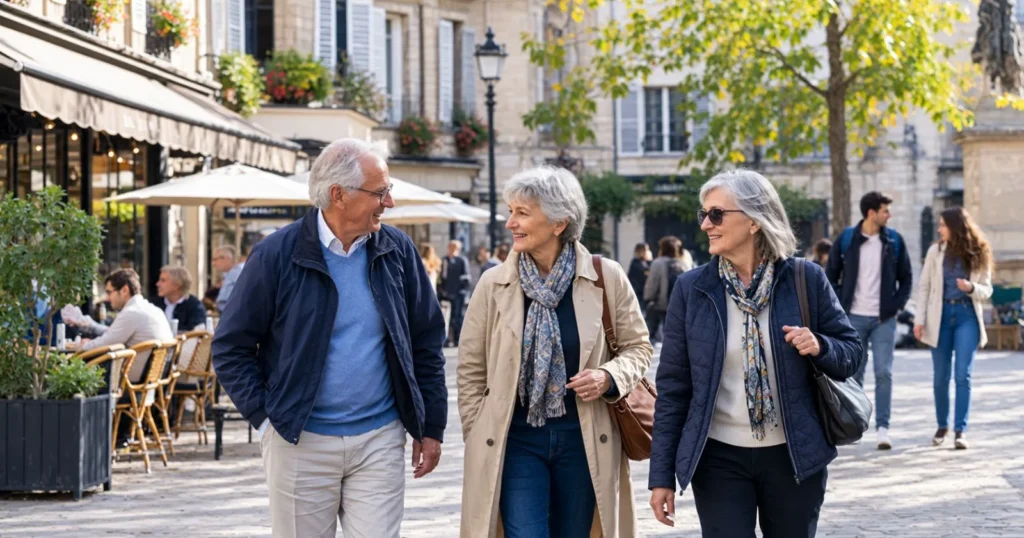
France’s population is ageing at a decisive pace. On 1 January 2026 the country counted 69.1 million residents. Roughly 22.2% of them, about 15.3 million people, were aged 65 or older, almost equal to the share of residents under 20. This shift, driven by longer lives, fewer births and the retirement of large postwar cohorts, is already reshaping healthcare demand, housing needs, labour markets and public finances. New INSEE projections published in June 2026 confirm the trend will intensify through the middle of the century.
How old is France’s population today?
The share of French residents aged 65 and older
According to INSEE’s provisional estimates for 1 January 2026, people aged 65 and over make up 22.2% of the total population. The detailed age distribution shows:
| Age group | Number (thousands) | Share of population |
|---|---|---|
| Under 15 | 11,228 | 16.3% |
| 15–19 | 4,300 | 6.2% |
| 20–64 | ≈38,200 | ≈55% |
| 65–69 | 3,992 | 5.8% |
| 70–74 | 3,661 | 5.3% |
| 75 and over | 7,686 | 11.1% |
| Total | 69,082 | 100% |
The number of people aged 65 and over has risen steadily for decades. In 2011 the share stood near 16.7%. By 2026 it has climbed more than five percentage points. Women form a clear majority of the older population because of higher female life expectancy.
How many people in France are aged 80 and older?
The oldest groups are expanding fastest. INSEE data place the population aged 80 and over at roughly 4.3 million in early 2026, about 6.3% of the total. Within this group, women heavily outnumber men. The 75-and-over cohort alone exceeds 7.6 million. These ages drive the bulk of long-term care needs. Rates of severe dependency rise sharply after 80 and especially after 85.
Is France ageing faster than other European countries?
France sits in the middle of the European spectrum. Eurostat data for 2025 show the EU average share of people aged 65 and over at about 21.6 to 22%. Italy (around 24.7 to 25%), Portugal and Bulgaria record higher shares. Ireland, Luxembourg and Cyprus remain younger. Germany’s share is higher than France’s, while Spain’s is comparable or slightly lower. France’s relatively higher fertility in past decades slowed its ageing relative to southern Europe, but the gap is closing as French birth rates fall.
Median age in France continues to rise and is expected to keep doing so under all projection scenarios.
Why is France’s population getting older?
Falling fertility and smaller younger generations
France’s total fertility rate fell to 1.56 children per woman in 2025, the lowest level since the end of the First World War and well below the 2.1 replacement threshold. Births numbered only 645,000 that year, 24% fewer than in 2010. Smaller cohorts of children and young adults gradually reduce the base of the population pyramid. In 2025 the natural balance (births minus deaths) turned negative for the first time since the end of the Second World War, a historic demographic milestone.
Longer life expectancy and survival into older age
Life expectancy at birth reached 85.9 years for women and 80.3 years for men in 2025. Gains have resumed after the temporary setbacks of the COVID-19 period. At age 65, women can expect roughly 23.6 more years and men about 20 years. These improvements mean more people survive into their 80s and 90s, swelling the oldest age groups even if fertility stabilises.
The retirement of large generations
The postwar baby-boom cohorts (born roughly 1946 to 1965) are now fully in or approaching retirement. Their sheer size, combined with longer survival, produces a rapid rise in the number of retirees relative to workers. Subsequent generations are smaller, so the imbalance persists.
Can migration slow population ageing?
Net migration has kept overall population growth positive despite the negative natural balance. Immigrants are typically younger than the resident population on arrival and therefore temporarily boost the working-age share. Over time, however, migrants themselves age. INSEE’s central projection assumes continued net inflows. Even so, the population still ages markedly. Lower migration assumptions produce faster ageing and earlier population decline.
What does population ageing mean for healthcare?
Demand for hospitals and medical services
Older adults account for a disproportionate share of healthcare use. People with long-term conditions (affections de longue durée), 15 million individuals in 2025 or 22% of insured persons, generate 67% of reimbursable health expenditure. Ageing and the rise in chronic disease have driven a 72% increase in the cost of this scheme over ten years, reaching €19.7 billion in 2025. Regional disparities in access to specialists and hospital capacity are already visible and will intensify where older populations are concentrated.
Long-term care and care worker shortages
DREES projections indicate that the number of older people needing help with daily activities will rise by roughly 700,000 to 740,000 between the early 2020s and 2050 under intermediate assumptions about healthy ageing. Dependent seniors could reach 2.6 to 3 million by mid-century. Demand for both residential places (EHPADs) and home-care services will grow. Staffing needs could require 150,000 to 200,000 additional care workers by 2050, depending on the balance between institutional and home-based support. Recruitment and retention of care staff remain chronic challenges.
Dementia, disability, and healthy life expectancy
Not all extra years of life are spent in good health. Disability-free life expectancy at age 65 stood at 11.8 years for women and 10.5 years for men in 2024 (DREES). France performs better than the EU average on this indicator, yet the absolute number of people living with severe limitations, including dementia, will still increase because of the larger older population. The gap between total life expectancy and healthy life expectancy underscores the need for prevention, adapted housing and community support.
Track Real-time Population Growth @ FRANCE POPULATION CLOCK
How is ageing changing French households and housing?
Older adults living alone
Single-person households are increasingly common among older adults, especially women after widowhood. Isolation raises risks of delayed care, depression and emergency hospital admissions. Community services, local social centres and digital inclusion programmes have grown in response, but coverage remains uneven.
Accessible homes and age-friendly communities
Most older people prefer to remain at home. This requires adaptations such as single-level living, grab rails, accessible bathrooms, and proximity to shops, transport and medical services. Public programmes subsidise some modifications, yet the stock of suitable housing lags demand, particularly in rural areas and older urban neighbourhoods.
Rural areas versus major cities
Ageing is more pronounced in rural and certain southern or central departments (for example Allier, Creuse, Cantal and parts of Nouvelle-Aquitaine and Occitanie). These areas often combine higher shares of older residents with thinner healthcare networks and fewer care facilities. Major cities and Île-de-France remain younger on average, thanks to migration and higher birth rates, but face their own pressures from dense demand for specialised geriatric services.
Can France maintain a productive workforce as its population ages?
The working-age population and dependency ratios
The old-age dependency ratio (people aged 65 and over per 100 people aged 20 to 64) stood near 40 in 2026. Under INSEE’s central scenario it rises to about 49 by 2040 and 62 by 2070. This does not mean each worker will support exactly that many retirees. Employment rates, productivity and the age of actual retirement all matter. Still, the direction of change is clear: fewer potential workers relative to retirees.
Employment among people approaching retirement
The employment rate of people aged 55 to 64 reached a record 61.7% in 2025 (Dares/Eurostat), up more than 30 percentage points since 2000. Progress has been strongest among those aged 60 to 64 following successive pension reforms that raised the legal retirement age and contribution periods. France still trails the EU average (around 66%), mainly because of lower employment after age 60. Barriers include health limitations, age discrimination and limited opportunities for part-time or flexible work late in careers.
How automation, productivity, and migration affect the outlook
Higher productivity, later retirement and continued migration can offset some of the decline in the working-age population. Automation and digital tools may reduce labour needs in certain sectors, while care and personal services will still require large numbers of workers. Migration helps in the short term but does not permanently reverse ageing. Real outcomes will depend on policy choices around skills, lifelong learning and labour-force participation.
How old could France’s population become by 2050 and 2070?
INSEE’s June 2026 central projections paint a clear picture:
- Total population rises modestly to a peak of 69.8 million around 2037, then declines to 65.9 million by 2070.
- The number of people aged 65 and over climbs from 15.3 million in 2026 to roughly 21.1 million in 2070 (about 32% of the population).
- Those aged 80 and over more than double, reaching around 9 million. The number of centenarians could quadruple.
- The under-20 share falls from 22.5% to 16.3%.
- The old-age dependency ratio moves from 40 to 62 per 100 people of working age.
Alternative scenarios with lower fertility or weaker migration produce faster decline and more pronounced ageing. Higher migration or fertility softens but does not reverse the trend. Ageing itself is virtually certain under any plausible set of assumptions.
Ageing timeline (central scenario, share aged 65 and over)
- 2026: 22%
- 2040: ≈28 to 29%
- 2050: ≈30%
- 2070: ≈32%
These changes will place sustained pressure on the pension system, healthcare budgets and the care workforce. At the same time they create demand for age-friendly products, services and housing, economic opportunities that France is only beginning to develop systematically.
Recent social tensions, including the large cost-of-living and education protests of October 2026, unfold against this demographic backdrop. An older population with higher dependency ratios intensifies competition for public resources and heightens sensitivity to living standards among both workers and retirees.
France’s ageing is not a sudden crisis but a long, structural transformation that began decades ago and will continue for decades more. The quality of the policy response on fertility support, healthy ageing, labour-force participation, care organisation and productive immigration will determine whether the country adapts successfully or faces mounting fiscal and social strain.
Recommended Articles Related to France Population & Policy:
- France’s Immigration Challenges and Future
- How Religion Is Changing in France
- Can France Reverse Its Population Decline?
- Immigration’s Role in France’s Population Growth
- How Second Generation Immigrants Are Shaping France
- France’s Regional Population Winners and Losers
- How Demographics Are Reshaping France’s Elections
- France’s Pension Crisis: Fewer Workers, More Retirees
- France’s Religious Diversity and the Future of Laïcité
- Why French Households Are Getting Smaller
- Why Are Fewer French Families Having Children?
- Migrants in France Today: The Numbers Behind the Headlines
FAQs
1. What percentage of France’s population is over 65?
Approximately 22.2% on 1 January 2026 (about 15.3 million people).
2. How many people over 80 live in France?
Around 4.3 million in early 2026 (roughly 6.3% of the population).
3. Why is France’s population ageing?
A combination of falling fertility (1.56 children per woman in 2025), rising life expectancy, and the retirement of the large baby-boom generations.
4. Which parts of France have the oldest populations?
Many rural departments in central and south-western France (e.g., Allier, Creuse, Cantal) and certain southern regions show the highest shares of older residents.
5. Will France have enough healthcare workers for its ageing population?
Current projections point to a need for 150,000 to 200,000 additional care workers by 2050. Shortages are already evident and are expected to grow without stronger recruitment and retention measures.
6. How will ageing affect France’s economy?
Higher public spending on pensions and healthcare, potential labour shortages in some sectors, and opportunities in the “silver economy” (products and services for older adults). Productivity growth and higher employment rates among older workers will be critical offsets.
7. What is the projected elderly population of France in 2050?
Under the central scenario the number of people aged 65 and over will be substantially higher than today, approaching or exceeding 20 million, with the share of the total population near 30%. The exact figure depends on future fertility, mortality and migration.
Primary sources
- INSEE population estimates and 2026 projections (Bilan démographique 2025 Projections de population 2026)
- Eurostat ageing indicators
- DREES reports on healthy life expectancy, long-term care and health expenditure
- OECD and Dares labour-market statistics