
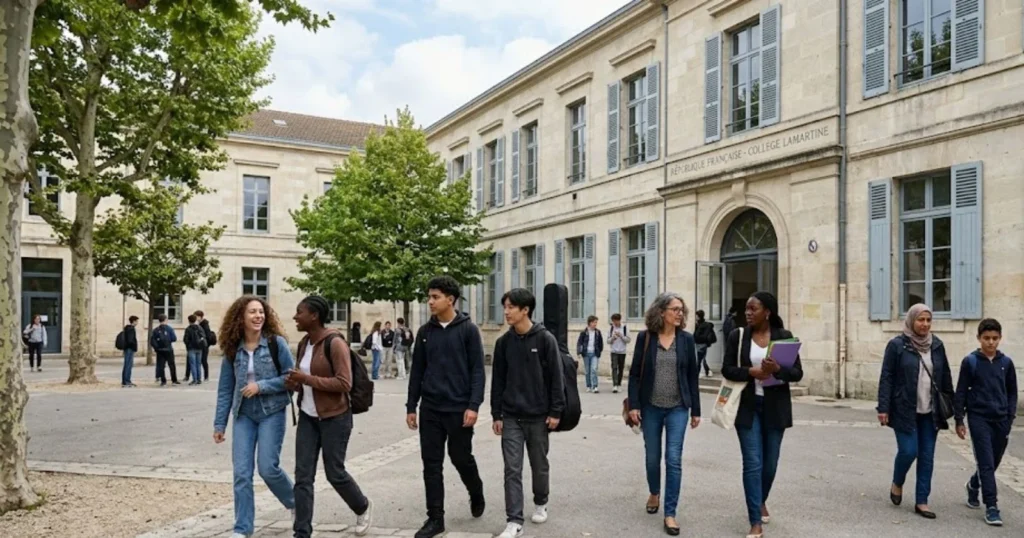
France has no official count of its religious groups, yet several large surveys allow a reasonably clear picture. People reporting no religion make up roughly 4 in 10 residents aged 15 and over, and a slim majority of working-age adults in the INED and INSEE survey. Catholicism remains the largest declared religion, Islam is second, and religious practice sits far below religious affiliation for most groups.
The timing matters. On October 17 and 18, 2026, cost-of-living protests turned into some of the most violent unrest France has seen in years. Officials and major outlets did not describe it as religious. It came after a year in which the Interior Ministry recorded nearly 2,500 anti-religious acts, so this article reports both and keeps them separate.
What do the latest statistics reveal about religion in France?
How many people in France identify with a religion?
No single source covers every age group, territory and definition of religion. Two surveys carry most of the weight in 2026.
The first is Trajectoires et Origines 2 (TeO2), produced by INED and INSEE. Fieldwork took place in 2019 and 2020 among about 27,200 people aged 18 to 59 living in ordinary housing in metropolitan France. Respondents were asked “Do you have a religion today?” and then, without a list, which one. The wording follows the European Social Survey, answers on religion were optional, and 1% declined. Immigrants, overseas natives and their children are over-represented, with weights restoring a representative picture. Result: 51% reported no religion, so 49% reported one.
The second is an Ifop survey completed in 2025 among 14,244 people aged 15 and over in metropolitan France, weighted to INSEE’s 2022 population data and conducted for the journal Écran de veille. About 37.5% reported no religion and 3% did not answer, which leaves roughly 59.5% reporting a religion. Its Muslim subsample of 1,005 people was interviewed by telephone between August 8 and September 2, 2025.
Neither survey is a 2026 measurement. TeO2 is six years old, excludes people aged 60 and over, and neither covers the 2.3 million residents of overseas departments (INSEE, January 2026).
What percentage of France identifies as Christian, Muslim, or nonreligious?
Each column below has its own denominator, so the table shows three separate pictures, not one time series.
Religious affiliation in France by survey
| Group | TeO2 (2019 to 2020, ages 18 to 59) | Ifop (2025, ages 15 and over) | Pew Research (2020, all ages, modeled) |
|---|---|---|---|
| No religion | 51% | 37.5% | 42.6% |
| Catholic | 29% | 43% | Christian total 46.5% |
| Other Christian | 9% | 4% Protestant or evangelical, 1% Orthodox | Included in Christian total |
| Muslim | 10% | About 7% (6.9%) | 9.1% |
| Jewish | 0.5% (ages 18 to 49) | 1% | 0.7% |
| Buddhist | 0.5% (ages 18 to 49) | 1% | 0.7% |
| Other religion | Within a 10% “other religions” total | 2.5% | 0.4% |
Sources: INED and INSEE, TeO2 (Insee Références, 2023); Ifop, 2025 survey for Écran de veille; Pew Research Center, 2025 report on global religious change. Category definitions differ by source.
Adding the Christian rows gives about 38% for TeO2, 48% for Ifop and 46.5% for Pew. Pew found that France lost its Christian majority between 2010 and 2020, when Christians fell from 57.1% to 46.5% and the unaffiliated rose from 34.5% to 42.6%.
The gap between TeO2 and Ifop for Catholics (29% against 43%) does not mean one survey is wrong: Catholic identification is more common among people over 59, whom Ifop includes and TeO2 excludes. The gap for Muslims (10% against about 7%) reflects different age ranges, question sets and methods.
Why France does not have a conventional religious census
The census asked about religion until 1872, then dropped the question, except in concordat-era Alsace, where it continued until 1962. Data on religion are classed as “sensitive” under the 1978 law on information technology, files and freedoms. Processing is allowed for statistical or scientific purposes when the data protection authority, the CNIL, validates the purpose and the data are adequate and not excessive.
The evidence therefore comes from sample surveys, not administrative counts. A survey interviews thousands of people and extrapolates, which adds sampling error and wording effects, and answers change depending on whether a question asks about affiliation, upbringing, belief or practice.
Track Real-time Population Growth @ FRANCE POPULATION CLOCK
Is France becoming more secular?
The decline of Catholic identification across generations
The direction of change is consistent across sources, even if the size varies.
- TeO2 compared 18 to 49 year olds in 2008 and 2009 with the same age group in 2019 and 2020. The no religion share rose from 45% to 53%, and the Catholic share fell from 43% to 25%.
- Ifop’s long series puts the Catholic share at 83% in 1985 and 43% in 2025, with no religion rising from 13% to 37.5%. Its methods changed over the decades, so it shows direction better than precise change.
Three ideas need separating. Catholic background means being raised in a Catholic family. Catholic affiliation means saying “Catholic” today. Catholic observance means attending Mass or praying. TeO2 found that 67% of people raised in Catholic families still call themselves Catholic, while 31% report no religion.
A December 2025 Ifop survey for La Croix found 46% of adults identifying as Catholic and regular practitioners, meaning monthly Mass attendance, at 5.5% of adults, with about 6.3 million “engaged” Catholics (12% of adults). A shrinking group can become more concentrated and more committed.
France and selected European countries, religious composition in 2020 (Pew Research, modeled estimates)
| Country | Christian | Muslim | Religiously unaffiliated |
|---|---|---|---|
| France | 46.5% | 9.1% | 42.6% |
| Germany | 56.2% | 6.5% | 36.1% |
| United Kingdom | 49.4% | 6.4% | 40.2% |
| Belgium | 51.0% | 6.8% | 39.0% |
| Netherlands | 35.1% | 5.5% | 54.1% |
| Spain | 69.5% | 3.6% | 26.4% |
| Italy | 80.5% | 4.4% | 13.3% |
Source: Pew Research Center, 2025 report on global religious change from 2010 to 2020, Appendix B. Reference year 2020. Estimates combine censuses and surveys and are not directly comparable with TeO2 or Ifop.
Younger adults and religious nonaffiliation
Among people with no migration background, disaffiliation dominates. TeO2 found that 58% of 18 to 59 year olds with no migration background reported no religion, and 62% of those aged 18 to 49, up 12 points from 50% in 2008 and 2009. For people with a migration history the change was small: from 16% to 19% for immigrants who arrived after age 16, and unchanged at 23% for descendants of two immigrant parents.
Generational and group differences in affiliation and religious intensity
| Group | Affiliation | Practice or identity indicator | Source and year |
|---|---|---|---|
| Ages 18 to 49, 2008 and 2009 | 45% no religion, 43% Catholic | 7% cite religion as part of identity | TeO1 |
| Ages 18 to 49, 2019 and 2020 | 53% no religion, 25% Catholic | 7% cite religion as part of identity | TeO2 |
| No migration background, ages 18 to 59 | 58% no religion, 1% Muslim | 6% of Catholics with no migration background attend Mass regularly | TeO2 |
| Immigrants who arrived after age 16 | 19% no religion; 44% of all immigrants Muslim | 20% of Muslims attend a mosque regularly (all origins) | TeO2 |
| Descendants of two immigrant parents | 26% no religion, 48% Muslim | 17% of Muslim women descendants aged 18 to 49 wear a headscarf | TeO2 |
| Muslims under 25 | Not applicable | 67% pray daily, 40% attend Friday prayers | Ifop, 2025 |
Notes: the TeO2 chapter reviewed does not publish affiliation by single age band, so differences are shown by period and migration generation. Ifop figures for Muslims under 25 come from Ifop’s published analysis and French media coverage of it.
Nothing in these surveys shows that nonreligious people share the same beliefs. TeO2 measured affiliation, upbringing and practice, not belief in God, and it does not separate believers without a religion from convinced atheists. It does show that 60% of people with no religion grew up in homes where religion was not important at all.
Religious practice versus religious identity
Affiliation is only one of four measures. The others are practice, belief and the role of religion in identity.
Religious affiliation versus practice in France
| Measure | Definition | Survey result |
|---|---|---|
| Declared religion | Answers yes to “Do you have a religion today?” | 49% of people aged 18 to 59 (TeO2) |
| Regular attendance | Attends a place of worship at least monthly | Catholics 8%; Muslims, other Christians and Buddhists just over 20%; Jews 34% (TeO2) |
| Weekly prayer | Prays at least once a week | Catholics 15%; Muslims 58% (TeO2) |
| Never prays | Reports never praying | Catholics 44%; Muslims 21% (TeO2) |
| Religion important in life | Very or somewhat important | Catholics 27%; other Christians 39%; Muslims 76% (TeO2) |
| Religion in identity | Cites religion among up to four identity dimensions (ages 18 to 49) | Catholics 6%; Muslims 30%; Jews 54% (TeO2) |
| Strict fasting | Respects fasting periods strictly | Catholics 3%; other Christians 5%; Muslims 75% (TeO2) |
| Regular Catholic practice | Mass at least monthly | 5.5% of adults (Ifop for La Croix, 2025) |
For most self-identified Catholics, attendance is rare and religion is not a defining part of identity. For Muslims, mosque attendance is a weak indicator: it is not one of the five pillars of Islam and is far more common among men (30%) than women (10%), while women slightly more often say religion is important (78% against 73%).
How is Islam shaping religious life in France?
Estimates of the Muslim population in France
Published estimates differ because researchers count different things.
- TeO2 (2019 to 2020): 10% of people aged 18 to 59 in metropolitan France.
- Ifop (2025): 6.9% of people aged 15 and over, up from 4.2% in 2009 and 5.6% in 2016. A French religion news outlet converted that into roughly 3.9 million adults.
- Pew Research (2020): 9.1% of the total population, up from 6.6% in 2010. Its 2017 report estimated 5.7 million Muslims, or 8.8%, in 2016.
A figure of nine million appeared in a remark attributed to then-Prime Minister François Bayrou in coverage by Hyphen. No survey reviewed here reaches it, and Pew’s 9.1% corresponds to about 6 million people.
Ancestry is not affiliation. TeO2 found that 44% of immigrants and 48% of descendants of two immigrant parents are Muslim, so more than half are not. Among descendants of immigrants from mixed couples, 14% are Muslim, and among people with no migration background, 1%. Immigrants from the Maghreb, Turkey and Sahelian Africa report the highest affiliation, while those from Asia and from predominantly Christian European countries report less. Counting everyone from a Muslim-majority country as Muslim overstates the population and erases Christians, Jews, nonreligious people and others.
Ifop’s 2025 report drew scrutiny. Muslim worship councils in Loiret, Aube and Bouches-du-Rhône filed a complaint over a poll tied to Écran de veille, arguing it breached the 1977 polling law’s objectivity requirement, according to TRT World citing BFM TV. Ifop’s political research director, François Kraus, has described the findings as showing re-Islamization. They are best treated as one contested input, cited with their commissioning context.
Generational differences in Muslim identity and religious practice
Two datasets point in different directions, and both can be accurate because they measure different things.
TeO2 found that the share of Muslims citing religion as part of their identity fell from 33% to 30% between 2008 and 2009 and 2019 and 2020. Following age cohorts over eleven years, researchers found the decline in every cohort. The stronger identity of people under 30 in 2008 and 2009 was an age effect that reappeared in 2019 and 2020, not a lasting generational gap. Meanwhile, headscarf wearing among Muslim women aged 18 to 49 rose from 18% to 26%, driven mostly by immigrant women (22% to 36%) and more modestly by descendants (13% to 17%).
Ifop’s 2025 report found that 67% of Muslims under 25 pray daily, against 26% in 1989, and that 40% attend Friday prayers, against 7% in 1989. The sources cover different ages (18 to 59 against 15 and over) and were collected years apart, and higher observance among those who remain Muslim can coexist with a smaller share who rank religion first in their identity.
Immigration, family background, and religious transmission
Immigration brings diversity, but family transmission shapes it over decades. TeO2 found that 91% of people raised in Muslim families still follow their parents’ religion, against 84% for Jewish, 69% for other Christian and 67% for Catholic families. Transmission is higher in families from Turkey, the Middle East and Sahelian Africa (97%) than from the Maghreb (89%).
People who leave rarely switch. Most who did not keep their parents’ affiliation left religion altogether, and the exit rate reached 57% where parents had two different religions or one had none. Among descendants of immigrants raised in Muslim homes where religion was very important, the modeled probability of saying religion is very important in adult life was 70%, against 21% for comparable Catholic upbringing and 27% for mixed religious ancestry. The mechanism is family socialization, not ancestry.
What do the data show about Protestantism, Judaism, and other religions?
Protestant communities and religious diversity
Ifop puts Protestants and evangelicals together at about 4% of people aged 15 and over and Orthodox Christians at 1%. TeO2 shows a larger “other Christian” group (9% of 18 to 59 year olds), and INSEE notes that Protestant churches have grown among immigrants from Central Africa. Among overseas natives living in metropolitan France, 18% report another Christian affiliation. Just over 20% of non-Catholic Christians attend worship regularly, against 8% of Catholics.
Jewish identification and the limitations of population estimates
Estimates depend on definition. Ifop’s 1% and Pew’s 0.7% rest on self-identified religion. Sergio DellaPergola’s “core Jewish population” estimate, published through the Jewish Virtual Library, put France at 438,500 in 2024. The Institute for Jewish Policy Research publishes four versions: about 436,000 core, 494,860 with a Jewish parent, 553,720 in an enlarged definition that adds non-Jewish household members, and 612,580 under the Law of Return definition. None comes from a French census.
TeO2 recorded the strongest religious identity among Jews: 54% cite religion as part of their identity, 34% attend worship regularly and 84% of those raised in Jewish families remain Jewish. Small subsamples mean wider margins of error.
Other religions and religiously mixed households
Buddhists account for about 0.5% of 18 to 49 year olds in TeO2 and 1% in Ifop. Only 15% never pray, the lowest share of any group, yet only 32% pray weekly. The surveys do not report separate estimates for smaller groups such as Hindus or Sikhs. Mixed households push toward disaffiliation, since mixed or Catholic ancestry is a key factor in secularization among descendants of immigrants (TeO2).
Why is laïcité central to debates about religion in France?
The legal and historical foundations of French secularism
Article 1 of the 1958 Constitution declares France an indivisible, secular, democratic and social Republic. The foundation text is the law of December 9, 1905 on the separation of the Churches and the State. Its first article guarantees freedom of conscience and free exercise of worship, subject to public order. Its second says the Republic does not recognize, pay salaries for or subsidize any religion, with exceptions for chaplaincies in schools, hospitals, prisons and the military.
The 1905 law does not apply uniformly. Alsace and Moselle were German territory in 1905 and still operate under a concordat-era regime, which INSEE describes as outside the purview of the secularism law, and some overseas territories also have distinct arrangements.
Religious expression in schools and public institutions
- Public primary and secondary schools. A 2004 law bans signs and clothing through which pupils conspicuously show a religious affiliation. Commonly cited examples include the Muslim headscarf, the Jewish kippa, the Sikh turban and a large Christian cross.
- Public employees. Civil servants owe a duty of neutrality. A 2021 law on respecting the principles of the Republic extended neutrality obligations to private contractors performing public service missions.
- Public space. A 2010 law bans covering the face in public, which the European Court of Human Rights upheld in 2014 in S.A.S. v. France.
- Universities, private schools and the street. University students are adults and are not covered by the 2004 school ban, and private confessional schools, including those under contract with the state, operate under separate rules.
Religious freedom, public policy, and social debate
- Football and headscarves. On June 29, 2023, the Conseil d’État upheld the French Football Federation’s ban on wearing the hijab in competition.
- Sports bill. In February 2025 the Senate voted 210 to 81 for a bill banning conspicuous religious signs in competitions run by sports federations. Senator Michel Savin argued that neutrality protects sport from communitarian pressure, while Amnesty International and left-wing senators argued it discriminates against Muslim women. It still needed National Assembly approval, and no confirmation that it became law was found for this article.
- Muslim Brotherhood and entryism. On January 22, 2026, the National Assembly adopted a non-binding resolution, 157 to 101, urging the EU to list the Muslim Brotherhood as a terrorist organization. On May 5, 2026, the Senate adopted a bill on Islamist entryism by 208 votes to 124, and it moved to the National Assembly. Critics warn that vague definitions could cast suspicion on ordinary Muslim civic life. On October 8, 2026, the European Parliament adopted a non-binding resolution on entryism, 381 to 167 with 15 abstentions, stressing that criticism of an ideology must not be equated with an attack on a religion.
Supporters describe these measures as defending the Republic against political Islam, and critics such as Amnesty International say parts of them target Muslims.
What does the latest violence in France reveal about religion and social tension?
The October 2026 riots and why reporting does not frame them as religious
On Saturday, October 17, 2026, demonstrations over the cost of living and public services spread across France. Interior Minister Laurent Nuñez said 550,000 people marched, including 110,000 in Paris, while other reporting gave a range of 550,000 to 800,000. The marches grew out of student-led rallies a month earlier over crumbling schools, then widened to fuel prices and living costs, with comparisons to the Yellow Vest movement of 2018.
Most marchers were peaceful, but after nightfall masked groups attacked police, looted shops and set public buildings on fire in cities including Paris, Marseille, Lyon and Lille. Limoges’ 143-year-old city hall burned and its spire collapsed, and the prefect’s residence in Bordeaux was ransacked.
Numbers changed through the weekend. Prime Minister Sébastien Lecornu said late Saturday that about 1,200 people had been arrested and more than 150 officers injured. By Sunday, reports put detentions at 1,800 and injuries at more than 500 police officers, gendarmes and firefighters, according to Nuñez. One protester died north of Paris of what BFMTV, citing Paris police, described as cardiorespiratory arrest, and the police oversight body was investigating at least two dozen allegations of police violence.
Lecornu blamed “far-left groups,” and Nuñez blamed “extreme left” activists and “opportunistic” looters. The reporting reviewed here tied the unrest to prices, schools and public services, and none attributed it to religious motives. It matters for this topic because it shapes the climate in which religion, immigration and security debates will play out before next year’s presidential election.
Anti-religious acts recorded in 2025
The Interior Ministry released headline figures in February 2026 and a 2010 to 2025 overview in May. It warned that the figures probably understate reality because many victims do not file complaints, and that they are recorded incidents, not official crime statistics.
Anti-religious acts recorded in France in 2025
| Target group | Acts recorded | Share of total | Change and detail |
|---|---|---|---|
| Jewish | 1,320 | 53% | Down 16% from 1,570 in 2024, still far above 436 in 2022; physical assaults rose from 42 in 2022 to 126 |
| Christian | 843 | 34% | Up 9% on 2024; attacks on individuals up 70%; physical assaults rose from 11 to 23; 817 targeted Catholics |
| Muslim | 326 | 13% | Up 88% on 2024 and 35% on 2023; attacks on individuals up 151%; 25 cases of pig carcasses dumped near prayer rooms |
Source: French Interior Ministry reports published in February and May 2026, as reported by the European Jewish Congress, Euronews and ednews. Total just under 2,500 acts.
The ministry attributed part of the rise in anti-Muslim acts to better reporting through the association ADDAM, and linked persistent antisemitism among younger people to violent speech on social media. The state has allocated more than €47.8 million since 2015 to secure nearly 1,000 places of worship. The year also included the September 10, 2025 murder of Ashur Sarnaya, a 45-year-old Iraqi Christian, in Lyon.
Recent plots and attacks
In mid-July 2026 (reports give July 11 and July 12), about 300 people were evacuated in Sarcelles, north of Paris, after a vehicle holding a Kalashnikov-type rifle and a pistol was found near a synagogue. On July 25, the national anti-terrorism prosecutor’s office said six men had been charged and held. It described the case as originating in intelligence about a possible Islamist attack on a synagogue, but said the target was unclear and the charges were common-law offenses, including organized robbery and weapons transport, not terrorism conspiracy. Investigations were continuing.
How could France’s religious composition change by 2050?
No official French agency projects religion. INSEE’s population projections, updated in June 2026, cover age and sex, so a religious projection layers assumptions on top of demographic ones. Four drive the result:
- Fertility. France had 645,000 births in 2025 against 651,000 deaths, the first natural deficit since 1945 (INSEE). Fertility differences between religious groups are poorly measured.
- Migration. Net migration of about +176,000 in 2025 kept the population growing at 0.25%. Future flows depend on policy and events.
- Transmission and disaffiliation. TeO2 shows high transmission in Muslim (91%) and Jewish (84%) families and lower transmission in Catholic (67%) and other Christian (69%) families, but rates can change.
- Conversion and measurement. Most people who leave a religion become nonreligious, not converts, and baseline estimates for Muslims alone differ by about 3 points (6.9% to 10%).
The most cited projection is Pew’s 2017 study of Europe, which predates TeO2 and Ifop. It estimated 5.7 million Muslims in France (8.8%) in 2016, and projected 8.6 million (12.7%) by 2050 with zero migration and about 12.6 million (17.4%) in a medium-migration scenario. Those assumptions date from 2016 and sit above recent survey readings.
The defensible conclusions are directional. Nonaffiliation is likely to keep rising among people with no migration background, and Catholic identification to keep falling with its age structure. Islam’s share depends on migration, fertility and retention among descendants of immigrants, which TeO2 finds high but not universal.
Recommended Articles Related to France Population & Policy:
- France’s Immigration Challenges and Future
- How Religion Is Changing in France
- Can France Reverse Its Population Decline?
- France’s Growing Ageing Population
- Immigration’s Role in France’s Population Growth
- How Second Generation Immigrants Are Shaping France
- France’s Regional Population Winners and Losers
- How Demographics Are Reshaping France’s Elections
- France’s Pension Crisis: Fewer Workers, More Retirees
- Why French Households Are Getting Smaller
- Why Are Fewer French Families Having Children?
- Migrants in France Today: The Numbers Behind the Headlines
Frequently Asked Questions
What is the largest religion in France?
By declared affiliation, Catholicism: 29% of people aged 18 to 59 (TeO2) and 43% of people aged 15 and over (Ifop, 2025). People reporting no religion form the largest category in TeO2 (51%).
What percentage of France is Muslim?
Estimates range from about 7% of people aged 15 and over (Ifop, 2025) to 9.1% of the total population (Pew, 2020) and 10% of people aged 18 to 59 (TeO2), reflecting different age ranges and methods.
How many people in France have no religion?
TeO2 found 51% of people aged 18 to 59 in 2019 and 2020, Ifop 37.5% of people aged 15 and over in 2025, and Pew 42.6% of the total population in 2020.
Is France officially a secular country?
Yes. Article 1 of the 1958 Constitution describes France as a secular Republic, and the 1905 law separates religious institutions from the state, with different arrangements in Alsace and Moselle and some overseas territories.
Does France count religion in its census?
No. The census dropped the religion question after 1872, apart from Alsace until 1962. Information comes from sample surveys such as TeO2 and polls.
Are younger people in France less religious?
Among people with no migration background, successive cohorts are more likely to report no religion. Among Muslims, TeO2 found religious identity decreases with age, while Ifop reports higher observance among the youngest than in 1989.
How has religious affiliation changed in France over time?
Ifop’s series shows Catholic identification falling from 83% in 1985 to 43% in 2025. TeO found the Catholic share among 18 to 49 year olds fell from 43% to 25% between 2008 and 2009 and 2019 and 2020, and Pew found France lost its Christian majority between 2010 and 2020.
Sources
- INED and INSEE, Trajectoires et Origines 2 (2019 to 2020), and Drouhot, Simon and Tiberj, “Religious diversity in France: intergenerational transmissions and practices by origins,” Insee Références, 2023 edition
- INED, demographic facts sheet on the share of the population reporting no religion
- INSEE, Bilan démographique 2025, Insee Première no. 2087, January 2026, and Projections de population 2026, June 2026
- Ifop, 2025 survey on religion and Muslims in France for Écran de veille, and Ifop for La Croix on engaged Catholics, December 2025
- Pew Research Center, global religious change report for 2010 to 2020, June 2025, and “Europe’s Growing Muslim Population,” 2017
- French Interior Ministry, anti-religious acts reports, February and May 2026, as reported by the European Jewish Congress, Euronews and ednews
- Institute for Jewish Policy Research and Sergio DellaPergola, World Jewish Population (via Jewish Virtual Library)
- French National Assembly, adopted text no. 215 (January 22, 2026); French Senate vote (May 5, 2026); European Parliament resolution (October 8, 2026)
- France 24, Forbes, Amnesty International and Hyphen coverage of the sports secularism bill, 2025
- CNN, Bloomberg, i24NEWS, Yahoo News and Ynet coverage of the October 17 and 18, 2026 unrest
- Reuters, Times of Israel and Jerusalem Post reporting on the Sarcelles case, July 2026
- TRT World coverage of the complaint over the Écran de veille poll





