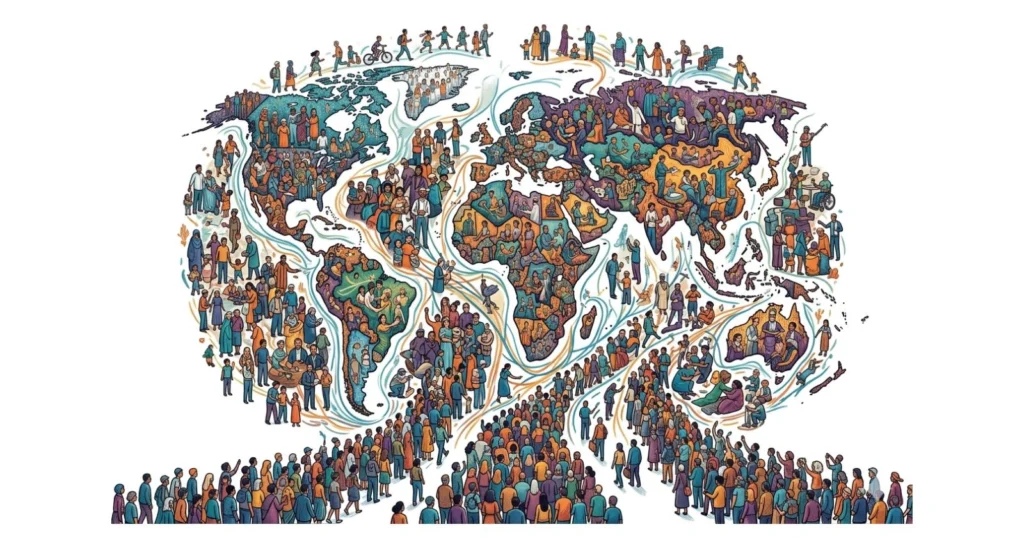
2030 is not just another year on the population calendar. It is the year the United Nations itself has used for decades as a headline benchmark, the figure quoted in sustainability reports, government planning documents, and global development goals. By the time this year arrives, the human population is projected to settle at approximately 8.5 billion people, a milestone that closes out one of the fastest-growing decades in recorded history while opening a much slower one.
This piece walks through that milestone year in a different way than a typical statistics roundup. Instead of front-loading every table at once, it moves chapter by chapter: first the headline number, then the decade of change that led to it, then the countries and cities carrying the most weight, then the demographic undercurrents (fertility, aging, urbanization) that explain why the next ten years will look nothing like the last fifty.
Chapter One: The Number Itself
8.5 billion. That is the figure the United Nations has projected for global population in 2030 since at least its 2015 revision, and it has held remarkably steady across multiple subsequent revisions, a rare case of demographic stability in long-range forecasting. Some sources place the figure slightly higher, closer to 8.6 billion, depending on which fertility variant and update cycle they reference, but 8.5 billion remains the most widely cited consensus estimate.
To put that number in context:
- It represents roughly 900 million more people than were alive when the UN first published this projection back in 2015.
- It is almost exactly double the population the planet held in 1980.
- It arrives just eight years after the world crossed 8 billion in November 2022, the shortest gap between any two half-billion milestones in human history.
None of this is a literal headcount. Like every population figure in this guide, it is a model output built from census data, birth and death registries, and migration records, refined by the United Nations every two years as better information becomes available.
Chapter Two: How We Got Here, A Decade in Three Acts
2020 to 2023: The slowdown becomes official
Global growth dipped below 1% annually for the first time since 1950, a threshold many demographers consider the real start of the “population deceleration era.” The world still crossed 8 billion in late 2022, but the pace of that crossing was noticeably slower than the leap from 6 to 7 billion a decade earlier.
2023 to 2027: The great handoff
India overtook China as the most populous nation on Earth, a transition years in the making and now fully entrenched. China’s population began an outright decline that has continued every year since, while India kept adding tens of millions annually.
2027 to 2030: Consolidation
Growth concentrated even further into a small cluster of countries, mostly in Sub-Saharan Africa, while an expanding list of nations, now over 90, settled into year-over-year population decline. By 2030, the structural story of this decade is essentially locked in: explosive growth in one region, quiet contraction in several others, and a global average sitting somewhere in between.
Chapter Three: The Headline Country Numbers
India enters 2030 with a population of around 1.51 to 1.52 billion, holding a commanding lead over China, whose population has settled closer to 1.40 billion. The gap between the two nations, which didn’t exist at all before 2023, now exceeds 110 million people and continues widening.
The United States remains the third-largest country, at roughly 357 million, a figure increasingly dependent on net migration rather than natural population increase. Indonesia, Pakistan, Nigeria, and Brazil round out the rest of the top tier, with Nigeria’s growth rate standing out as the fastest among any country of comparable size.
Population by Country, 2030 (Top 100, Estimated Rounded Figures)
| Country | Rank | Population |
|---|---|---|
| India | 1 | 1.51 billion |
| China | 2 | 1.40 billion |
| United States | 3 | 357 million |
| Indonesia | 4 | 299 million |
| Pakistan | 5 | 280 million |
| Nigeria | 6 | 264 million |
| Brazil | 7 | 217 million |
| Bangladesh | 8 | 188 million |
| Ethiopia | 9 | 158 million |
| DR Congo | 10 | 136 million |
| Russia | 11 | 142 million |
| Mexico | 12 | 137 million |
| Egypt | 13 | 129 million |
| Philippines | 14 | 124 million |
| Japan | 15 | 119 million |
| Vietnam | 16 | 105 million |
| Iran | 17 | 96 million |
| Turkey | 18 | 90 million |
| Germany | 19 | 83 million |
| Tanzania | 20 | 83 million |
| United Kingdom | 21 | 71 million |
| Thailand | 22 | 71 million |
| South Africa | 23 | 69 million |
| France | 24 | 67 million |
| Kenya | 25 | 65 million |
| Uganda | 26 | 61 million |
| Italy | 27 | 58 million |
| Sudan | 28 | 59 million |
| Myanmar | 29 | 56 million |
| Colombia | 30 | 56 million |
| Iraq | 31 | 53 million |
| Algeria | 32 | 51 million |
| South Korea | 33 | 51 million |
| Afghanistan | 34 | 51 million |
| Spain | 35 | 48 million |
| Argentina | 36 | 47 million |
| Yemen | 37 | 47 million |
| Angola | 38 | 47 million |
| Canada | 39 | 42 million |
| Mozambique | 40 | 42 million |
| Uzbekistan | 41 | 41 million |
| Morocco | 42 | 40 million |
| Ghana | 43 | 40 million |
| Poland | 44 | 38 million |
| Saudi Arabia | 45 | 38 million |
| Malaysia | 46 | 38 million |
| Ukraine | 47 | 37 million |
| Côte d’Ivoire | 48 | 38 million |
| Madagascar | 49 | 37 million |
| Peru | 50 | 35 million |
| Cameroon | 51 | 34 million |
| Niger | 52 | 35 million |
| Nepal | 53 | 30 million |
| Mali | 54 | 31 million |
| Venezuela | 55 | 29 million |
| Burkina Faso | 56 | 28 million |
| Syria | 57 | 29 million |
| Australia | 58 | 28 million |
| North Korea | 59 | 27 million |
| Zambia | 60 | 26 million |
| Malawi | 61 | 26 million |
| Chad | 62 | 25 million |
| Somalia | 63 | 24 million |
| Sri Lanka | 64 | 23 million |
| Taiwan | 65 | 23 million |
| Kazakhstan | 66 | 22 million |
| Senegal | 67 | 22 million |
| Guatemala | 68 | 20 million |
| Chile | 69 | 20 million |
| Zimbabwe | 70 | 20 million |
| Cambodia | 71 | 19 million |
| Netherlands | 72 | 19 million |
| Ecuador | 73 | 19 million |
| Romania | 74 | 19 million |
| Guinea | 75 | 17 million |
| Rwanda | 76 | 17 million |
| Benin | 77 | 17 million |
| Burundi | 78 | 17 million |
| South Sudan | 79 | 14 million |
| Bolivia | 80 | 13 million |
| Tunisia | 81 | 13 million |
| Haiti | 82 | 13 million |
| United Arab Emirates | 83 | 13 million |
| Jordan | 84 | 12 million |
| Tajikistan | 85 | 12 million |
| Belgium | 86 | 12 million |
| Dominican Republic | 87 | 12 million |
| Honduras | 88 | 12 million |
| Papua New Guinea | 89 | 12 million |
| Sweden | 90 | 11 million |
| Togo | 91 | 11 million |
| Cuba | 92 | 11 million |
| Azerbaijan | 93 | 11 million |
| Czechia | 94 | 11 million |
| Israel | 95 | 10 million |
| Portugal | 96 | 10 million |
| Greece | 97 | 10 million |
| Hungary | 98 | 9 million |
| Sierra Leone | 99 | 10 million |
| Austria | 100 | 9 million |
Figures rounded to the nearest convenient unit. Source: United Nations World Population Prospects, medium-fertility variant, consistent with the 8.5 billion global milestone repeatedly cited across multiple UN revisions for 2030.
Chapter Four: Where People Cluster, City by City
National borders only tell part of the story. By 2030, more than 6 in 10 people on Earth will live in an urban area, and the largest of those urban areas will function almost like an independent nation in terms of scale.
Tokyo and Delhi remain locked in a close race for the title of largest urban agglomeration on the planet, with Delhi’s faster growth rate putting it on track to take the lead sometime around this point in the decade. Shanghai, Dhaka, and Cairo follow, each comfortably above 24 million residents. Kinshasa has climbed into the top tier of global cities, a direct reflection of the Democratic Republic of the Congo’s position as one of the fastest-growing large countries on Earth.
Population by City, 2030 (Top 100, Estimated Rounded Figures)
| City | Country | Rank | Population |
|---|---|---|---|
| Delhi | India | 1 | 38 million |
| Tokyo | Japan | 2 | 37 million |
| Shanghai | China | 3 | 32 million |
| Dhaka | Bangladesh | 4 | 27 million |
| Cairo | Egypt | 5 | 26 million |
| Kinshasa | DR Congo | 6 | 24 million |
| Mumbai | India | 7 | 25 million |
| São Paulo | Brazil | 8 | 24 million |
| Mexico City | Mexico | 9 | 24 million |
| Beijing | China | 10 | 23 million |
| Lagos | Nigeria | 11 | 22 million |
| Karachi | Pakistan | 12 | 21 million |
| Bangalore | India | 13 | 18 million |
| Lahore | Pakistan | 14 | 18 million |
| Osaka | Japan | 15 | 19 million |
| Chongqing | China | 16 | 19 million |
| Istanbul | Turkey | 17 | 17 million |
| Kolkata | India | 18 | 17 million |
| Manila | Philippines | 19 | 17 million |
| Buenos Aires | Argentina | 20 | 16 million |
| Guangzhou | China | 21 | 16 million |
| Tianjin | China | 22 | 15 million |
| Chennai | India | 23 | 14 million |
| Rio de Janeiro | Brazil | 24 | 14 million |
| Shenzhen | China | 25 | 14 million |
| Moscow | Russia | 26 | 13 million |
| Jakarta | Indonesia | 27 | 13 million |
| Bogotá | Colombia | 28 | 13 million |
| Hyderabad | India | 29 | 13 million |
| Luanda | Angola | 30 | 13 million |
| Lima | Peru | 31 | 12 million |
| Bangkok | Thailand | 32 | 12 million |
| Dar es Salaam | Tanzania | 33 | 11 million |
| Paris | France | 34 | 11 million |
| Ho Chi Minh City | Vietnam | 35 | 11 million |
| Nanjing | China | 36 | 11 million |
| Ahmedabad | India | 37 | 10 million |
| Chengdu | China | 38 | 11 million |
| Seoul | South Korea | 39 | 10 million |
| London | United Kingdom | 40 | 10 million |
| Tehran | Iran | 41 | 10 million |
| Baghdad | Iraq | 42 | 9.4 million |
| Kuala Lumpur | Malaysia | 43 | 9.9 million |
| Surat | India | 44 | 9.7 million |
| Xi’an | China | 45 | 9.8 million |
| Wuhan | China | 46 | 9.5 million |
| Nagoya | Japan | 47 | 9.5 million |
| Suzhou | China | 48 | 9.2 million |
| Hangzhou | China | 49 | 9.1 million |
| Riyadh | Saudi Arabia | 50 | 9 million |
| New York City | United States | 51 | 8.4 million |
| Pune | India | 52 | 8.6 million |
| Shenyang | China | 53 | 8.3 million |
| Khartoum | Sudan | 54 | 8.2 million |
| Addis Ababa | Ethiopia | 55 | 8 million |
| Dongguan | China | 56 | 8.1 million |
| Foshan | China | 57 | 8.1 million |
| Hong Kong | Hong Kong (China) | 58 | 7.8 million |
| Abidjan | Côte d’Ivoire | 59 | 7.4 million |
| Harbin | China | 60 | 7.4 million |
| Santiago | Chile | 61 | 7.2 million |
| Nairobi | Kenya | 62 | 7.2 million |
| Madrid | Spain | 63 | 7 million |
| Johannesburg | South Africa | 64 | 6.9 million |
| Toronto | Canada | 65 | 6.8 million |
| Dalian | China | 66 | 6.6 million |
| Belo Horizonte | Brazil | 67 | 6.5 million |
| Qingdao | China | 68 | 6.5 million |
| Zhengzhou | China | 69 | 6.5 million |
| Yangon | Myanmar | 70 | 6.4 million |
| Singapore | Singapore | 71 | 6.3 million |
| Jinan | China | 72 | 6.3 million |
| Chittagong | Bangladesh | 73 | 6.5 million |
| Alexandria | Egypt | 74 | 6.3 million |
| Kabul | Afghanistan | 75 | 6.1 million |
| Hanoi | Vietnam | 76 | 6.1 million |
| Yaoundé | Cameroon | 77 | 6 million |
| Barcelona | Spain | 78 | 5.9 million |
| Ankara | Turkey | 79 | 5.9 million |
| Guadalajara | Mexico | 80 | 5.9 million |
| Melbourne | Australia | 81 | 5.9 million |
| Saint Petersburg | Russia | 82 | 5.7 million |
| Sydney | Australia | 83 | 5.6 million |
| Fukuoka | Japan | 84 | 5.6 million |
| Monterrey | Mexico | 85 | 5.5 million |
| Kano | Nigeria | 86 | 5.6 million |
| Cape Town | South Africa | 87 | 5.4 million |
| Jeddah | Saudi Arabia | 88 | 5.4 million |
| Changsha | China | 89 | 5.4 million |
| Urumqi | China | 90 | 5.4 million |
| Brasília | Brazil | 91 | 5.3 million |
| Kunming | China | 92 | 5.2 million |
| Changchun | China | 93 | 5.2 million |
| Hefei | China | 94 | 5.2 million |
| Ningbo | China | 95 | 5.1 million |
| Tel Aviv | Israel | 96 | 4.9 million |
| Shantou | China | 97 | 5 million |
| Shijiazhuang | China | 98 | 4.8 million |
| New Taipei | Taiwan | 99 | 4.7 million |
| Kozhikode | India | 100 | 4.8 million |
Figures rounded to the nearest convenient unit. Source: UN World Urbanization Prospects, projected forward to 2030 using confirmed urban growth trajectories.
Chapter Five: The Seven Continents in 2030 (Estimated Figures)
| Region | Population (Rounded) | Share of Humanity |
|---|---|---|
| Asia | 5.0 billion | ~58% |
| Africa | 1.75 billion | ~20.5% |
| Europe | 730 million | ~8.5% |
| North America | 612 million | ~7.2% |
| South America | 448 million | ~5.3% |
| Oceania | 49 million | ~0.6% |
| Antarctica | No permanent population | — |
Africa’s share has now climbed past 20% of humanity for the first time, a threshold it last touched in the colonial era of the 19th century, before centuries of disease, conflict, and slower development suppressed its relative population share. The continent’s return past this line marks a genuine historical reversal, not just a statistical milestone.
Chapter Six: The Fertility Divide, Wider Than Ever
By 2030, the gap between the world’s highest and lowest fertility nations has stretched further than at any point in modern demographic record-keeping. On one end, several Sub-Saharan African countries continue averaging close to six children per woman. On the other hand, a cluster of East Asian economies has settled at less than one child per woman, a level no country has ever sustained over multiple generations without severe long-term population contraction.
The 20 nations with the highest fertility, 2030 (Estimated, rounded figures):
- Niger, 5.7 children per woman
- Chad, 5.6 children per woman
- Somalia, 5.5 children per woman
- DR Congo, 5.4 children per woman
- Central African Republic, 5.1 children per woman
- Mali, 5.0 children per woman
- Angola, 4.6 children per woman
- Nigeria, 4.2 children per woman
- Burundi, 4.1 children per woman
- South Sudan, 4.0 children per woman
- Uganda, 4.0 children per woman
- Benin, 3.9 children per woman
- Burkina Faso, 3.9 children per woman
- Mozambique, 3.8 children per woman
- Guinea, 3.8 children per woman
- Cameroon, 3.7 children per woman
- Afghanistan, 3.6 children per woman
- Sierra Leone, 3.6 children per woman
- Senegal, 3.5 children per woman
- Yemen, 3.4 children per woman
The 20 nations with the lowest fertility, 2030 (estimated, rounded figures):
- Macao (China), 0.6 children per woman
- South Korea, 0.6 children per woman
- Hong Kong (China), 0.65 children per woman
- Taiwan, 0.75 children per woman
- Singapore, 0.8 children per woman
- China, 0.9 children per woman
- Ukraine, 0.95 children per woman
- Puerto Rico, 1.0 children per woman
- Italy, 1.1 children per woman
- Spain, 1.1 children per woman
- Poland, 1.1 children per woman
- Japan, 1.15 children per woman
- Greece, 1.15 children per woman
- Malta, 1.2 children per woman
- Thailand, 1.2 children per woman
- Cyprus, 1.2 children per woman
- Bosnia and Herzegovina, 1.2 children per woman
- Canada, 1.2 children per woman
- Finland, 1.2 children per woman
- Portugal, 1.25 children per woman
Chapter Seven: What Changes Permanently After 2030
A handful of demographic shifts will crystallize by 2030 in ways that will not reverse within most readers’ lifetimes:
The youth bulge moves to Africa for good
By this point, Africa holds the largest concentration of people under 25 anywhere on Earth, a position it will hold for the rest of the century, given current fertility trajectories.
Aging becomes a near-universal policy issue, not a wealthy-nation problem
Countries once considered “young,” including several in Latin America and Southeast Asia, begin confronting aging populations far earlier in their development cycle than today’s wealthy nations did.
The replacement-level club keeps growing
More than half of all countries on Earth now sit below the 2.1 children-per-woman replacement threshold, meaning natural population decline, absent migration, is now the default trajectory for a majority of the world’s nations, not a minority case.
Megacity growth decouples from megacity wealth
The fastest-growing large cities by 2030 are concentrated in countries with modest per-capita income, a reversal of the 20th-century pattern where the largest cities were also typically the wealthiest.
Quick Reference: 2030 at a Glance
| Metric | Figure |
|---|---|
| Global population | 8.5 billion |
| Most populous country | India, 1.51 billion |
| Second most populous | China, 1.40 billion |
| Largest urban area | Delhi or Tokyo, both near 38 million |
| Fastest-growing continent | Africa |
| Slowest-growing continent | Europe |
| The highest national fertility rate | Niger, 5.7 |
| Lowest national fertility rate | Macao, 0.6 |
| Countries below replacement fertility | Over 100 |
| Countries with shrinking populations | Over 90 |
| Years since the world passed 8 billion | 8 years |
Closing Note
8.5 billion is a tidy, memorable number, and it has functioned as a planning benchmark for governments and institutions for over a decade. But the real story of 2030 isn’t the headline figure itself, it’s the structural transformation underneath it: a fertility gap wider than ever recorded, a continent reclaiming a demographic share not seen in over a century, and a growing list of nations already living with the long-term consequences of population decline. These currents will keep moving long after the calendar turns past 2030, which is exactly why understanding them matters more than memorizing any single year’s number.
Frequently Searched Questions
Will the world population reach 8.5 billion by 2030?
Yes, this figure has been the United Nations’ consistent medium-variant projection across multiple revisions, making it one of the most stable long-range demographic forecasts available.
Will India remain the most populous country in 2030?
Yes, and by a wider margin than ever. India’s lead over China is projected to exceed 110 million people by this point.
How many people will live in cities by 2030?
More than 60% of the global population, continuing a steady rise from roughly 30% in 1950.
Which country will have the highest birth rate in 2030?
Niger is projected to retain the highest fertility rate globally, close to 5.7 children per woman.
Is the world population growth rate still slowing in 2030?
Yes, growth has decelerated to under 0.8% annually, continuing a decline that began in the mid-1960s.
How many countries will have below-replacement fertility by 2030?
More than 100 countries, over half of all nations tracked by the UN, are projected to sit below the 2.1 replacement threshold.
This article reflects United Nations World Population Prospects projections, consistent with the widely cited 8.5 billion milestone for 2030, and is reviewed periodically as updated UN revisions become available.