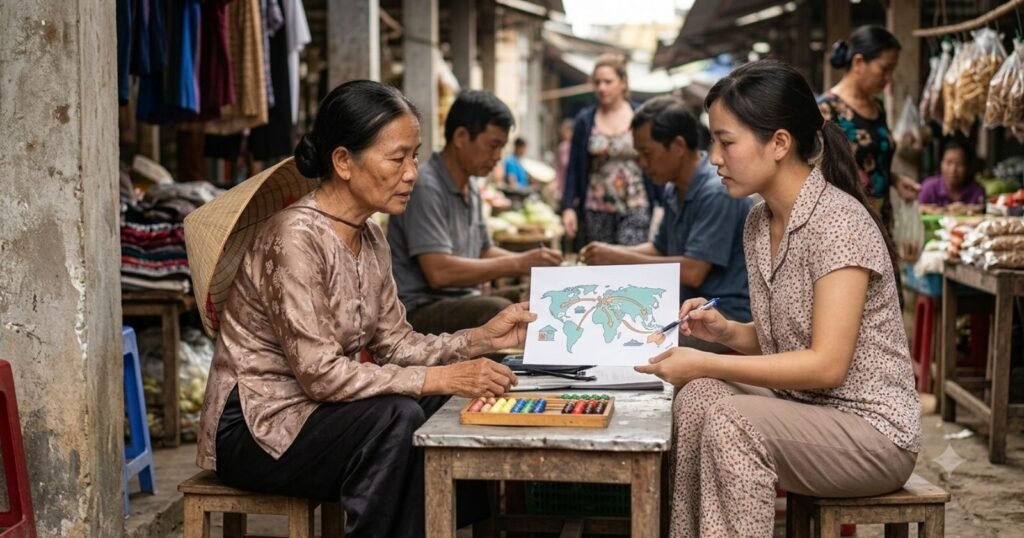
A record 304 million people were living outside their country of birth in 2024, according to the United Nations Population Division, roughly the combined population of Germany, France, the United Kingdom and Spain. That figure has doubled since 1990 and nearly quadrupled since 1970. Yet international migrants still make up only 3.7% of the global population, which means the overwhelming majority of humanity, more than 96 in every 100 people, still lives in the country where they were born. Global migration is at once a record scale and a minority experience, concentrated into specific corridors, specific destinations and specific drivers that a simple headline count obscures.
This is the difference between a migrant stock, the number of people currently living abroad at a given moment, and a migration flow, the number of people who cross a border in a given year. Nearly every figure in this article describes the stock, which behaves like a slowly accumulating reservoir rather than a fast-moving current, and understanding that distinction is the single most useful tool for making sense of migration statistics.
What Is International Migration?
The UN defines an international migrant as a person who has moved away from their country of usual residence for at least one year, regardless of the reason for the move or their legal status in the destination country. That definition deliberately excludes short-term travel, tourism and business trips, and it does not require legal authorization to count someone as a migrant.
A related but distinct measure, foreign-born population, counts people by their country of birth rather than length or purpose of stay, and is often used interchangeably with migrant stock in practice, though the two can diverge in countries with complex historical border changes. Migration status is also separate from citizenship: a person can be foreign-born and later naturalize, becoming a citizen of their destination country while remaining, by the UN’s definition, an international migrant for statistical purposes.
How Many International Migrants Are There?
The UN Department of Economic and Social Affairs (UN DESA), the custodian of the global migrant stock dataset, put the mid-2024 figure at 304 million people, or 3.7% of the world’s roughly 8.2 billion population.
Global International Migrant Stock, Selected Years
| Year | Estimated Migrants | Share of World Population |
|---|---|---|
| 1970 | ~84 million | ~2.3% |
| 1990 | ~153.9 million | ~2.9% |
| 2000 | not directly cited above | rising steadily |
| 2020 | ~275 million | ~3.5% |
| 2024 | 304 million | 3.7% |
Source: UN DESA, International Migrant Stock 2024; Migration Policy Institute tabulation.
Between 2020 and 2024 alone, the estimated global migrant population grew by 10.4%, roughly three times faster than growth in the world’s total population (3.5%) over the same period, evidence that international mobility has been accelerating relative to underlying demographic growth rather than simply tracking it.
Where Do International Migrants Live?
The world’s migrant population is heavily concentrated in a small number of destination countries and, more broadly, in a handful of major regions.
Largest Migrant Destination Countries, 2024
| Rank | Country | International Migrant Population |
|---|---|---|
| 1 | United States | 52 million |
| 2 | Germany | 17 million |
| 3 | Saudi Arabia | 14 million |
| 4 | United Kingdom | 12 million |
| 5 | France | 9 million |
| 6 | Türkiye | 7.1 million |
| 7 | Italy | 6.6 million |
Source: UN DESA, International Migrant Stock 2024: Key facts and figures; Rural Migration Blog (UC Davis), citing UN DESA and MPI.
The United States alone hosts about 17% of the entire world’s international migrant population, more than the next four destination countries combined. The top five destination countries together account for roughly a third of all global migrants, a level of concentration that stands in sharp contrast to the origin side of the ledger, described below.
At the regional level, Asia hosted an estimated 92.2 million international migrants at mid-2024, up from 84.7 million at mid-2020, while Africa hosted 29.2 million, up from 25.3 million over the same period, a 15% increase. Within Africa, migration is overwhelmingly intra-regional: 86% of international migrants residing in Africa in 2024 originated from elsewhere within the region.
Where Do Migrants Come From?
The origin side of global migration is markedly more diverse than the destination side, spread across a larger number of significant source countries rather than concentrated in a handful of hubs.
Largest Migrant Origin Countries, 2024
| Rank | Country of Origin | Emigrant Population Abroad |
|---|---|---|
| 1 | India | 18 million |
| 2 | China | 12 million |
| 2 | Mexico | 12 million |
| 4 | Ukraine | 10 million |
| 5 | Russia | 9 million |
Source: Rural Migration Blog (UC Davis), citing UN DESA and Migration Policy Institute.
The top five origin countries account for about 20% of the world’s migrants, roughly two-thirds the concentration seen among the top five destinations, underscoring that migrants leaving any single country tend to disperse across a wider range of destinations than the reverse.
The World’s Biggest Migration Corridors
Bilateral migration corridors, the specific pairing of one origin country and one destination country, reveal patterns that country-level totals alone do not. The largest documented inter-regional corridor identified in UN DESA’s 2024 dataset connects Central and Southern Asia to Europe, accounting for roughly 10 million migrants. Every other inter-regional corridor in the dataset falls under 7 million migrants, illustrating how dominant that single Central/Southern Asia-to-Europe pathway is relative to the broader field.
Regional migration patterns also differ sharply in how self-contained they are. Central and Southern Asia has the largest share, 75%, of its diaspora living outside its home region, followed by Northern America (73%) and Latin America and the Caribbean (71%). Africa sits at the opposite extreme: the large majority of African migrants stay within Africa, reflecting well-established regional labor migration systems rather than long-distance movement to other continents.
Why People Move Across Borders
Migration research consistently identifies several distinct but overlapping drivers, and any individual migration decision typically reflects more than one of them simultaneously:
- Employment and economic opportunity. Wage differentials between origin and destination countries remain the most consistently documented driver of voluntary labor migration, particularly evident in Gulf states, where migrant workers make up the overwhelming majority of the resident population in countries like Qatar and the UAE.
- Family reunification. A substantial share of migration to established destination countries, particularly in North America and Europe, occurs through family-based pathways rather than direct labor recruitment.
- Education. International student mobility contributes meaningfully to migrant stocks in major destination countries, and a portion of student migrants transition to longer-term residency after completing their studies.
- Conflict and political instability. Forced displacement across borders is a distinct but overlapping category from voluntary economic migration, and its scale has grown substantially in recent years, discussed in detail below.
- Environmental pressure. Climate and environmental factors are increasingly documented as contributing drivers of both internal and cross-border movement, though isolating environmental factors from the broader economic and political conditions they often compound remains methodologically difficult at the global statistical level.
Temporary, Permanent and Circular Migration
Not all migration fits a single mold. Permanent migration typically involves settlement with an intent to remain indefinitely, often eventually leading to naturalization. Temporary migration, prevalent across Gulf labor markets and in many seasonal or contract-based labor programs elsewhere, involves a defined period of residence tied to a specific job or visa category, without an expectation of permanent settlement.
Circular migration describes repeated movement back and forth between an origin and destination country, common among seasonal agricultural workers and certain cross-border labor arrangements, and is one of the more difficult migration patterns to capture accurately in stock-based statistics, since a person’s status at the moment of measurement may not reflect an established pattern of repeated movement.
Refugees and Other Forced Migrants
Forced displacement across international borders sits within the broader migrant stock total but is tracked separately because it reflects a fundamentally different set of drivers and legal protections. According to the 2024 data, more than 123 million people worldwide were forcibly displaced in total, a figure spanning both internal and international displacement.
Within that total, 51.7 million people, about one in every six international migrants globally, had been forcibly displaced across an international border, the highest share of the global migrant stock accounted for by forced displacement since UNHCR’s refugee data series began in the 1950s.
Forced Displacement, 2024
| Category | Estimated Population |
|---|---|
| Total forcibly displaced (internal and international) | 123+ million |
| Refugees under UNHCR mandate | 36.8 million |
| Asylum seekers | 8 million |
| Other people in need of international protection | ~6 million |
| Internally displaced persons | 73.5 million |
| Forcibly displaced across international borders | 51.7 million (1 in 6 international migrants) |
Source: UN DESA/UNHCR, cited in Migration Policy Institute, “Top Statistics on Global Migration and Migrants.”
The distinction matters for policy and for interpreting country-level migrant totals: a country hosting a large refugee population, driven by proximity to conflict, will show a very different migration profile than one attracting predominantly labor migrants, even if their total migrant stock numbers look similar.
How Migration Has Changed Over Time
The long-run trajectory shows both steady growth and a shift in composition. From 84 million migrants in 1970 to 304 million in 2024, the global stock has more than tripled, while the migrant share of world population has crept up more gradually, from 2.6% in 1960 to 2.9% in 1990 to 3.7% in 2024, a rise of roughly one percentage point over 34 years despite the underlying absolute numbers nearly doubling since 1990.
Recent years have seen this growth accelerate: the 10.4% increase in migrant stock between 2020 and 2024 outpaced total world population growth (3.5%) by a factor of roughly three, driven by a combination of post-pandemic labor migration recovery and record levels of forced displacement.
The Economic and Demographic Effects of Migration
Migration functions as a significant economic and demographic lever at both ends of a corridor. Officially recorded global remittances, money migrants send back to their countries of origin, were projected to reach nearly $905 billion in 2024, with India, Mexico, China, the Philippines and Pakistan together receiving close to half of all such flows directed toward low- and middle-income countries. For many origin countries, remittances represent a larger and more stable source of foreign income than foreign direct investment.
On the destination side, migration reshapes labor markets and, in countries facing population aging or decline, provides one of the few levers available to sustain working-age population size in the near term. The migrant share of national population varies enormously by this logic: Qatar (76.7%) and the UAE (74%) lead the world by immigrant share, reflecting economies structurally built around imported labor, while the United States, despite hosting the largest absolute migrant population of any country, has a far lower migrant share of its total population given its much larger overall population base.
What the Future of International Migration May Look Like
Migration researchers generally expect the underlying pressures driving current migration, labor market gaps in aging destination countries, wage differentials, conflict and displacement, to persist or intensify over coming decades, but translating that into precise numerical projections carries substantial uncertainty, since migration flows respond quickly to policy changes, economic shocks and conflict in ways that longer-run demographic processes like fertility and mortality do not.
What can be said with more confidence is structural: as more of the world’s largest destination countries, including several in Europe and East Asia, enter sustained working-age population decline, the economic incentive for continued labor migration into those countries is likely to remain strong, even as the specific policy environment governing that migration remains politically contested and subject to change. Any specific numerical forecast for total migrant stock in future decades should be treated as one plausible scenario rather than a settled outcome.
Key Findings
- A record 304 million people were living outside their country of birth in 2024, 3.7% of the world’s population, up from 3.5% in 2020 and roughly double the 1990 figure of about 154 million.
- The United States hosts more international migrants than any other country, 52 million, about 17% of the entire global migrant stock, more than the next four destination countries combined.
- India is the largest single source of international migrants, with 18 million of its citizens living abroad, followed by China and Mexico at 12 million each.
- Qatar and the UAE have the highest migrant shares of any national population in the world, at 76.7% and 74% respectively, driven by large temporary labor migration programs.
- Forced displacement now accounts for an unprecedented share of global migration: 51.7 million people, one in six international migrants, had been forcibly displaced across a border by 2024, the highest share since UNHCR records began in the 1950s.
- Global remittances reached a projected $905 billion in 2024, with India, Mexico, China, the Philippines and Pakistan together receiving nearly half of all flows to low- and middle-income countries.
- The global migrant stock grew 10.4% between 2020 and 2024, nearly three times faster than growth in total world population over the same period.
Frequently Asked Questions
1. How many international migrants are there in the world?
An estimated 304 million people were living outside their country of birth as of mid-2024, according to the UN Population Division, representing 3.7% of the world’s population.
2. Which country receives the most migrants?
The United States hosts the largest international migrant population of any country, about 52 million people in 2024, roughly 17% of the world’s total migrant stock.
3. Which countries send the most migrants?
India is the largest source of international migrants, with about 18 million citizens living abroad, followed by China and Mexico, each with roughly 12 million, and then Ukraine and Russia.
4. Why do people migrate?
The most consistently documented drivers are economic opportunity and wage differentials, family reunification, education, and conflict or political instability, with most individual migration decisions reflecting more than one of these factors at once.
5. What is the difference between a migrant and an immigrant?
“Migrant” is the general term for anyone living outside their country of birth or usual residence for a year or more. “Immigrant” specifically describes that same person from the perspective of the destination country they have moved into, while “emigrant” describes them from the perspective of the country they left.
6. What is the difference between migrant stock and migration flow?
Migrant stock is the total number of people currently living outside their country of birth at a given moment, a slowly accumulating figure. Migration flow is the number of people who cross a border to migrate within a defined period, typically a year, and can rise or fall sharply year to year.
7. How many people have been forcibly displaced across borders?
About 51.7 million people, roughly one in six international migrants worldwide, had been forcibly displaced across an international border as of 2024, including 36.8 million refugees under UNHCR’s mandate, the highest share of global migration accounted for by forced displacement since the 1950s.
8. Which countries have the highest share of migrants in their population?
Qatar (76.7%) and the United Arab Emirates (74%) have the highest migrant shares of any national population, both driven by extensive reliance on temporary foreign labor.
9. Is global migration increasing?
Yes. The global migrant stock grew from about 275 million in 2020 to 304 million in 2024, a 10.4% increase that outpaced total world population growth (3.5%) by roughly three times over the same period.
10. What is the biggest migration corridor in the world?
The largest documented inter-regional migration corridor connects Central and Southern Asia to Europe, accounting for approximately 10 million migrants as of the 2024 UN DESA data, the single largest pathway in the dataset.
Sources
- United Nations Department of Economic and Social Affairs (UN DESA), Population Division, International Migrant Stock 2024: Key facts and figures, 2025
- UN DESA, International Migrant Stock 2024 dataset, cited via Our World in Data
- Migration Policy Institute, “Top Statistics on Global Migration and Migrants,” 2025
- migrationdataportal.org, “International migrant stocks,” UN DESA 2025 data
- IOM, World Migration Report 2026, “International migrants: numbers and trends” chapter
- Rural Migration Blog, University of California, Davis, citing UN DESA and MPI, January 2026
- UNHCR, forced displacement statistics, cited via Migration Policy Institute