Ukraine does not currently have one population figure. It has several, depending on what is being counted: roughly 33 to 35 million people physically present on government-controlled territory, close to 5.9 million refugees registered abroad, and about 3.7 million more displaced within the country’s own borders. Before rebuilding anything else, Ukraine faces the more basic problem of rebuilding a population whose size cannot be stated with a single confident number.
Key Findings
- Ukraine’s population cannot currently be stated as a single figure; estimates range from roughly 33 million within government-controlled territory to nearly 40 million across internationally recognized borders, depending on definition.
- UNHCR recorded 5.86 million Ukrainian refugees globally and 3.7 million internally displaced people as of December 2025, together representing over a third of the prewar population.
- Ukraine’s child population has shrunk by an estimated 26 percent, or roughly 2 million children, since the start of the full-scale invasion in 2022.
- Youth return-intention surveys show a sharp decline, from 66 percent in 2023 to 32 percent in 2024, suggesting displacement is increasingly becoming permanent rather than temporary.
- UN medium-variant projections put Ukraine’s population at approximately 21 million by 2100, though this figure carries substantial uncertainty tied to the unresolved course of the war.
What Happened to Ukraine’s Population?
Ukraine’s prewar population, as tracked by the State Statistics Service, stood at roughly 41 million people at the start of 2022, a figure that already excluded Crimea and the parts of Donbas occupied since 2014. The full-scale invasion that began on February 24, 2022, triggered the largest displacement crisis in Europe since the Second World War.
By December 2025, UNHCR recorded 5.86 million Ukrainian refugees globally, including about 5.3 million hosted within Europe, alongside 3.7 million people internally displaced inside Ukraine, with 73 percent of that group having lived in displacement for more than two years. Some accounting sources place the combined displaced total, refugees plus IDPs, at over one third of Ukraine’s prewar population. Worldometer’s elaboration of UN data, which reflects internationally recognized territory rather than the government-controlled area, put Ukraine’s mid-2026 population at approximately 39.5 million, while World Bank data for 2024 recorded a population of 37.86 million. A separate estimate focused specifically on the population physically present in government-controlled territory put the 2026 figure closer to 33 to 35 million.
The spread among these figures, from roughly 33 million to nearly 40 million, is not a data error. It reflects genuinely different questions: how many Ukrainian citizens exist globally, how many people live within Ukraine’s internationally recognized borders, and how many live specifically in areas the government currently administers. Each is a legitimate but different number.
Ukraine Population Estimates by Definition, 2025 to 2026
| Measure | Approximate Figure | Source Basis |
|---|---|---|
| UN World Population Prospects (recognized territory) | ~39.5 million (mid-2026) | UN WPP 2024 Revision |
| World Bank total population | 37.86 million (2024) | World Bank development indicators |
| Population in government-controlled territory | ~33–35 million (2026) | Combined UN, UNHCR, IOM tracking |
| Refugees from Ukraine, recorded globally | 5.86 million (Dec 2025) | UNHCR |
| Internally displaced persons | 3.7 million (Dec 2025) | UNHCR / IOM |
| Prewar population estimate (early 2022, excl. Crimea/occupied Donbas) | ~41 million | Ukraine State Statistics Service |
The Population Effects of War
Beyond displacement, the war has caused direct and indirect population effects that are difficult to quantify precisely. Military and civilian casualties are not published in verified detail by either side, and independent researchers generally treat casualty estimates as highly uncertain. What can be documented with more confidence is a sharp shift in the age and sex composition of the population that remains: continued martial-law restrictions on the emigration of men aged 18 to 60 mean that the population moving abroad has skewed disproportionately toward women, children, and older adults.
A United Nations country analysis for Ukraine reported that the country’s child population had shrunk by 26 percent, or roughly 2 million children, since 2022, a decline driven by both displacement and a sharp drop in births during wartime conditions.
Ukraine’s Refugees and Population Abroad
Poland has hosted the largest number of Ukrainian refugees among European countries, with other major destinations including Germany, Czechia, and other EU member states. UNHCR figures show that around 90 percent of registered Ukrainian refugees remain within Europe, reflecting both geographic proximity and the temporary protection status the European Union extended to Ukrainian arrivals starting in 2022.
Return intentions among refugees have weakened over time rather than strengthened. Youth surveys cited in UN reporting found that the share of young refugees intending to return home fell from 66 percent to 32 percent between 2023 and 2024, a shift particularly pronounced among those from rural areas, suggesting that the longer displacement continues, the more it risks becoming permanent rather than temporary.
Fertility and Births
Ukraine entered the war with fertility already below replacement level, consistent with the broader Eastern European pattern. Wartime conditions have compounded that decline: displacement, economic hardship, family separation caused by martial law restrictions on men’s travel, and general uncertainty about the future have all been associated with delayed childbearing. The reported 26 percent contraction in the under-18 population since 2022 reflects both the departure of children with displaced mothers and a reduced number of new births within the country.
Aging and the Shrinking Working Age Population
The population that remains within Ukraine, particularly in government-controlled territory, skews older than the prewar population. One estimate placed the median age within government-controlled territory at approximately 44 years in 2026, notably higher than Ukraine’s prewar median age and a reflection of the disproportionate emigration of younger women and children alongside the domestic mobilization of working-age men.
This combination, an aging remaining population plus continued outmigration of skilled workers, has already produced documented labor shortages. Ukraine’s Ministry of Economy and related reporting has noted deepening labor shortages driven jointly by displacement and military mobilization, a dynamic that complicates both wartime economic activity and any future reconstruction effort that depends on domestic labor supply.
What Determines Whether People Return?
Return migration research and refugee surveys point to several recurring factors shaping whether displaced Ukrainians eventually come home: security conditions and the state of the front line, availability of housing given that over 2.5 million homes have been damaged or destroyed since 2022, employment prospects, access to schools and health services, and family reunification, particularly for households split by the restrictions on men’s travel abroad. None of these factors currently points uniformly toward large-scale return; declining return-intention survey figures suggest the opposite trend is underway.
Regional Demographic Differences
Displacement and war damage have not been distributed evenly across Ukraine. Front-line and formerly occupied regions have experienced the most severe population loss and infrastructure destruction, including the environmental disaster following the 2023 destruction of the Kakhovka Dam, which displaced additional communities and caused lasting ecological damage. Western Ukraine, further from active combat, has functioned as both a receiving area for internally displaced people and a transit corridor toward the European Union.
Ukraine’s Labor Force Reconstruction
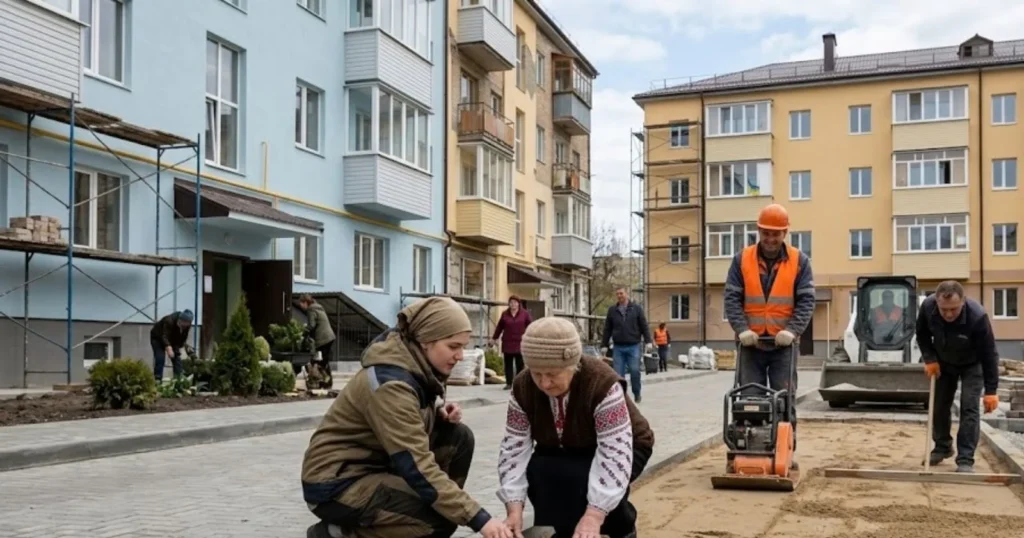
The scale of the eventual reconstruction effort, estimated by the Rapid Damage and Needs Assessment at over 176 billion dollars in direct damages as of December 2024, depends heavily on labor availability that the current demographic trajectory does not clearly support. The convergence of population loss, an aging remaining workforce, and continued emigration intent among young people inside Ukraine points toward a structural labor shortage that could persist well beyond the end of active fighting, regardless of how quickly infrastructure funding becomes available.
Population Scenarios for Ukraine
Long-range UN medium-variant projections, as elaborated by third-party trackers using the same underlying framework, suggest Ukraine’s population could fall to approximately 21 million by 2100, a decline of nearly half from prewar levels. This figure should be treated as a scenario built on current and assumed trends in fertility, mortality, and migration, carrying unusually high uncertainty given that the war’s duration, outcome, and effect on return migration remain unresolved. It is not a fixed forecast, and the degree to which displaced Ukrainians eventually return will materially change the trajectory in either direction.
Conclusion
Ukraine’s demographic reconstruction problem cannot be solved by rebuilding buildings alone. The population that will eventually staff a rebuilt economy is smaller, older, and more female than the population that existed before February 2022, and the survey evidence on return intentions is moving in the wrong direction. Whatever population figure eventually stabilizes for postwar Ukraine will be shaped as much by decisions individual refugee families make about returning as by anything written into a reconstruction budget.
Frequently Asked Questions
1. How much has Ukraine’s population declined?
There is no single universally comparable figure. Estimates for the population physically present in government-controlled territory in 2026 range from about 33 to 35 million, compared with a prewar estimate of roughly 41 million in early 2022, a decline on the order of 15 to 20 percent by that specific measure.
2. How many Ukrainian refugees are there?
UNHCR recorded 5.86 million Ukrainian refugees globally as of December 2025, with approximately 5.3 million hosted within Europe.
3. How many people are internally displaced within Ukraine?
Approximately 3.7 million people remained internally displaced within Ukraine as of December 2025, with 73 percent having been displaced for more than two years.
4. Will Ukrainian refugees return?
Recent survey data points in the opposite direction from return: youth return-intention rates fell from 66 percent in 2023 to 32 percent in 2024. Return will depend heavily on security conditions, housing availability, and employment prospects rather than time elapsed alone.
5. Why is Ukraine’s fertility rate important to its recovery?
Ukraine entered the war with below-replacement fertility, and wartime disruption has further depressed births, contributing to a documented 26 percent decline in the under-18 population since 2022, a trend that will shape the size of Ukraine’s future working-age population for decades.
6. Can migration offset Ukraine’s population decline?
Return migration could partially offset losses if security and economic conditions improve, but current survey trends show declining rather than rising intent to return, meaning migration is currently a net negative rather than an offsetting factor.
7. What is Ukraine’s median age now?
Estimates for the population in government-controlled territory put the median age at approximately 44 years in 2026, notably elevated by the disproportionate emigration of younger women and children.
8. How much physical damage has the war caused?
The fourth Rapid Damage and Needs Assessment, released in February 2025 by the Ukrainian government, World Bank, EU, and UN, estimated direct damages at over 176 billion dollars as of December 2024, including more than 2.5 million damaged or destroyed homes.
9. Is Ukraine’s population expected to keep shrinking?
UN medium-variant projections suggest continued long-term decline, reaching roughly 21 million by 2100, though this scenario depends heavily on assumptions about the war’s resolution and subsequent return migration that remain highly uncertain.
10. Which countries host the most Ukrainian refugees?
Poland has hosted the largest number of Ukrainian refugees among individual countries, with Germany and Czechia also among the largest host nations; around 90 percent of all registered Ukrainian refugees remain within Europe.
Sources
- United Nations High Commissioner for Refugees (UNHCR), Ukraine Situation 2026 Plans and Financial Requirements
- United Nations Country Analysis Ukraine, December 2025
- International Organization for Migration (IOM), Ukraine Crisis Response Plan 2026
- World Bank, Monitoring Living Conditions in Ukraine, Fall 2025 update
- Worldometer, elaboration of UN World Population Prospects: The 2024 Revision, Ukraine population data
- Ukraine State Statistics Service, prewar population estimates
- Rapid Damage and Needs Assessment (RDNA4), Government of Ukraine, World Bank, European Union, and United Nations, February 2025