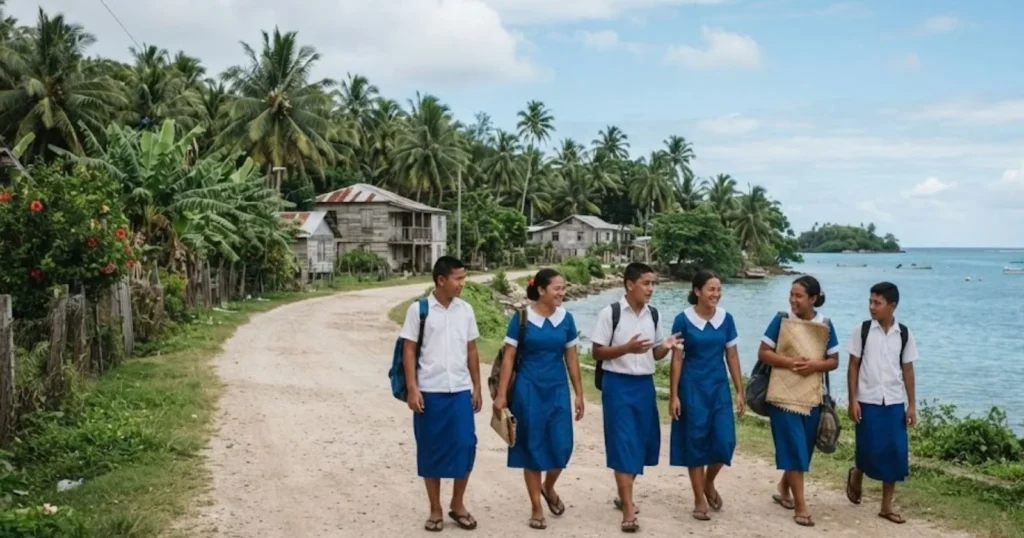
Tonga’s population is shrinking even though its birth rate is not the problem. Our World in Data’s analysis of UN figures found that Tonga’s population growth rate in 2023 was negative 0.4%, but that without migration, natural increase alone would have produced growth of positive 1.7%. That six-point swing, from a healthy expansion to an outright decline, is caused entirely by people leaving the country. Tonga is, in demographic terms, a young country that keeps exporting the very people who would otherwise make it grow.
At the 2021 census, Tonga counted 100,179 residents, a figure that has since drifted down toward roughly 99,000 to 104,000 depending on the estimate and year used. Meanwhile, the global ethnic Tongan population, spread mainly across New Zealand, the United States and Australia, is estimated at roughly 305,000, three times the number of Tongans actually living in Tonga.
Tonga’s Population Today
| Metric | Figure | Year / Source |
|---|---|---|
| Resident population (census) | 100,179 | 2021 Census, Tonga Statistics Department |
| Resident population (estimate) | 99,000–104,000 | 2025–2026, varying sources |
| Land area | 720 km² | UN Statistics Division |
| Population density | ~143–144 per km² | 2026 estimate |
| Median age | 21–22 years | 2026 estimate |
| Urban population share | 23–26% | 2024–2026 estimates |
| Total fertility rate | 2.76–3.4 children per woman | Recent estimates |
| Net migration rate | Roughly –16 to –18 per 1,000 population | Recent years |
| Population growth rate excluding migration | +1.7% | 2023, Our World in Data / UN |
| Actual population growth rate, 2023 | –0.4% | Our World in Data / UN |
Tonga’s Age Structure
Tonga’s median age of roughly 21 to 22 years places it firmly among the Pacific’s younger nations, though it has risen steadily from 18.1 years in 1970. Age-structure estimates suggest more than half the population, around 55%, is under 25, while roughly 32% is under 15.
At the other end of the pyramid, only about 6.8% to 7% of the population is 65 or older. This is a textbook expansive population pyramid: a wide base of children and young adults tapering quickly at older ages, a shape typically associated with high fertility and, historically, higher mortality, though Tonga’s life expectancy of around 73 to 77.5 years is considerably higher than that pattern usually implies.
| Age Group | Approximate Share of Population | Notes |
|---|---|---|
| 0–14 years | 29–32% | Broad base of the population pyramid |
| 15–24 years | ~23–26% | Combined with 0-14, over half the population is under 25 |
| 15–64 years (working age) | ~58–62% | Core labor force pool, heavily depleted by emigration |
| 65 and over | ~6.8–7.0% | Small but slowly rising elderly share |
What Being a Young Population Means for Tonga
A population this young places specific demands on Tonga’s education and health systems: primary and secondary schools must serve a large cohort of children relative to the working-age population that funds them, while maternal and child health services carry a heavier caseload than in an aging society. Tonga’s literacy rate, at close to 99.5% among adults, reflects decades of investment in near-universal education, a genuine achievement for a small island economy.
The harder challenge lies on the other side of school-leaving age: Tonga’s formal labor market is small, public sector employment is limited, and private sector job creation has not kept pace with the number of young Tongans finishing school each year, a mismatch that feeds directly into the emigration pattern that follows.
Migration and the Loss of Working Age Population
Tonga’s net migration rate, estimated at roughly negative 16 to negative 18 per 1,000 population in recent years, is among the highest sustained emigration rates of any country its size. Unlike some migration patterns that skew toward either the very young or very old, Tongan emigration draws disproportionately from working-age adults, exactly the cohort a young population needs to retain in order to convert its demographic structure into economic growth.
The result is a resident population that looks younger, on paper, than its true dependency burden suggests, because a meaningful share of the prime working-age group has already left.
This dynamic explains the striking gap Our World in Data identified: Tonga’s fertility alone would produce robust population growth, but sustained emigration converts that potential growth into an actual decline. Tonga is not short on new-generation Tongans; it is short on a country large enough, economically, to keep them.
The Tongan Diaspora
The scale of Tongan emigration becomes clearer when the diaspora is measured against the resident population. Ethnic Tongan population estimates put roughly 100,210 people in Tonga itself, alongside approximately 97,824 in New Zealand, 78,871 in the United States, and 43,465 in Australia, for a global ethnic Tongan population of around 305,000. In other words, roughly two-thirds of all ethnic Tongans alive today live outside Tonga, a proportion that places Tonga among the most diaspora-dominated nations on Earth relative to its resident population.
| Location | Ethnic Tongan Population | Approximate Source Year |
|---|---|---|
| Tonga (resident) | 100,179–104,000 | 2021 Census / 2026 estimate |
| New Zealand | 97,824 | 2018 Census |
| United States | 78,871 | Recent U.S. Census estimate |
| Australia | 43,465 | 2021 Census |
| Other (Japan, Canada, Italy, etc.) | ~400 | Various recent estimates |
New Zealand’s Tongan community has grown rapidly, from 60,336 in the 2013 census to 82,389 by 2018, a 36.6% increase in just five years, driven by ongoing family reunification migration and New Zealand’s specific Pacific migration quota categories. The Tongan community in New Zealand also skews notably young, with 38.3% under 15 as of the 2018 census, a reflection of continued family-based migration rather than only individual labor migration.
Fertility and Population Change
Tonga’s total fertility rate, estimated at anywhere from 2.76 to 3.4 children per woman depending on the source and year, remains comfortably above the replacement level of 2.1. Demographically, this places Tonga in an unusual position: most countries facing outright population decline are dealing with sub-replacement fertility, as seen across East Asia and much of Europe.
Tonga’s decline is different in kind. Its fertility rate, on its own, would sustain and grow the population; it is emigration, not a shortage of births, that is driving the resident headcount down.
Education and Employment for Young Tongans
Tonga’s high youth literacy rate and near-universal school completion have not been matched by equivalent domestic job creation. With unemployment reported at a notably low 2.01% in recent labor force data, on the surface Tonga does not appear to have a joblessness crisis. But that low headline figure obscures how much of the working-age population, and specifically the segment most likely to be formally unemployed if it stayed, has already emigrated rather than remained in Tonga searching for work.
Much of the domestic workforce that remains is engaged in subsistence farming, fishing and small-scale trade, sectors that absorb labor without necessarily providing the wage growth or career progression that would make staying in Tonga more attractive than emigrating.
What Could Tonga’s Population Look Like in the Future?
Tonga’s population is officially projected to decline modestly in the coming years. One projection based on IMF data anticipated the population dropping by roughly 1,470 people between 2025 and 2031, continuing the downward trajectory already visible since the early 2020s.
The UN’s medium-variant scenario, which factors in continued high emigration alongside above-replacement fertility, points to a population that either stagnates or gradually contracts through the coming decades unless migration patterns to New Zealand, Australia or the United States shift substantially.
Whether that decline continues, stabilizes, or reverses depends on factors largely outside Tonga’s direct control: labor market conditions and immigration policy in its three main destination countries, the strength of seasonal labor schemes that allow temporary rather than permanent emigration, and the extent to which remittances and diaspora investment can substitute for the economic activity that emigrating workers would otherwise have generated at home. Tonga’s economy already relies heavily on remittances from its diaspora in New Zealand and Australia, a flow of income that partly offsets the loss of domestic labor even as it cannot fully replace it.
Key Findings
- Tonga’s population would have grown by 1.7% in 2023 based on births and deaths alone, but actually declined by 0.4% once emigration is factored in, according to Our World in Data’s analysis of UN figures.
- Roughly two-thirds of all ethnic Tongans, an estimated 305,000 people combining Tonga, New Zealand, the United States and Australia, live outside Tonga itself.
- Tonga’s net migration rate of roughly negative 16 to negative 18 per 1,000 population is among the highest sustained emigration rates of any small Pacific nation.
- More than half of Tonga’s resident population is under the age of 25, while only about 7% is 65 or older, giving the country one of the youngest age structures in Polynesia.
- New Zealand’s Tongan community grew 36.6% in just five years, from 60,336 in 2013 to 82,389 in 2018, driven by ongoing family reunification migration.
- Tonga’s total fertility rate of 2.76 to 3.4 children per woman remains well above replacement level, meaning population decline stems from emigration rather than insufficient births.
- Tonga’s population is officially projected to keep shrinking modestly through the early 2030s absent a significant shift in migration patterns to its three main destination countries.
Frequently Asked Questions
1. What is the population of Tonga?
Tonga’s 2021 census recorded 100,179 residents. Current estimates for 2025-2026 range from approximately 99,000 to 104,000 depending on the source, with most recent projections pointing to a slight decline.
2. Is Tonga’s population growing or shrinking?
Tonga’s resident population is shrinking. In 2023, births exceeded deaths by enough to produce 1.7% growth on their own, but net emigration turned that into an actual decline of roughly 0.4% for the year.
3. How young is Tonga’s population?
Tonga’s median age is roughly 21 to 22 years, and more than half the population is under 25, giving it one of the youngest demographic profiles among Pacific Island nations.
4. Why do Tongans migrate overseas?
Tongans migrate primarily for employment and educational opportunities unavailable in Tonga’s small domestic economy, using long-established family and community migration networks to New Zealand, the United States and Australia.
5. What does Tonga’s population structure mean for the future?
Tonga’s young population represents both an opportunity and a risk: it provides a large potential future workforce, but without enough domestic job creation, that same cohort is likely to continue emigrating in large numbers, as it has for decades.
6. How large is the Tongan diaspora?
The global ethnic Tongan population is estimated at roughly 305,000, with about two-thirds living outside Tonga, primarily in New Zealand (97,824), the United States (78,871) and Australia (43,465).
7. What is Tonga’s fertility rate?
Tonga’s total fertility rate is estimated at 2.76 to 3.4 children per woman, well above the replacement level of 2.1, meaning Tonga’s population decline is driven by migration rather than low birth rates.
8. Where do most people live in Tonga?
Tongatapu, the main island, is home to about 74,454 people as of the 2021 census, roughly three-quarters of Tonga’s national population, with the remainder spread across the Vava’u, Ha’apai and Eua island groups.
9. What is Tonga’s unemployment rate?
Tonga’s reported unemployment rate is a very low 2.01%, though this figure partly reflects the fact that much of the working-age population that might otherwise be unemployed has already emigrated rather than remained in Tonga.
10. Is Tonga’s population projected to keep declining?
Yes. Current projections, including IMF-based estimates, anticipate Tonga’s population continuing to decline modestly through the early 2030s unless migration patterns to its main destination countries change significantly.
Sources
- Tonga Statistics Department, 2021 Population and Housing Census Preliminary Results
- United Nations, Department of Economic and Social Affairs, Population Division, World Population Prospects: The 2024 Revision
- Our World in Data, “Population and Demography Country Profile: Tonga” (2026)
- Statistics New Zealand, 2013 and 2018 Census ethnicity data
- Australian Bureau of Statistics, 2021 Census ancestry data
- Statista / IMF, “Total population of Tonga from 1980 to 2031” (December 2025)
- UN OCHA / ReliefWeb, “Tonga: Population Distribution” map, Census 2021
- Wikipedia, Demographics of Tonga, Tongans and Tongan New Zealanders (diaspora and island-level population figures cross-referenced against national census sources)