
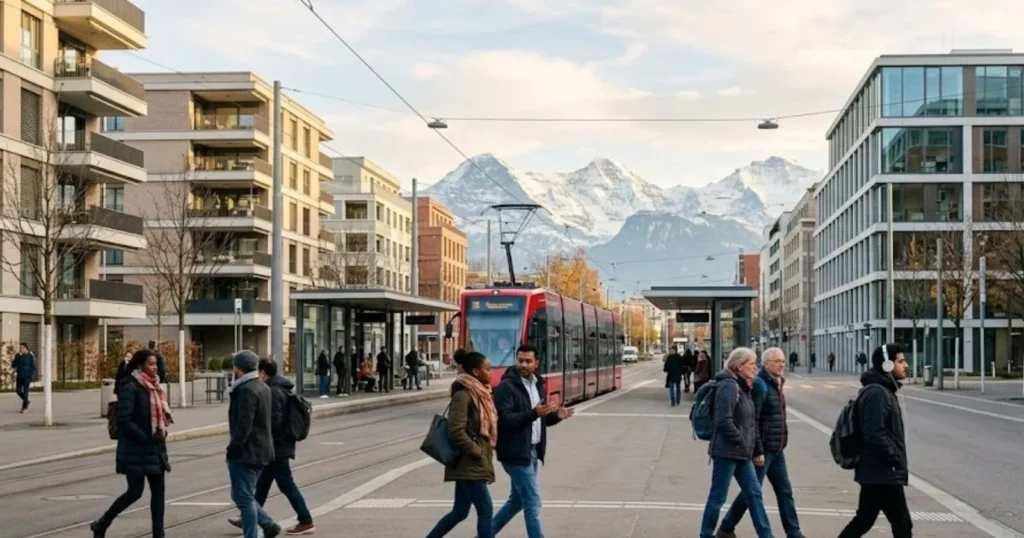
For the first time in Switzerland’s recorded demographic history, the country now has more people aged 65 and over than people under 20. The Swiss Federal Statistical Office (BFS) confirmed the crossover in its provisional 2025 population release, alongside a still-growing overall population, a country simultaneously expanding and aging in a way its own fertility numbers cannot explain on their own.
Switzerland’s Population Is Still Growing
Switzerland’s permanent resident population reached 9.05 million at the start of 2025, after crossing the symbolic 9 million threshold during 2024, according to BFS data reviewed by SWI swissinfo.ch. That represented growth of nearly 89,000 people, or roughly 1 percent, over the preceding year, a pace that keeps Switzerland among the faster-growing populations in Western Europe even as its underlying fertility continues to decline. Worldometer’s elaboration of UN data puts Switzerland’s median age at 43.2 years as of the mid-2020s.
Fertility Is Not High Enough to Explain the Growth
Of the roughly 89,000 people Switzerland added in the year through early 2025, natural growth, births minus deaths, contributed no more than 6,000, according to BFS-sourced reporting. That means immigration accounted for over 93 percent of Switzerland’s population increase that year.
Switzerland’s total fertility rate stood at 1.33 children per woman as of 2023 estimates, and BFS’s own April 2026 release on 2025 vital statistics confirmed the decline in fertility continued for a fourth consecutive year, though the pace of that decline slowed somewhat in 2025 compared with the prior three years.
Switzerland’s Population Growth Components, Year to Early 2025
| Component | Contribution | Share of Total Growth |
|---|---|---|
| Total population growth | ~89,000 | 100% |
| From immigration | ~83,000 | >93% |
| From natural growth (births minus deaths) | ~6,000 | <7% |
Immigration Is Central to Population Growth
Switzerland’s birth rate stood at 8.7 births per 1,000 population in 2024, against a death rate of 8.0 per 1,000, a narrow gap that leaves little room for natural increase to drive growth on its own. The share of Switzerland’s population with a migrant background, a broader measure than foreign citizenship alone that includes naturalized citizens and their immediate descendants, reached 41 percent at the start of 2025, while resident foreigners specifically made up 26.3 percent of the population as of 2023 data, one of the highest shares of any country in Europe.
Italy provided the largest single group of foreign residents, at 14.7 percent of Switzerland’s total foreign population, followed closely by Germany at 14.0 percent and Portugal at 11.7 percent. France (6.6 percent), Kosovo (5.1 percent), and Spain (3.9 percent) rounded out the next tier of significant source countries, with the large majority, 83 percent, of Switzerland’s foreign residents originating from elsewhere in Europe.
Largest Foreign National Groups in Switzerland, 2023
| Country of Origin | Share of Foreign Population |
|---|---|
| Italy | 14.7% |
| Germany | 14.0% |
| Portugal | 11.7% |
| France | 6.6% |
| Kosovo | 5.1% |
| Spain | 3.9% |
| Turkey | 3.1% |
| North Macedonia | 3.1% |
Switzerland’s Aging Population
Life expectancy in Switzerland reached 83.8 years overall as of recent BFS-linked estimates, 81.9 years for men and 85.6 years for women, among the higher figures recorded in Europe. Combined with sustained low fertility, that longevity produced the demographic crossover BFS highlighted in its April 2026 release: for the first time on record, Switzerland’s population aged 65 and over now exceeds its population under 20, a threshold that marks a structural shift in the country’s age pyramid rather than a one-year statistical anomaly, since it follows four consecutive years of declining fertility working in the same direction.
Who Is Driving Population Growth?
BFS’s 2025 provisional data noted that net international migration itself fell during the year, even as it remained the dominant source of Switzerland’s population growth. This combination, slowing fertility and slowing net migration occurring simultaneously, produced a population growth rate for 2025 that, while still positive, is expected to moderate from the roughly 1 percent pace recorded the year before.
Switzerland’s Gallup-measured Potential Net Migration Index, at plus 150 percent as of a widely cited 2010 study, remains the highest of any European country by a wide margin, implying sustained latent demand among prospective migrants worldwide even as actual net migration figures ease from recent highs.
Where Population Growth Is Concentrated
Switzerland’s population growth and foreign-resident concentration are not evenly distributed across the country’s 26 cantons. Urban cantons and major metropolitan areas, particularly around Zurich, Geneva, and Basel, have historically absorbed a disproportionate share of both international migration and domestic population growth, reflecting the concentration of Switzerland’s financial, pharmaceutical, and international-organization employment in and around these centers, though comprehensive canton-level 2025 breakdowns were not yet finalized at the time of BFS’s provisional release.
What Population Growth Means for Housing and Infrastructure
A political response to Switzerland’s sustained migration-driven growth surfaced directly in 2025: the Swiss People’s Party (SVP) proposed capping Switzerland’s population at 10 million, a measure the Swiss Federal Council rejected during the year, according to Wikipedia’s chronicle of 2025 events in Switzerland.
The proposal’s emergence itself signals that Switzerland’s rate of population growth, driven overwhelmingly by immigration rather than domestic births, has become a live policy debate, tied directly to housing costs, infrastructure capacity, and the broader question of how large Switzerland’s population should be allowed to grow.
Switzerland’s Demographic Outlook
BFS’s own framing of the 2025 data, explicitly titled around the theme of demographic aging progressing during the year, suggests Swiss population policy discussions are likely to increasingly separate two distinct questions that are often conflated: whether Switzerland’s total population should keep growing, a matter largely determined by migration policy, and whether Switzerland’s population will keep aging, a trend that four consecutive years of fertility decline and the 2025 65-over-20 crossover suggest is now underway regardless of what happens to migration policy going forward.
Conclusion
Switzerland’s 2025 demographic data captures a pattern likely to become more common across wealthy, low-fertility countries: population growth and population aging proceeding at the same time, driven by entirely different mechanisms. Immigration is keeping Switzerland’s population expanding even as its birth rate continues falling, and the country crossed a symbolic threshold in 2025, with more residents over 65 than under 20, that no amount of continued migration alone is likely to reverse.
Key Findings
- Switzerland’s population reached 9.05 million at the start of 2025, growing by nearly 89,000 people, with over 93 percent of that growth coming from immigration rather than births exceeding deaths.
- Switzerland’s fertility rate, at 1.33 children per woman in 2023, has now declined for four consecutive years, though the pace of decline slowed in 2025.
- For the first time on record, Switzerland’s population aged 65 and over exceeded its population under 20 in 2025, according to BFS’s provisional vital statistics release.
- Resident foreigners made up 26.3 percent of Switzerland’s population as of 2023, with Italy, Germany, and Portugal as the three largest source countries, together accounting for over 40 percent of the foreign population.
- The Swiss Federal Council rejected a 2025 proposal from the Swiss People’s Party to cap the country’s population at 10 million, reflecting an active political debate over migration-driven growth.
Frequently Asked Questions
1. Why is Switzerland’s population growing despite low fertility?
Immigration, not births, is driving Swiss population growth: over 93 percent of the roughly 89,000 people Switzerland added in the year to early 2025 came from net migration, while natural growth contributed no more than 6,000.
2. Is Swiss fertility low?
Yes. Switzerland’s total fertility rate stood at 1.33 children per woman as of 2023, and BFS’s 2025 data confirmed fertility declined for a fourth consecutive year, though the decline slowed somewhat during 2025.
3. Is Switzerland aging?
Yes, notably so: for the first time on record, Switzerland’s population aged 65 and over exceeded its population under 20 in 2025, according to BFS’s provisional vital statistics.
4. What share of Switzerland’s population is foreign?
Resident foreigners made up 26.3 percent of Switzerland’s population as of 2023 data, while the broader migrant-background population, including naturalized citizens, reached 41 percent at the start of 2025.
5. Which countries do most immigrants to Switzerland come from?
Italy (14.7% of foreign residents), Germany (14.0%), and Portugal (11.7%) are the three largest source countries, with 83 percent of Switzerland’s foreign population originating from elsewhere in Europe.
6. When did Switzerland’s population reach 9 million?
Switzerland’s population crossed the 9 million threshold during 2024, reaching 9.05 million at the start of 2025.
7. Is Switzerland’s population growth slowing?
BFS’s 2025 data noted net international migration fell during the year, suggesting Switzerland’s exceptional recent growth pace, around 1 percent annually, may be beginning to moderate alongside the ongoing fertility decline.
8. Did Switzerland consider capping its population?
Yes. The Swiss People’s Party proposed capping Switzerland’s population at 10 million in 2025, a measure the Swiss Federal Council rejected during the year.
9. What is Switzerland’s median age?
Switzerland’s median age stood at 43.2 years as of recent estimates, reflecting the combined effect of sustained low fertility and high life expectancy.
10. How does Switzerland’s demographic pattern compare with its neighbors?
Switzerland’s reliance on immigration for nearly all population growth mirrors patterns seen in Germany and Austria, though Switzerland’s foreign resident share, at 26.3 percent, is notably higher than in most large European economies.
Sources
- Swiss Federal Statistical Office (BFS), “Switzerland’s demographic ageing progressed in 2025 – Population change and Vital Statistics in 2025: Provisional results,” press release, April 2, 2026
- SWI swissinfo.ch, “2025 Review: six graphics to help explain Swiss trends,” December 2025
- Wikipedia, “Demographics of Switzerland” and “Immigration to Switzerland,” citing BFS data
- Wikipedia, “2025 in Switzerland,” citing Federal Council population cap decision
- Worldometer, elaboration of UN World Population Prospects: The 2024 Revision, Switzerland population data





