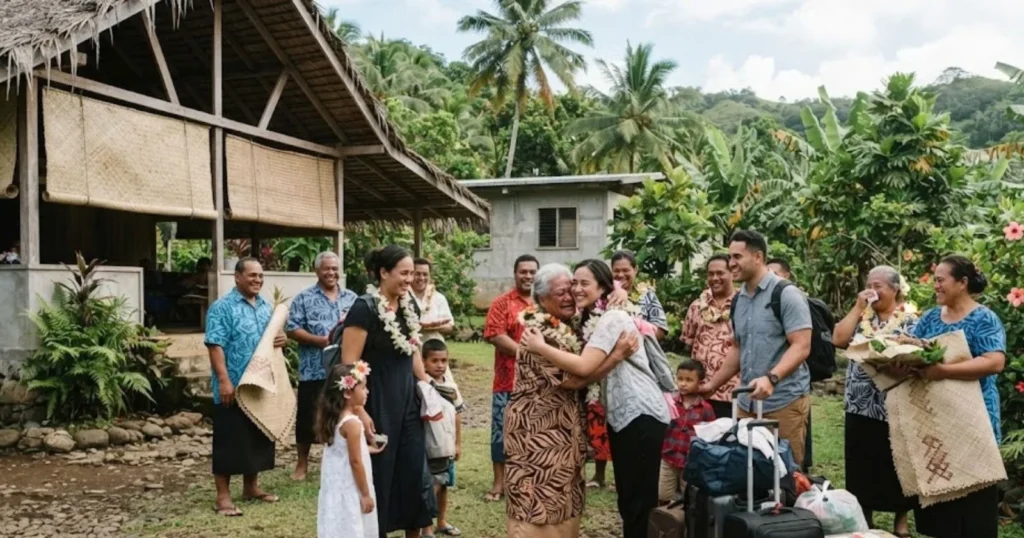
Samoa’s resident population stood at 205,557 people at the 2021 census. Yet the number of people who identify as ethnically Samoan and live outside the country is larger than the population living inside it. The United States alone counts 243,682 Samoans by ancestry, more than the entire population of Samoa itself. Add New Zealand’s 218,069, Australia’s 98,029 and American Samoa’s 47,910, and the global Samoan community outside independent Samoa runs well past 600,000 people, roughly three times the resident count.
This is not a footnote to Samoa’s demographic story. It is the story. Samoa is a country where the population that matters most to household incomes, to national identity and to future policy planning is split roughly evenly between those who live on Upolu and Savai’i and those who live in Auckland, Sydney, Los Angeles and Pago Pago. Any account of Samoa’s population that stops at the resident headcount is describing only part of the nation.
Key Facts & Findings
- Samoa’s global diaspora across the United States, New Zealand, Australia and American Samoa exceeds 600,000 people, roughly three times the country’s 205,557 resident population at the 2021 census.
- The ethnic Samoan population in the United States alone (243,682) is larger than the entire resident population of Samoa.
- Remittances account for roughly 24% to 28% of Samoa’s GDP, with around 80% of households receiving money from relatives abroad.
- Samoa’s population is concentrated on two islands: 78% on Upolu and 22% on Savai’i, with Upolu’s density (roughly 140 per km²) more than five times that of Savai’i (roughly 26 per km²).
- Samoa’s UN-estimated diaspora of 124,400 people in 2019 equaled roughly 60% of its domestic population and had grown by an average of 2,176 people a year over the preceding decade.
- Most Samoan migration to Australia occurs indirectly via New Zealand residency rather than direct migration from Samoa.
- Samoa’s urbanization rate has remained flat to slightly declining since 2000, at around 17% to 19%, because outward emigration rather than internal rural-to-urban movement dominates the country’s population redistribution.
Samoa Population Today
| Metric | Figure | Year / Source |
|---|---|---|
| Resident population (census) | 205,557 | 2021 Census, Samoa Bureau of Statistics |
| Resident population (estimate) | 218,000–220,500 | 2024–2026, World Bank / UN estimates |
| Population density | ~73–78 per km² | 2026 estimate |
| Land area | 2,830–2,840 km² | UN Statistics Division |
| Urban population share (Apia Urban Area) | ~17.5% | 2021 Census |
| Median age | 22 years (2021); ~20 years (2026 est.) | Samoa Bureau of Statistics / UN |
| Sex ratio | 104 males per 100 females | 2021 Census |
| Total fertility rate | 2.4–2.9 children per woman | Recent estimates |
| Life expectancy | 74 years male, 77 years female | 2021 Census |
| Next scheduled census | 2026 | Samoa Bureau of Statistics |
Samoa’s population growth has slowed to a crawl by regional standards, expanding by well under 1% a year even though births consistently exceed deaths. As in several Pacific neighbors, this is because people leaving the country substantially offset natural increase.
Estimates for 2026 suggest Samoa gains roughly 4,300 people a year from births minus deaths but loses around 2,500 to 2,800 of that gain to net emigration, leaving true population growth closer to 0.6% to 0.7% annually.
Samoa’s Population Geography
Samoa’s population is concentrated overwhelmingly on its two main volcanic islands, Upolu and Savai’i, with small numbers on Manono and Apolima. According to the 2021 census, approximately 78% of Samoa’s population lives on Upolu, the smaller of the two main islands at about 1,125 square kilometers, while 22% lives on Savai’i, which is larger in land area at roughly 1,708 square kilometers but far less densely settled.
Upolu’s population density runs around 140 people per square kilometer, driven by its flatter coastal terrain and concentration of government, commerce and port infrastructure, compared with roughly 26 people per square kilometer on Savai’i’s more forested and undeveloped interior.
Apia, the capital, sits on Upolu’s north coast and recorded 35,974 residents within the officially defined Apia Urban Area at the 2021 census, about 17.5% of the national population. That urbanization rate has been essentially flat to slightly declining since 2000, when it stood closer to 19%, reflecting the fact that outward migration, not internal rural-to-urban movement, is the dominant force reshaping where Samoans live.
| Region | 2021 Census Population | Share of National Total |
|---|---|---|
| Apia Urban Area | 34,963–35,974 | ~17.5% |
| North West Upolu | 74,216–75,307 | ~36.9% |
| Rest of Upolu | 46,638–49,101 | ~22.7–23.9% |
| Savai’i | 43,262–45,175 | ~21.6–22.0% |
Samoa’s Age Structure
Samoa’s 2021 census recorded a median age of just 22 years, reflecting a population still shaped by comparatively high fertility, even as that fertility rate has declined from historical highs. Roughly 29% of the population is under 15, based on recent demographic estimates, a share that has been gradually falling as fertility eases toward 2.4 to 2.9 children per woman. Life expectancy at 74 years for men and 77 years for women puts Samoa in line with regional Pacific Island averages, well below high-income benchmarks but consistent with steady mortality improvement over recent decades.
The interaction between Samoa’s young resident age structure and its heavy emigration produces a distinctive pattern: many of the country’s young adults, precisely the cohort about to enter its most economically productive years, leave for New Zealand, Australia or the United States, leaving behind a resident population skewed toward children, older adults, and those not yet old enough or credentialed enough to emigrate.
Samoa’s Migration and Diaspora
Samoa’s diaspora is one of the largest relative to home population anywhere in the world. UN data placed the Samoan diaspora at 124,400 international migrants in 2019, equivalent to roughly 60% of Samoa’s domestic population at the time, concentrated in New Zealand, Australia, the mainland United States and American Samoa.
That diaspora had been growing by an average of 2,176 people a year between 2010 and 2019, with growth increasingly weighted toward Australia even though direct migration from Samoa to Australia remains small; most Samoans who move to Australia arrive via New Zealand residency first, taking advantage of the Trans-Tasman travel arrangement rather than applying for Australian visas directly from Samoa.
Counting by ethnic ancestry rather than migrant stock produces an even larger figure. Global estimates of the ethnic Samoan population, including people of partial Samoan descent, range from 700,000 to 800,000, of whom fewer than a third live in independent Samoa itself.
| Destination | Ethnic Samoan Population | Census Year |
|---|---|---|
| United States | 243,682 | Recent U.S. Census estimate |
| New Zealand | 218,069 (213,069 per 2023 census) | 2023 Census |
| Samoa (resident) | 205,557 | 2021 Census |
| Australia | 98,029 | 2021 Census |
| American Samoa | 47,910 | Recent estimate |
| Canada | ~1,100 | Recent estimate |
Why Samoans Move Overseas
Samoan emigration is driven by a combination of employment opportunity, education, and family reunification through long-established migration channels, particularly to New Zealand, which has maintained specific Pacific migration quota categories for decades, and onward to Australia through the Trans-Tasman pathway.
The United States draws Samoan migrants both directly and via American Samoa, an unincorporated U.S. territory whose residents hold U.S. national status and can move to the mainland without a visa, a pathway that partly explains why the ethnic Samoan population in the United States now exceeds the population of Samoa itself.
Seasonal labor schemes have also become a significant channel in recent years, with Samoan workers participating in New Zealand’s Recognised Seasonal Employer scheme and Australia’s Pacific Australia Labour Mobility program, both of which allow temporary agricultural and other work without requiring permanent emigration.
Where the Samoan Diaspora Lives
The distribution of the Samoan diaspora reflects decades of layered migration. New Zealand’s Samoan community, at over 213,000 people by the 2023 census, is concentrated in Auckland, where Samoan migration dates back to the mid-20th century and where Samoan-born residents doubled during the 1970s alone.
The United States’ larger ethnic Samoan population reflects both direct migration and the unique status of American Samoa, while Australia’s smaller but fast-growing Samoan community increasingly arrives via New Zealand rather than through direct Samoa-to-Australia migration pathways.
Remittances and the Demographic Connection
Remittances sent home by the diaspora are central to Samoa’s economy, accounting for roughly 24% to 28% of GDP depending on the year and measurement source, among the highest remittance dependency ratios in the world.
Australia’s government reports that around 80% of Samoan households receive remittances from family members working abroad, primarily in Australia, New Zealand and the United States. This flow of money functions as a direct demographic dividend from emigration: money earned by Samoans who left the country returns to support the households, health needs and education of those who remain.
Does the Diaspora Change Samoa’s Population Story?
Resident population figures alone understate Samoa’s true demographic footprint and its economic reality. A country of 205,557 to 220,000 residents functions, in practical terms, as the home base of a global community exceeding 700,000 to 800,000 people connected by ancestry, remittances, and continued family ties.
Policy questions that would normally be framed around a population of roughly 220,000, such as healthcare capacity, workforce planning, and pension sustainability, look different once diaspora remittances, return migration, and dual citizenship arrangements enter the calculation. Samoa’s government and its Australian and New Zealand development partners increasingly treat the diaspora not as a population loss but as an extension of the national economy operating across borders.
Samoa’s Future Population Outlook
Samoa’s next Population and Housing Census, scheduled for 2026, will provide the first fully updated picture of the country’s demographic trajectory since 2021. Current UN medium-variant projections point to continued slow growth, driven by a fertility rate still modestly above replacement level but persistently eroded by emigration.
Should migration pathways to New Zealand, Australia and the United States remain open and economically attractive, as they have for decades, Samoa’s resident population is likely to keep growing only slowly while its diaspora continues to expand, deepening rather than reversing the demographic pattern that has defined the country since the mid-20th century.
Frequently Asked Questions
1. How many people live in Samoa?
Samoa’s 2021 census recorded 205,557 residents. Current 2026 estimates put the population at about 218,000 to 220,500, reflecting slow natural growth partly offset by emigration.
2. How large is the Samoan diaspora?
Counting ethnic Samoans across the United States (243,682), New Zealand (218,069), Australia (98,029) and American Samoa (47,910), the diaspora outside independent Samoa exceeds 600,000 people, roughly three times the resident population.
3. Where do most Samoans live outside Samoa?
The largest overseas Samoan communities are in the United States, New Zealand and Australia, with New Zealand’s Samoan population concentrated heavily in Auckland.
4. Why do Samoans migrate?
Samoans migrate primarily for employment, education, and family reunification, using long-established migration channels to New Zealand and the United States, plus seasonal labor schemes to New Zealand and Australia.
5. How do remittances affect Samoa?
Remittances account for roughly 24% to 28% of Samoa’s GDP, with around 80% of Samoan households receiving money from relatives working abroad, making diaspora income a central pillar of the domestic economy.
6. What is Samoa’s population growth rate?
Samoa’s population grows at roughly 0.6% to 0.7% per year, well below what its birth rate alone would suggest, because sustained net emigration offsets much of the natural increase from births exceeding deaths.
7. Is Samoa mostly urban or rural?
Samoa is predominantly rural. Only about 17.5% of the population lived in the Apia Urban Area at the 2021 census, a share that has stayed roughly flat to slightly declining since 2000.
8. How is Samoa’s population distributed between its islands?
Approximately 78% of Samoa’s population lives on Upolu, the smaller but more developed main island, while 22% lives on the larger, more sparsely settled Savai’i.
9. What is Samoa’s median age?
Samoa’s median age was 22 years at the 2021 census, reflecting a still-young population structure even as fertility has declined from historically higher levels.
10. When is Samoa’s next census?
Samoa’s next Population and Housing Census is scheduled for 2026, five years after the 2021 count.
Sources
- Samoa Bureau of Statistics, 2021 Population and Housing Census Final Report and Fact Sheet
- United Nations, Department of Economic and Social Affairs, Population Division, World Population Prospects: The 2024 Revision
- Devpolicy Blog (Australian National University), “The NZ pathway: how and why Samoans migrate to Australia” (2021), citing UN DESA migrant stock data
- Australian Government Department of Foreign Affairs and Trade, Samoa country brief (2024-2025)
- Statistics New Zealand, 2023 Census ethnicity data
- Wikipedia, Demographics of Samoa, Samoans and Samoan New Zealanders (diaspora population figures cross-referenced against national census sources)
- UN OCHA, Samoa Population Distribution map, Census 2021
- World Bank, World Development Indicators, Samoa population data