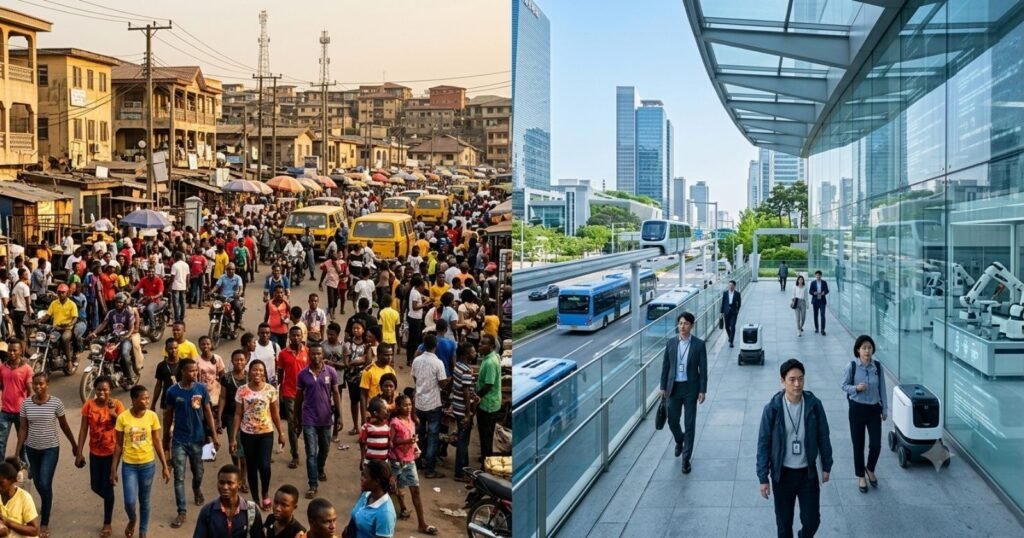
Nigeria’s population has grown more than fivefold since 1960, from around 45 million to over 230 million today. Over that same period, its GDP per capita, adjusted for inflation, has risen only modestly and remains among the lowest of any large economy. Compare that with South Korea, whose population grew far less over a similar span but whose GDP per capita rose more than twentyfold. Population growth clearly is not the deciding factor in whether living standards rise. The more useful question is what conditions turn population growth into rising prosperity, and what conditions turn it into stagnation.
Why Population Growth and Prosperity Are Not the Same Thing
Total GDP measures the size of an economy. GDP per capita divides that output across the population and offers a rough proxy for average material living standards. Real GDP per capita adjusts for inflation to allow comparison over time, and purchasing-power-parity (PPP) adjustments allow more meaningful comparison across countries with different price levels. A country can post strong total GDP growth while GDP per capita barely moves, simply because population is growing at a similar pace.
How Population Growth Can Affect GDP Per Capita
Population growth affects per-capita income through several channels working in different directions. On the labor-supply side, more workers can expand total output, but if capital investment (machinery, infrastructure, technology) does not grow proportionally, each worker ends up with less capital to work with, a dynamic economists call capital dilution, which tends to suppress productivity growth. On the human-capital side, rapid population growth can strain education and health systems, particularly in lower-income countries, making it harder to build the skilled workforce that supports rising incomes.
The Demographic Dividend and Rising Living Standards
When a country’s working-age share rises relative to its dependent population (children and elderly), it can free up savings and investment that would otherwise support dependents, creating room for capital accumulation and, potentially, faster growth in income per person. This dividend has historically been strongest where countries paired a favorable age structure with heavy investment in education and infrastructure, as several East Asian economies did from the 1960s through the 1990s.
| Country | Population Growth (1960-2020, approx.) | Real GDP Per Capita Growth (approx.) |
|---|---|---|
| South Korea | ~2.4x | ~20x+ |
| Nigeria | ~5.5x | Modest, low single-digit multiple |
| China | ~2.2x | ~25x+ (since 1978 reforms) |
| United States | ~2.0x | ~3x |
| Niger | ~6x+ | Largely flat to modestly higher |
Population multiples and GDP-per-capita growth figures are approximate long-run estimates drawn from World Bank national accounts and UN population data; they illustrate contrast rather than precise national accounting.
When Rapid Population Growth Becomes an Economic Challenge
In countries where fertility remains high and job creation, infrastructure, and education investment lag, rapid population growth can outpace the economy’s capacity to absorb new workers productively, contributing to high youth unemployment, strained public services, and slower gains, or outright stagnation, in GDP per capita.
Niger, with one of the highest fertility rates in the world at over 6 children per woman, exemplifies this challenge: its population is growing extremely fast, but per-capita income gains have been limited by the difficulty of expanding infrastructure, education, and formal employment fast enough to match.
Why Population Decline Does Not Automatically Make People Richer
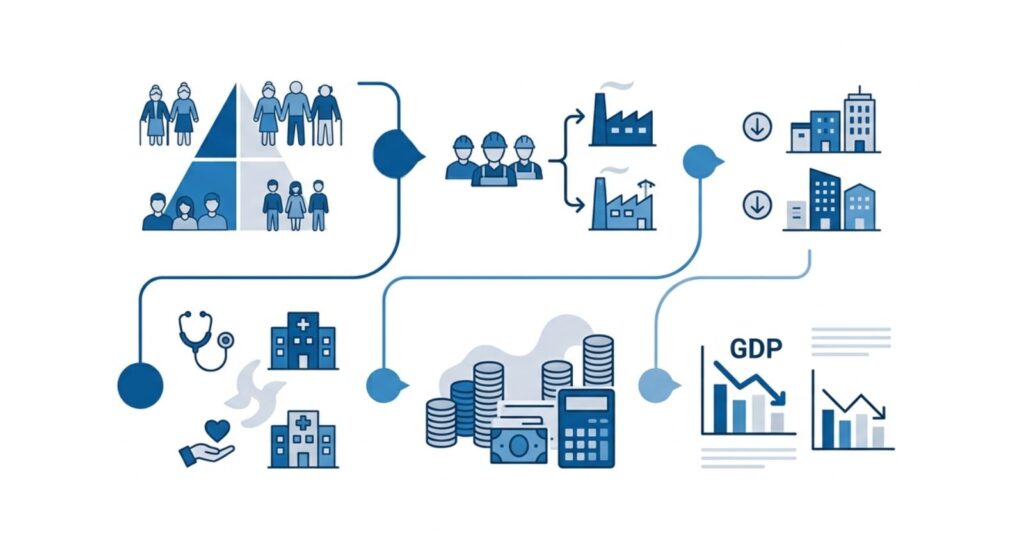
A shrinking population does not guarantee rising GDP per capita either. Aging societies face their own headwinds: shrinking tax bases, rising pension and healthcare costs relative to the working-age population, and labor shortages in key sectors like healthcare and construction.
Japan’s experience shows that a country can maintain relatively stable per-capita income despite population decline, but largely because of high labor force participation among older workers and steady productivity investment, not because population decline itself is inherently beneficial.
Education, Health, and Productivity Can Change the Equation
Human capital interacts with demographic structure in ways that can amplify or dampen the effects of population growth on prosperity. A rapidly growing population with strong investment in education and health can convert demographic growth into a productive, skilled labor force; without that investment, the same population growth can instead produce a large cohort of under-employed young workers. This is why the World Bank consistently frames the demographic dividend as conditional on complementary investment rather than a guaranteed outcome of population structure alone.
Geography Matters: Similar Growth, Different Outcomes
Comparing countries with similar population growth rates but different institutional environments illustrates how much non-demographic factors matter. Two countries can each see population roughly double over a 40-year span and end up with vastly different GDP-per-capita trajectories depending on governance quality, trade openness, infrastructure investment, and political stability.
How to Interpret GDP Per Capita Correctly
GDP per capita is an average, not a distribution. A rising national average can mask stagnant or falling incomes for a large share of the population if gains concentrate among the wealthy, which is why inequality measures and household survey data provide important context alongside GDP-per-capita figures.
Nominal GDP per capita, unadjusted for price differences, can also mislead when comparing countries; PPP-adjusted figures give a more accurate sense of what income can actually buy locally. Nonmarket production, such as subsistence farming or unpaid household labor, is generally undercounted in GDP figures, which matters more in lower-income, more rural economies.
What the Global Demographic Shift Means for Future Prosperity
As global population growth slows and more economies, particularly in East Asia and Europe, move into population decline over coming decades, the connection between population and prosperity is expected to weaken further as a driver of growth, with productivity, technology adoption, and human capital investment increasingly determining which economies see rising living standards.
Countries still earlier in the demographic transition, concentrated in Sub-Saharan Africa and parts of South Asia, retain the largest theoretical scope for a demographic dividend, conditional on whether they can pair continued population growth with the investment needed to employ it productively.
Key Findings
- Nigeria’s population has grown more than fivefold since 1960, while GDP per capita has risen only modestly, illustrating that population growth alone does not guarantee rising prosperity.
- South Korea and China both combined moderate-to-strong population growth with a demographic dividend and heavy human capital investment to produce among the fastest sustained GDP-per-capita growth in modern economic history.
- Niger’s fertility rate, among the world’s highest at over 6 children per woman, has produced extremely rapid population growth without comparable gains in per-capita income.
- Japan shows population decline does not automatically raise or lower GDP per capita; the outcome depends on productivity and labor force participation trends.
- GDP per capita is an average that can mask inequality; PPP adjustments and household survey data provide more accurate pictures of typical living standards.
- Sub-Saharan Africa holds the largest remaining potential for a demographic dividend globally, contingent on matching population growth with education, health, and job-creation investment.
Frequently Asked Questions
1. Does population growth lower GDP per capita?
Not automatically. It depends on whether capital investment, job creation, and productivity growth keep pace with the growing population; when they do not, GDP per capita growth tends to slow or stagnate.
2. What is the relationship between population and living standards?
Population size and growth are inputs to an economy, but living standards depend far more on productivity, institutional quality, and how effectively population growth is matched with investment in education, health, and infrastructure.
3. Does a smaller population mean higher income?
Not inherently. A shrinking population can coincide with rising, falling, or stagnant GDP per capita depending on productivity trends and labor force participation, as Japan’s experience illustrates.
4. What is the demographic dividend?
It is the economic boost available when a country’s working-age population share rises relative to dependents, provided that growth is paired with sufficient investment in education, health, and employment.
5. Is GDP per capita a good measure of prosperity?
It is a useful average measure but does not capture income distribution, inequality, or nonmarket production, so it works best alongside other indicators like household income surveys and poverty rates.
6. Why did South Korea’s per-capita income grow so much faster than its population?
Because it combined a favorable working-age population structure with heavy investment in education, industrial policy, and export-oriented growth, converting demographic change into productivity gains well beyond what population growth alone would predict.
7. Can rapid population growth ever help a poor country develop faster?
Yes, if it is matched with investment in education, health, and job creation that allows the growing labor force to be productively employed; without that investment, rapid population growth more often strains public services and slows per-capita gains.
8. Why does Niger have high population growth but low income per person?
Niger’s fertility rate, among the highest in the world, has produced extremely rapid population growth that has outpaced the country’s capacity to expand infrastructure, education, and formal employment, limiting per-capita income gains.
9. Does population aging always hurt GDP per capita?
Not necessarily; if productivity and labor force participation rise enough to offset a shrinking workforce, GDP per capita can still grow, though aging typically does create fiscal and labor-market pressure.
10. What matters most for raising GDP per capita over time?
Most economists point to productivity growth, driven by education, technology adoption, capital investment, and institutional quality, as the dominant long-run driver of rising GDP per capita, more than population growth or decline on its own.
Sources
- World Bank, World Development Indicators, GDP per capita and population data (data.worldbank.org)
- World Bank, Global Monitoring Report: Demographic Trends Are Shaping Economic Growth (worldbank.org)
- United Nations, World Population Prospects 2024 (population.un.org)
- International Monetary Fund, World Economic Outlook (imf.org)