
Japan offers one of the starkest previews the modern world has seen. With over 29 percent of its citizens aged 65 or older as of 2023, the country has been watching its workforce shrink, its pension funds strain, and entire rural villages gradually empty for decades. Ghost towns, once a distant concept, are now a documented phenomenon. Convenience stores began hiring elderly workers out of necessity, not generosity. And for all its technological ingenuity, Japan has not found a clean solution, only a series of difficult trade-offs. The aging population challenge is not a future risk. For dozens of countries, it is the present reality.
Demographic aging is the structural shift that occurs when the proportion of older adults in a population rises steadily relative to younger cohorts. It happens when birth rates fall, life expectancy climbs, or both occur simultaneously, as has been the case across most high-income nations since the latter half of the twentieth century.
According to the United Nations, the global share of people aged 60 and over is expected to reach 2.1 billion by 2050, nearly double the 2019 figure. That transformation will affect every level of organized society, from how governments fund public services to how families structure their daily lives.
What makes aging populations a particularly complex policy challenge is that the effects do not arrive as a single shock. They compound quietly across decades, reshaping fiscal balances, labor markets, housing demand, healthcare infrastructure, and cultural norms in ways that are difficult to reverse. Understanding those effects clearly, and separately, is essential for any serious assessment of where countries that face this demographic shift are actually headed.
The Fiscal Pressure That Builds Quietly Over Decades
The most immediate and measurable consequence of an aging population is fiscal. When the ratio of working-age adults to retirees declines, the tax base supporting public pensions and healthcare systems narrows while the demand on those systems expands. This is the engine of what economists call the dependency ratio problem.
Why the Dependency Ratio Is More Than a Statistic
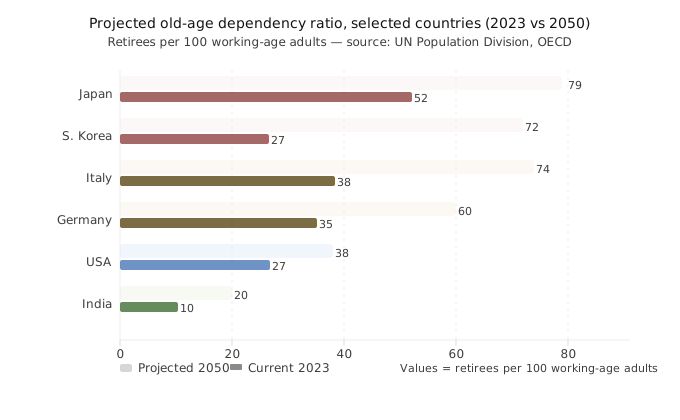
The old-age dependency ratio, the number of people aged 65 and over per 100 working-age adults, is one of the clearest indicators of fiscal stress. In 1950, that global ratio sat around 8. By 2019, it had risen to roughly 16. By 2050, projections from the OECD suggest it will approach 28 in member countries. For nations like South Korea and Spain, the numbers are starker still; forecasts place their ratios above 70 by mid-century.
When a pension system is structured on a pay-as-you-go model, as most developed-world systems are, current workers fund current retirees. Fewer workers supporting more retirees mathematically produces one of three outcomes: higher contribution rates, reduced benefit levels, or expanded deficit spending.
Countries that delay addressing this arithmetic tend to face all three simultaneously. The 2023 pension reform protests in France, which erupted in response to a proposal to raise the retirement age from 62 to 64, illustrated just how politically combustible these choices become when long deferred.
Healthcare expenditure compounds the problem. Older populations consume substantially more medical care per capita than younger ones. A 2019 study published in The Lancet found that in 35 high-income countries, per-person health spending for individuals over 65 was, on average, five to seven times higher than for those aged 15 to 64. As the proportion of elderly citizens rises, that differential translates directly into systemic cost growth that outpaces overall economic expansion.
Labor Market Consequences That Go Beyond a Skills Gap
An aging workforce changes more than the size of the labor pool. It changes its character, its flexibility, and its distribution across industries and geographies.
Workforce Shrinkage and Productivity Dynamics
When large cohorts of experienced workers retire simultaneously, as the post-war baby boomer generation has done across much of North America and Western Europe, organizations lose institutional knowledge at a pace that is rarely offset by incoming labor alone. This is particularly acute in specialized fields: skilled trades, healthcare, education, and engineering have all documented significant succession gaps in recent years.
Productivity implications are debated. Some economic research, including work by Daron Acemoglu and Pascual Restrepo, published in the American Economic Review, suggests that aging economies spur automation adoption as firms respond to labor scarcity.
Germany and South Korea, both facing serious demographic headwinds, rank among the world’s highest in industrial robot density. This technological substitution can preserve or even grow output per worker. But it also concentrates gains unevenly and does not resolve workforce gaps in sectors where human presence is irreplaceable, long-term care being the most obvious example.
Geographic Concentration Amplifies Regional Strain
Aging populations do not distribute themselves evenly. Rural regions, small towns, and former industrial centers tend to age faster than urban cores as younger cohorts migrate toward cities. This spatial dimension of aging creates a two-tier system within the same country: urban centers maintain relative economic dynamism while peripheral regions hollow out.
Eastern Germany, rural Japan, and parts of southern Italy all exhibit this pattern, where shrinking local tax bases must still service aging infrastructure and elderly service demands. The fiscal stress in these areas is disproportionately severe relative to national averages.
Healthcare Systems Under Structural Transformation
No sector absorbs the impact of an aging population more directly than healthcare. The challenge is not simply volume; it is the nature of care that older populations require, which is categorically different from what younger populations typically need.
The Shift From Acute to Chronic Care
Younger populations predominantly generate demand for acute care: emergency treatment, maternity services, and surgical intervention for injuries. Aging populations generate demand for chronic disease management, cardiovascular conditions, diabetes, dementia, osteoarthritis, and respiratory illness. These are conditions that do not resolve. They require sustained monitoring, recurring medication, specialist coordination, and eventual social support as functional capacity declines.
The global burden of dementia illustrates the scale. The World Health Organization estimated in 2023 that approximately 55 million people globally live with dementia, with nearly 10 million new cases diagnosed each year.
Given that incidence rises sharply with age, demographic aging will mechanically expand this figure without any change in disease biology. Care for dementia patients is resource-intensive, often requiring round-the-clock supervision, and the formal care sector in most countries is already under acute staffing pressure.
Long-Term Care Infrastructure Gaps
Long-term care sits at the intersection of healthcare and social support and tends to be chronically underfunded relative to need. The assumption, often unstated in policy frameworks, is that family networks absorb a substantial share of elder care.
As birth rates fall and geographic mobility rises, the informal care infrastructure weakens precisely when it is needed most. Countries without robust publicly funded long-term care systems will face a growing gap between available care capacity and demand, affecting both care quality and labor force participation among the working-age adults, disproportionately women, who step into unpaid caregiving roles.
Economic Growth, Innovation, and the Savings Paradox
The macroeconomic effects of demographic aging extend beyond labor supply and public spending. They reach into capital markets, consumption patterns, and long-run growth potential.
How Aging Reshapes Consumption and Investment
Household consumption patterns shift substantially with age. Older populations typically spend more on health services, less on durable goods, housing, and transportation. At a macroeconomic level, this re-weighting reduces the demand-side drivers of growth that powered twentieth-century expansion.
Japan’s experience of sustained low growth and deflation from the 1990s onward has been cited by economists, including Charles Goodhart, as at least partially attributable to these demographic demand dynamics.
Capital allocation patterns shift, too. As large cohorts move from accumulating retirement savings to drawing them down, the net savings rate in an economy tends to decline. Whether this translates into higher long-term interest rates, as some economists predict that aging accelerates globally, or is offset by other factors, remains an active debate. What is clear is that asset markets, particularly housing, are sensitive to demographic momentum. Regions where the population is aging and shrinking have already experienced sustained property value stagnation or decline.
The Innovation Counterargument
A persistent counterargument holds that aging economies are not destined for stagnation. Higher capital-to-labor ratios can boost per-worker productivity. Technology investment rises when labor is scarce. Older workers bring accumulated expertise that drives certain forms of incremental innovation. And migration, when well-managed, offers a practical lever for replenishing working-age populations.
Canada’s points-based immigration system has been specifically calibrated to address demographic labor needs and provides a frequently cited model. The counterargument does not eliminate the fiscal and healthcare challenges, but it does complicate any linear pessimism about aging and economic decline.
Key Data Snapshot: Aging by the Numbers
The table below synthesizes key comparative metrics across select countries facing significant demographic aging, based on data available through the OECD, UN Population Division, and World Health Organization.
| Country | % Population 65+ (2023) | Old-Age Dependency Ratio (2023) | Projected Dependency Ratio (2050) | Fertility Rate (2022) |
|---|---|---|---|---|
| Japan | 29.1% | 52.1 | ~79 | 1.26 |
| Italy | 23.8% | 38.4 | ~74 | 1.24 |
| Germany | 22.4% | 35.2 | ~60 | 1.46 |
| South Korea | 18.4% | 26.6 | ~72 | 0.78 |
| United States | 17.3% | 26.8 | ~38 | 1.67 |
| India | 6.8% | 10.4 | ~20 | 2.01 |
| Nigeria | 3.2% | 5.9 | ~6 | 5.14 |
Sources: UN Population Division, OECD Health Statistics, World Bank Development Indicators.
Social and Cultural Dimensions That Statistics Miss
The lived experience of demographic aging reaches beyond the numbers captured in dependency ratios and fiscal projections. It alters family structure, social solidarity, and the cultural relationship a society has with age itself.
Intergenerational Tension and Social Contracts Under Strain
Pension and healthcare systems are fundamentally intergenerational contracts. Younger generations agree, through tax systems, to support older ones, in expectation of receiving similar support themselves. When those contracts appear tilted by decades of policy decisions that favored asset-owning older cohorts over younger workers entering expensive housing markets and precarious labor conditions, the social solidarity underlying the contract erodes.
This tension, visible in political discourse across the United States, the United Kingdom, and much of continental Europe, is not simply economic resentment. It reflects a genuine uncertainty among younger cohorts about whether the system will honor its side of the arrangement by the time they need it.
Redefining What Old Age Means
One underexplored dimension is the changing nature of aging itself. People reaching 65 today in high-income countries are, on average, healthier, more cognitively active, and more connected than any previous generation at that age. Fixed retirement ages and the assumption of dependency at 65 reflect mid-twentieth-century realities that no longer fit the biology of aging in wealthy societies.
An increasingly prominent argument from researchers in gerontology and labor economics holds that policy frameworks have not kept pace with this reality, that extending working lives, redesigning career pathways, and treating older adults as economic contributors rather than dependents could significantly alter the fiscal calculus while improving individual well-being. Finland’s age-management programs and the Netherlands’ phased retirement provisions represent early experiments with this framework.
Closing Thoughts
The transformation a country undergoes as its population ages is not a linear decline; it is a systemic reorganization that tests the adaptability of every major institution, from pension funds to primary care networks to labor markets to housing. Countries that treat demographic aging as a slow-moving crisis to be managed at the margins tend to accumulate structural imbalances that eventually demand abrupt and painful correction.
Those who engage with it as a design problem, requiring deliberate reform of retirement systems, long-term care architecture, immigration frameworks, and labor policy, create genuine room to navigate the transition without sacrificing living standards across generations.
The data from Japan, South Korea, Germany, and Italy do not point uniformly toward catastrophe. It points toward difficulty, specifically the difficulty of maintaining social contracts that were designed for a demographic reality that no longer exists, in the face of political incentive structures that favor the already-large older voter blocs.
That is a solvable problem, but solving it requires honestly acknowledging what aging populations actually demand of public systems, not in the abstract language of demographic projections, but in the concrete choices that determine who pays, who receives, and how the burdens and benefits of a society’s changing age structure are ultimately shared.
FAQ: Aging Populations, Questions and Answers
1. What does it mean when a country has an aging population?
An aging population means the proportion of older adults, typically those aged 65 and above, is increasing relative to younger age groups. This occurs when birth rates decline, life expectancy rises, or both trends occur simultaneously, resulting in a structural shift in the age composition of the population.
2. Which countries currently have the oldest populations in the world?
Japan has the world’s highest proportion of elderly citizens, with over 29 percent of its population aged 65 or older. Italy, Finland, Portugal, and Germany also rank among the most demographically aged nations globally, all reporting elderly population shares above 22 percent.
3. How does an aging population affect government spending?
As populations age, government spending on pensions, healthcare, and social services rises while the tax-contributing working-age population shrinks. This fiscal imbalance can increase public debt, force tax increases, or require reductions in benefit levels, depending on the policy response chosen.
4. Does an aging population always lead to economic decline?
Not necessarily. While an aging workforce reduces labor supply, it can also spur productivity gains through automation, capital deepening, and technology investment. Countries with well-designed immigration, labor, and productivity policies can mitigate or offset many of the negative economic impacts.
5. What role does immigration play in addressing aging demographics?
Immigration can replenish working-age populations, maintain workforce size, and stabilize the dependency ratio. Canada’s points-based immigration system is a frequently cited example of a deliberate policy designed to address demographic labor shortfalls. The effectiveness depends on integration policies and the alignment of immigrant skills with labor market needs.
6. How does an aging population affect the healthcare system?
Older populations generate substantially higher per-capita healthcare demand, particularly for chronic disease management, long-term care, and dementia support. Healthcare systems designed primarily for acute care face structural strain as the nature of dominant care needs shifts toward sustained, ongoing management of complex conditions.
7. Why are rural areas more affected by population aging than cities?
Rural and peripheral regions tend to lose younger residents to urban economic centers, accelerating local aging beyond national averages. This leaves smaller tax bases to fund elder care services and infrastructure, often while geographic isolation makes efficient service delivery more costly.
8. What is the old-age dependency ratio, and why does it matter?
The old-age dependency ratio measures the number of people aged 65 and over per 100 working-age adults. It is a key indicator of fiscal pressure on pension and healthcare systems. Rising ratios signal that fewer workers must support more retirees, which directly influences the sustainability of pay-as-you-go public benefit systems.
9. How does demographic aging affect housing markets?
As large older cohorts downsize or leave the housing market and younger, smaller cohorts enter, demand for certain housing types shifts. In regions where aging combines with population decline, property values stagnate or fall. Urban areas with strong in-migration may be partially insulated, but localized housing market distortions can persist for decades.
10. Can extending working lives solve the aging population problem?
Extending working lives can meaningfully reduce fiscal pressure by expanding the tax base and delaying pension drawdowns. However, it is one tool among many, not a standalone solution. Its effectiveness depends on older workers’ health status, employer practices around age-inclusive hiring, and the physical demands of available occupations. Policy reforms that create flexible, phased transition options tend to produce better outcomes than those that simply raise mandatory retirement ages.