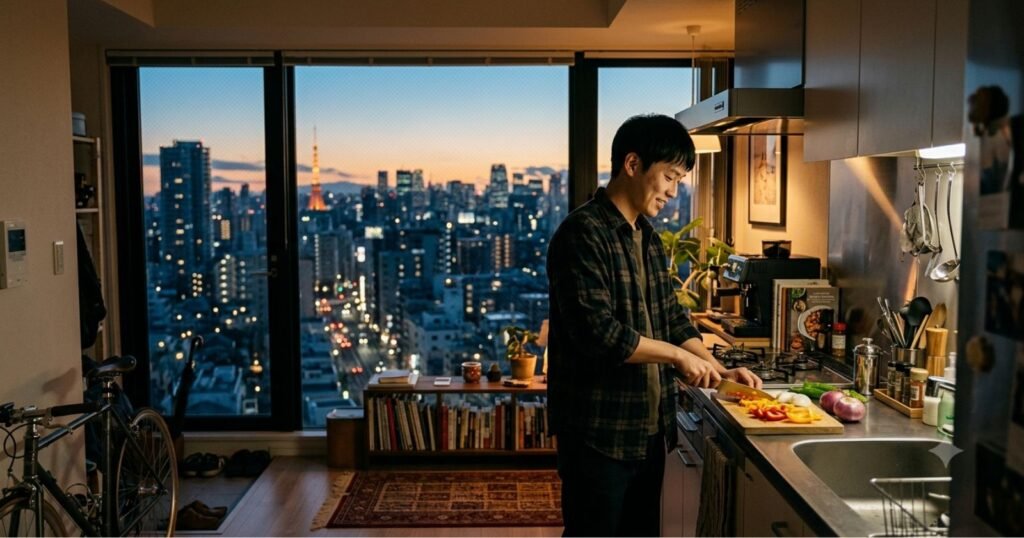
South Korea crossed a threshold in 2024 that no country in its history had reached before: more than 10 million of its households, 42 percent of the national total, now consist of a single person living alone. A decade earlier, that share was closer to a third. This is not a uniquely Korean phenomenon. Across Europe, North America and East Asia, the one-person household has become one of the fastest-growing living arrangements of the past thirty years, driven by a mix of population aging, delayed marriage and a growing willingness among younger adults to live independently.
What Is a One Person Household?
A one-person household is exactly what it sounds like statistically: a single individual who maintains a separate residence, whether by choice, circumstance or the loss of a partner. South Korea’s national statistics office defines it precisely as one person living alone, earning their own income, cooking for themselves and sleeping alone, a complete independent domestic unit.
Living alone is a household classification, not a marital status. A widow, a never-married young professional and a divorced retiree can all be counted as one-person households despite having arrived there through entirely different life paths.
How Common Is Living Alone Worldwide?
Prevalence varies enormously by country and region, more than almost any other household indicator. Within the wealthy G7 economies, Germany recorded the highest one-person household share at 40.8 percent as of a 2021 comparison, with France at 36.9 percent, Japan at 34.6 percent, Italy at 33.2 percent, the United Kingdom at 29.5 percent and Canada at 29.3 percent. The United States had the lowest G7 share, at 28.5 percent. Outside the G7, Finland topped the wider comparison at 45.3 percent, followed by Sweden (40.7 percent) and Norway (40.0 percent), while Australia recorded a comparatively low 25.0 percent.
One-Person Household Share by Selected Country
| Country | One-Person Household Share | Year |
|---|---|---|
| South Korea | 42.0% | 2024 |
| Finland | 45.3% | 2021 |
| Germany | 40.8% | 2021 |
| Sweden | 40.7% | 2021 |
| Norway | 40.0% | 2021 |
| Denmark | 39.1% | 2021 |
| France | 36.9% | 2021 |
| Italy | 33.2% | 2021 |
| Japan | 34.6% | 2021 |
| United Kingdom | 29.5% | 2021 |
| Canada | 29.3% | 2021 |
| United States | 28.5% | 2021 |
| Australia | 25.0% | 2021 |
Sources: Statistics Canada G7 and comparator-country compilation, 2021; Statistics Korea, 2024 household survey.
South Korea’s rise is especially rapid in comparative terms: its one-person household share moved from just above 30 percent in 2019 to 42 percent by 2024, an increase of roughly one percentage point per year, among the fastest sustained shifts recorded anywhere in this dataset.
Where Is Living Alone Most Common?
Northern and Western Europe host the highest concentrations of solo dwellers among wealthy countries, a pattern consistent across multiple measurement years and datasets. Within South Korea itself, the pattern reverses the usual urban-solo, rural-family assumption: South Jeolla Province recorded the country’s highest one-person household share at 43.3 percent in 2020 data, ahead of Gangwon Province (42.4 percent) and North Gyeongsang Province (41 percent), driven substantially by elderly women whose spouses have died and whose adult children have relocated to metropolitan areas. Seoul’s own share climbed from 29.5 percent in 2015 to 39.3 percent by 2023, a purely urban and largely younger-adult-driven pattern distinct from the rural elderly pattern found elsewhere in the country.
Who Is Most Likely to Live Alone?
Older Adults
Age is the single strongest predictor of living alone almost everywhere it has been studied. Statistics Canada’s 2021 census data show that 42 percent of Canadians aged 85 and older lived alone in private households, compared with just 7 percent of those aged 20 to 24, an age gradient so steep that living alone can reasonably be described as a predominantly late-life phenomenon layered on top of a smaller, distinct pattern of young-adult independent living.
South Korea’s 2024 figures confirm the same pattern at scale: of its roughly 5.65 million households containing someone aged 65 or older, 2.13 million consisted of a senior living entirely alone, a 37.8 percent increase in a single year, reflecting both a growing elderly population and rising rates of solo living within it.
Younger Adults
A separate and growing cohort of one-person households consists of adults in their 20s and 30s who have not yet partnered or married, a pattern Statistics Canada notes has been “increasing over time in middle adulthood” even as the very old remain the most likely group of all to live alone. South Korea’s 2024 data show 3.2 million of its 10 million one-person households belonged to people in their 20s and 30s, a substantial share though smaller than the 3.81 million households headed by people 60 or older.
Women and Men
Older women are disproportionately represented among elderly solo dwellers in most countries, largely because women’s longer life expectancy means they are more likely to outlive a spouse and subsequently live alone, a pattern documented in South Korea’s rural provinces and consistent with global life expectancy differences between the sexes.
Urban and Rural Populations
The urban-rural pattern is not uniform. In South Korea, solo living is high in dense urban centers like Seoul, driven by young professionals, but also high in rural provinces, driven by elderly widows left behind as adult children move to cities, showing that the same national statistic can conceal two entirely different demographic stories.
Why Are More People Living Alone?
Several forces are pushing the one-person household share upward simultaneously in most affected countries:
- Population aging. As life expectancy rises and populations skew older, the sheer number of elderly people, especially widows, who end up living alone increases mechanically.
- Delayed marriage. Later marriage extends the period during which young adults, particularly in wealthier countries, live independently before partnering.
- Divorce and separation. Marital breakdown routinely converts one household into two, at least one of which is frequently a solo residence for some period.
- Never marrying. A growing share of adults in some countries do not marry at all, extending solo living well beyond a transitional life stage.
- Housing and income. Higher personal incomes and more available small-format housing make independent living financially feasible for more people than in previous generations, though affordability pressures cut the other way in some markets.
- Cultural shift. Younger generations in many countries increasingly view living alone as a normal or even preferred stage of adult life rather than an interim state before marriage.
Living Alone Is Not the Same as Social Isolation
One-person households and social isolation are frequently conflated in casual discussion, but they measure different things. A person living alone can maintain an active social network, regular family contact and strong community ties; a person living with others can nonetheless be socially isolated.
That said, researchers studying South Korea’s rapidly growing population of solo-dwelling seniors have documented genuine, serious risks specific to that subgroup, including so-called “lonely deaths,” where an older person living alone dies without being discovered for an extended period, and elevated suicide rates among the oldest solo dwellers, reaching approximately 62.6 per 100,000 among South Koreans in their 80s as of 2020, compared with roughly 30 per 100,000 among those aged 40 to 60. These findings apply specifically to isolated elderly solo dwellers and should not be generalized to the much larger and more heterogeneous population of people living alone across all ages.
What More One Person Households Mean for Housing and Services
A rising share of one-person households increases demand for smaller housing units even where total population is flat or declining, a dynamic already visible in Japan and South Korea, where household counts have kept rising even as national population has fallen.
It also raises per-capita demand for utilities, since a single-occupant home consumes similar baseline heating, lighting and appliance energy regardless of occupancy, and it increases demand for aged-care and welfare services tailored to elderly people living without a co-resident caregiver.
Where the Trend Could Go Next
Japan’s National Institute of Population and Social Security Research projects the number of elderly Japanese living alone will rise from 7.37 million in 2020 (13.2 percent of all households) to 10.8 million by 2050 (20.6 percent of all households), meaning roughly one in five Japanese households will be an elderly person living alone within a generation.
A separate Institute projection puts total one-person households, across all ages, at 23.3 million by 2050, or 44.3 percent of all Japanese households, up from 38 percent in 2020, with people 65 and older making up 46.5 percent of all solo dwellers by then, up from 34.9 percent in 2020.
South Korea’s trajectory points in the same direction: with marriage and birth rates continuing to fall and the population aging rapidly, its one-person household share, already the highest single-year jump recorded among major economies, shows no sign of plateauing.
Frequently Asked Questions
1. How common is living alone worldwide?
It varies widely by country. South Korea reported 42 percent of households as one-person households in 2024, while Finland and Germany post similar shares among wealthy nations, compared with closer to a quarter to a third in the United States, Canada and Australia.
2. Which country has the most people living alone?
By household share, South Korea and Finland rank among the highest recorded, both above 40 percent of all households, though methodology and reference years differ across countries, so direct rankings should be read with some caution.
3. Why are more people living alone?
Population aging, delayed marriage, rising divorce, more people never marrying, greater financial independence and a cultural shift toward viewing solo living as a normal life stage are all contributing simultaneously in most affected countries.
4. Are older women especially likely to live alone?
Yes. Because women generally outlive their male partners, elderly women make up a disproportionate share of solo dwellers in most countries, a pattern especially visible in South Korea’s rural provinces.
5. Is living alone the same as being lonely or isolated?
No. Living alone describes a household arrangement, not a psychological or social state. Many people who live alone maintain strong social ties, though researchers have documented specific and serious isolation risks among some elderly solo dwellers, particularly in South Korea and Japan.
6. How is a one-person household defined?
It is a household containing exactly one usual resident, who lives, sleeps and typically manages their own finances and meals independently, regardless of their marital status or reason for living alone.
7. Will one-person households keep increasing?
Current projections suggest yes in most aging, wealthy societies. Japan’s government researchers project one-person households will reach 44.3 percent of all households by 2050, up from 38 percent in 2020.
8. Do young people or old people live alone more often?
Living alone is far more common at older ages in most countries studied. In Canada, 42 percent of people 85 and older lived alone in 2021, compared with just 7 percent of those aged 20 to 24, though a distinct and growing pattern of independent living among younger adults exists alongside it.
9. How does living alone affect housing demand?
It increases the number of housing units needed for a given population size, since one-person households require separate dwellings even as they use fewer resources per unit than larger households, a dynamic already reshaping housing markets in Japan and South Korea despite population decline.
10. Which regions have the lowest rates of one-person households?
Countries with larger households and stronger extended-family living traditions, concentrated in Sub-Saharan Africa, South Asia and parts of the Middle East, report much lower one-person household shares than the wealthy, aging societies of Europe and East Asia.
Sources
- Statistics Canada, “Living Solo,” 2021 Census-based comparison of G7 and additional countries
- Statistics Korea, Ministry of Interior and Safety, 2024 household registration data, via Yonhap and The Independent/AOL reporting
- Japan National Institute of Population and Social Security Research, household projections to 2050, via Reuters and Manila Times/Malay Mail reporting
- PMC/National Institutes of Health, study on living arrangements and mental health among older adults in South Korea
- Korea Economic Daily/RSQUARE, Seoul one-person household share data, 2015-2023
- Inquirer.net, South Korea Ministry of Interior and Safety provincial one-person household data, 2020