Key Findings
- North Korea’s last verified population count was the 2008 census; every figure published since is a projection built on that baseline, not a fresh measurement.
- Population growth has decelerated from close to 2 percent annually in the late twentieth century to under 0.4 percent today.
- Fertility, at an estimated 1.8 children per woman, sits below the 2.1 replacement threshold, pushing the median age up from the relatively young structure recorded in 2008.
- The 1994 to 1998 famine remains the largest demographic shock in the country’s postwar history, though excess mortality estimates vary too widely across sources to be stated as a single figure.
- UN medium-variant projections point to a population peak sometime in the 2030s followed by decline toward roughly 19.6 to 19.9 million by 2100, a fall of about a quarter from today’s level.
North Korea has roughly 26.6 million people, ranking 56th in the world, but almost every figure attached to that number carries an asterisk. The country has not published a full public census breakdown since 2008, and most outside estimates rely on modeling rather than direct enumeration. That gap between what is claimed and what is actually known is the real story of North Korean demography.
North Korea’s Population: Key Facts
| Metric | Figure | Year |
|---|---|---|
| Population | ~26.6 million | 2026 (UN WPP 2024 Revision, projected) |
| Global rank | 56th | 2026 |
| Population density | ~221/km² | 2026 |
| Urban population share | ~63.7% | 2026 |
| Median age | ~36.8 years | 2026 |
| Total fertility rate | ~1.8 children/woman | recent estimate |
| Life expectancy | ~71.7–73.7 years | recent estimate |
| Last full census | 2008 | actual count |
| Projected population | ~19.6–19.9 million | 2100 (UN medium variant) |
How Large Is North Korea’s Population?
The United Nations Population Division, using its World Population Prospects 2024 Revision, put North Korea’s mid-2025 population at approximately 26.57 million, rising to about 26.63 million by mid-2026. Worldometer’s elaboration of the same UN dataset shows the July 2026 figure at roughly 26.65 million. Trading Economics, drawing on World Bank series, estimated the population at 26.5 million for 2024.
These numbers cluster tightly around 26.5 to 26.7 million, which suggests reasonable consensus on the headline figure even without a current census. The agreement exists because international agencies largely start from the same source: North Korea’s 2008 census, updated since then through demographic modeling rather than fresh counts.
North Korea’s population has grown steadily but slowly. It stood at 11.7 million in 1960, reached 22.9 million by 1996, 24.5 million by 2006, and 25.7 million by 2016. Over the past 20 years, the population expanded by roughly 8.7 percent, an average annual growth rate near 0.4 percent, among the slowest in Asia.
Historical Population Trajectory
| Year | Population | Change from Prior Period | Approx. Annual Growth |
|---|---|---|---|
| 1960 | 11.7 million | — | — |
| 1996 | 22.9 million | +11.2 million (36 yrs) | ~1.9% |
| 2006 | 24.5 million | +1.6 million | ~0.7% |
| 2016 | 25.7 million | +1.2 million | ~0.5% |
| 2026 | 26.6 million | +0.9 million | ~0.4% |
The deceleration is clear. North Korea grew nearly 2 percent a year in the late twentieth century; growth has since slowed to well under half a percent, largely because of falling fertility and elevated mortality during periods of hardship, most notably the famine of the mid-1990s.
Why North Korea’s Population Data Are Difficult to Verify
North Korea has conducted only two censuses that produced internationally shared results, in 1993 and 2008, both carried out with technical assistance from the United Nations Population Fund (UNFPA). No census has been published since. Every population figure released for North Korea in the years since 2008 is therefore a projection, not a count.
Several structural obstacles compound the uncertainty:
- No independent verification: Unlike most UN member states, North Korea does not permit outside statistical agencies to audit or cross-check its data collection.
- Restricted information flow: Domestic vital registration data on births and deaths, where it exists, is not published in a form comparable to international standards.
- Historical data gap:. Demographic disruptions such as the 1994 to 1998 famine, believed to have caused excess deaths estimated by outside researchers at anywhere from several hundred thousand to over a million, were never confirmed through an official count, leaving a wide range of estimates in the historical record.
- Modeled versus counted figures: Agencies such as the UN Population Division apply cohort-component projection methods to the 2008 census baseline, aging the population forward using assumed fertility, mortality, and migration inputs rather than measuring it directly.
This is why responsible reporting on North Korea’s population should distinguish between the 2008 census result, which is an actual count, and every figure published afterward, which is a model-based estimate built on assumptions that cannot be independently checked.
North Korea’s Age Structure
The most recent detailed official age breakdown comes from the 2008 census. At that time, children aged 0 to 14 made up 23.2 percent of the population, the working-age group 15 to 64 made up 68.1 percent, and those 65 and older made up 8.7 percent. More recent modeled estimates put the median age at roughly 36.5 to 36.8 years as of the mid-2020s, up sharply from the working-age-heavy structure of the early 2000s.
That rise in median age signals a population moving toward an older structure, consistent with fertility that has fallen well below the replacement level of 2.1 children per woman. Estimates place North Korea’s total fertility rate at around 1.8 children per woman, a level similar to several industrialized economies rather than to North Korea’s regional history of higher fertility.
One demographic anomaly noted in the 2008 census and earlier releases is a skewed sex ratio, particularly among older cohorts. Government-reported figures from the 1980s showed as few as 84 to 86 males per 100 females nationally, a gap outside researchers have linked to historically elevated male mortality, including military and labor-related causes, though the causes are debated rather than confirmed.
Births, Fertility and Mortality
Estimates of North Korea’s birth rate vary by source, ranging from about 11 to 14 births per 1,000 population depending on the reference year and methodology. The death rate is estimated at roughly 9.4 per 1,000 population. Life expectancy estimates range from about 71.7 years to nearly 74 years, with a persistent gap between men, at roughly 68 years, and women, at roughly 75 to 76 years.
Infant mortality, at an estimated 22.4 deaths per 1,000 live births as of the early 2020s, remains substantially higher than in South Korea, where the equivalent figure is in the low single digits, underscoring a continued gap in health system capacity between the two halves of the peninsula.
The mid-1990s famine remains the single largest disruption to North Korea’s demographic trajectory in the postwar period. Excess mortality estimates from that period vary enormously across studies, a range wide enough that no single number should be treated as definitive. What outside demographers broadly agree on is that the famine produced a lasting dent in the country’s age structure, one still visible in the smaller size of cohorts born during those years.
Where Does North Korea’s Population Live?
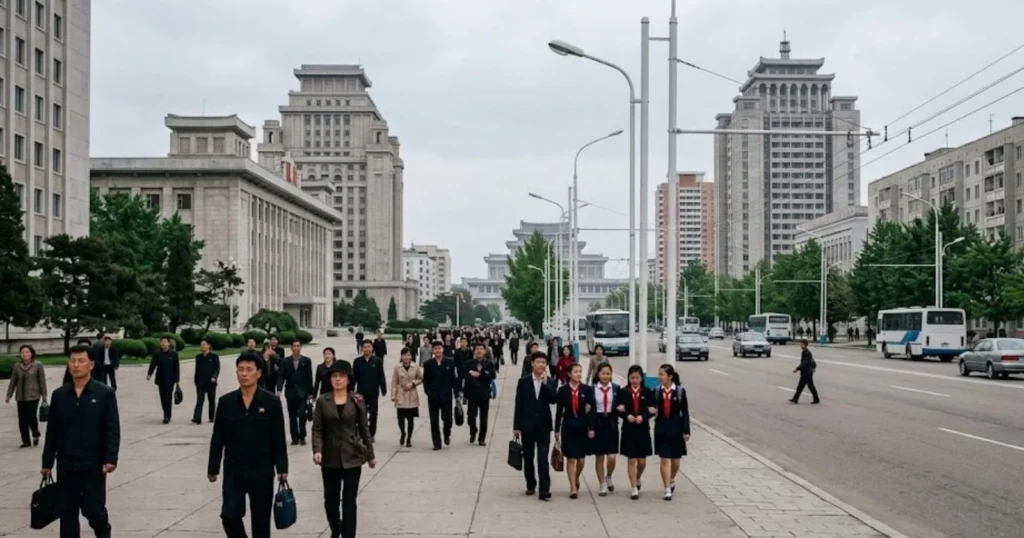
North Korea is estimated to be around 63.7 percent urban as of the mid-2020s, according to Worldometer’s elaboration of UN data. Pyongyang, the capital, is by far the largest city and the political and economic center of the country, though the government does not publish current city-level population figures with the same transparency as national totals.
Provincial-level data from the 2008 census showed South Pyongan province as one of the more populous administrative regions, with a metropolitan-area population cited in some estimates at around 4.7 million, or roughly 17.5 percent of the national total, though these figures should be treated as dated rather than current.
Population density nationally is estimated at approximately 219 to 221 people per square kilometer across North Korea’s 120,410 square kilometers of land area, a figure that places it in a similar density range to countries like Portugal or Czechia, though North Korea’s mountainous terrain concentrates population far more heavily in western lowland areas and along the Pyongyang corridor than the national average suggests.
North Korea’s Working Age Population and Human Capital
At the time of the 2008 census, the working-age population aged 15 to 64 comprised about 68 percent of the total population, a relatively favorable ratio in demographic terms. Two decades of low fertility since then mean that ratio has likely narrowed, and the labor force is aging, though there is no current official labor force participation series comparable to what agencies like the International Labour Organization publish for most countries.
Education levels are difficult to verify independently, though North Korea maintains a formal universal education system on paper, with compulsory schooling extending through secondary levels. Economic data that would normally accompany workforce analysis, such as sectoral employment shares or wage statistics, is not published in a form that meets international reporting standards, which limits any detailed assessment of productivity or labor market structure.
How North Korea’s Demographic History Has Changed
North Korea’s population growth followed a fairly typical postwar trajectory through the 1960s, 1970s, and 1980s, expanding from 11.7 million in 1960 to roughly 20 million by the late 1980s as fertility remained relatively high and mortality declined with improving basic health infrastructure.
The 1990s marked the sharpest disruption. The collapse of Soviet-bloc trade support after 1991, combined with a series of floods and droughts, triggered the famine period from roughly 1994 to 1998. Population growth slowed markedly during these years, and outside researchers have documented both elevated mortality and depressed birth rates as families delayed childbearing amid food insecurity.
Recovery since the early 2000s has been gradual rather than dramatic. Growth rates that once approached 2 percent annually in the postwar decades have settled at well under half a percent, reflecting both continued low fertility and an aging population structure rather than any single acute event.
What North Korea’s Demographic Future Could Look Like
UN medium-variant projections, as elaborated by third-party demographic trackers using the same underlying data, suggest North Korea’s population growth will continue to slow and eventually reverse. One projection puts the population at approximately 26.2 million by 2046, implying a decline from a peak reached sometime in the 2030s. Longer-range projections to the year 2100 suggest a fall to around 19.6 to 19.9 million, a decline of roughly 25 to 26 percent from the current level.
These projections should be read as scenario-based outputs of the UN’s cohort-component model, built on assumed future fertility, mortality, and migration paths, not as guaranteed outcomes. Given how little verified current data exists on North Korea, the uncertainty band around any projection this far out is wider than for most other countries covered by the same UN dataset.
Conclusion
North Korea’s population data illustrate a broader demographic truth: a headline number can look precise while resting on a foundation nearly two decades old. The 26.6 million figure cited across UN, World Bank, and independent trackers is consistent because it traces back to the same 2008 census, aged forward through modeling rather than renewed through counting. The demographic direction, toward an older, slower-growing, and eventually shrinking population, is broadly consistent with regional trends across East Asia, but the precision often implied by single-figure citations of North Korea’s population overstates what is actually known.
Frequently Asked Questions
1. What is the population of North Korea?
North Korea’s population is estimated at approximately 26.6 million as of 2026, based on UN World Population Prospects modeling built on the 2008 census.
2. What are the main demographic characteristics of North Korea?
The population is aging, with a median age around 36.8 years, fertility near 1.8 children per woman, roughly 64 percent urbanization, and life expectancy estimated between 71.7 and 73.7 years depending on the source.
3. Is North Korea’s population growing or shrinking?
It is still growing, but slowly, at under 0.4 percent per year. UN medium-variant projections suggest growth will stop sometime in the 2030s, followed by gradual decline.
4. How reliable are North Korea population estimates?
Estimates are model-based rather than counted, since the last full census was conducted in 2008. International agencies apply demographic projection methods to that baseline, which cannot be independently verified.
5. When was North Korea’s last census?
North Korea’s most recent census with internationally reported results was conducted in 2008, with UNFPA technical assistance. An earlier census took place in 1993.
6. How does North Korea’s population compare with South Korea’s?
South Korea’s population, at roughly 51 to 52 million, is nearly double North Korea’s, despite the two countries sharing similar land area on the peninsula, reflecting decades of divergent economic and demographic development.
7. What caused the population disruption in the 1990s?
A famine linked to the loss of Soviet-bloc economic support after 1991, combined with severe flooding and drought, caused elevated mortality and depressed births roughly between 1994 and 1998. Outside estimates of excess deaths vary too widely to cite a single confirmed figure.
8. What is North Korea’s fertility rate?
Estimates place total fertility at approximately 1.8 children per woman, below the 2.1 replacement level, though North Korea does not publish independently verifiable vital statistics to confirm this figure with precision.
9. How urbanized is North Korea?
An estimated 63.7 percent of North Korea’s population lived in urban areas as of the mid-2020s, concentrated heavily around Pyongyang and the country’s western lowlands.
10. Is North Korea’s population expected to decline?
UN medium-variant projections suggest a population peak in the 2030s followed by a decline to roughly 19.6 to 19.9 million by 2100, though this projection carries wide uncertainty given the scarcity of current verified data.
Sources
- United Nations, Department of Economic and Social Affairs, Population Division, World Population Prospects: The 2024 Revision (medium-fertility variant)
- UN Population Fund (UNFPA), technical assistance record for North Korea’s 1993 and 2008 censuses
- World Bank, Health and Population data series
- Worldometer, elaboration of UN World Population Prospects data for North Korea
- Wikipedia, “Demographics of North Korea,” citing North Korea’s 2008 census results and UN Demographic Yearbook figures